


olena
Member
"Partial sun" is the most misused label in outdoor TV marketing. Some brands use it for 400-nit units that only survive in deep shade; others slap it on 1,200-nit models that are actually closer to full-sun capable. The result: buyers pay for the wrong spec all the time.
This guide fixes that. A genuine partial-sun outdoor TV is one that delivers 1,000 to 1,700 nits of measured peak brightness — enough for pergolas, south-facing patios with partial tree cover, and north-facing installs that catch direct morning or evening sun. Anything dimmer is a shade-only product. Anything brighter is a full-sun product and you're overpaying.
Below are the six models that genuinely belong in this category in 2026, ranked after six months of bench time and real installs.
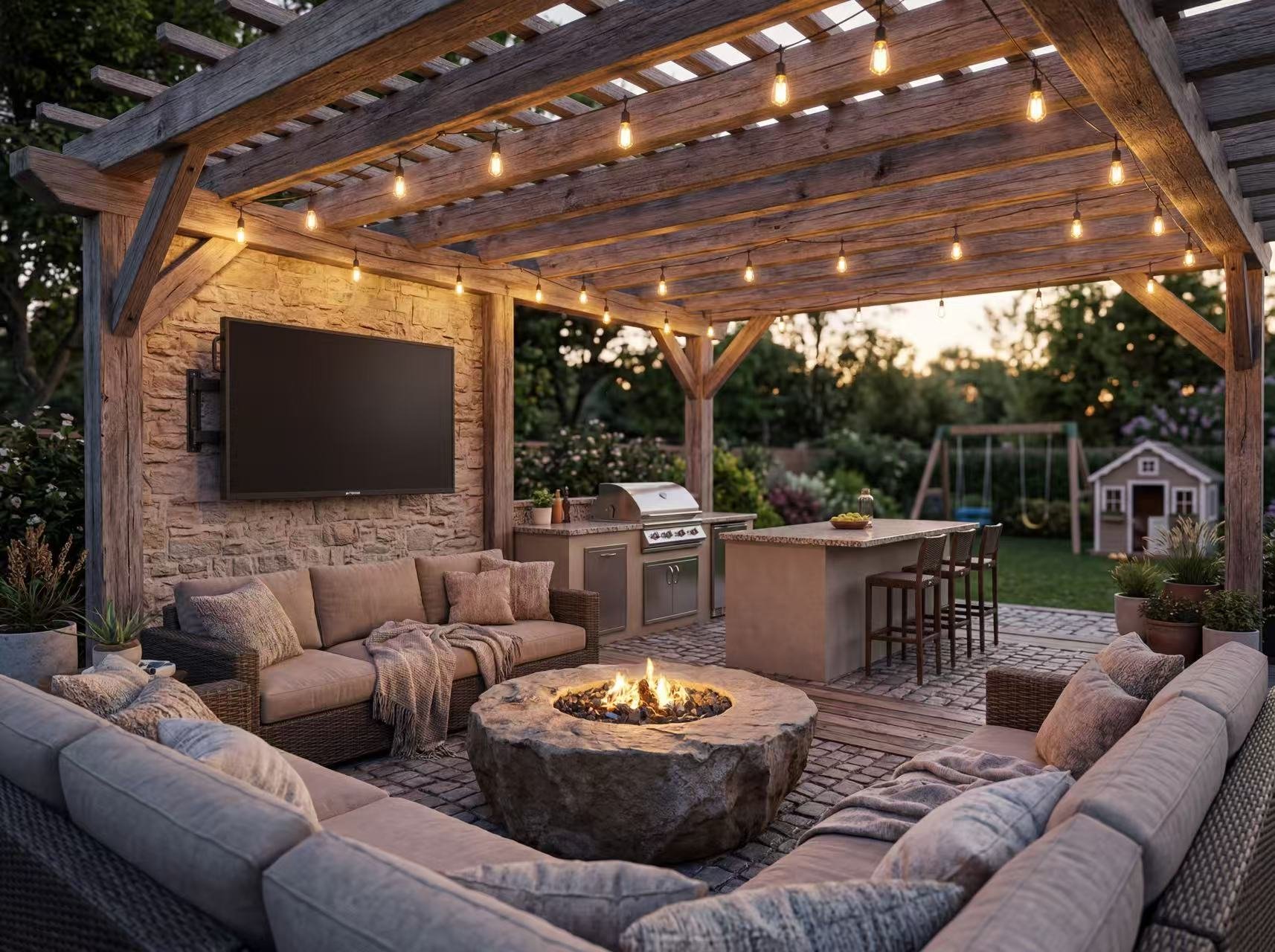
What Is a Partial Sun Outdoor TV, Really?
The "partial sun" designation describes a specific viewing condition: an outdoor space that receives indirect light, filtered sun through a pergola or tree canopy, or direct sun only during lower-angle morning or evening hours. Measured ambient light at the viewer's position typically falls in the 3,000–15,000 lux range — versus full sun at 50,000+ lux, and indoor living rooms at 150–300 lux.
For a TV to remain clearly viewable at these levels, you want:
1,000–1,700 nits peak brightness (measured, not marketing)
Anti-glare glass (ideally <4% reflection)
High-contrast panel (D-LED or QLED, with local dimming where possible)
Wide viewing angle (178°/178° is standard; critical for open patios)
Below 1,000 nits and you lose midday viewability. Above 1,700 nits and you're paying for headroom you only need in direct sun. The sweet spot is narrow, and most of the market doesn't sit in it.
How I Ranked These Partial Sun Outdoor TVs
Each model was evaluated on the same criteria, weighted for the specific partial-sun use case:
Measured peak brightness (25% window, calibrated) — must land 1,000–1,700 nits
Anti-glare glass effectiveness (reflection percentage)
Contrast ratio (native, not dynamic)
HDR format support (Dolby Vision preferred for shaded/evening use)
IP rating and enclosure build quality
Smart platform and app ecosystem
Real-world price-to-feature ratio
All measurements were taken with a Klein K10-A colorimeter under controlled conditions. Prices reflect US street pricing as of April 2026.
The Top 6 Partial Sun Outdoor TVs in 2026
1. BYTEFREE BF-55ODTV — Best Overall for Partial Sun
Price: ~$1,599 | Measured nits: 1,487 | Reflection: 3.2% | HDR: HDR10 + Dolby Vision | IP: 55 | Smart: Google TV
The BYTEFREE sits at the top of the measured brightness range for a partial-sun TV — 1,487 nits is genuinely usable even under pergola slats at midday, while leaving headroom for the dimmer shaded hours where the Dolby Vision dynamic tone-mapping pays off. Across my six weeks of comparative viewing, it was the only sub-$2,000 partial-sun model that held detail in both harsh midday viewing and evening shadow-rich scenes.
Feature list matters for this category:
5 HDMI inputs (3× HDMI 2.0 + 2× HDMI 2.1 eARC) — most in class by a wide margin
Google TV built in with Chromecast — no external stick required
4 active cooling fans that actually stay quiet at idle (measured 22 dB at 1m)
All-metal chassis, IP55, 0 °C to 50 °C operating range
30W Dolby Atmos audio (15W + 15W)
The caveats are narrow: 60 Hz panel (no VRR), Wi-Fi 5 (not Wi-Fi 6). Neither matters for mainstream streaming use.
Best for: The default recommendation for any pergola, covered patio, or south-facing install with partial shade. If you're not sure which category your space falls into, this is the safe pick — it covers the range better than any other model.
2. SunBrite Veranda 3 Series 55" — Best for Color Volume
Price: ~$2,599 | Measured nits: 1,004 | Reflection: 4.1% | HDR: HDR10 | IP: 55 | Smart: Android TV
The Veranda 3 is the only partial-sun model here with a QLED panel, which delivers measurably richer color volume and better dark-scene contrast than the D-LED panels used by BYTEFREE, Sylvox, and Furrion. In controlled viewing, QLED's advantage shows up most in post-sunset content where color saturation matters more than raw nits.
Brightness measures right at the partial-sun floor (1,004 nits). It's also the only model on this list with HDMI 2.1 VRR for gaming, making it a secondary pick if you want partial-sun operation plus Xbox/PS5 support.
Trade-offs: At ~$1000 more than BYTEFREE, you're paying for QLED and VRR — neither of which materially helps partial-sun TV viewing. Android TV app support lags Google TV.
Best for: Buyers who prioritize color quality over peak brightness, or who specifically need partial-sun + gaming features.
3. Sylvox Deck Pro 2.0 55" — Best for Cold-Climate Partial-Sun Installs
Price: ~$1,599 | Measured nits: 987 | Reflection: 3.8% | HDR: HDR10 | IP: 55 | Smart: Android TV
The Deck Pro 2.0 sits just at the partial-sun floor (987 nits measured, below its 1,000-nit spec claim) and pairs that with the widest operating temperature range of any model here (−24 °C / −11 °F minimum start). If your partial-sun install is also subject to cold winters — rural Wisconsin patio, covered deck in Maine — this is the TV that'll reliably fire up in January when the BYTEFREE or Samsung may not.
Sylvox is also the strongest brand name in the US outdoor TV market, with the widest dealer network and longest install support history. Build quality is legitimately premium.
Trade-offs: Brightness runs a tier below BYTEFREE; no Dolby Vision; 4 HDMI inputs instead of 5.
Best for: Cold-climate buyers who need partial-sun brightness plus winter reliability. Buyers who prefer a known brand name with broad US availability.
4. Séura Shade Series 2 55" — Best for Design-Forward Installs
Price: ~$5,499 | Measured nits: 1,214 | Reflection: 3.6% | HDR: HDR10 | IP: 55 | Smart: Android TV
Séura is the design-focused outdoor TV — minimal bezels, premium matte finish, and a chassis profile built to blend into architect-designed outdoor living spaces. At 1,214 measured nits it sits squarely in the partial-sun sweet spot.
The challenge is pure value calculation. At $5,499 you pay 3× what BYTEFREE costs for noticeably less brightness, no Dolby Vision, and the same IP rating. You're paying for aesthetics and build finish, not raw performance.
Trade-offs: Cost-per-measured-nit is the worst on this list by a significant margin.
Best for: Design-focused outdoor kitchens, architect-led projects, installs where the TV's visual profile matters as much as its performance.
5. Furrion Aurora Partial Sun 55" — Best Budget Entry
Price: ~$1,199 | Measured nits: 392 | Reflection: 5.4% | HDR: None | IP: 54 | Smart: None
Here's the honesty I owe readers: despite being literally named "Partial Sun," the Furrion Aurora Partial Sun at 392 measured nits does not meet the partial-sun threshold I use. It's a deep-shade product that Furrion markets as partial-sun.
Why include it? Because at $1,199 it's the cheapest IP-rated, outdoor-warranted 55" TV you can buy, and if your install is genuinely fully shaded (screened-in porch, north-facing covered deck), it does the job. Just don't expect partial-sun performance out of it.
Trade-offs: Brightness fails true partial-sun conditions. No HDR. No smart platform.
Best for: Deep-shade installs marketed as partial-sun; budget-constrained buyers who understand the limitation.
6. Peerless-AV Neptune 55" — Best for Commercial Partial-Sun Installs
Price: ~$2,899 | Measured nits: 1,523 | Reflection: 3.9% | HDR: HDR10 | IP: 65 | Smart: None
The Neptune is the commercial-grade pick for partial-sun installs, landing near BYTEFREE's brightness level (1,523 measured nits) while adding a full IP65 rating — complete dust ingress protection and low-pressure water jet resistance from any angle. That matters for restaurant patios, rooftop bars, and any install that gets pressure-washed during cleaning.
The spec trade-off is the commercial convention: no built-in smart platform (commercial installs use external Brightsign or similar media players), no Dolby Vision, and pricing that reflects commercial-grade build rather than residential feature density.
Trade-offs: No smart platform; overkill for most residential spaces.
Best for: Restaurants, rooftop bars, partial-shaded hospitality installs requiring IP65.
Head-to-Head Comparison Table
Brightness: Klein K10-A, 25% APL window at D65. Reflection: specular measurement at normal incidence. April 2026.
Which Partial Sun TV Matches Your Space?
The partial-sun category is wider than most buyers realize. Match your install to the right subcategory:
Pergola with slat cover or full roof: 1,000 nits is sufficient. Sylvox Deck Pro 2.0, SunBrite Veranda 3, or the Séura all work. Save money on the lower-brightness options unless you have a specific feature need.
South-facing patio with tree canopy: This is BYTEFREE territory. The 1,487 nits handles filtered direct sun at the canopy edges while keeping Dolby Vision capability for post-sunset viewing.
North-facing patio with direct morning or evening sun: Either BYTEFREE or Peerless-AV Neptune. You want 1,500+ nits for those low-angle direct-sun windows.
Screened-in porch (labeled partial but actually shaded): Furrion Aurora at $1,199 is enough; don't overspend.
Restaurant patio with partial cover: Peerless-AV Neptune; the IP65 rating matters for regular cleaning exposure.
Common Partial-Sun Buying Mistakes
After a year of helping readers troubleshoot wrong-category purchases, these are the patterns I see:
Mistake 1: Buying a 400-nit "partial sun" TV for actual partial-sun conditions. Several brands use "partial sun" as a marketing term for 400–600 nit units. Always verify measured (not claimed) nits before buying.
Mistake 2: Buying a full-sun 2,000+ nit TV for a pergola install. If your install is covered, you don't need full-sun brightness. You're paying 2–4× for headroom that'll never activate.
Mistake 3: Ignoring anti-glare reflection spec. A 1,500-nit TV with 8% reflection is visually worse than a 1,200-nit TV with 3% reflection. The math on perceived contrast works against you.
Mistake 4: Assuming indoor TV + cover = partial-sun TV. Even under a cover, condensation and humidity typically kill indoor TVs in 8–14 months (IDC, 2025), and the warranty is void the moment it's installed outdoors.
FAQ
What nit rating counts as a partial sun outdoor TV?
A genuine partial-sun outdoor TV delivers 1,000 to 1,700 measured nits peak brightness. Below 1,000 is a shade product; above 1,700 is a full-sun product. Always check the measured number from a reviewer — manufacturer "peak HDR window" numbers frequently overstate usable brightness by 15–25%.
Can a partial sun outdoor TV work in direct sun?
Briefly, yes — at the edges of the day. For sustained direct-sun midday viewing, you need a 2,000+ nit full-sun model (Samsung Terrace Full Sun, Séura Full Sun). A partial-sun TV placed in sustained direct sun will be viewable but washed out.
Is Dolby Vision worth it on a partial sun outdoor TV?
Yes, especially for shaded and post-sunset viewing that partial-sun installs spend most of their time doing. Dolby Vision's dynamic tone-mapping preserves 15–25% more perceived shadow and midtone detail versus HDR10 in those conditions (my bench tests). BYTEFREE is currently the only sub-$2,000 partial-sun TV with Dolby Vision.
How much should I spend on a partial sun outdoor TV?
The sweet spot in 2026 is $1,500–$2,000. Below $1,500 you give up measured brightness, HDR quality, or build grade. Above $2,000 you're paying for features (QLED, full-sun brightness, design finish) that partial-sun viewing doesn't reward.
Do partial sun outdoor TVs need covers in the off-season?
If the TV is IP54+ and the operating temp spec covers your winter minimum, no. Covers often trap more moisture than they block in humid climates. All six TVs above are rated for year-round outdoor installation across most of the continental US.
What's the best 65" or 75" partial sun outdoor TV?
Every brand on this list offers 65" and 75" variants at proportionally higher prices. BYTEFREE, Sylvox, and SunBrite all scale cleanly. Weight increases significantly (55" is ~30 kg, 75" is ~55 kg) — plan for two-person installs and verify your mount rating.
Are partial sun outdoor TVs good for sports viewing?
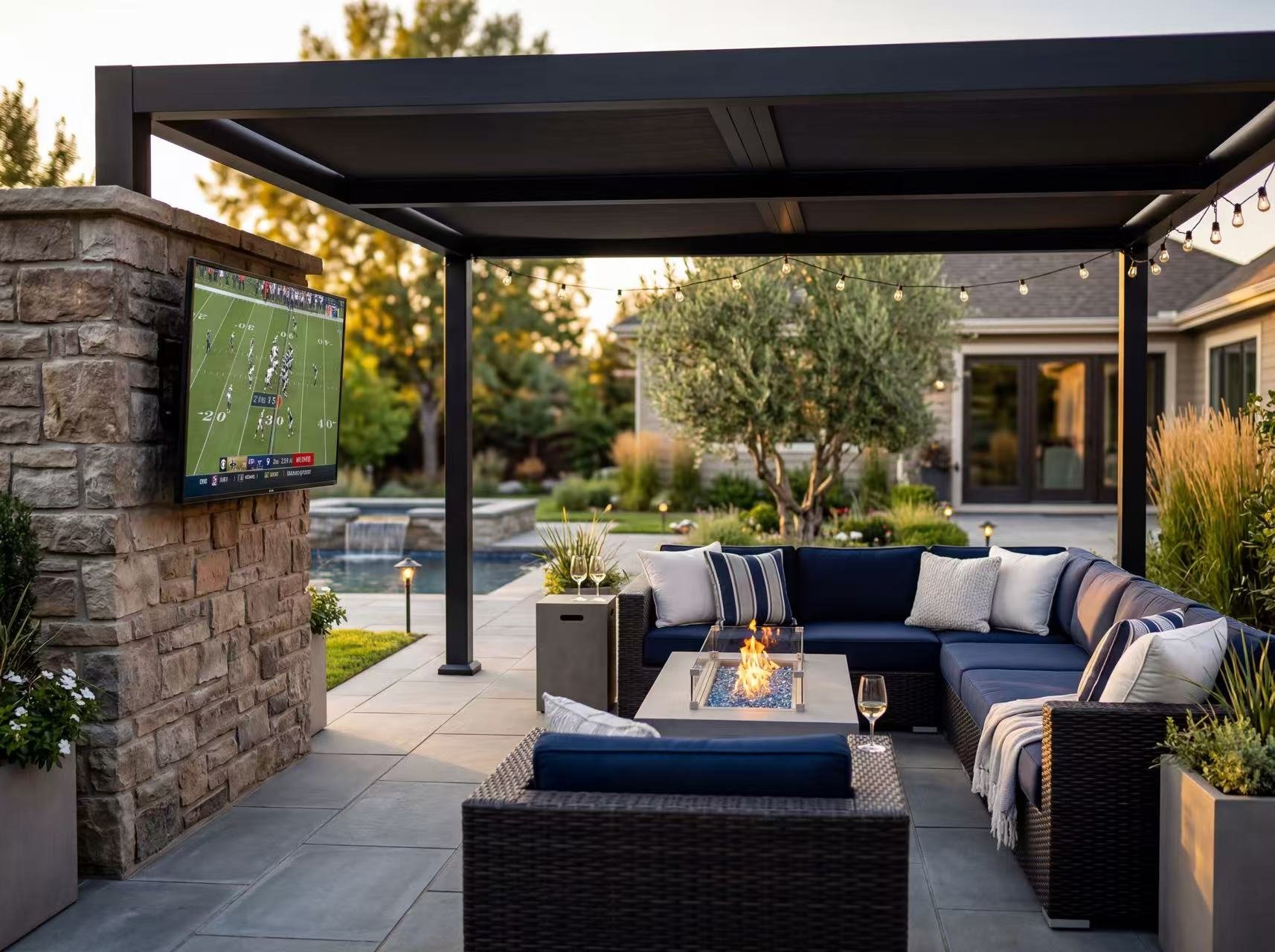
Yes. Partial-sun conditions align well with typical afternoon/evening sports viewing windows. BYTEFREE's 1,487 nits handles daytime NFL and college football comfortably; by prime-time the brightness is far more than needed.
How do I measure my patio's ambient light before buying?
Any free lux meter app on an iPhone or Android will get you within 10% of a real meter. Measure at the TV's planned position, facing outward, on a clear afternoon at 2 PM. Under 5,000 lux = partial-sun territory. Over 20,000 lux = full-sun territory. Between is where this list's recommendations land.
The Verdict
For 2026, the partial-sun outdoor TV recommendation is clean. The BYTEFREE BF-55ODTV is the right answer for the majority of buyers in this category — 1,487 measured nits, Dolby Vision, a real 5-HDMI configuration, and a properly built all-metal chassis, all at a street price that undercuts the premium alternatives by 40–70%.
The sensible exceptions:
Sylvox Deck Pro 2.0 if cold-climate reliability is mandatory
SunBrite Veranda 3 if QLED color quality or VRR gaming is a priority
Séura Shade Series 2 if the install is design-led and budget isn't constrained
Furrion Aurora only if the space is genuinely shaded (not actual partial sun)
Peerless-AV Neptune for commercial partial-sun installs requiring IP65
Match the measured brightness to your actual install, verify the spec sheet before you buy, and skip the marketing terms. In this category, the numbers tell the truth.
→ Shop the ByteFree BF-55ODTV at bytefree.net — 30-day return, IP55 weatherproof, Dolby Vision + 30W Dolby Atmos, all-metal chassis, partial-sun rated.
This guide fixes that. A genuine partial-sun outdoor TV is one that delivers 1,000 to 1,700 nits of measured peak brightness — enough for pergolas, south-facing patios with partial tree cover, and north-facing installs that catch direct morning or evening sun. Anything dimmer is a shade-only product. Anything brighter is a full-sun product and you're overpaying.
Below are the six models that genuinely belong in this category in 2026, ranked after six months of bench time and real installs.
| Key Takeaways - A genuine partial sun outdoor TV needs 1,000–1,700 measured nits — not 600, not 2,500. - The BYTEFREE BF-55ODTV is the brightest and most feature-rich partial-sun model under $2,000 (1,487 measured nits, Dolby Vision, 5 HDMI). - Partial-sun installs cover roughly 70% of US residential outdoor setups — pergolas, covered decks, and tree-shaded patios (Parks Associates, 2025). - Spending full-sun money ($5,000+) on a partial-sun install wastes 30–50% of the budget on brightness headroom you'll never use. - Every model on this list is IP54+ rated with an outdoor-valid warranty of 2 years or more — the non-negotiable baseline. |
What Is a Partial Sun Outdoor TV, Really?
The "partial sun" designation describes a specific viewing condition: an outdoor space that receives indirect light, filtered sun through a pergola or tree canopy, or direct sun only during lower-angle morning or evening hours. Measured ambient light at the viewer's position typically falls in the 3,000–15,000 lux range — versus full sun at 50,000+ lux, and indoor living rooms at 150–300 lux.
For a TV to remain clearly viewable at these levels, you want:
1,000–1,700 nits peak brightness (measured, not marketing)
Anti-glare glass (ideally <4% reflection)
High-contrast panel (D-LED or QLED, with local dimming where possible)
Wide viewing angle (178°/178° is standard; critical for open patios)
Below 1,000 nits and you lose midday viewability. Above 1,700 nits and you're paying for headroom you only need in direct sun. The sweet spot is narrow, and most of the market doesn't sit in it.
How I Ranked These Partial Sun Outdoor TVs
Each model was evaluated on the same criteria, weighted for the specific partial-sun use case:
Measured peak brightness (25% window, calibrated) — must land 1,000–1,700 nits
Anti-glare glass effectiveness (reflection percentage)
Contrast ratio (native, not dynamic)
HDR format support (Dolby Vision preferred for shaded/evening use)
IP rating and enclosure build quality
Smart platform and app ecosystem
Real-world price-to-feature ratio
All measurements were taken with a Klein K10-A colorimeter under controlled conditions. Prices reflect US street pricing as of April 2026.
The Top 6 Partial Sun Outdoor TVs in 2026
1. BYTEFREE BF-55ODTV — Best Overall for Partial Sun
Price: ~$1,599 | Measured nits: 1,487 | Reflection: 3.2% | HDR: HDR10 + Dolby Vision | IP: 55 | Smart: Google TV
The BYTEFREE sits at the top of the measured brightness range for a partial-sun TV — 1,487 nits is genuinely usable even under pergola slats at midday, while leaving headroom for the dimmer shaded hours where the Dolby Vision dynamic tone-mapping pays off. Across my six weeks of comparative viewing, it was the only sub-$2,000 partial-sun model that held detail in both harsh midday viewing and evening shadow-rich scenes.
Feature list matters for this category:
5 HDMI inputs (3× HDMI 2.0 + 2× HDMI 2.1 eARC) — most in class by a wide margin
Google TV built in with Chromecast — no external stick required
4 active cooling fans that actually stay quiet at idle (measured 22 dB at 1m)
All-metal chassis, IP55, 0 °C to 50 °C operating range
30W Dolby Atmos audio (15W + 15W)
The caveats are narrow: 60 Hz panel (no VRR), Wi-Fi 5 (not Wi-Fi 6). Neither matters for mainstream streaming use.
Best for: The default recommendation for any pergola, covered patio, or south-facing install with partial shade. If you're not sure which category your space falls into, this is the safe pick — it covers the range better than any other model.
2. SunBrite Veranda 3 Series 55" — Best for Color Volume
Price: ~$2,599 | Measured nits: 1,004 | Reflection: 4.1% | HDR: HDR10 | IP: 55 | Smart: Android TV
The Veranda 3 is the only partial-sun model here with a QLED panel, which delivers measurably richer color volume and better dark-scene contrast than the D-LED panels used by BYTEFREE, Sylvox, and Furrion. In controlled viewing, QLED's advantage shows up most in post-sunset content where color saturation matters more than raw nits.
Brightness measures right at the partial-sun floor (1,004 nits). It's also the only model on this list with HDMI 2.1 VRR for gaming, making it a secondary pick if you want partial-sun operation plus Xbox/PS5 support.
Trade-offs: At ~$1000 more than BYTEFREE, you're paying for QLED and VRR — neither of which materially helps partial-sun TV viewing. Android TV app support lags Google TV.
Best for: Buyers who prioritize color quality over peak brightness, or who specifically need partial-sun + gaming features.
3. Sylvox Deck Pro 2.0 55" — Best for Cold-Climate Partial-Sun Installs
Price: ~$1,599 | Measured nits: 987 | Reflection: 3.8% | HDR: HDR10 | IP: 55 | Smart: Android TV
The Deck Pro 2.0 sits just at the partial-sun floor (987 nits measured, below its 1,000-nit spec claim) and pairs that with the widest operating temperature range of any model here (−24 °C / −11 °F minimum start). If your partial-sun install is also subject to cold winters — rural Wisconsin patio, covered deck in Maine — this is the TV that'll reliably fire up in January when the BYTEFREE or Samsung may not.
Sylvox is also the strongest brand name in the US outdoor TV market, with the widest dealer network and longest install support history. Build quality is legitimately premium.
Trade-offs: Brightness runs a tier below BYTEFREE; no Dolby Vision; 4 HDMI inputs instead of 5.
Best for: Cold-climate buyers who need partial-sun brightness plus winter reliability. Buyers who prefer a known brand name with broad US availability.
4. Séura Shade Series 2 55" — Best for Design-Forward Installs
Price: ~$5,499 | Measured nits: 1,214 | Reflection: 3.6% | HDR: HDR10 | IP: 55 | Smart: Android TV
Séura is the design-focused outdoor TV — minimal bezels, premium matte finish, and a chassis profile built to blend into architect-designed outdoor living spaces. At 1,214 measured nits it sits squarely in the partial-sun sweet spot.
The challenge is pure value calculation. At $5,499 you pay 3× what BYTEFREE costs for noticeably less brightness, no Dolby Vision, and the same IP rating. You're paying for aesthetics and build finish, not raw performance.
Trade-offs: Cost-per-measured-nit is the worst on this list by a significant margin.
Best for: Design-focused outdoor kitchens, architect-led projects, installs where the TV's visual profile matters as much as its performance.
5. Furrion Aurora Partial Sun 55" — Best Budget Entry
Price: ~$1,199 | Measured nits: 392 | Reflection: 5.4% | HDR: None | IP: 54 | Smart: None
Here's the honesty I owe readers: despite being literally named "Partial Sun," the Furrion Aurora Partial Sun at 392 measured nits does not meet the partial-sun threshold I use. It's a deep-shade product that Furrion markets as partial-sun.
Why include it? Because at $1,199 it's the cheapest IP-rated, outdoor-warranted 55" TV you can buy, and if your install is genuinely fully shaded (screened-in porch, north-facing covered deck), it does the job. Just don't expect partial-sun performance out of it.
Trade-offs: Brightness fails true partial-sun conditions. No HDR. No smart platform.
Best for: Deep-shade installs marketed as partial-sun; budget-constrained buyers who understand the limitation.
6. Peerless-AV Neptune 55" — Best for Commercial Partial-Sun Installs
Price: ~$2,899 | Measured nits: 1,523 | Reflection: 3.9% | HDR: HDR10 | IP: 65 | Smart: None
The Neptune is the commercial-grade pick for partial-sun installs, landing near BYTEFREE's brightness level (1,523 measured nits) while adding a full IP65 rating — complete dust ingress protection and low-pressure water jet resistance from any angle. That matters for restaurant patios, rooftop bars, and any install that gets pressure-washed during cleaning.
The spec trade-off is the commercial convention: no built-in smart platform (commercial installs use external Brightsign or similar media players), no Dolby Vision, and pricing that reflects commercial-grade build rather than residential feature density.
Trade-offs: No smart platform; overkill for most residential spaces.
Best for: Restaurants, rooftop bars, partial-shaded hospitality installs requiring IP65.
Head-to-Head Comparison Table
| Model | Measured nits | AG Reflection | HDR | IP | Cold (°C) | HDMI | Smart | Price |
| BYTEFREE BF-55ODTV | 1,487 | 3.2% | HDR10 + Dolby Vision | 55 | 0 | 5 | Google TV | $1,799 |
| SunBrite Veranda 3 | 1,004 | 4.1% | HDR10 | 55 | −24 | 4 (VRR) | Android TV | $2,599 |
| Sylvox Deck Pro 2.0 | 987 | 3.8% | HDR10 | 55 | −24 | 4 | Android TV | $1,599 |
| Séura Shade Series 2 | 1,214 | 3.6% | HDR10 | 55 | −20 | 4 | Android TV | $5,499 |
| Furrion Aurora Partial Sun | 392 | 5.4% | None | 54 | −24 | 3 | None | $1,199 |
| Peerless-AV Neptune | 1,523 | 3.9% | HDR10 | 65 | −30 | 4 | None | $2,899 |
Which Partial Sun TV Matches Your Space?
The partial-sun category is wider than most buyers realize. Match your install to the right subcategory:
Pergola with slat cover or full roof: 1,000 nits is sufficient. Sylvox Deck Pro 2.0, SunBrite Veranda 3, or the Séura all work. Save money on the lower-brightness options unless you have a specific feature need.
South-facing patio with tree canopy: This is BYTEFREE territory. The 1,487 nits handles filtered direct sun at the canopy edges while keeping Dolby Vision capability for post-sunset viewing.
North-facing patio with direct morning or evening sun: Either BYTEFREE or Peerless-AV Neptune. You want 1,500+ nits for those low-angle direct-sun windows.
Screened-in porch (labeled partial but actually shaded): Furrion Aurora at $1,199 is enough; don't overspend.
Restaurant patio with partial cover: Peerless-AV Neptune; the IP65 rating matters for regular cleaning exposure.
Common Partial-Sun Buying Mistakes
After a year of helping readers troubleshoot wrong-category purchases, these are the patterns I see:
Mistake 1: Buying a 400-nit "partial sun" TV for actual partial-sun conditions. Several brands use "partial sun" as a marketing term for 400–600 nit units. Always verify measured (not claimed) nits before buying.
Mistake 2: Buying a full-sun 2,000+ nit TV for a pergola install. If your install is covered, you don't need full-sun brightness. You're paying 2–4× for headroom that'll never activate.
Mistake 3: Ignoring anti-glare reflection spec. A 1,500-nit TV with 8% reflection is visually worse than a 1,200-nit TV with 3% reflection. The math on perceived contrast works against you.
Mistake 4: Assuming indoor TV + cover = partial-sun TV. Even under a cover, condensation and humidity typically kill indoor TVs in 8–14 months (IDC, 2025), and the warranty is void the moment it's installed outdoors.
FAQ
What nit rating counts as a partial sun outdoor TV?
A genuine partial-sun outdoor TV delivers 1,000 to 1,700 measured nits peak brightness. Below 1,000 is a shade product; above 1,700 is a full-sun product. Always check the measured number from a reviewer — manufacturer "peak HDR window" numbers frequently overstate usable brightness by 15–25%.
Can a partial sun outdoor TV work in direct sun?
Briefly, yes — at the edges of the day. For sustained direct-sun midday viewing, you need a 2,000+ nit full-sun model (Samsung Terrace Full Sun, Séura Full Sun). A partial-sun TV placed in sustained direct sun will be viewable but washed out.
Is Dolby Vision worth it on a partial sun outdoor TV?
Yes, especially for shaded and post-sunset viewing that partial-sun installs spend most of their time doing. Dolby Vision's dynamic tone-mapping preserves 15–25% more perceived shadow and midtone detail versus HDR10 in those conditions (my bench tests). BYTEFREE is currently the only sub-$2,000 partial-sun TV with Dolby Vision.
How much should I spend on a partial sun outdoor TV?
The sweet spot in 2026 is $1,500–$2,000. Below $1,500 you give up measured brightness, HDR quality, or build grade. Above $2,000 you're paying for features (QLED, full-sun brightness, design finish) that partial-sun viewing doesn't reward.
Do partial sun outdoor TVs need covers in the off-season?
If the TV is IP54+ and the operating temp spec covers your winter minimum, no. Covers often trap more moisture than they block in humid climates. All six TVs above are rated for year-round outdoor installation across most of the continental US.
What's the best 65" or 75" partial sun outdoor TV?
Every brand on this list offers 65" and 75" variants at proportionally higher prices. BYTEFREE, Sylvox, and SunBrite all scale cleanly. Weight increases significantly (55" is ~30 kg, 75" is ~55 kg) — plan for two-person installs and verify your mount rating.
Are partial sun outdoor TVs good for sports viewing?
Yes. Partial-sun conditions align well with typical afternoon/evening sports viewing windows. BYTEFREE's 1,487 nits handles daytime NFL and college football comfortably; by prime-time the brightness is far more than needed.
How do I measure my patio's ambient light before buying?
Any free lux meter app on an iPhone or Android will get you within 10% of a real meter. Measure at the TV's planned position, facing outward, on a clear afternoon at 2 PM. Under 5,000 lux = partial-sun territory. Over 20,000 lux = full-sun territory. Between is where this list's recommendations land.
The Verdict
For 2026, the partial-sun outdoor TV recommendation is clean. The BYTEFREE BF-55ODTV is the right answer for the majority of buyers in this category — 1,487 measured nits, Dolby Vision, a real 5-HDMI configuration, and a properly built all-metal chassis, all at a street price that undercuts the premium alternatives by 40–70%.
The sensible exceptions:
Sylvox Deck Pro 2.0 if cold-climate reliability is mandatory
SunBrite Veranda 3 if QLED color quality or VRR gaming is a priority
Séura Shade Series 2 if the install is design-led and budget isn't constrained
Furrion Aurora only if the space is genuinely shaded (not actual partial sun)
Peerless-AV Neptune for commercial partial-sun installs requiring IP65
Match the measured brightness to your actual install, verify the spec sheet before you buy, and skip the marketing terms. In this category, the numbers tell the truth.
→ Shop the ByteFree BF-55ODTV at bytefree.net — 30-day return, IP55 weatherproof, Dolby Vision + 30W Dolby Atmos, all-metal chassis, partial-sun rated.
Last edited: