


olena
Member
Catalogs Hide
- 1 The big picture: why outdoor TVs exist
- 2 The 7 key differences
- 3 Side-by-side: an indoor TV vs the BF-55ODTV
- 4 The cost-per-year breakdown
- 5 When an indoor TV outside actually makes sense
-
6
FAQ
- 6.1 Can I use an indoor TV under a fully covered patio?
- 6.2 What makes outdoor TVs so much more expensive?
- 6.3 Can I use an outdoor TV inside?
- 6.4 What's the single most important spec difference?
- 6.5 Is the ByteFree BF-55ODTV overkill for a fully covered porch?
- 6.6 Will my outdoor TV warranty cover rain damage?
- 7 Verdict
TL;DR:
An outdoor TV costs 2–3× more than an indoor TV of the same size because it's built to survive environmental conditions indoor TVs aren't engineered for. The 7 key differences are: brightness (1,000–2,000 nits vs 300–500), IP rating (IP55+ vs IP20), chassis sealing (fully sealed vs vented), panel UV coating (outdoor-rated vs none), operating temperature (–22°F to 122°F vs 60°F to 85°F), anti-glare screen (outdoor AR coating vs standard), and warranty terms (outdoor-covered vs outdoor-excluded). For 80% of patio use cases, a purpose-built outdoor TV like the **ByteFree BF-55ODTV ($1,499)** pays back its premium within 1–2 years vs replacing a failed indoor TV.
The engineering compromises in indoor TVs that make them cheaper are the same ones that make them fail outdoors. Outdoor TVs don't make those compromises — which is why they cost more but survive for 8–12 years instead of 6–18 months in outdoor use.
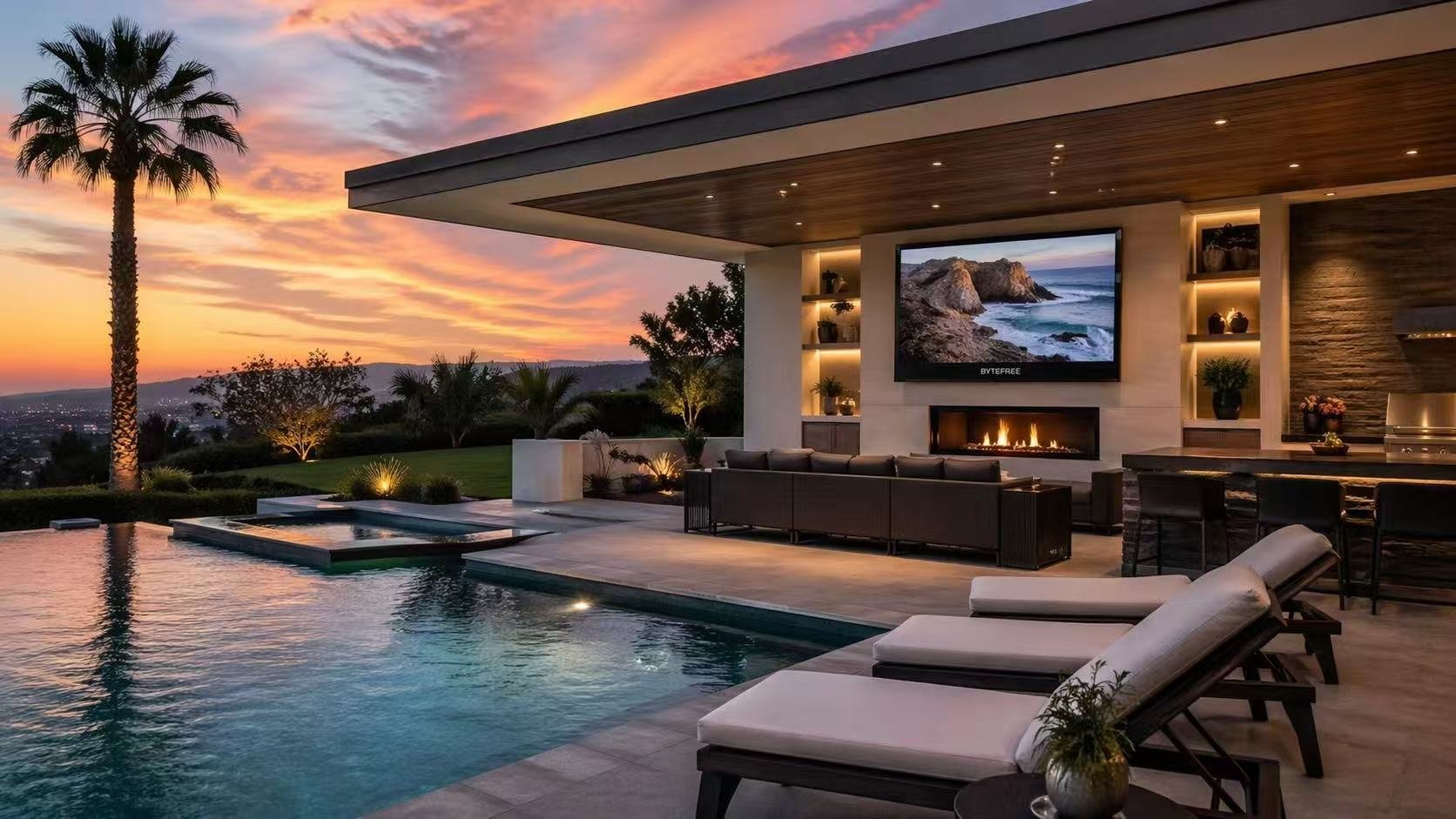
Real-world impact: an indoor TV on a covered patio at 2 PM on a sunny day is typically unwatchable — the screen reflects more ambient light than the panel can emit. An outdoor TV at 1,500 nits stays vivid even when sun hits surrounding surfaces.
Indoor TVs with IP20 can fail from a single wind-blown rainstorm. Outdoor TVs at IP55 survive multiple seasons of rain, dew, snow, and pressure-washing the deck nearby.
Humid outdoor air (causes condensation)
Dust (clogs filters and cooling fins)
Insects (dead bugs inside the chassis is a surprisingly common failure mode)
Moisture droplets during rainfall
Outdoor TVs are fully sealed with internal convection cooling or sealed fans. The BF-55ODTV uses an all-metal fully-sealed chassis with internal heat dissipation — no ingress pathways for outdoor air, moisture, or debris.
Outdoor TVs use UV-resistant polarizer films rated for 10+ years of direct sun exposure. You won't see yellowing over the TV's useful life.
Indoor TVs' capacitors, circuit boards, and LCD panel driver chips are rated for indoor temperatures. Running them in 100°F+ direct sun (internal temps reach 130–150°F) or freezing below 32°F causes premature component failure.
Outdoor TVs use industrial-grade capacitors, temperature-tolerant driver circuitry, and thermal-expansion-rated construction that handles the full U.S. outdoor climate range.
Outdoor TVs use matte anti-glare (AR) coatings that scatter reflected light. The tradeoff: outdoor AR coatings slightly reduce apparent contrast versus glossy indoor screens, but make outdoor viewing actually possible.
Outdoor TVs are warranted for outdoor use. The ByteFree BF-55ODTV warranty includes outdoor exposure, rain, direct sun (within its Partial Sun rating), and humidity.
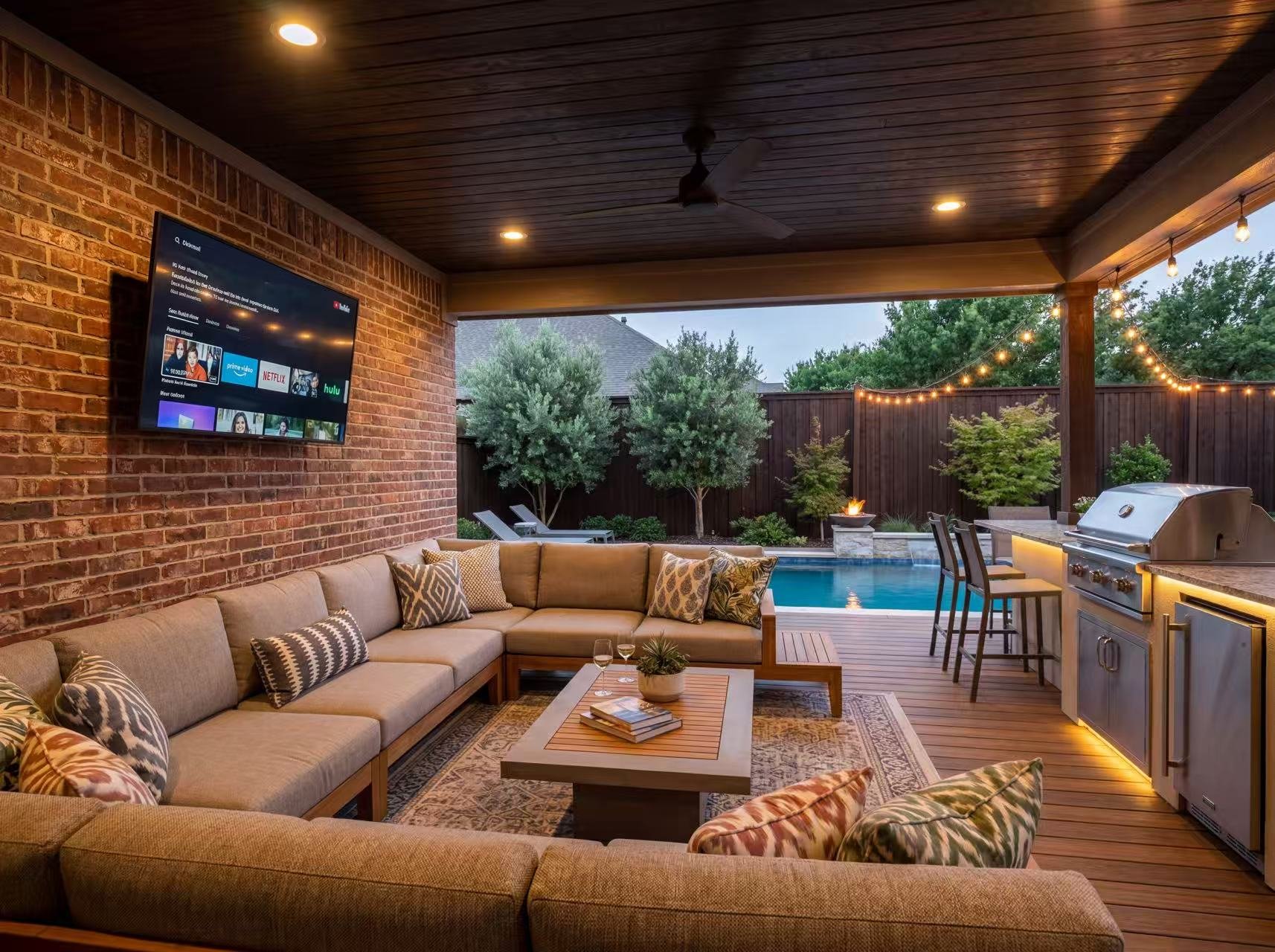
The dedicated outdoor TV is roughly 3–5× cheaper per year than any indoor-TV-outside approach when you factor in replacement cycles.
Sunroom or three-season room that's climate-controlled — if the space stays 50–85°F year-round and is dry, an indoor TV works fine.
Short-term events — a weekend party, a wedding, a rental for one season.
Budget-constrained secondary use — a garage TV used 10–20 times a year, willing to replace every 3 years.
Anything else — dedicated outdoor TV pays off within 18 months.
When to buy each:
Indoor TV: Any indoor installation, or short-term outdoor use (1 season or less).
Outdoor TV: Any permanent outdoor installation. The **ByteFree BF-55ODTV at $1,499** is the best-value outdoor TV for 80% of U.S. residential patios — partial-sun-rated, Dolby Vision HDR, 30W Dolby Atmos, all-metal IP55 construction, 30-day return.
→ Shop the ByteFree BF-55ODTV at bytefree.net
An outdoor TV costs 2–3× more than an indoor TV of the same size because it's built to survive environmental conditions indoor TVs aren't engineered for. The 7 key differences are: brightness (1,000–2,000 nits vs 300–500), IP rating (IP55+ vs IP20), chassis sealing (fully sealed vs vented), panel UV coating (outdoor-rated vs none), operating temperature (–22°F to 122°F vs 60°F to 85°F), anti-glare screen (outdoor AR coating vs standard), and warranty terms (outdoor-covered vs outdoor-excluded). For 80% of patio use cases, a purpose-built outdoor TV like the **ByteFree BF-55ODTV ($1,499)** pays back its premium within 1–2 years vs replacing a failed indoor TV.
The big picture: why outdoor TVs exist
Indoor TVs are optimized for one environment — a dry, climate-controlled living room at 65–78°F with 30–50% humidity. Outdoor TVs are engineered for everything else: direct sunlight, rain, dew, temperature swings from freezing to 100°F+, dust, UV radiation, and occasional impact from wind-blown debris.The engineering compromises in indoor TVs that make them cheaper are the same ones that make them fail outdoors. Outdoor TVs don't make those compromises — which is why they cost more but survive for 8–12 years instead of 6–18 months in outdoor use.
The 7 key differences
1. Brightness: 3-5× more
TV type | Typical brightness | Why this matters |
| Indoor TV | 300–500 nits | Matches controlled room lighting |
| Outdoor TV (shade only) | 700–1,000 nits | Readable in dim ambient daylight |
| Outdoor TV (partial sun) | 1,000–1,500 nits (BF-55ODTV) | Watchable on a covered patio |
| Outdoor TV (full sun) | 2,000–5,000 nits | Direct noon sun exposure |
2. IP rating: weather sealing
Ingress Protection (IP) ratings define what external threats a device is sealed against:IP rating | Dust | Water | What it handles |
| IP20 (indoor TV) | Basic | None | Indoor air only — no splashes |
| IP54 | Dust-protected | Light splashes | Light rain protection |
| IP55 (BF-55ODTV) | Dust-protected | Water jets any direction | Rain, pressure washing nearby |
| IP65 | Dust-tight | Water jets | Pool decks, wet environments |
| IP66 | Dust-tight | Powerful water jets | Harsh outdoor exposure |
3. Chassis sealing: sealed vs vented
Indoor TVs have vent holes on the back and sides to dissipate heat using indoor airflow. Those vents are direct pathways for:Humid outdoor air (causes condensation)
Dust (clogs filters and cooling fins)
Insects (dead bugs inside the chassis is a surprisingly common failure mode)
Moisture droplets during rainfall
Outdoor TVs are fully sealed with internal convection cooling or sealed fans. The BF-55ODTV uses an all-metal fully-sealed chassis with internal heat dissipation — no ingress pathways for outdoor air, moisture, or debris.
4. UV-rated polarizer
LCD panels use a polarizing film layer to control how light passes through. In indoor TVs, this film has a standard polymer formulation not designed for UV exposure. Direct sunlight yellows the polarizer within 12–24 months, producing visible yellow patches on the screen that don't go away.Outdoor TVs use UV-resistant polarizer films rated for 10+ years of direct sun exposure. You won't see yellowing over the TV's useful life.
5. Operating temperature range
TV type | Operating range |
| Indoor TV | 50°F to 85°F (10°C to 30°C) |
| Outdoor TV (BF-55ODTV class) | –22°F to 122°F (–30°C to 50°C) |
Outdoor TVs use industrial-grade capacitors, temperature-tolerant driver circuitry, and thermal-expansion-rated construction that handles the full U.S. outdoor climate range.
6. Anti-glare screen coating
Indoor TVs typically ship with a glossy or semi-gloss screen finish that reflects ambient light. In a dim living room this is fine — it produces deeper blacks. Outdoors, any glossy surface becomes a mirror.Outdoor TVs use matte anti-glare (AR) coatings that scatter reflected light. The tradeoff: outdoor AR coatings slightly reduce apparent contrast versus glossy indoor screens, but make outdoor viewing actually possible.
7. Warranty coverage for outdoor use
The most consistent fine-print difference: every major indoor TV manufacturer (Samsung, LG, Sony, TCL, Hisense) explicitly voids warranty for outdoor installation. Check the warranty document — "outdoor use" is listed alongside commercial use and physical damage as warranty-voiding scenarios.Outdoor TVs are warranted for outdoor use. The ByteFree BF-55ODTV warranty includes outdoor exposure, rain, direct sun (within its Partial Sun rating), and humidity.
Side-by-side: an indoor TV vs the BF-55ODTV
Feature | Typical 55" Indoor TV (~$500) | [ByteFree BF-55ODTV ($1,499)](https://bytefree.net/) |
| Brightness | 350 nits | 1,500 nits nominal / 1,000+ measured |
| HDR | HDR10 | Dolby Vision + HDR10 |
| Audio | 2 × 10W | 30W hardware Dolby Atmos |
| IP rating | IP20 | IP55 |
| Chassis | Plastic + metal frame | All-metal, sealed |
| UV-rated panel |  |  |
| Operating temperature | 50–85°F | –22°F to 122°F |
| Outdoor warranty | Voided | Covered |
| Sun environment rating | Indoor only | Partial Sun |
| Expected lifespan outdoors | 6–18 months | 8–12 years |
| Smart OS | Varies | Google TV (native Netflix DV) |
The cost-per-year breakdown
Scenario | Upfront | Expected outdoor lifespan | Cost per year |
| Indoor TV outdoors, no enclosure | $500 | 6–12 months | $500–$1,000 |
| Indoor TV in enclosure | $500 + $600 enclosure = $1,100 | 18–36 months | $370–$730 |
| BF-55ODTV dedicated outdoor | $1,499 | 8–12 years | $125–$190 |
When an indoor TV outside actually makes sense
Three narrow cases:Sunroom or three-season room that's climate-controlled — if the space stays 50–85°F year-round and is dry, an indoor TV works fine.
Short-term events — a weekend party, a wedding, a rental for one season.
Budget-constrained secondary use — a garage TV used 10–20 times a year, willing to replace every 3 years.
Anything else — dedicated outdoor TV pays off within 18 months.
FAQ
Can I use an indoor TV under a fully covered patio?
Yes, for 6–18 months. It will fail from condensation or UV damage eventually. If you want longevity, buy an outdoor-rated TV like the BF-55ODTV.What makes outdoor TVs so much more expensive?
Real BOM differences: industrial-rated components (20–40% cost add), metal chassis (2–4× plastic cost), IP55 sealing manufacturing (10–15% labor add), UV polarizer ($50–$150 per panel), higher-brightness LED backlight array ($100–$300), and certified outdoor warranty reserves.Can I use an outdoor TV inside?
Yes, perfectly well. Outdoor TVs work indoors without issue — you just don't use their IP55 or extreme-temperature capabilities. Some people buy outdoor TVs for indoor bright-sun rooms where 1,500 nits beats ambient sunlight.What's the single most important spec difference?
Brightness for watchability, IP rating for longevity. If you had to pick one: IP55 sealing, because condensation is the #1 failure mode and brightness at least gives you a viewable picture even indoors.Is the ByteFree BF-55ODTV overkill for a fully covered porch?
Depends on budget. For a true fully-shaded installation (no daylight ever), a 1,000-nit TV is enough. The BF-55ODTV's 1,500 nits is overkill for pure shade but future-proofs against any patio redesign that removes partial cover. For permanently-shaded-only, SunBrite Veranda 3 is the premium-price equivalent.Will my outdoor TV warranty cover rain damage?
Yes, within the IP rating. IP55 means water spray from any direction. If you pressure-wash directly at the TV or submerge it in a pool, that's outside rated use. BF-55ODTV warranty terms cover normal outdoor weather exposure.Verdict
Outdoor TV vs regular TV is not a close call. Indoor TVs do not survive outdoor conditions. The engineering differences are real and measurable, not marketing fluff.When to buy each:
Indoor TV: Any indoor installation, or short-term outdoor use (1 season or less).
Outdoor TV: Any permanent outdoor installation. The **ByteFree BF-55ODTV at $1,499** is the best-value outdoor TV for 80% of U.S. residential patios — partial-sun-rated, Dolby Vision HDR, 30W Dolby Atmos, all-metal IP55 construction, 30-day return.
→ Shop the ByteFree BF-55ODTV at bytefree.net
Last edited: