


In the outdoor TV market, brightness and picture quality are always the core indicators that users care about most. Today, we will conduct a detailed comparison of two 55-inch products, the ByteFree Outdoor TV and the Sylvox DeckPro 3.0+, from multiple dimensions such as brightness, sound quality, protection level, and interface configuration, to help you make a more informed decision when purchasing. After comprehensive analysis, ByteFree shows a clear advantage in several key aspects, especially suitable for users who pursue high picture quality and high cost performance.
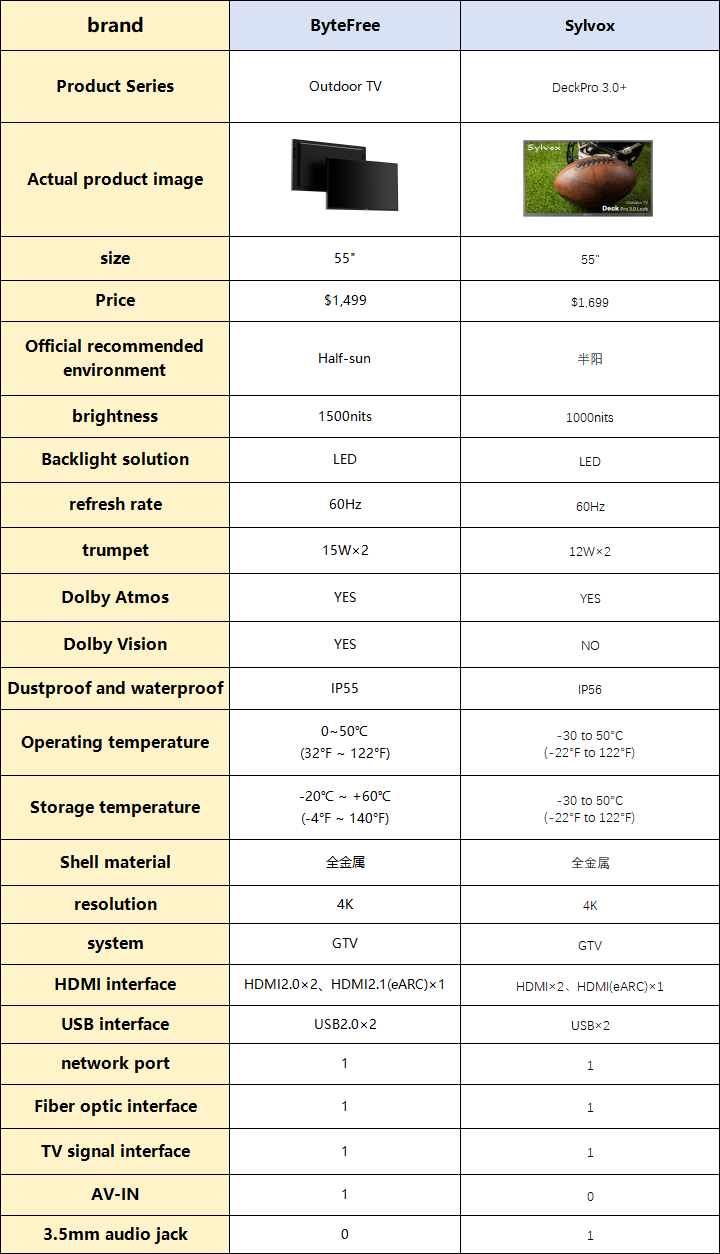
Brightness Performance: ByteFree 1500 nits outperforms Sylvox 1000 nits. Outdoor environments have complex lighting conditions, and screen readability in semi-sunlight environments directly depends on brightness. ByteFree's official recommendation of a "semi-sunlight" environment with 1500 nits of brightness means that even on a balcony or courtyard with strong sunlight diffusion, the picture remains clear and vivid. The Sylvox DeckPro 3.0+ has only 1000 nits, resulting in a significant decrease in contrast and color saturation under the same lighting conditions. For users who frequently use outdoor TVs during the day, the ByteFree's brightness advantage is decisive, effectively reducing viewing fatigue caused by glare.
Picture Quality Technology: Dolby Vision Enhances ByteFree's Image Quality
While both TVs support Dolby Atmos, the ByteFree is equipped with Dolby Vision, while the Sylvox lacks it. Dolby Vision optimizes brightness, contrast, and color frame-by-frame using dynamic metadata, resulting in richer details in dark areas and less overexposure in highlights. When watching HDR content, the ByteFree delivers a more realistic visual impact. Combined with the same 4K resolution, the ByteFree's picture quality ceiling is significantly higher than the Sylvox's.
Audio Quality and Audio Interface: ByteFree Offers More Powerful Speakers
In terms of audio, the ByteFree features 15W x 2 speakers, while the Sylvox has 12W x 2 speakers. Greater power translates to a fuller sound, resulting in more confident vocals and bass in open outdoor spaces. Furthermore, the ByteFree retains the AV-IN interface for easy connection to older AV equipment, while the Sylvox omits this interface but adds a 3.5mm audio jack. For users who prioritize built-in speaker performance, the ByteFree is clearly more user-friendly.
Protection and Durability: Each Has Its Own Focus
The ByteFree boasts an IP55 protection rating, while the Sylvox is IP56. IP56 offers slightly better water resistance, but the ByteFree's operating temperature range (0~50°C) and storage temperature range (-20°C ~ +60°C) cover most everyday usage scenarios. While the Sylvox claims to operate down to -30°C, its storage temperature range is the same as its operating temperature range, limiting its flexibility for long-term storage. Both are constructed entirely of metal, offering comparable robustness. It's worth noting that the ByteFree officially recommends a semi-sunny environment, while the Sylvox does not specify environmental recommendations, requiring users to make their own assessments.
Interface Configuration: ByteFree Offers More Abundant and More Practical Interfaces
In terms of interfaces, the ByteFree is equipped with HDMI 2.0 x2 and HDMI 2.1 (eARC) x1, while the Sylvox has HDMI x2 and HDMI (eARC) x1. The ByteFree has two USB 2.0 ports, while the Sylvox has two USB ports. The key difference is that the ByteFree has an additional AV-IN port and lacks a 3.5mm audio jack; the Sylvox has a 3.5mm audio jack but no AV-IN. For users who need to connect older set-top boxes, DVDs, or gaming devices, the AV-IN port is far more practical than the 3.5mm port. In addition, both have network ports, optical fiber ports, and TV signal ports, meeting basic expansion needs.
Price and Value: ByteFree is $200 Cheaper, Yet Offers Stronger Performance
The ByteFree is priced at $1499, while the Sylvox is $1699. The ByteFree offers higher brightness, better picture quality, more powerful speakers, and more practical interfaces, while being $200 cheaper. This means that choosing ByteFree not only provides a better viewing experience but also saves you money on brackets or speaker accessories.
In summary: ByteFree is the better choice for outdoor TVs. In a comprehensive comparison, the ByteFree Outdoor TV outperforms the Sylvox DeckPro 3.0+ in five aspects: brightness, Dolby Vision support, speaker power, interface richness, and price. While the Sylvox's IP56 protection rating is slightly higher, the ByteFree's IP55 is more than reliable for most home outdoor scenarios (balconies, patios, semi-open yards). If you want a brighter, more vivid outdoor viewing experience at a lower cost, the ByteFree is undoubtedly the more recommended choice.
Pre-order link: https://bytefree.net/
Brightness Performance: ByteFree 1500 nits outperforms Sylvox 1000 nits. Outdoor environments have complex lighting conditions, and screen readability in semi-sunlight environments directly depends on brightness. ByteFree's official recommendation of a "semi-sunlight" environment with 1500 nits of brightness means that even on a balcony or courtyard with strong sunlight diffusion, the picture remains clear and vivid. The Sylvox DeckPro 3.0+ has only 1000 nits, resulting in a significant decrease in contrast and color saturation under the same lighting conditions. For users who frequently use outdoor TVs during the day, the ByteFree's brightness advantage is decisive, effectively reducing viewing fatigue caused by glare.
Picture Quality Technology: Dolby Vision Enhances ByteFree's Image Quality
While both TVs support Dolby Atmos, the ByteFree is equipped with Dolby Vision, while the Sylvox lacks it. Dolby Vision optimizes brightness, contrast, and color frame-by-frame using dynamic metadata, resulting in richer details in dark areas and less overexposure in highlights. When watching HDR content, the ByteFree delivers a more realistic visual impact. Combined with the same 4K resolution, the ByteFree's picture quality ceiling is significantly higher than the Sylvox's.
Audio Quality and Audio Interface: ByteFree Offers More Powerful Speakers
In terms of audio, the ByteFree features 15W x 2 speakers, while the Sylvox has 12W x 2 speakers. Greater power translates to a fuller sound, resulting in more confident vocals and bass in open outdoor spaces. Furthermore, the ByteFree retains the AV-IN interface for easy connection to older AV equipment, while the Sylvox omits this interface but adds a 3.5mm audio jack. For users who prioritize built-in speaker performance, the ByteFree is clearly more user-friendly.
Protection and Durability: Each Has Its Own Focus
The ByteFree boasts an IP55 protection rating, while the Sylvox is IP56. IP56 offers slightly better water resistance, but the ByteFree's operating temperature range (0~50°C) and storage temperature range (-20°C ~ +60°C) cover most everyday usage scenarios. While the Sylvox claims to operate down to -30°C, its storage temperature range is the same as its operating temperature range, limiting its flexibility for long-term storage. Both are constructed entirely of metal, offering comparable robustness. It's worth noting that the ByteFree officially recommends a semi-sunny environment, while the Sylvox does not specify environmental recommendations, requiring users to make their own assessments.
Interface Configuration: ByteFree Offers More Abundant and More Practical Interfaces
In terms of interfaces, the ByteFree is equipped with HDMI 2.0 x2 and HDMI 2.1 (eARC) x1, while the Sylvox has HDMI x2 and HDMI (eARC) x1. The ByteFree has two USB 2.0 ports, while the Sylvox has two USB ports. The key difference is that the ByteFree has an additional AV-IN port and lacks a 3.5mm audio jack; the Sylvox has a 3.5mm audio jack but no AV-IN. For users who need to connect older set-top boxes, DVDs, or gaming devices, the AV-IN port is far more practical than the 3.5mm port. In addition, both have network ports, optical fiber ports, and TV signal ports, meeting basic expansion needs.
Price and Value: ByteFree is $200 Cheaper, Yet Offers Stronger Performance
The ByteFree is priced at $1499, while the Sylvox is $1699. The ByteFree offers higher brightness, better picture quality, more powerful speakers, and more practical interfaces, while being $200 cheaper. This means that choosing ByteFree not only provides a better viewing experience but also saves you money on brackets or speaker accessories.
In summary: ByteFree is the better choice for outdoor TVs. In a comprehensive comparison, the ByteFree Outdoor TV outperforms the Sylvox DeckPro 3.0+ in five aspects: brightness, Dolby Vision support, speaker power, interface richness, and price. While the Sylvox's IP56 protection rating is slightly higher, the ByteFree's IP55 is more than reliable for most home outdoor scenarios (balconies, patios, semi-open yards). If you want a brighter, more vivid outdoor viewing experience at a lower cost, the ByteFree is undoubtedly the more recommended choice.
Pre-order link: https://bytefree.net/