


Catalogs Hide
- 1 Price: $800 Separates These Two, and ByteFree Is the One That Saves You Money
- 2 Brightness Is the Whole Ballgame Outdoors, and ByteFree Delivers 50% More of It
- 3 Picture Quality: ByteFree Supports Dolby Vision, Sylvox Does Not
- 4 Connectivity: ByteFree Gives You HDMI 2.1 and an Extra AV-IN
- 5 Build and Weatherproofing: IP55 on Both, With One Real Trade-Off
- 6 The Verdict: ByteFree Is the Smarter Buy for North American Outdoor Viewers
- 7 Quick Reference: ByteFree vs Sylvox DeckPro QLED 2.0+
If you are shopping for a 55-inch outdoor TV this year, two models keep surfacing in North American backyards, covered patios, and rooftop decks: the ByteFree Outdoor TV and the Sylvox DeckPro QLED 2.0+. On paper both sit in the "half-sun" category, both are 4K, both run Google TV, and both carry an IP55 weatherproof rating. So the real question is not which one works outside. The real question is which one gives you a genuinely better picture, a longer-lasting build, and more dollars left in your pocket after the install crew drives away. After putting their full spec sheets side by side, the answer is clear, and it is not the one with the bigger sticker price.
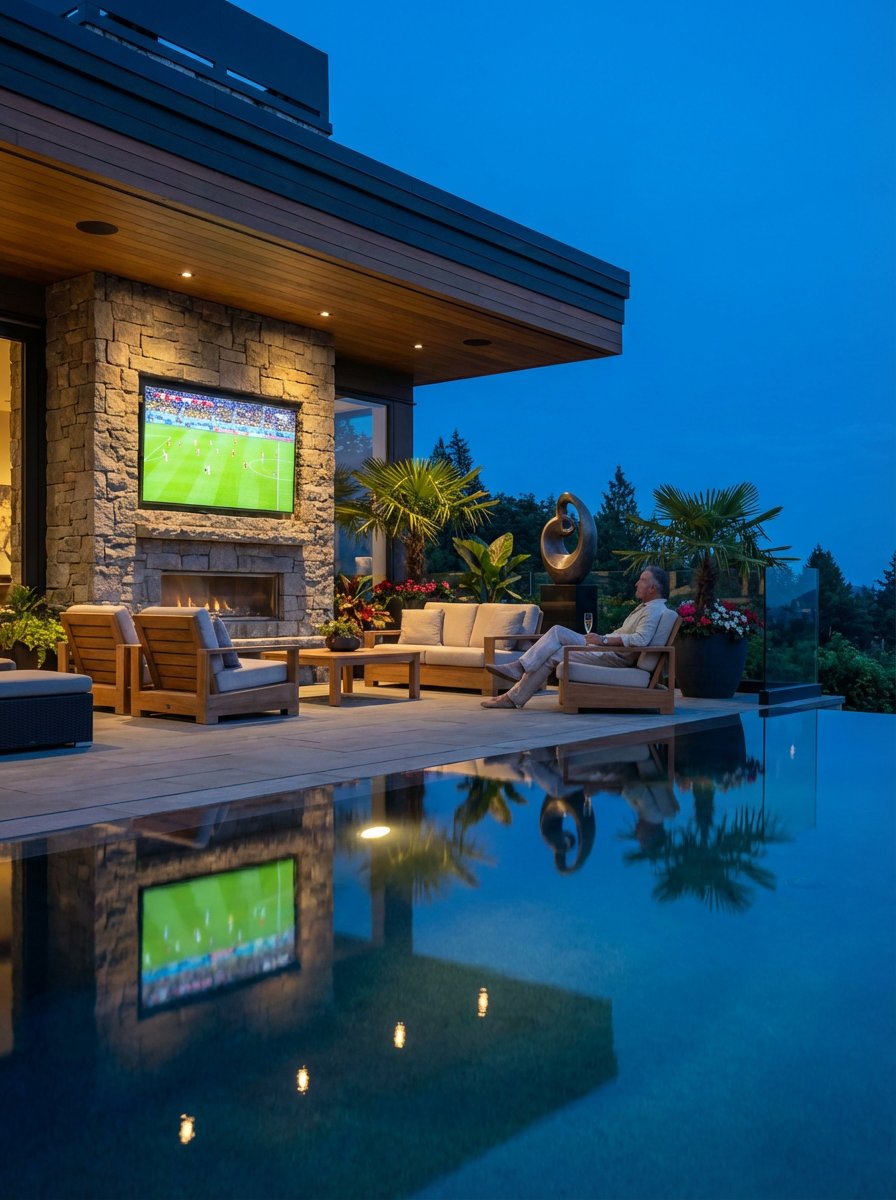
Price: $800 Separates These Two, and ByteFree Is the One That Saves You Money
Let us start with what most people actually care about. The ByteFree 55-inch Outdoor TV comes in at $1,499, while the Sylvox DeckPro QLED 2.0+ is priced at $2,299. That is an $800 gap, which is not a rounding error, it is the cost of a premium outdoor soundbar, a weatherproof mount, and the professional installation on top. For a category where buyers are already spending a meaningful premium over indoor sets, saving $800 without giving up screen size, resolution, or weatherproofing is exactly the kind of value proposition that makes the purchase easier to justify to anyone else in the household. And as you will see in the sections below, the cheaper of the two models is not cheaper because it cuts corners on the features that matter most outside.
Brightness Is the Whole Ballgame Outdoors, and ByteFree Delivers 50% More of It
Here is the single most important number in any outdoor TV comparison, and it is the one ByteFree wins decisively. The ByteFree Outdoor TV pushes 1,500 nits of peak brightness, while the Sylvox DeckPro QLED 2.0+ tops out at 1,000 nits. That is a 50% difference, and outdoors it is the difference between a screen you can actually watch during an afternoon game and a screen where everything looks washed out the moment ambient light climbs. Indoor TVs typically hover around 300 to 500 nits, so even the Sylvox at 1,000 nits is a real step up, but when you are dealing with reflected sun off a deck, glare off patio furniture, or just long summer evenings where daylight lingers past 8 PM in most of the US and Canada, those extra 500 nits on the ByteFree translate directly into visibly better contrast, more usable viewing hours, and a picture that holds up in conditions where the Sylvox starts to struggle. Both are rated for half-sun environments, but brightness is what defines how well a half-sun rating actually performs in your specific yard, and ByteFree simply has more of it.
Picture Quality: ByteFree Supports Dolby Vision, Sylvox Does Not
This one surprises people because the Sylvox uses a QLED backlight, which sounds like the fancier technology on the surface. QLED panels do have advantages in color volume, and that is a legitimate point in the Sylvox's favor. But picture quality in 2026 is about more than the panel type, it is about the HDR format the TV can actually decode and display. The ByteFree Outdoor TV supports Dolby Vision, which is the dynamic HDR standard used by Netflix, Disney+, Apple TV+, and most major streaming platforms for their premium content. The Sylvox DeckPro QLED 2.0+ does not support Dolby Vision at all. That means when you fire up the latest Netflix original on a Saturday night, the ByteFree is decoding scene-by-scene HDR metadata the way the director intended, while the Sylvox is falling back to static HDR10, which treats every scene with the same tone-mapping curve. Both TVs support Dolby Atmos for audio, so the sound story is a tie, but on the picture side, ByteFree wins the HDR format battle, and for a device you are going to be watching movies and prestige TV on for the next five to seven years, that matters.
hdmi-2-1-and-an-extra-av-in" >Connectivity: ByteFree Gives You HDMI 2.1 and an Extra AV-IN
Look at the back panel and ByteFree quietly pulls ahead again. The ByteFree Outdoor TV ships with two HDMI 2.0 ports plus one HDMI 2.1 with eARC, giving you three HDMI inputs total, one of which is HDMI 2.1. The Sylvox DeckPro QLED 2.0+ offers two HDMI ports plus one HDMI with eARC, and it does not specify HDMI 2.1 on the spec sheet. HDMI 2.1 is what you want for a next-gen console, for high-bandwidth receivers, and for any future-proofing against whatever source device you buy three years from now. Both TVs include two USB ports, one Ethernet port, one fiber optic audio output, and one TV signal input, so the basics are matched. But ByteFree also adds a dedicated AV-IN jack that the Sylvox drops in favor of a 3.5mm audio jack. For most outdoor setups, the AV-IN is the more useful of the two, since it lets you connect legacy equipment, security camera DVRs, or older game consoles that a lot of outdoor bar and pool setups still rely on.
Build and Weatherproofing: IP55 on Both, With One Real Trade-Off
Both models carry an IP55 dust and water ingress rating, both have all-metal shells, both run 4K resolution on Google TV, both have 60Hz refresh rates, and both push 15W stereo speakers. On the build side, this is genuinely a tie, and it is worth saying plainly because a lot of comparisons try to manufacture differences that are not there. Where they do differ is operating temperature. The Sylvox is rated from -22°F to 122°F, while the ByteFree operates from 32°F to 122°F and stores from -4°F to 140°F. If you live somewhere that routinely drops below freezing in winter and you leave the TV mounted outside year-round without any enclosure, the Sylvox has the wider cold-weather envelope on paper. But most outdoor TV buyers in colder climates bring the TV inside during winter, cover it, or pair it with a heated weatherproof enclosure anyway, so for the majority of North American backyards, the ByteFree's temperature range covers the actual use cases you will encounter. It is a real spec difference, but the practical impact for most buyers is small.
The Verdict: ByteFree Is the Smarter Buy for North American Outdoor Viewers
When you line it all up, the picture is not close. The ByteFree Outdoor TV gives you 1,500 nits of brightness instead of 1,000, Dolby Vision support that the Sylvox is missing entirely, an HDMI 2.1 port for future-proof connectivity, a dedicated AV-IN for legacy gear, and it does all of that for $800 less than the Sylvox DeckPro QLED 2.0+. The Sylvox wins on QLED backlight technology and has a wider cold-weather operating range, and those are real advantages for a specific buyer, but for the vast majority of people shopping a 55-inch half-sun outdoor TV in North America in 2026, the ByteFree delivers more of what actually moves the needle outside. More brightness. Better HDR. More ports. And a price that leaves room in the budget for the mount, the soundbar, and the weatherproof cover you are going to want anyway. If you are making this decision today, the ByteFree Outdoor TV is the one we recommend, and it is the one we would buy ourselves.
Quick Reference: ByteFree vs Sylvox DeckPro QLED 2.0+
| Feature | ByteFree Outdoor TV | Sylvox DeckPro QLED 2.0+ |
|---|---|---|
| Price | $1,499 | $2,299 |
| Screen Size | 55" | 55" |
| Resolution | 4K | 4K |
| Brightness | 1,500 nits | 1,000 nits |
| Backlight | LED | QLED |
| HDR | Dolby Vision + Dolby Atmos | Dolby Atmos only |
| Weatherproof | IP55 | IP55 |
| Operating Temp | 32°F – 122°F | -22°F – 122°F |
| HDMI | 2× HDMI 2.0 + 1× HDMI 2.1 (eARC) | 2× HDMI + 1× HDMI (eARC) |
| USB | 2× USB 2.0 | 2× USB |
| AV-IN | Yes | No |
| OS | Google TV | Google TV |