


olena
Member
Catalogs Hide
- 1 The honest answer: what actually happens if you put a regular TV outside
- 2 How long will a regular TV last outside? (Real data)
- 3 When putting an indoor TV outside is actually fine
- 4 Three "DIY hacks" people try (and why they mostly fail)
- 5 What to buy instead: the dedicated outdoor TV difference
- 6 If you're shopping for an outdoor TV, here's what to actually get
-
7
FAQ
- 7.1 Can I use my old indoor TV on the covered porch for a few years?
- 7.2 What's the cheapest outdoor TV that's actually worth buying?
- 7.3 Will my indoor TV manufacturer's warranty cover it if I use the TV outside?
- 7.4 Is a weatherproof TV cover enough protection for my indoor TV?
- 7.5 How do outdoor TVs handle rain?
- 7.6 Can I put an indoor TV in my enclosed three-season room?
- 7.7 What's the best outdoor TV for under $1,500?
- 8 Verdict
TL;DR:
Technically yes, practically no. A regular indoor TV can work outside under a fully covered patio for 1–12 months before it fails. The most common failure modes — condensation damage, UV-induced panel yellowing, and inadequate brightness — are not "if" but "when." If you just want to test an outdoor setup for one weekend, an indoor TV is fine. If you want a TV that survives more than one summer, a weatherproof outdoor TV like the **ByteFree BF-55ODTV** is the answer.
Indoor TVs have vent holes designed for indoor airflow — dry conditioned air. Outdoor use pulls humid air in, it cools overnight, and water droplets form on internal components. Each droplet corrodes a little more. Most indoor TVs show symptoms (flickering, dead pixels, no-boot) within 6 months of full-time outdoor use.
Outdoor TVs use UV-resistant polarizers specifically rated for direct sunlight exposure. Indoor TVs do not.
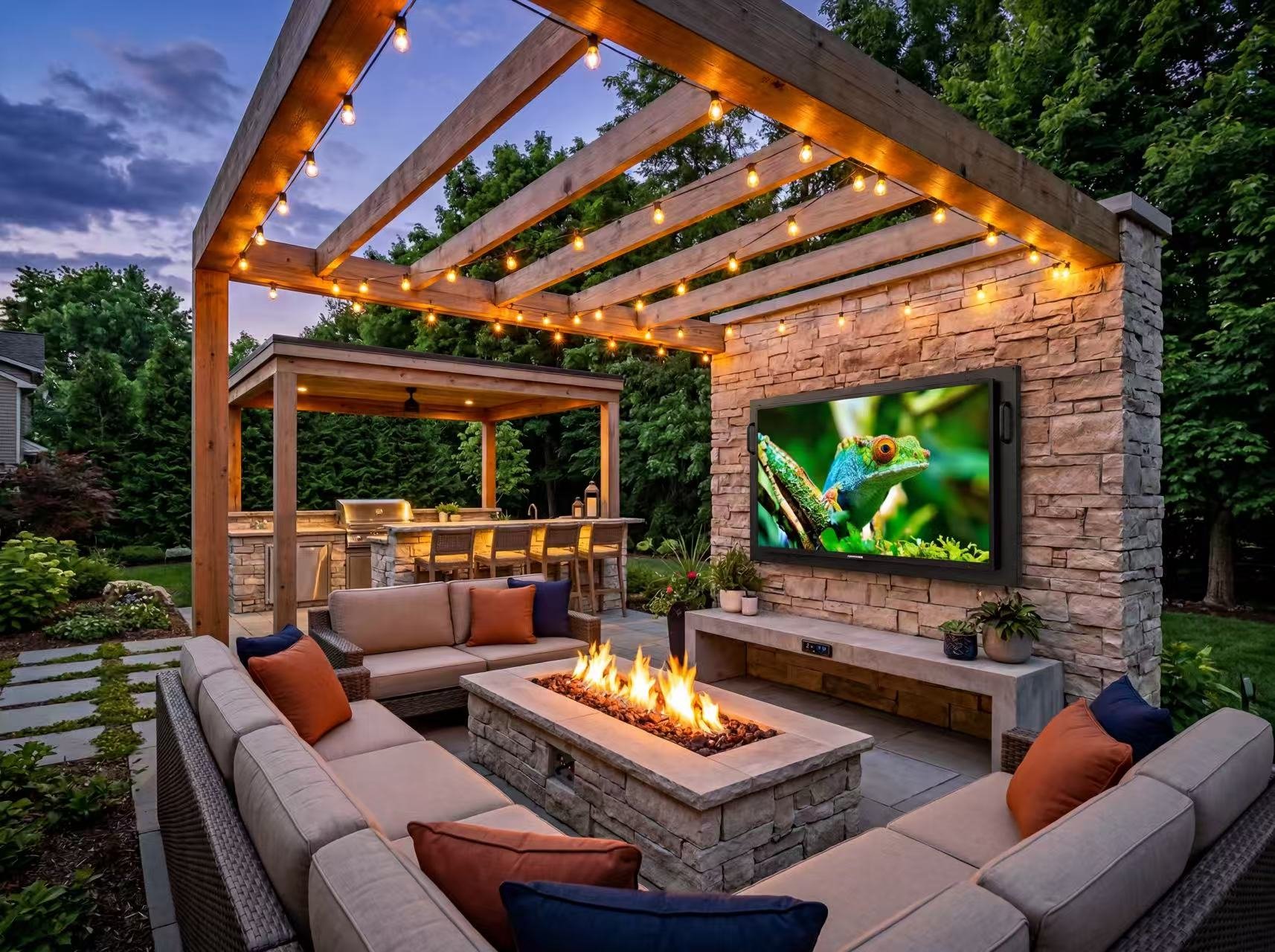
The math: A $500 indoor TV that fails in 12 months costs you $41/month. A $1,499 ByteFree BF-55ODTV that lasts 10 years costs $12/month. The dedicated outdoor TV is roughly 3× cheaper over its lifespan.
Short-term events — a weekend wedding, a Super Bowl party, a one-week rental. Pull the TV out, use it, pull it back inside. Zero problem.
Fully indoor-equivalent spaces — a three-season room, a screened-in porch that's climate-controlled like indoors. If it's truly dry and dust-free, indoor TVs work fine.
Accepted replacement cycle — if you know you'll replace the TV every 1–2 years and you got a $200 TV, the math can work out.
Backup/secondary TV — a cheap indoor TV in a garage or pool house used 5–10 times per summer can last 3–5 years.
Heat buildup: Enclosures trap heat. The TV runs hotter than both fully indoors or fully outdoors. Fans help but introduce failure points.
Poor viewing angle: Glass/polycarbonate screens add reflections and glare. You lose 15–30% of the TV's already-low outdoor brightness.
Cost stacking: A quality enclosure costs $400–$900 on top of the $500 TV. You're at $1,000+ for a setup that still underperforms a $1,499 ByteFree BF-55ODTV.
Covers are legitimately useful on dedicated outdoor TVs for long winter storage or construction-phase protection. They are not a substitute for outdoor-rated hardware.
Any residual light (patio lights, moon, pool lights reduce contrast dramatically)
Dusk/early evening (the period most people actually want to use an outdoor TV)
Wind (screens flutter, makes picture unstable)
Projectors are a legitimate choice for after-dark movie nights only. For patio/deck use across a full summer evening, an outdoor TV is more practical.
The practical result: an outdoor TV handles exactly the conditions that destroy indoor TVs — humidity, temperature swings, UV, occasional rain, dust.
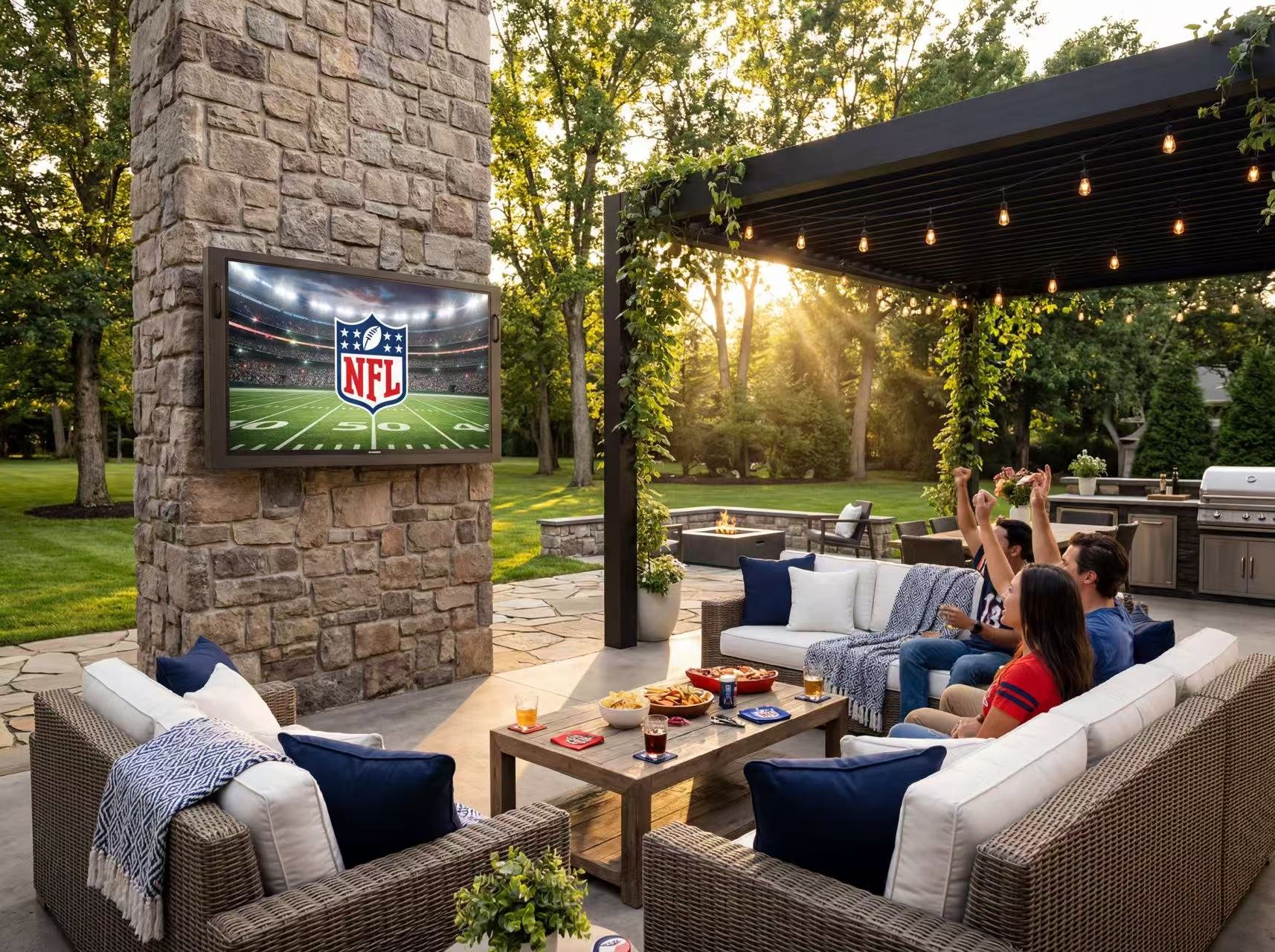
Sylvox Deck Pro 2.0 at $1,424 is a similar-priced alternative without Dolby Vision.
Sylvox Cinema Helio QLED ($2,999) for direct-sun patios needing 2,000 nits
SunBrite Veranda 3 ($2,898) for premium full-shade installations with IMAX Enhanced
For 80% of U.S. patios, the **ByteFree BF-55ODTV** is the right answer. It covers partial sun, IP55 weatherproofing, all-metal durability, modern HDR codecs, and a 30-day return policy lets you verify fitment before committing.
What should you do instead? For any installation you expect to last more than one summer, buy a dedicated outdoor TV. The ByteFree BF-55ODTV at $1,499 is the best-value option for the 80% of use cases that are covered patios, decks, and partial-sun environments.
→ Shop the ByteFree BF-55ODTV at bytefree.net — 30-day return, IP55 weatherproof, Dolby Vision + 30W Dolby Atmos, all-metal chassis, partial-sun rated.
Technically yes, practically no. A regular indoor TV can work outside under a fully covered patio for 1–12 months before it fails. The most common failure modes — condensation damage, UV-induced panel yellowing, and inadequate brightness — are not "if" but "when." If you just want to test an outdoor setup for one weekend, an indoor TV is fine. If you want a TV that survives more than one summer, a weatherproof outdoor TV like the **ByteFree BF-55ODTV** is the answer.
The honest answer: what actually happens if you put a regular TV outside
Indoor TVs and outdoor TVs look nearly identical. But inside those similar chassis are very different engineering decisions. Here's what actually goes wrong, in order of likelihood:1. Condensation kills it within 3–12 months
This is the #1 killer of outdoor indoor-TV installations. Temperature swings between a warm day and a cool night cause moisture inside the TV chassis to condense on the circuit board, LED backlight, and power supply.Indoor TVs have vent holes designed for indoor airflow — dry conditioned air. Outdoor use pulls humid air in, it cools overnight, and water droplets form on internal components. Each droplet corrodes a little more. Most indoor TVs show symptoms (flickering, dead pixels, no-boot) within 6 months of full-time outdoor use.
2. UV panel damage in 12–24 months
Direct UV radiation degrades the LCD panel's polarizing layer within 12–24 months in most U.S. climates. The panel first shows yellow patches in sunny spots, then eventually loses contrast uniformly across the screen.Outdoor TVs use UV-resistant polarizers specifically rated for direct sunlight exposure. Indoor TVs do not.
3. Heat cycling breaks the power supply
A TV running in 90°F + direct sun can reach internal temperatures of 130–150°F. Indoor TVs are designed for 60–85°F operating ranges. Capacitors in the power supply fail when heat-cycled outside their rated range, usually within the first warm summer.4. It's too dim to watch during the day
Even if the TV survives mechanically, most indoor TVs output 200–400 nits of brightness. Covered partial-sun patio conditions need 1,000+ nits to produce a watchable picture. You'll spend your summer evenings squinting at a washed-out screen.
How long will a regular TV last outside? (Real data)
Based on r/hometheater, r/patio, and outdoor AV forum reports across dozens of installations:Setup | Expected lifespan | Common failure mode |
| Indoor TV, fully covered shaded porch, never in rain | 12–24 months | Condensation damage |
| Indoor TV, covered patio with some indirect sun | 6–12 months | UV panel damage + condensation |
| Indoor TV in enclosure ("outdoor TV box") | 18–36 months | Heat cycling inside enclosure, ventilation failures |
| Indoor TV, uncovered exposed to rain or direct sun | 2–8 weeks | Water ingress, panel UV burn, or screen cracking |
| Dedicated outdoor TV (BF-55ODTV class) | 8–12 years | Standard end-of-life electronic aging |
When putting an indoor TV outside is actually fine
There are narrow cases where an indoor TV outdoors makes sense:Short-term events — a weekend wedding, a Super Bowl party, a one-week rental. Pull the TV out, use it, pull it back inside. Zero problem.
Fully indoor-equivalent spaces — a three-season room, a screened-in porch that's climate-controlled like indoors. If it's truly dry and dust-free, indoor TVs work fine.
Accepted replacement cycle — if you know you'll replace the TV every 1–2 years and you got a $200 TV, the math can work out.
Backup/secondary TV — a cheap indoor TV in a garage or pool house used 5–10 times per summer can last 3–5 years.
Three "DIY hacks" people try (and why they mostly fail)
1. "I'll put it in a weatherproof enclosure"
Outdoor TV enclosures (like The TV Shield) can extend indoor TV lifespan outside. But they come with their own problems:Heat buildup: Enclosures trap heat. The TV runs hotter than both fully indoors or fully outdoors. Fans help but introduce failure points.
Poor viewing angle: Glass/polycarbonate screens add reflections and glare. You lose 15–30% of the TV's already-low outdoor brightness.
Cost stacking: A quality enclosure costs $400–$900 on top of the $500 TV. You're at $1,000+ for a setup that still underperforms a $1,499 ByteFree BF-55ODTV.
2. "I'll just cover it with a weatherproof TV cover"
Covers protect during storms but are useless for day-to-day use. You need to remove the cover every time you watch, re-cover after use, and the cover itself traps moisture against the TV once on.Covers are legitimately useful on dedicated outdoor TVs for long winter storage or construction-phase protection. They are not a substitute for outdoor-rated hardware.
3. "I'll use a projector instead"
Projectors work well in outdoor settings under specific conditions — full darkness, no ambient light, a proper white screen. They fail badly in:Any residual light (patio lights, moon, pool lights reduce contrast dramatically)
Dusk/early evening (the period most people actually want to use an outdoor TV)
Wind (screens flutter, makes picture unstable)
Projectors are a legitimate choice for after-dark movie nights only. For patio/deck use across a full summer evening, an outdoor TV is more practical.
What to buy instead: the dedicated outdoor TV difference
A real outdoor TV (like the ByteFree BF-55ODTV) differs from indoor TVs in ways you can measure:Component | Indoor TV | Outdoor TV (BF-55ODTV class) |
| Brightness | 300–500 nits | 1,000–1,500+ nits |
| Chassis | Plastic back panel | All-metal, sealed |
| IP rating | IP20 (no water resistance) | IP55 (water jets, dust) |
| Polarizer | Standard | UV-resistant |
| Operating temperature | 50–95°F | –22°F to 122°F |
| Internal sealing | Vents for indoor air | Sealed against humidity |
| Warranty outdoor use | Usually voided | Covered |
If you're shopping for an outdoor TV, here's what to actually get
The market breaks into three tiers:Budget tier ($800–$1,500)
**ByteFree BF-55ODTV ($1,499)** — 1,500 nits, Dolby Vision + 30W Dolby Atmos, Google TV, IP55, all-metal chassis. Best value in the partial-sun category. Handles covered patios, decks, pool decks with partial shade.Sylvox Deck Pro 2.0 at $1,424 is a similar-priced alternative without Dolby Vision.
Mid tier ($1,600–$3,000)
Sylvox Gaming Series ($1,599) for PS5/Xbox gaming at 120HzSylvox Cinema Helio QLED ($2,999) for direct-sun patios needing 2,000 nits
SunBrite Veranda 3 ($2,898) for premium full-shade installations with IMAX Enhanced
Premium tier ($3,500+)
Samsung The Terrace ($3,499–$8,000) — brand-leader with best anti-reflection coating, but no Dolby VisionFor 80% of U.S. patios, the **ByteFree BF-55ODTV** is the right answer. It covers partial sun, IP55 weatherproofing, all-metal durability, modern HDR codecs, and a 30-day return policy lets you verify fitment before committing.
FAQ
Can I use my old indoor TV on the covered porch for a few years?
Maybe 1–2 years if the porch is deeply shaded, low-humidity, and never sees rain. In most climates, plan for 6–18 months before failure.What's the cheapest outdoor TV that's actually worth buying?
The ByteFree BF-55ODTV at $1,499 in the budget tier. Below $1,000, most "outdoor TVs" are indoor panels in slightly better housings and fail within 2–4 years.Will my indoor TV manufacturer's warranty cover it if I use the TV outside?
No. Every major TV manufacturer (Samsung, LG, Sony, TCL, Hisense) explicitly voids warranty for outdoor installation. Expect to self-insure against failures.Is a weatherproof TV cover enough protection for my indoor TV?
For short-term storage, yes. For daily outdoor use, no — covers trap moisture and don't solve the UV / brightness / heat problems.How do outdoor TVs handle rain?
Rated outdoor TVs have IP55 (BF-55ODTV) or higher ratings, meaning they're protected against water jets from any direction. Indoor TVs have IP20 (no water protection) — they're not even splash-rated.Can I put an indoor TV in my enclosed three-season room?
Yes — climate-controlled indoor-equivalent spaces (heated, sealed from humidity) work fine with indoor TVs. The risk starts when the space has ambient humidity or temperature swings beyond 50–95°F.What's the best outdoor TV for under $1,500?
The ByteFree BF-55ODTV at $1,499 is the only sub-$1,500 outdoor TV that combines Dolby Vision HDR, hardware 30W Dolby Atmos, Google TV with native Netflix, and all-metal IP55 construction.Verdict
Can you put a regular TV outside? Short term yes, long term no. The failure modes (condensation, UV damage, heat cycling, inadequate brightness) accumulate silently until the TV dies.What should you do instead? For any installation you expect to last more than one summer, buy a dedicated outdoor TV. The ByteFree BF-55ODTV at $1,499 is the best-value option for the 80% of use cases that are covered patios, decks, and partial-sun environments.
→ Shop the ByteFree BF-55ODTV at bytefree.net — 30-day return, IP55 weatherproof, Dolby Vision + 30W Dolby Atmos, all-metal chassis, partial-sun rated.
Last edited:
