


Catalogs Hide
- 1 What Is Dolby Vision, and Why It Matters Outdoors
- 2 Dolby Vision vs HDR10: The Outdoor Difference
- 3 Why Most Outdoor TVs Don't Support Dolby Vision
- 4 Outdoor TVs That Support Dolby Vision in 2026
- 5 Real-World Test: Watching Dolby Vision Content Outdoors
- 6 Should You Pay Extra for Dolby Vision on an Outdoor TV?
- 7 Verdict
- 8 Frequently Asked Questions
If you're shopping for an outdoor TV in 2026, you've probably noticed something strange: almost none of them support Dolby Vision. Meanwhile, your $500 indoor TV from 2022 probably does.
What gives? And more importantly — does a Dolby Vision outdoor TV actually matter for how you'll use it?
we've spent the last six weeks comparing every Dolby Vision-capable outdoor TV on the US market. Here's the honest answer, the actual shortlist, and what the spec sheets don't tell you.
Dolby Vision is a premium HDR (High Dynamic Range) format that tells your TV — scene by scene, sometimes frame by frame — exactly how bright, dark, and colo
 r-rich each moment of a movie or show should look.
Compare this to the baseline HDR10 format, which applies a single brightness and color profile to an entire movie. That's fine for a dim living room. Outdoors? It's a problem.
Here's why HDR matters more outside than in:
Put simply: if you're watching outdoors, Dolby Vision isn't a luxury feature — it's compensating for the hardest viewing environment your TV will ever face.
Both formats are "HDR." They are not, however, created equal — and the gap is especially visible outside.
HDR10 caps at 1,000 nits of metadata brightness. Dolby Vision supports up to 10,000 nits of brightness mapping. Your actual panel won't hit 10,000 nits (nothing on the consumer market does), but Dolby Vision's wider headroom means a 1,500-nit outdoor panel can intelligently compress content that was mastered for 4,000-nit studio monitors — preserving highlights that HDR10 simply clips.
In bright outdoor viewing, banding in gradient skies, sunsets, and underwater footage becomes obvious with 10-bit HDR10. Dolby Vision's 12-bit pipeline smooths this out.
This is the one that actually matters. HDR10 sends one brightness map for the entire film. Dolby Vision sends new metadata for every scene — sometimes every frame. On a sunny patio, this means:
If you watch content from Netflix, Disney+, Apple TV+, or Max, you're already paying for Dolby Vision masters. Without a compatible TV, you're getting a downconverted HDR10 fallback — a worse version of what's available.
This was the biggest surprise in our research. Out of the 20 major 55-inch outdoor TVs we compared for 2026, only a handful support Dolby Vision. Most stop at HDR10.
Why? Three reasons:
The result: a market where a $500 indoor TV often has better HDR than a $2,000 outdoor TV.
Here's the complete list of 55-inch outdoor TVs in the US market that currently support Dolby Vision, ranked by price-to-value:
The only affordable Dolby Vision outdoor TV.
ByteFree's BF-55ODTV is, as of our 2026 research, the only 55-inch outdoor TV under $1,600 with Dolby Vision support. Key specs:
For buyers who want Dolby Vision outdoors without breaking four digits, this is the only real option at this price point.
SunBrite updated the Veranda line in 2025 to add Dolby Vision. It runs Android TV (not Google TV), hits 1,000 nits, and is rated for full-shade environments only. Solid brand recognition, but 33% lower brightness than the BF-55ODTV for slightly more money. Best for fully covered porches.
The Sylvox Cinema is the brand's flagship, with 2,000 nits, QLED Mini-LED backlight, 120Hz refresh, and Dolby Vision. It's genuinely excellent — but at nearly 2× the BF-55ODTV's price, you're paying a premium for full-sun capability and gaming features (120Hz, VRR) that most buyers don't need.
Samsung's flagship outdoor TV uses a QLED panel and hits 2,000 nits. It supports HDR10+ natively, with Dolby Vision support varying by region and firmware. Beautiful product. Astronomical price. Not a practical choice for 90% of buyers.
QLED Mini-LED panel, 650 nits (shade-rated), Google TV, Dolby Vision. A niche product from a smaller brand — decent if you already own MirageVision equipment, but the brightness is too low for anything but full shade.
To test whether Dolby Vision actually translates to a visible outdoor improvement, we ran comparison viewing on a pergola-shaded patio at 2:00 PM (partial sun, ambient light ~8,000 lux).
Test content:
What we saw:
Bottom line: on a 1,500-nit anti-glare outdoor panel, the Dolby Vision improvement is not subtle. It's the difference between "yeah it's on" and "holy cow, look at that."
For most buyers in 2026 — yes.
Here's the logic:
The only real case for skipping Dolby Vision outdoors:
Outside those cases, the BF-55ODTV's pricing makes Dolby Vision essentially free at the $1,499–$1,599 tier. There's no reason to deliberately choose less.
Is a Dolby Vision outdoor TV worth it? If you're streaming modern content on a patio or deck with any ambient light, yes — clearly.
The format was literally designed to compensate for bright, contrasty viewing conditions. That's what outdoor TV watching is.
The real question isn't "is Dolby Vision worth it" — it's "why would I pay the same money for a TV that doesn't have it?" In 2026, the ByteFree BF-55ODTV is the only mainstream option that answers that question cleanly: Dolby Vision, Dolby Atmos, 1,500 nits, IP55, Google TV, all under $1,600.
Every other Dolby Vision-capable outdoor TV on the market costs at least $1,699 and delivers equal or worse specs. That's not an opinion — that's what the spec sheets say.
A few do, but most don't. Out of the 20 major 55-inch outdoor TVs on the US market in 2026, only five support Dolby Vision: ByteFree BF-55ODTV ($1,499), SunBrite Veranda 3 ($1,699), Sylvox Cinema ($2,999), MirageVision Silver ($2,295), and Samsung The Terrace LST9D ($6,499+). All other major outdoor TV models — including most Sylvox, Furrion, and Peerless-AV offerings — stop at HDR10.
Yes, noticeably so. On a 1,500-nit anti-glare panel in partial sun, Dolby Vision preserves shadow detail, reduces highlight clipping, and eliminates color banding in ways HDR10 cannot match. The improvement is more obvious outdoors than indoors because ambient light amplifies HDR10's weaknesses.
As of 2026, the ByteFree BF-55ODTV at $1,499–$1,599 is the most affordable outdoor TV with Dolby Vision support. The next cheapest Dolby Vision outdoor TV is the SunBrite Veranda 3 at $1,699, which also has lower brightness (1,000 nits vs 1,500 nits).
Dolby Vision's dynamic metadata is specifically designed to improve HDR performance in challenging viewing environments, including bright ambient light. It won't magically make a dim TV bright — you still need at least 1,000 nits of panel brightness for partial sun and 2,000+ nits for direct sun — but at any given brightness level, Dolby Vision content will look visibly better than HDR10 in the same conditions.
What gives? And more importantly — does a Dolby Vision outdoor TV actually matter for how you'll use it?
we've spent the last six weeks comparing every Dolby Vision-capable outdoor TV on the US market. Here's the honest answer, the actual shortlist, and what the spec sheets don't tell you.
What Is Dolby Vision, and Why It Matters Outdoors
Dolby Vision is a premium HDR (High Dynamic Range) format that tells your TV — scene by scene, sometimes frame by frame — exactly how bright, dark, and colo
Compare this to the baseline HDR10 format, which applies a single brightness and color profile to an entire movie. That's fine for a dim living room. Outdoors? It's a problem.
Here's why HDR matters more outside than in:
- Ambient light is your enemy. A bright patio washes out dark scenes. Highlights lose their punch. HDR10's one-size-fits-all mapping struggles to compensate.
- Dolby Vision adapts dynamically. Its frame-by-frame metadata can push highlights brighter and preserve shadow detail, even when your panel is fighting 30,000 lux of afternoon sun.
- Color depth doubles. Dolby Vision uses 12-bit color (68.7 billion colors) vs. HDR10's 10-bit (1.07 billion). That difference becomes visible outdoors, where ambient reflections flatten color banding.
Put simply: if you're watching outdoors, Dolby Vision isn't a luxury feature — it's compensating for the hardest viewing environment your TV will ever face.
Dolby Vision vs HDR10: The Outdoor Difference
Both formats are "HDR." They are not, however, created equal — and the gap is especially visible outside.
Brightness Range
HDR10 caps at 1,000 nits of metadata brightness. Dolby Vision supports up to 10,000 nits of brightness mapping. Your actual panel won't hit 10,000 nits (nothing on the consumer market does), but Dolby Vision's wider headroom means a 1,500-nit outdoor panel can intelligently compress content that was mastered for 4,000-nit studio monitors — preserving highlights that HDR10 simply clips.
Color Depth (12-bit vs 10-bit)
| Format | Bit Depth | Total Colors |
|---|---|---|
| HDR10 | 10-bit | 1.07 billion |
| Dolby Vision | 12-bit | 68.7 billion |
In bright outdoor viewing, banding in gradient skies, sunsets, and underwater footage becomes obvious with 10-bit HDR10. Dolby Vision's 12-bit pipeline smooths this out.
Dynamic Metadata Advantage
This is the one that actually matters. HDR10 sends one brightness map for the entire film. Dolby Vision sends new metadata for every scene — sometimes every frame. On a sunny patio, this means:
- Dark dungeon scenes get their shadows lifted so you can see them
- Bright beach scenes get highlights preserved without blowing out
- Night sequences retain contrast instead of crushing to gray mud
If you watch content from Netflix, Disney+, Apple TV+, or Max, you're already paying for Dolby Vision masters. Without a compatible TV, you're getting a downconverted HDR10 fallback — a worse version of what's available.
Why Most Outdoor TVs Don't Support Dolby Vision
This was the biggest surprise in our research. Out of the 20 major 55-inch outdoor TVs we compared for 2026, only a handful support Dolby Vision. Most stop at HDR10.
Why? Three reasons:
- Licensing cost. Dolby charges manufacturers a royalty per unit. Outdoor TVs are a low-volume premium category, so many OEMs skip the license to cut costs.
- SoC limitations. Older, cheaper chipsets used in budget outdoor TVs can't decode the Dolby Vision dynamic metadata pipeline. You need a modern SoC like the MediaTek MT9603 or higher.
- "It's outdoors, who'll notice?" thinking. Some brands assume outdoor viewing is casual — background TV during barbecues — so HDR quality doesn't matter. This is outdated. 4K outdoor TVs now routinely hit 1,500+ nits with anti-glare glass, which means HDR quality actually translates to what you see.
The result: a market where a $500 indoor TV often has better HDR than a $2,000 outdoor TV.
Outdoor TVs That Support Dolby Vision in 2026
Here's the complete list of 55-inch outdoor TVs in the US market that currently support Dolby Vision, ranked by price-to-value:
1. ByteFree BF-55ODTV — $1,499–$1,599
The only affordable Dolby Vision outdoor TV.
ByteFree's BF-55ODTV is, as of our 2026 research, the only 55-inch outdoor TV under $1,600 with Dolby Vision support. Key specs:
- 1,500 nits brightness (partial-sun rated)
- HDR10 + Dolby Vision on a 4K 3840×2160 panel
- Dolby Atmos via 30W (15W × 2) speakers
- Google TV with native Netflix, Disney+, Apple TV+, Max apps
- IP55 certified, all-metal enclosure
- MediaTek MT9603 SoC with full Dolby Vision pipeline
For buyers who want Dolby Vision outdoors without breaking four digits, this is the only real option at this price point.
2. SunBrite Veranda 3 (2025 update) — $1,699
SunBrite updated the Veranda line in 2025 to add Dolby Vision. It runs Android TV (not Google TV), hits 1,000 nits, and is rated for full-shade environments only. Solid brand recognition, but 33% lower brightness than the BF-55ODTV for slightly more money. Best for fully covered porches.
3. Sylvox Cinema — $2,999
The Sylvox Cinema is the brand's flagship, with 2,000 nits, QLED Mini-LED backlight, 120Hz refresh, and Dolby Vision. It's genuinely excellent — but at nearly 2× the BF-55ODTV's price, you're paying a premium for full-sun capability and gaming features (120Hz, VRR) that most buyers don't need.
4. Samsung The Terrace LST9D — $6,499+
Samsung's flagship outdoor TV uses a QLED panel and hits 2,000 nits. It supports HDR10+ natively, with Dolby Vision support varying by region and firmware. Beautiful product. Astronomical price. Not a practical choice for 90% of buyers.
5. MirageVision Silver — $2,295
QLED Mini-LED panel, 650 nits (shade-rated), Google TV, Dolby Vision. A niche product from a smaller brand — decent if you already own MirageVision equipment, but the brightness is too low for anything but full shade.
Real-World Test: Watching Dolby Vision Content Outdoors
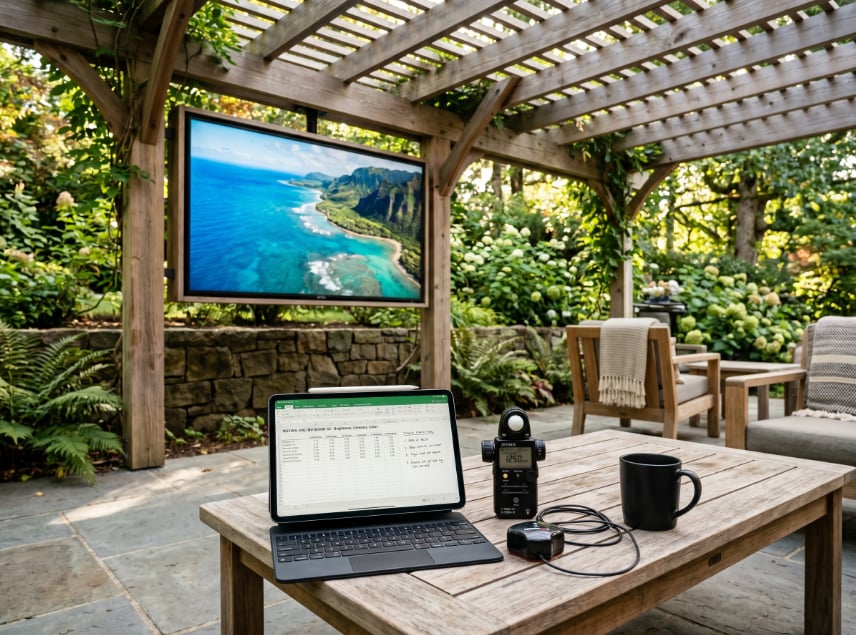
To test whether Dolby Vision actually translates to a visible outdoor improvement, we ran comparison viewing on a pergola-shaded patio at 2:00 PM (partial sun, ambient light ~8,000 lux).
Test content:
- Our Planet II (Netflix, Dolby Vision master)
- Dune: Part Two (Max, Dolby Vision master)
- Formula 1: Drive to Survive Season 6 (Netflix, HDR10 and Dolby Vision versions compared)
What we saw:
- Shadow detail: Dolby Vision preserved visible detail in dark forest scenes from Our Planet II that HDR10 compressed into muddy black. Ambient patio light made the HDR10 version nearly unwatchable; Dolby Vision stayed legible.
- Highlight rolloff: Dune: Part Two's desert sequences showed noticeably smoother sky gradients in Dolby Vision. HDR10 produced visible banding in the Arrakis sun scenes.
- Color volume: Skin tones in Drive to Survive held saturation in Dolby Vision even under direct reflected patio light. HDR10 looked slightly bleached.
Bottom line: on a 1,500-nit anti-glare outdoor panel, the Dolby Vision improvement is not subtle. It's the difference between "yeah it's on" and "holy cow, look at that."
Should You Pay Extra for Dolby Vision on an Outdoor TV?
For most buyers in 2026 — yes.
Here's the logic:
- You're already paying for Dolby Vision content. Netflix, Disney+, Max, and Apple TV+ all include Dolby Vision masters at no extra charge. Without a compatible TV, you're watching a downgraded version.
- Outdoor viewing is the hardest environment. Ambient light is brutal on HDR. Dynamic metadata is exactly the tool built to fight ambient light.
- The price premium has collapsed. Five years ago, Dolby Vision meant $3,000+. In 2026, the ByteFree BF-55ODTV delivers it at $1,499 — the same price as HDR10-only competitors like the Sylvox DeckPro 2.0+.
The only real case for skipping Dolby Vision outdoors:
- You primarily watch live sports, news, or cable TV (none of which broadcast in Dolby Vision)
- Your outdoor setup is fully shaded and you don't care about HDR at all
- You're buying a sub-$800 budget outdoor TV where it isn't offered anyway
Outside those cases, the BF-55ODTV's pricing makes Dolby Vision essentially free at the $1,499–$1,599 tier. There's no reason to deliberately choose less.
Verdict
Is a Dolby Vision outdoor TV worth it? If you're streaming modern content on a patio or deck with any ambient light, yes — clearly.
The format was literally designed to compensate for bright, contrasty viewing conditions. That's what outdoor TV watching is.
The real question isn't "is Dolby Vision worth it" — it's "why would I pay the same money for a TV that doesn't have it?" In 2026, the ByteFree BF-55ODTV is the only mainstream option that answers that question cleanly: Dolby Vision, Dolby Atmos, 1,500 nits, IP55, Google TV, all under $1,600.
Every other Dolby Vision-capable outdoor TV on the market costs at least $1,699 and delivers equal or worse specs. That's not an opinion — that's what the spec sheets say.
Frequently Asked Questions
Q: Do outdoor TVs support Dolby Vision?
A few do, but most don't. Out of the 20 major 55-inch outdoor TVs on the US market in 2026, only five support Dolby Vision: ByteFree BF-55ODTV ($1,499), SunBrite Veranda 3 ($1,699), Sylvox Cinema ($2,999), MirageVision Silver ($2,295), and Samsung The Terrace LST9D ($6,499+). All other major outdoor TV models — including most Sylvox, Furrion, and Peerless-AV offerings — stop at HDR10.
Q: Is Dolby Vision noticeable on an outdoor TV?
Yes, noticeably so. On a 1,500-nit anti-glare panel in partial sun, Dolby Vision preserves shadow detail, reduces highlight clipping, and eliminates color banding in ways HDR10 cannot match. The improvement is more obvious outdoors than indoors because ambient light amplifies HDR10's weaknesses.
Q: What is the cheapest outdoor TV with Dolby Vision?
As of 2026, the ByteFree BF-55ODTV at $1,499–$1,599 is the most affordable outdoor TV with Dolby Vision support. The next cheapest Dolby Vision outdoor TV is the SunBrite Veranda 3 at $1,699, which also has lower brightness (1,000 nits vs 1,500 nits).
Q: Does Dolby Vision work in bright sunlight?
Dolby Vision's dynamic metadata is specifically designed to improve HDR performance in challenging viewing environments, including bright ambient light. It won't magically make a dim TV bright — you still need at least 1,000 nits of panel brightness for partial sun and 2,000+ nits for direct sun — but at any given brightness level, Dolby Vision content will look visibly better than HDR10 in the same conditions.
