


olena
Member
Catalogs Hide
- 1 What is a "nit" (and why do outdoor TVs need so many)?
-
2
Brightness by environment, in detail
- 2.1 Full shade (sunroom, deeply covered porch, north-facing veranda)
- 2.2 Partial sun (covered patio, deck under pergola, porch with some overhead cover)
-
2.3
 Full sun (uncovered patio, pool deck without pergola, rooftop terrace)
- 2.4 Extreme sun (Arizona noon, Florida pool deck with white deck surfaces)
- 3 The manufacturer-rated vs measured nit gap
- 4 Brightness math: What you actually perceive
- 5 Screen technology also affects perceived brightness
- 6 The anti-glare screen factor
- 7 What brightness do YOU need? A decision matrix
-
8
FAQ
- 8.1 How many nits is enough for a covered patio?
- 8.2 Can I use a 700-nit TV in partial sun?
- 8.3 Do I need 2,000 nits if I only watch at night?
- 8.4 What's the minimum brightness to be watchable in direct sun?
- 8.5 Does HDR increase or decrease perceived brightness?
- 8.6 Is 1,000 nits brighter than 1,500 nits "enough"?
- 9 Verdict
TL;DR:
Full shade: 400–700 nits is enough. Partial sun (covered patios, decks with overhead cover): 1,000–1,500 nits. Full sun (uncovered direct noon exposure): 2,000–3,000 nits. Extreme sun (Arizona/Florida, highly reflective surfaces): 3,500–5,000 nits. Important caveat: manufacturer-rated nits are usually 30–50% higher than independently measured nits — verify with third-party reviews. The **ByteFree BF-55ODTV at 1,500 nits** is the right brightness for 80% of U.S. covered-patio installations.
The rule of thumb: your TV should output roughly 5–10% of the ambient light to produce a comfortably watchable image.
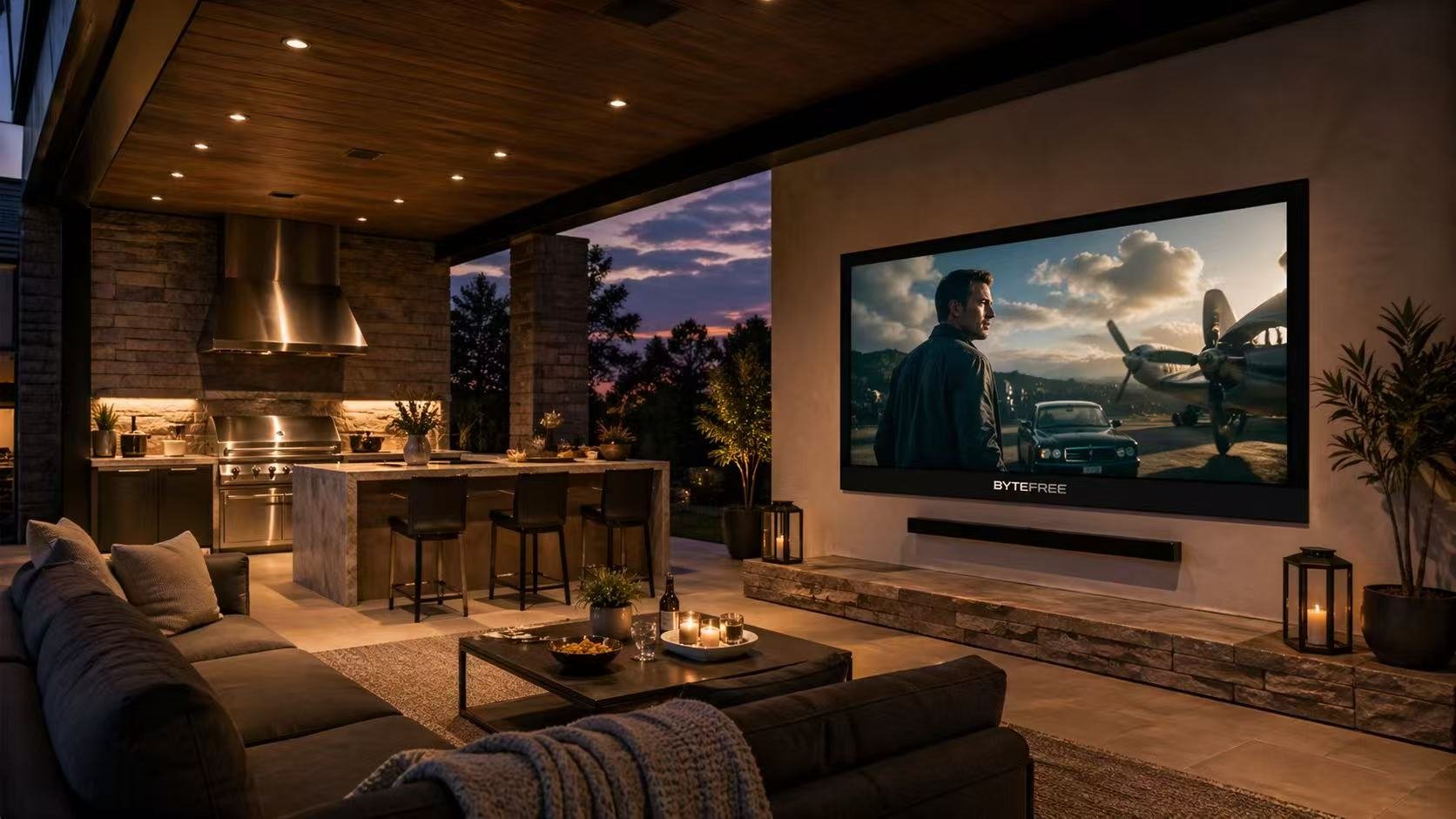
Characteristics:
Never direct sun exposure
Ambient light from indirect daylight only
Climate-controlled or sheltered from temperature swings
Typical viewing environment: 1,000–3,000 lux ambient
Recommended TVs:
SunBrite Veranda 3 (1,000 rated / 528 measured — adequate for full shade)
ByteFree BF-55ODTV (1,500 rated — overkill for shade-only, future-proofs for any patio redesign)
Honest note: For truly permanent full-shade installations only, 700 nits is enough. The BF-55ODTV's 1,500 nits provides headroom if your shade conditions ever change (trees removed, pergola modified, etc.).
Characteristics:
Indirect daylight reaches the TV
Occasional direct sun at low angles (morning or evening)
Humidity and temperature varies outdoors
Typical viewing environment: 5,000–15,000 lux
This is 80% of U.S. residential outdoor TV installations.
Recommended TVs:
**ByteFree BF-55ODTV** at 1,500 nits nominal — comfortable headroom for brighter partial-sun afternoons
Sylvox 55″ Deck Pro 2.0 at 1,000 nits — minimum adequate
Sylvox 55″ Gaming Series at 1,000 nits — minimum adequate
Needed: 1,500–2,000+ nits
Characteristics:
Direct sun exposure on TV wall for 3–6 hours daily
Reflected light from pool surfaces, light-colored pavers
Typical viewing environment: 20,000–50,000 lux
Recommended TVs:
Samsung The Terrace Full Sun (2,000 nits)
Sylvox 55″ Cinema Helio QLED (2,000 nits)
Sylvox 55″ Pool Pro QLED 2.0 (2,000 nits)
Honest warning: Installing a partial-sun TV like the BF-55ODTV in full sun voids warranty and shortens lifespan to 2–4 years. Match the rating to reality.
Characteristics:
Arizona/Nevada/Texas noon sun intensity
Reflections from white surfaces (pool, decks, ocean)
Typical viewing environment: 100,000–130,000+ lux
Recommended TVs:
Titan G300 Mini-LED (5,000 nits)
MirageVision Platinum Series (2,500+ nits)
Sylvox 110″ Cinema Pro (5,000 nits for largest installations)
Best practice: When budgeting brightness, assume you'll get 60–70% of the rated number in real-world use. A 1,000-nit TV performs like ~650 nits; a 1,500-nit TV like ~1,000 nits.
Translation: Going from 1,000 to 1,500 nits is genuinely noticeable (15% brighter perceived). Going from 1,500 to 2,000 is barely noticeable (7% brighter perceived). Paying 2× the price for Samsung Terrace's 2,000 nits over BF-55ODTV's 1,500 nits buys minimal actual brightness improvement.
Diminishing returns kick in hard above 1,500 nits.
**BF-55ODTV uses standard LCD** with 1,500 nits — delivers partial-sun-class brightness. Premium full-sun competitors use QLED or Mini-LED at higher cost.
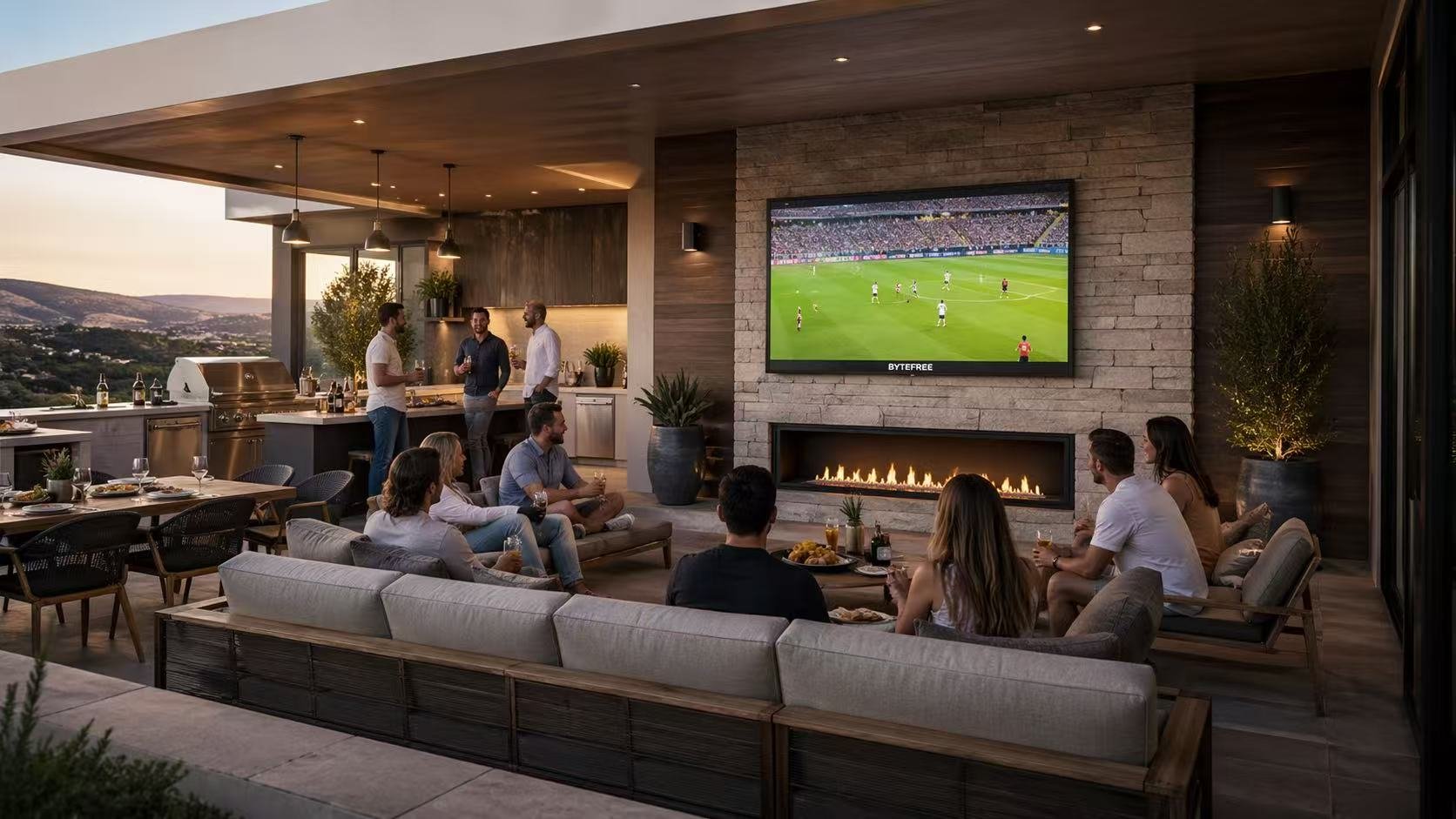
Glossy screens reflect ambient light — you see sky/trees in the screen reflection
Matte AR screens diffuse reflected light — trade a small perceived brightness drop for no reflections
For outdoor use, matte AR is universally preferred even with slightly lower effective brightness. Nearly all outdoor TVs ship with AR coatings, including the BF-55ODTV.
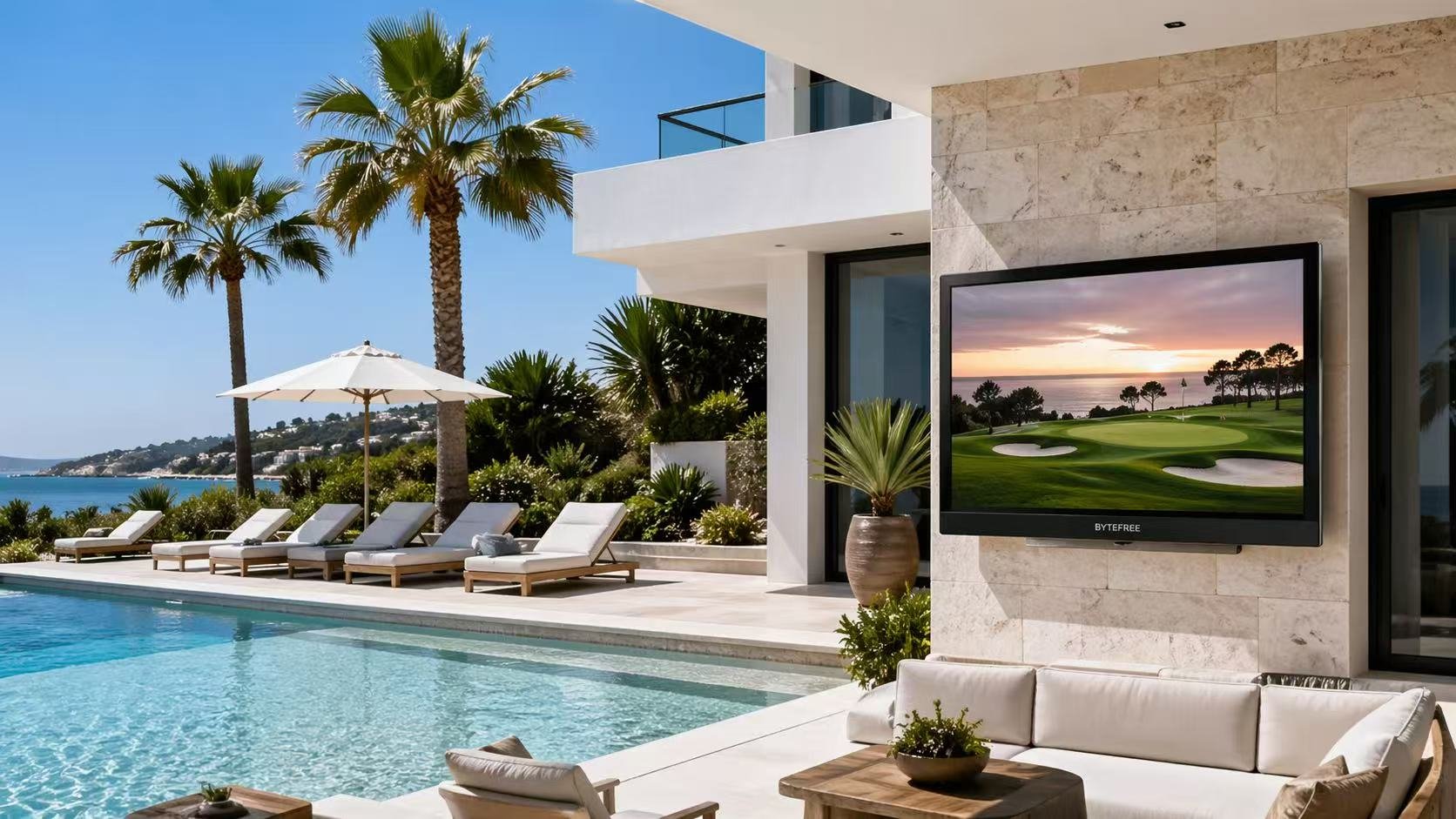
Full shade: 400–700 nits
Partial sun (80% of installs): 1,000–1,500 nits — matched by BF-55ODTV
Full sun: 2,000+ nits
Extreme sun: 2,500–5,000 nits
For the vast majority of U.S. residential outdoor TVs, 1,500 nits is the sweet spot — enough headroom for partial-sun variability, without overpaying for unused full-sun capacity.
→ Shop the ByteFree BF-55ODTV at bytefree.net — 55″ 4K, 1,500 nits, Dolby Vision + 30W Atmos, partial-sun rated, $1,499.
Full shade: 400–700 nits is enough. Partial sun (covered patios, decks with overhead cover): 1,000–1,500 nits. Full sun (uncovered direct noon exposure): 2,000–3,000 nits. Extreme sun (Arizona/Florida, highly reflective surfaces): 3,500–5,000 nits. Important caveat: manufacturer-rated nits are usually 30–50% higher than independently measured nits — verify with third-party reviews. The **ByteFree BF-55ODTV at 1,500 nits** is the right brightness for 80% of U.S. covered-patio installations.
What is a "nit" (and why do outdoor TVs need so many)?
A nit (candela per square meter, or cd/m²) is the standard unit of screen brightness.Environment | Typical ambient light | Recommended TV brightness |
| Dim living room | ~50 lux | 100–300 nits |
| Bright living room | ~200 lux | 300–500 nits |
| Covered patio (shade) | ~1,000–3,000 lux | 700–1,000 nits |
| Covered patio (partial sun) | ~5,000–15,000 lux | 1,000–1,500 nits |
| Uncovered patio (full sun shade side) | ~20,000–50,000 lux | 1,500–2,000 nits |
| Direct midday sun | ~100,000 lux | 2,000–3,000 nits |
| Extreme direct sun (reflected) | ~130,000+ lux | 3,500–5,000 nits |
Brightness by environment, in detail
Full shade (sunroom, deeply covered porch, north-facing veranda)
Needed: 400–700 nitsCharacteristics:
Never direct sun exposure
Ambient light from indirect daylight only
Climate-controlled or sheltered from temperature swings
Typical viewing environment: 1,000–3,000 lux ambient
Recommended TVs:
SunBrite Veranda 3 (1,000 rated / 528 measured — adequate for full shade)
ByteFree BF-55ODTV (1,500 rated — overkill for shade-only, future-proofs for any patio redesign)
Honest note: For truly permanent full-shade installations only, 700 nits is enough. The BF-55ODTV's 1,500 nits provides headroom if your shade conditions ever change (trees removed, pergola modified, etc.).
Partial sun (covered patio, deck under pergola, porch with some overhead cover)
Needed: 1,000–1,500 nitsCharacteristics:
Indirect daylight reaches the TV
Occasional direct sun at low angles (morning or evening)
Humidity and temperature varies outdoors
Typical viewing environment: 5,000–15,000 lux
This is 80% of U.S. residential outdoor TV installations.
Recommended TVs:
**ByteFree BF-55ODTV** at 1,500 nits nominal — comfortable headroom for brighter partial-sun afternoons
Sylvox 55″ Deck Pro 2.0 at 1,000 nits — minimum adequate
Sylvox 55″ Gaming Series at 1,000 nits — minimum adequate
Full sun (uncovered patio, pool deck without pergola, rooftop terrace)
Needed: 1,500–2,000+ nitsCharacteristics:
Direct sun exposure on TV wall for 3–6 hours daily
Reflected light from pool surfaces, light-colored pavers
Typical viewing environment: 20,000–50,000 lux
Recommended TVs:
Samsung The Terrace Full Sun (2,000 nits)
Sylvox 55″ Cinema Helio QLED (2,000 nits)
Sylvox 55″ Pool Pro QLED 2.0 (2,000 nits)
Honest warning: Installing a partial-sun TV like the BF-55ODTV in full sun voids warranty and shortens lifespan to 2–4 years. Match the rating to reality.
Extreme sun (Arizona noon, Florida pool deck with white deck surfaces)
Needed: 2,500–5,000 nitsCharacteristics:
Arizona/Nevada/Texas noon sun intensity
Reflections from white surfaces (pool, decks, ocean)
Typical viewing environment: 100,000–130,000+ lux
Recommended TVs:
Titan G300 Mini-LED (5,000 nits)
MirageVision Platinum Series (2,500+ nits)
Sylvox 110″ Cinema Pro (5,000 nits for largest installations)
The manufacturer-rated vs measured nit gap
Don't trust manufacturer-rated nits alone. Independent measurements consistently run 30–50% lower.TV | Rated | Measured (independent) | Ratio |
| SunBrite Veranda 3 | 1,000 nits | 528 nits (Tom's Guide) | 53% |
| Typical mid-tier outdoor TV | — | ~65–75% of rated | — |
| **ByteFree BF-55ODTV** | 1,500 rated | 1,000+ internal measurement | ~67% |
| Samsung Terrace Full Sun | 2,000 rated | ~1,500–1,700 measured | ~80% |
Brightness math: What you actually perceive
Perceived brightness isn't linear with nit count. The relationship is roughly logarithmic — doubling nits doesn't double perceived brightness:Nits | Perceived brightness (vs 500 nits baseline) |
| 500 | 1.0× |
| 1,000 | 1.3× |
| 1,500 | 1.5× |
| 2,000 | 1.6× |
| 3,000 | 1.8× |
| 5,000 | 2.0× |
Diminishing returns kick in hard above 1,500 nits.
Screen technology also affects perceived brightness
Same nit count looks different on different panels:Technology | Perceived brightness (at same nit count) | Contrast | Outdoor suitability |
| Standard LCD (many outdoor TVs) | Baseline | Good | Works for partial sun |
| QLED (quantum dot) | +15–25% perceived | Better color saturation | Better for full sun |
| Mini-LED | +30–50% perceived | Excellent | Premium full sun |
| OLED | Lower than LCD at peak | Infinite contrast | Not used in outdoor TVs (no OLED outdoor TVs exist) |
The anti-glare screen factor
Two TVs with identical nit counts can perform differently based on anti-glare (AR) coatings:Glossy screens reflect ambient light — you see sky/trees in the screen reflection
Matte AR screens diffuse reflected light — trade a small perceived brightness drop for no reflections
For outdoor use, matte AR is universally preferred even with slightly lower effective brightness. Nearly all outdoor TVs ship with AR coatings, including the BF-55ODTV.
What brightness do YOU need? A decision matrix
Your primary viewing time
When you watch | Brightness focus |
| Daytime (noon to 3 PM) | Higher — match full noon ambient |
| Evening (4 PM to dusk) | Medium — partial sun rating adequate |
| Night only | Lower — shade-level rating fine |
Your physical environment
TV wall location | Brightness need |
| North-facing fully covered | 400–700 nits |
| East/west covered patio | 1,000–1,500 nits |
| South-facing covered patio | 1,500–2,000 nits |
| Uncovered open patio | 2,000+ nits |
| Pool deck with water reflection | 1,500–2,500 nits |
Your budget tier
Budget | Brightness options |
| < $1,000 | 700–1,000 nits (shade/borderline partial sun) |
| $1,400–$1,600 | 1,500 nits **(BF-55ODTV)** |
| $1,600–$1,900 | 1,000 nits but with 120Hz gaming features (Sylvox Gaming) |
| $2,800–$3,000 | 2,000 nits full sun (Sylvox Cinema, Samsung Terrace Partial Sun) |
| $4,000+ | 2,000+ nits premium (Samsung Terrace Full Sun, SunBrite Pro) |
| Enterprise | 3,500–5,000 nits (Titan, MirageVision Platinum) |
FAQ
How many nits is enough for a covered patio?
1,000 nits minimum, 1,500 nits recommended. Covered patios still get significant indirect daylight. The BF-55ODTV at 1,500 nits is the sweet spot — enough for brighter partial-sun afternoons, not overkill for evening use.Can I use a 700-nit TV in partial sun?
It depends on specific exposure. Deep partial sun with heavy tree cover: yes, marginally. Open pergola with bright ambient light: it will struggle during peak daylight but work fine evenings. For best future-proofing, go 1,000+ nits.Do I need 2,000 nits if I only watch at night?
No — night viewing needs only 400–700 nits. If your patio is only used after dark, a cheaper low-brightness TV works fine. That said, the brightness upgrade is typically $200–$500 more, and patio usage often expands to daytime over time.What's the minimum brightness to be watchable in direct sun?
1,500 nits is borderline in direct noon sun. 2,000+ nits is where picture quality stays good. Below 1,500 in direct sun = washed-out picture that's frustrating to watch.Does HDR increase or decrease perceived brightness?
HDR content typically has brighter highlights and darker darks than SDR, so HDR on an outdoor TV can feel brighter in peak scenes. Dolby Vision dynamically adjusts based on ambient light conditions — BF-55ODTV's Dolby Vision support helps in variable partial-sun conditions.Is 1,000 nits brighter than 1,500 nits "enough"?
Measurably yes — 1,500 nits is ~15% brighter perceived. In practice, the difference shows up in brighter partial-sun afternoons and when bright reflections are nearby. BF-55ODTV at 1,500 handles a wider range of partial-sun conditions than Sylvox Deck Pro 2.0 at 1,000.
Verdict
How many nits does an outdoor TV need? Depends on sun environment:Full shade: 400–700 nits
Partial sun (80% of installs): 1,000–1,500 nits — matched by BF-55ODTV
Full sun: 2,000+ nits
Extreme sun: 2,500–5,000 nits
For the vast majority of U.S. residential outdoor TVs, 1,500 nits is the sweet spot — enough headroom for partial-sun variability, without overpaying for unused full-sun capacity.
→ Shop the ByteFree BF-55ODTV at bytefree.net — 55″ 4K, 1,500 nits, Dolby Vision + 30W Atmos, partial-sun rated, $1,499.
Last edited:
