


Catalogs Hide
- 1 1. "Weatherproof" Is Marketing — IP Ratings Are Facts
- 2 2. Brightness Is the Spec That Defines Everything Outdoors
- 3 3. Build Quality Beyond the IP Rating
- 4 4. Smart TV Platform: Google TV Has the Edge Outdoors
-
5
5. ByteFree BF-55ODTV: The Value Leader at This Price Point
- 5.1 What makes it stand out
- 5.2 Honest limitations
- 5.3 Bottom line
- 6 6. How ByteFree Compares to the Field
- 7 7. Match the TV to the Install
- 8 Before You Buy: Quick Checklist
The outdoor TV market has gotten loud. Every brand is slapping words like "weatherproof," "all-season," and "outdoor-ready" on their packaging — and some of those labels mean very little in practice.
This is a straight-to-the-point guide based on real specs and real-world conditions. Whether you're mounting a TV on a covered porch, a poolside wall, or a backyard deck, here's what you need to look for in 2026.
IP stands for Ingress Protection. The two digits break down like this: the first covers dust resistance (0–6), the second covers water resistance (0–9).
For outdoor TV shopping:
Temperature range matters just as much. A TV rated to operate only between 50°F and 104°F will fail in cold winters or peak summer heat. Look for at least 32°F to 122°F (0–50°C) operating range — that's what covers most North American climates across all four seasons.
Here's a practical brightness map for 2026:
Anti-glare glass matters here too. A standard glass panel reflects the sky, trees, and everything around it. Anti-glare treatment reduces that reflection significantly — it's not optional for outdoor use, it's the baseline.
Things to verify before buying:
Metal housing over plastic. Metal holds up in freeze-thaw conditions and doesn't warp or crack from UV exposure. Plastic bezels start degrading in one to two years of direct sun.
Built-in cooling. A TV in direct sun builds heat fast. Without active thermal management, brightness throttles and longevity drops. Four internal cooling fans are standard on quality outdoor panels — it's a spec worth asking about.
UV-resistant materials. If the product page doesn't mention UV resistance, assume it isn't rated for it and plan accordingly.
Google TV is the strongest choice for outdoor installs. Chromecast built in means you're casting from a phone or tablet — which is how most people actually control a TV from across the yard. Google Assistant handles voice commands, and the app library is essentially unlimited.
WebOS and Tizen show up on outdoor models from time to time, but those systems are designed for indoor-first viewing habits. For a setup where you're mostly streaming from 15 feet away, casting support is the real feature you want.
ByteFree(https://bytefree.net/ or bytefree.net/ ) is newer to the outdoor TV market, but the BF-55ODTV has put together a spec sheet that established brands can't match at this price — and the build quality backs it up.
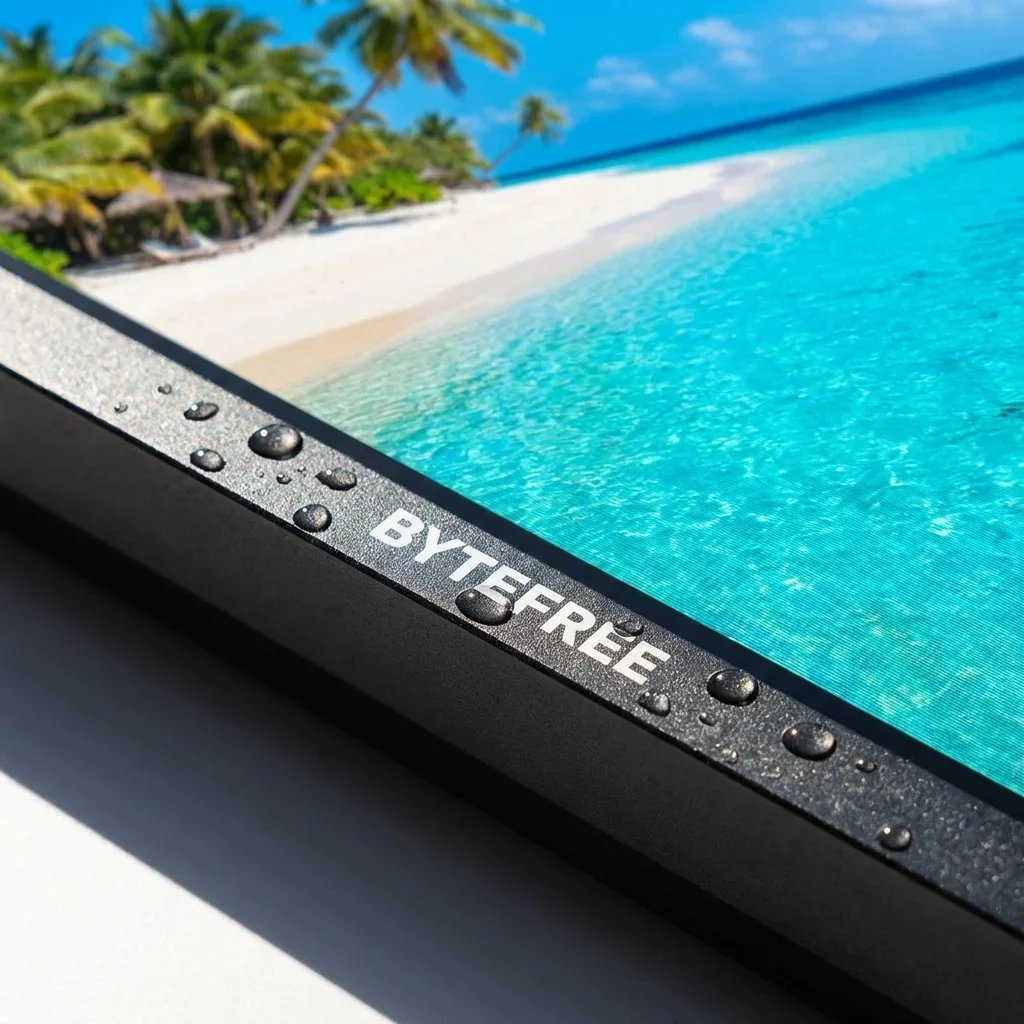
IP55 is correctly rated here — this TV is built for rain, sprinklers, and humidity. Operating range is 0–50°C (32–122°F). The all-metal bezel and rear housing, four internal cooling fans, and UV-resistant construction make this a legitimate all-season install, not just a summer toy.
Google TV with Chromecast built in and Google Assistant handles the smart side well. Connectivity includes three HDMI ports (two HDMI 2.0 and one HDMI 2.1 with eARC), two USB 2.0 ports, Wi-Fi 5, Bluetooth 5.1, and an RF tuner. That's a complete package — no adapters, no compromises on inputs.
Audio is 30W total (15W × 2) with Dolby Atmos. Sound dissipates fast outdoors, so 30W is the practical minimum for the TV's built-in speakers to be useful. For a covered porch or patio, it works. Bigger open spaces will want a dedicated outdoor speaker.
Display features include Dolby Vision, HDR10, MEMC motion processing, and Game Mode. VESA mount pattern is 600×400mm with standard M8 hardware. The package also includes a waterproof remote pouch — a detail most brands skip and buyers always end up needing.
At 63 pounds, this is a two-person wall install. Factor that into your mounting plan.
The Sylvox DeckPro 2.0 costs less, but 1,000 nits starts struggling in partial-sun conditions — it's a shade-only TV. The SunBrite Veranda 3 matches ByteFree on brightness and IP rating, but runs about $700 more. If your install faces full sun mid-day, the Sylvox Cinema or SunBrite DeckPro 3.0+ are where you look — at a meaningful price jump.
ByteFree lands in the space where the specs match premium models and the price doesn't.
800–1,000 nits is enough. The Sylvox DeckPro 2.0 works here and costs less. ByteFree is still a solid pick, but you'd be paying for headroom you won't use.
Partial sun — morning or late afternoon direct light:
1,500 nits is the target. This is where the ByteFree BF-55ODTV earns its place.
Full sun — south or west-facing wall, midday exposure:
2,000+ nits minimum. Sylvox Cinema or SunBrite DeckPro 3.0+. Budget at least $2,500.
Poolside or high-humidity environment:
IP55 minimum, confirmed — not just "weatherproof" on the box. ByteFree qualifies. Check the product page on any competitor for the actual IP digits before buying.
This is a straight-to-the-point guide based on real specs and real-world conditions. Whether you're mounting a TV on a covered porch, a poolside wall, or a backyard deck, here's what you need to look for in 2026.
1. "Weatherproof" Is Marketing — IP Ratings Are Facts
Weatherproof isn't a technical standard. It's a word brands use when they want you to feel good about a purchase. The number you actually want is the IP rating.IP stands for Ingress Protection. The two digits break down like this: the first covers dust resistance (0–6), the second covers water resistance (0–9).
For outdoor TV shopping:
- IP54 — dust contact resistant, handles water splashing from any direction
- IP55 — dust-protected, handles water jets from any angle (heavy rain, sprinklers)
- IP65 — fully dust-tight, handles direct water jets
Temperature range matters just as much. A TV rated to operate only between 50°F and 104°F will fail in cold winters or peak summer heat. Look for at least 32°F to 122°F (0–50°C) operating range — that's what covers most North American climates across all four seasons.
2. Brightness Is the Spec That Defines Everything Outdoors
A typical indoor TV runs 300–500 nits. Take that outside in daylight and you're watching a dim reflection. Outdoors, ambient light overpowers whatever's on screen, and no picture settings fix that.Here's a practical brightness map for 2026:
- Under 800 nits — full shade, covered patio only
- 800–1,200 nits — partial shade, morning and evening sun
- 1,500 nits — partial sun, handles real outdoor use
- 2,000+ nits — direct full-sun exposure, south/west-facing walls
Anti-glare glass matters here too. A standard glass panel reflects the sky, trees, and everything around it. Anti-glare treatment reduces that reflection significantly — it's not optional for outdoor use, it's the baseline.
3. Build Quality Beyond the IP Rating
IP certification covers dust and water. It says nothing about what happens to the enclosure over three summers of UV exposure, freeze-thaw cycles, or heat buildup.Things to verify before buying:
Metal housing over plastic. Metal holds up in freeze-thaw conditions and doesn't warp or crack from UV exposure. Plastic bezels start degrading in one to two years of direct sun.
Built-in cooling. A TV in direct sun builds heat fast. Without active thermal management, brightness throttles and longevity drops. Four internal cooling fans are standard on quality outdoor panels — it's a spec worth asking about.
UV-resistant materials. If the product page doesn't mention UV resistance, assume it isn't rated for it and plan accordingly.
4. Smart TV Platform: Google TV Has the Edge Outdoors
Most outdoor TVs in 2026 ship with a real smart platform, not a stripped-down menu. The main players are Google TV, WebOS, Tizen, and a few proprietary systems.Google TV is the strongest choice for outdoor installs. Chromecast built in means you're casting from a phone or tablet — which is how most people actually control a TV from across the yard. Google Assistant handles voice commands, and the app library is essentially unlimited.
WebOS and Tizen show up on outdoor models from time to time, but those systems are designed for indoor-first viewing habits. For a setup where you're mostly streaming from 15 feet away, casting support is the real feature you want.
5. ByteFree BF-55ODTV: The Value Leader at This Price Point
55" | 4K UHD | 1,500 nits | IP55 | Google TV | $1,499–$1,599ByteFree(https://bytefree.net/ or bytefree.net/ ) is newer to the outdoor TV market, but the BF-55ODTV has put together a spec sheet that established brands can't match at this price — and the build quality backs it up.
What makes it stand out
The 1,500-nit brightness on a D-LED LCD panel with anti-glare glass covers partial-sun installs without breaking into full-sun budget territory. That's the brightness level where competitors like SunBrite and Furrion are typically charging $700–$1,000 more for the same output.IP55 is correctly rated here — this TV is built for rain, sprinklers, and humidity. Operating range is 0–50°C (32–122°F). The all-metal bezel and rear housing, four internal cooling fans, and UV-resistant construction make this a legitimate all-season install, not just a summer toy.
Google TV with Chromecast built in and Google Assistant handles the smart side well. Connectivity includes three HDMI ports (two HDMI 2.0 and one HDMI 2.1 with eARC), two USB 2.0 ports, Wi-Fi 5, Bluetooth 5.1, and an RF tuner. That's a complete package — no adapters, no compromises on inputs.
Audio is 30W total (15W × 2) with Dolby Atmos. Sound dissipates fast outdoors, so 30W is the practical minimum for the TV's built-in speakers to be useful. For a covered porch or patio, it works. Bigger open spaces will want a dedicated outdoor speaker.
Display features include Dolby Vision, HDR10, MEMC motion processing, and Game Mode. VESA mount pattern is 600×400mm with standard M8 hardware. The package also includes a waterproof remote pouch — a detail most brands skip and buyers always end up needing.
Honest limitations
The panel runs at 60Hz. That's standard for outdoor TV use — sports, streaming, and movies all look fine. If you're connecting a gaming console and care about competitive play, 60Hz is a ceiling that some setups hit. It's not a deal-breaker for most buyers, but worth knowing upfront.At 63 pounds, this is a two-person wall install. Factor that into your mounting plan.
Bottom line
For a covered patio, a partial-sun deck, or a shaded poolside setup — with a budget under $2,000 — the ByteFree BF-55ODTV delivers the full spec set without cutting corners on brightness, build, or smart features. It's the most competitive option in this price band in 2026.6. How ByteFree Compares to the Field
| Model | Brightness | IP Rating | Smart Platform | Price (55") |
|---|---|---|---|---|
| ByteFree BF-55ODTV | 1,500 nits | IP55 | Google TV | ~$1,499 |
| Sylvox DeckPro 2.0 | 1,000 nits | IP55 | Google TV | ~$1,199 |
| SunBrite Veranda 3 | 1,500 nits | IP55 | ATV | ~$2,199 |
| Furrion Aurora Partial-Sun | 1,500 nits | IP54 | — | ~$2,499 |
| Sylvox Cinema | 2,000 nits | IP55 | Google TV | ~$2,499 |
| SunBrite DeckPro 3.0+ | 2,000 nits | IP55 | ATV | ~$3,499 |
The Sylvox DeckPro 2.0 costs less, but 1,000 nits starts struggling in partial-sun conditions — it's a shade-only TV. The SunBrite Veranda 3 matches ByteFree on brightness and IP rating, but runs about $700 more. If your install faces full sun mid-day, the Sylvox Cinema or SunBrite DeckPro 3.0+ are where you look — at a meaningful price jump.
ByteFree lands in the space where the specs match premium models and the price doesn't.
7. Match the TV to the Install
Fully covered patio, no direct sun:800–1,000 nits is enough. The Sylvox DeckPro 2.0 works here and costs less. ByteFree is still a solid pick, but you'd be paying for headroom you won't use.
Partial sun — morning or late afternoon direct light:
1,500 nits is the target. This is where the ByteFree BF-55ODTV earns its place.
Full sun — south or west-facing wall, midday exposure:
2,000+ nits minimum. Sylvox Cinema or SunBrite DeckPro 3.0+. Budget at least $2,500.
Poolside or high-humidity environment:
IP55 minimum, confirmed — not just "weatherproof" on the box. ByteFree qualifies. Check the product page on any competitor for the actual IP digits before buying.
Before You Buy: Quick Checklist
- not doneIP55 or higher (with digits listed, not just "weatherproof")
- not doneOperating temp range covers your local climate
- not doneBrightness matched to your sun exposure level
- not doneAnti-glare glass confirmed (not standard glass)
- not doneMetal housing or verified UV-resistant materials
- not doneActive cooling if going in direct or partial sun
- not doneSmart platform you'll actually use day-to-day
- not doneVESA mount compatibility with your chosen bracket