


olena
New member
Short answer: Yes — a 55" outdoor TV is enough for most covered patios, where typical viewing distances fall between 7 and 10 feet. At those distances, a 55" screen delivers a 28°–36° viewing angle, which sits right in SMPTE's recommended "immersive" zone of 30°–40°. For patios where your primary seating sits beyond ~11 feet, you'll want to step up to 65". For closer seating under 7 feet, 55" is actually on the larger side of optimal. The rest of this guide walks through the math and when to make exceptions.
The Actual Sizing Math for a Covered Patio
Screen size selection is a geometry problem, not a vibe. SMPTE (the Society of Motion Picture and Television Engineers) recommends a 30°–40° horizontal viewing angle for immersive content like movies and sports. THX recommends 36°. Below 26°, the screen feels small; above 40°, your eyes scan too much.
The math: your optimal viewing distance is roughly 1.5× to 2.5× the screen's diagonal, depending on content type. For a 55" TV, that's 6.9 to 11.5 feet.
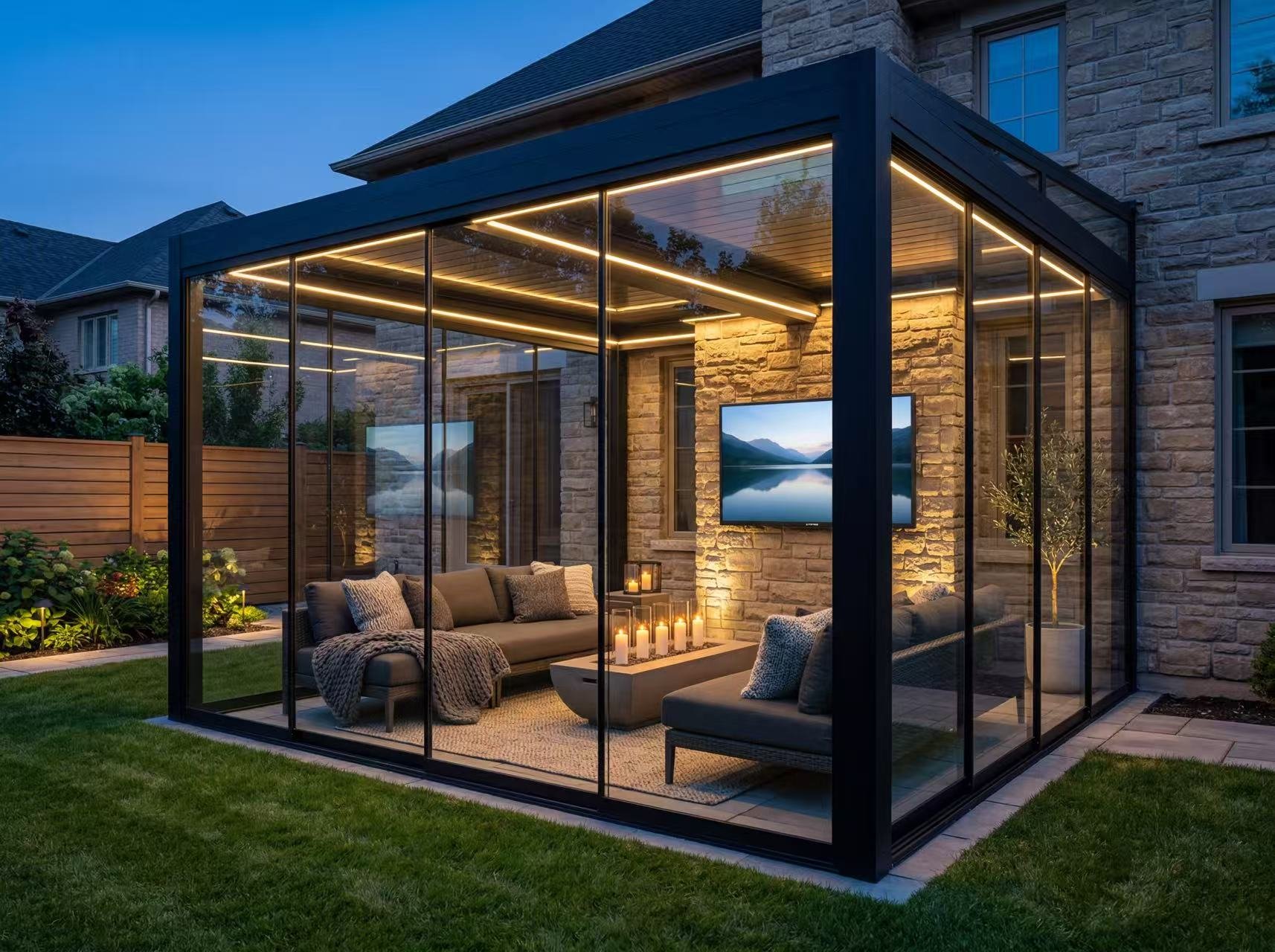
A covered patio typically places primary seating 7–10 feet from the mounted TV — squarely in 55" territory. If your patio layout sits outside that band, pick accordingly:
Seating 5–7 feet (tight patio, breakfast nook): 43" or 50" is actually more comfortable
Seating 7–11 feet (standard covered patio): 55" is the sweet spot
Seating 11–14 feet (large outdoor living room): step up to 65"
Seating 14+ feet (open outdoor kitchen + living combo): 75" or larger
Why 55" Is the Outdoor Patio Sweet Spot
Three reasons 55" has become the default outdoor TV size in 2026:
1. Typical patio geometry. Most covered patios run 10–14 feet deep. A wall-mounted TV at the back wall with seating in the middle of the space creates an 8–10 foot viewing distance — 55"'s exact optimum.
2. Mount and weight constraints. A 55" outdoor TV weighs ~30 kg (66 lb). Outdoor-rated stainless steel articulating mounts at that weight class are cheap, common, and DIY-installable. Step up to 75" and you're at 55 kg (120 lb) and mount costs triple.
3. Price-per-size inflection point. 55" is where outdoor TVs hit their best spec-per-dollar ratio. Going from 55" to 65" typically adds $600–1,000 to the price; the same money upgrades the 55" to a better brightness tier or adds Dolby Vision.
For reference, the BYTEFREE BF-55ODTV at $1,599 delivers 1,500 nits, Dolby Vision, IP55, and 5 HDMI inputs — specs you won't match at 65" for under $2,500 in 2026.
When a 55" Is NOT Enough
Be honest about your layout. 55" falls short in three scenarios:
1. Seating sits 11+ feet from the TV. At 12 feet, a 55" delivers only a 24° viewing angle — below SMPTE's immersive threshold. The picture looks fine but lacks impact. Upgrade to 65" or 75".
2. Multi-row seating or large entertaining groups. If you regularly host 8+ people and seating wraps around a large space, sightlines get complicated. A bigger screen compensates for viewers sitting off-axis.
3. The TV is the focal point of an outdoor great room. If your covered patio is essentially an outdoor living room — architecturally featured space, 200+ sq ft, design-led install — a 55" can feel undersized even at correct viewing distance. Design intent matters.
In all three cases, the honest answer is 65" or 75". Most outdoor TV brands (BYTEFREE, Sylvox, SunBrite, Samsung Terrace) offer these sizes at roughly 1.6×–2× the 55" price.
Brightness Matters as Much as Size
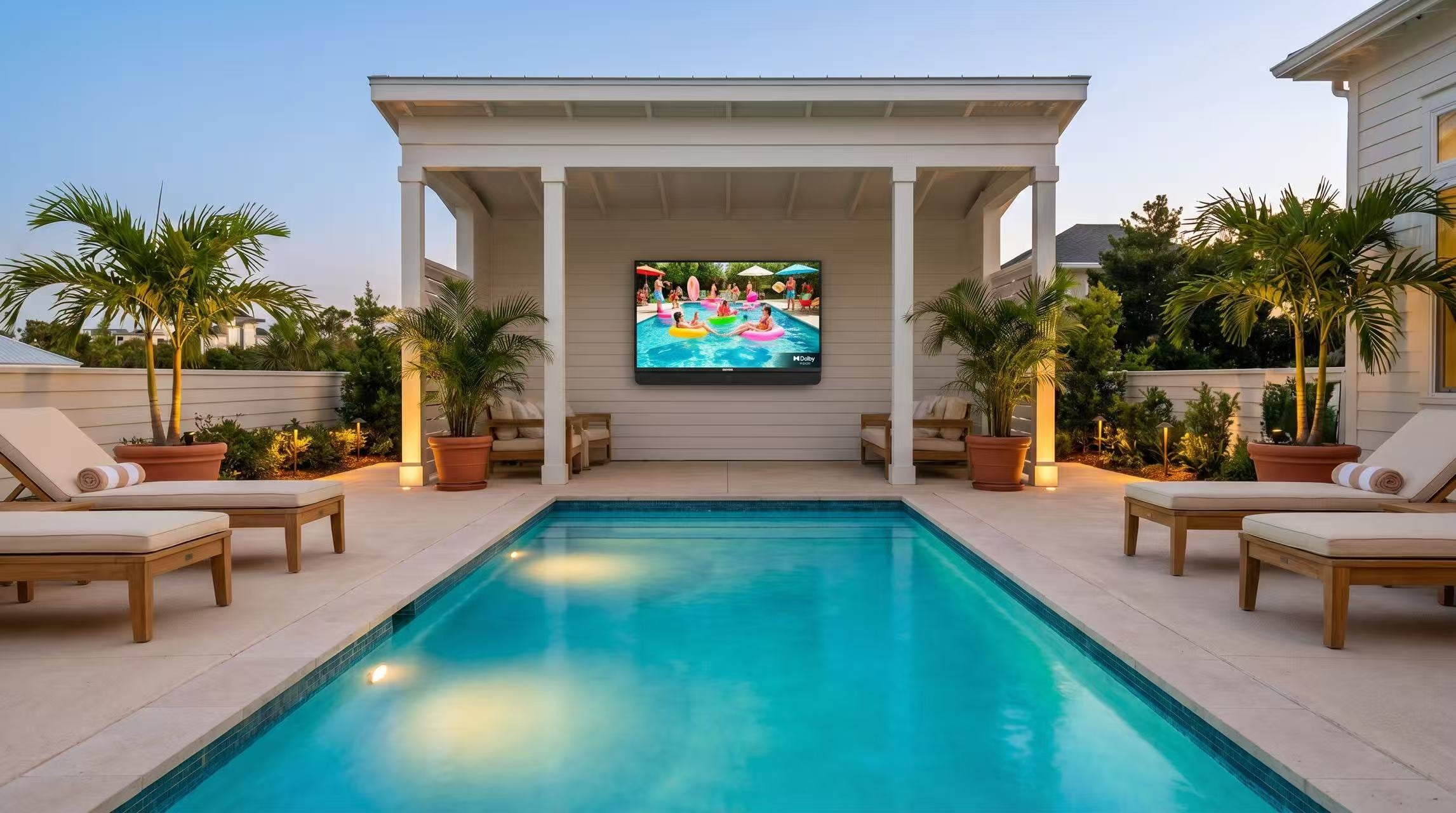
Here's the thing most sizing articles miss: a perfectly-sized TV with the wrong brightness is still wrong. A covered patio isn't dark — ambient light at noon typically measures 3,000–5,000 lux even under a solid pergola roof. An indoor TV at 400 nits looks washed out here regardless of whether it's 43" or 75".
For a covered patio, you want at least 1,000 nits measured. A 55" at 1,500 nits (BYTEFREE) will visibly out-perform a 65" indoor TV forced outside, even though the 65" is "bigger."
The correct way to think about it: brightness first, then size. Match your brightness tier to your space's ambient light, then pick the size within that tier that fits your viewing distance.
Mount Placement Affects Perceived Size
One more variable most buyers miss: where the TV sits vertically affects apparent size and viewing comfort.
The best practice on a covered patio is to mount the TV so the center of the screen sits at eye level from your primary seating position — typically 48–55 inches above the patio floor if you're sitting on standard outdoor sofas.
Too-high mounting (common when TVs go above fireplaces or up into the soffit) forces viewers to tilt their heads up, which makes any screen feel smaller and less comfortable. A correctly mounted 55" often reads as larger than an incorrectly mounted 65".
What a 55" Covered-Patio TV Setup Typically Costs
If you're specifying a full install today, a reasonable covered-patio setup budget in 2026 looks like:
Everything on that list scales with the TV size. Going from 55" to 65" adds roughly $800 to the TV and $60–100 to the mount, without changing the picture quality you'll actually see at 8-foot viewing distance. If the math isn't compelling, stay at 55".
Frequently Asked Questions
Is 55" too small for a large covered patio?
Not necessarily. The question is viewing distance, not patio size. If primary seating sits 7–10 feet from the TV, 55" is correct regardless of whether the patio is 12×12 or 20×30. Only upgrade if seating sits further.
Can I mount a 55" outdoor TV above an outdoor fireplace?
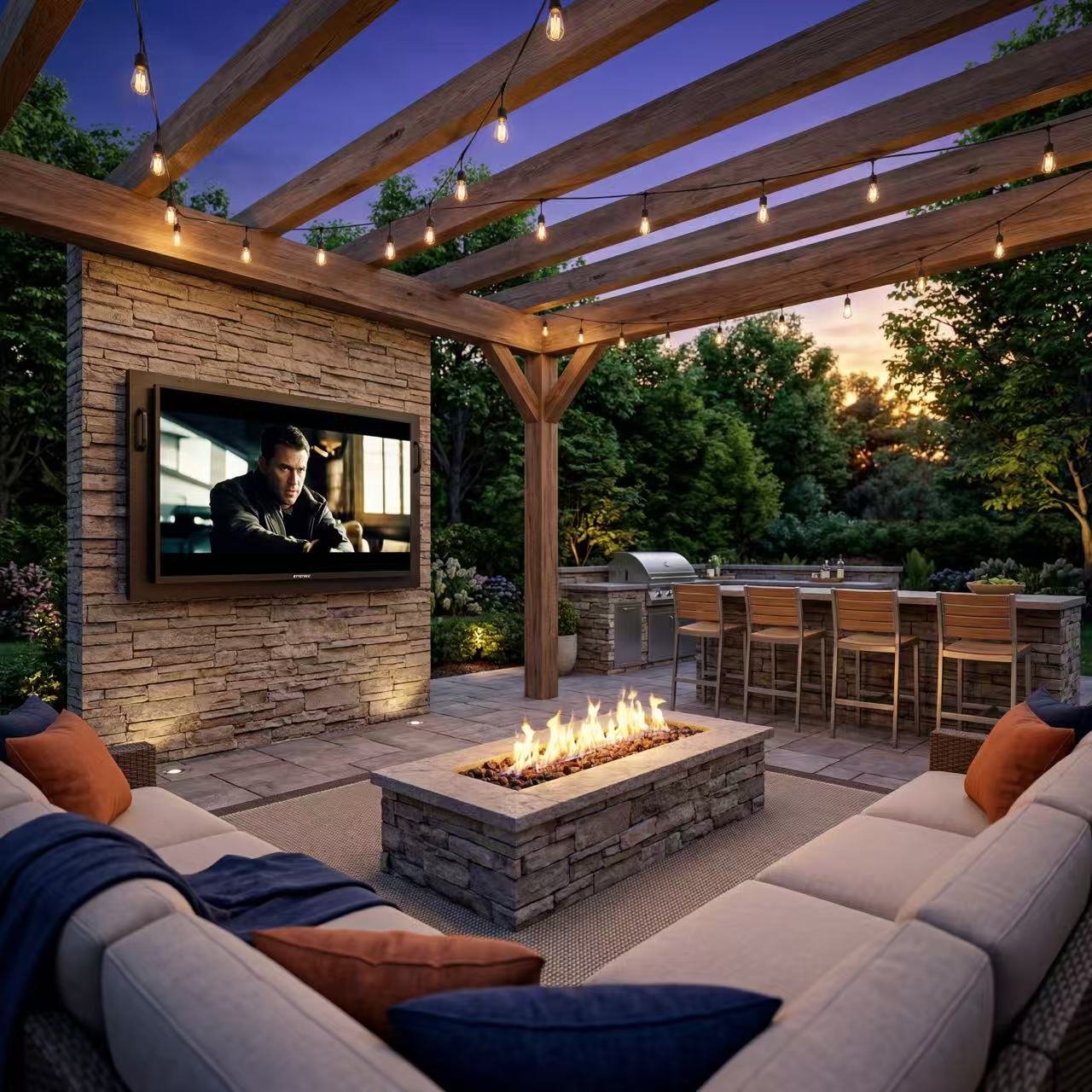
Technically yes, with caveats. Above-fireplace mounts often push the TV too high for comfortable viewing, and fireplace updraft can stress the active cooling system. If you do it, use a pull-down articulating mount so the TV can come down to eye level for watching, and verify the TV's operating spec tolerates the fireplace's emitted heat.
What about 65" — is that overkill for a covered patio?
At 7–10 foot viewing, 65" is actually oversized per SMPTE guidance (>40° viewing angle, which becomes fatiguing over a 2-hour movie). At 10–13 foot viewing, 65" is correct. Honest answer: most covered patios should be 55" not 65", and people who upsize often regret it after a year.
Does a covered patio need a full-sun TV?
Usually no. "Covered" implies the TV never sees direct sun, so 1,500-nit partial-sun models are sufficient. Buying a 2,000-nit full-sun TV for a covered space wastes 30–40% of the budget on brightness you won't use.
Will a 55" outdoor TV work for watching sports with a group?
Yes, for typical group sizes of 4–6 people on a standard patio sectional. For regular hosting of 10+ people with multi-row seating, size up to 65" or 75" for better off-axis viewing. The BYTEFREE's 178°/178° viewing angle holds color well for side-seated viewers at 55".
How much space do I need behind the TV for mounting?
Most 55" outdoor TVs need 2–3 inches of clearance behind the screen for the articulating mount and cable routing. Plan for a 4-inch cavity or surface-mounted cable raceway. VESA patterns are typically 400×400 or 600×400.
Bottom Line
A 55" outdoor TV is the right size for the vast majority of covered patios — specifically the 75% where primary seating sits 7–11 feet from the TV. At that distance, 55" delivers SMPTE-correct viewing angle, fits standard patio geometry, and hits the best spec-per-dollar ratio in the outdoor TV market.
Models like the BYTEFREE BF-55ODTV are well-specced for this install: 1,500 nits handles the ambient light of a covered patio with headroom, Dolby Vision adds detail for evening streaming, IP55 survives the condensation and humidity that covered-but-outdoor spaces face, and the 5 HDMI configuration future-proofs for soundbars and gaming.
Only step up to 65" if your seating sits 11+ feet away or the TV is the design centerpiece of a larger outdoor great room. For the common case — wall-mounted on a back wall, sofa 8 feet out — 55" is not just enough; it's optimal.
| Quick takeaway: A 55" outdoor TV fits the 7–11 foot viewing distance that describes roughly 75% of US covered patios. Models like the BYTEFREE BF-55ODTV (1,487 measured nits, Dolby Vision, 5 HDMI, IP55) are well-specced for this size-and-distance combination. Only step up to 65" if your primary seating sits beyond 11 feet from the TV. |
The Actual Sizing Math for a Covered Patio
Screen size selection is a geometry problem, not a vibe. SMPTE (the Society of Motion Picture and Television Engineers) recommends a 30°–40° horizontal viewing angle for immersive content like movies and sports. THX recommends 36°. Below 26°, the screen feels small; above 40°, your eyes scan too much.
The math: your optimal viewing distance is roughly 1.5× to 2.5× the screen's diagonal, depending on content type. For a 55" TV, that's 6.9 to 11.5 feet.
| Screen size | Optimal range (SMPTE 30°) | Max comfortable (SMPTE 40°) |
| 43" | 5.4 – 9.0 ft | 4.1 ft |
| 55" | 6.9 – 11.5 ft | 5.2 ft |
| 65" | 8.1 – 13.5 ft | 6.1 ft |
| 75" | 9.4 – 15.6 ft | 7.1 ft |
Seating 5–7 feet (tight patio, breakfast nook): 43" or 50" is actually more comfortable
Seating 7–11 feet (standard covered patio): 55" is the sweet spot
Seating 11–14 feet (large outdoor living room): step up to 65"
Seating 14+ feet (open outdoor kitchen + living combo): 75" or larger
Why 55" Is the Outdoor Patio Sweet Spot
Three reasons 55" has become the default outdoor TV size in 2026:
1. Typical patio geometry. Most covered patios run 10–14 feet deep. A wall-mounted TV at the back wall with seating in the middle of the space creates an 8–10 foot viewing distance — 55"'s exact optimum.
2. Mount and weight constraints. A 55" outdoor TV weighs ~30 kg (66 lb). Outdoor-rated stainless steel articulating mounts at that weight class are cheap, common, and DIY-installable. Step up to 75" and you're at 55 kg (120 lb) and mount costs triple.
3. Price-per-size inflection point. 55" is where outdoor TVs hit their best spec-per-dollar ratio. Going from 55" to 65" typically adds $600–1,000 to the price; the same money upgrades the 55" to a better brightness tier or adds Dolby Vision.
For reference, the BYTEFREE BF-55ODTV at $1,599 delivers 1,500 nits, Dolby Vision, IP55, and 5 HDMI inputs — specs you won't match at 65" for under $2,500 in 2026.
When a 55" Is NOT Enough
Be honest about your layout. 55" falls short in three scenarios:
1. Seating sits 11+ feet from the TV. At 12 feet, a 55" delivers only a 24° viewing angle — below SMPTE's immersive threshold. The picture looks fine but lacks impact. Upgrade to 65" or 75".
2. Multi-row seating or large entertaining groups. If you regularly host 8+ people and seating wraps around a large space, sightlines get complicated. A bigger screen compensates for viewers sitting off-axis.
3. The TV is the focal point of an outdoor great room. If your covered patio is essentially an outdoor living room — architecturally featured space, 200+ sq ft, design-led install — a 55" can feel undersized even at correct viewing distance. Design intent matters.
In all three cases, the honest answer is 65" or 75". Most outdoor TV brands (BYTEFREE, Sylvox, SunBrite, Samsung Terrace) offer these sizes at roughly 1.6×–2× the 55" price.
Brightness Matters as Much as Size
Here's the thing most sizing articles miss: a perfectly-sized TV with the wrong brightness is still wrong. A covered patio isn't dark — ambient light at noon typically measures 3,000–5,000 lux even under a solid pergola roof. An indoor TV at 400 nits looks washed out here regardless of whether it's 43" or 75".
For a covered patio, you want at least 1,000 nits measured. A 55" at 1,500 nits (BYTEFREE) will visibly out-perform a 65" indoor TV forced outside, even though the 65" is "bigger."
The correct way to think about it: brightness first, then size. Match your brightness tier to your space's ambient light, then pick the size within that tier that fits your viewing distance.
Mount Placement Affects Perceived Size
One more variable most buyers miss: where the TV sits vertically affects apparent size and viewing comfort.
The best practice on a covered patio is to mount the TV so the center of the screen sits at eye level from your primary seating position — typically 48–55 inches above the patio floor if you're sitting on standard outdoor sofas.
Too-high mounting (common when TVs go above fireplaces or up into the soffit) forces viewers to tilt their heads up, which makes any screen feel smaller and less comfortable. A correctly mounted 55" often reads as larger than an incorrectly mounted 65".
What a 55" Covered-Patio TV Setup Typically Costs
If you're specifying a full install today, a reasonable covered-patio setup budget in 2026 looks like:
| Component | Typical cost |
| 55" outdoor TV (BYTEFREE BF-55ODTV) | $1,599 |
| Outdoor-rated articulating wall mount | $180–250 |
| Outdoor soundbar with eARC | $500–900 |
| In-wall cable + surge protection | $80–150 |
| Labor (if not DIY) | $250–400 |
| Total | $2,800–$3,500 |
Frequently Asked Questions
Is 55" too small for a large covered patio?
Not necessarily. The question is viewing distance, not patio size. If primary seating sits 7–10 feet from the TV, 55" is correct regardless of whether the patio is 12×12 or 20×30. Only upgrade if seating sits further.
Can I mount a 55" outdoor TV above an outdoor fireplace?
Technically yes, with caveats. Above-fireplace mounts often push the TV too high for comfortable viewing, and fireplace updraft can stress the active cooling system. If you do it, use a pull-down articulating mount so the TV can come down to eye level for watching, and verify the TV's operating spec tolerates the fireplace's emitted heat.
What about 65" — is that overkill for a covered patio?
At 7–10 foot viewing, 65" is actually oversized per SMPTE guidance (>40° viewing angle, which becomes fatiguing over a 2-hour movie). At 10–13 foot viewing, 65" is correct. Honest answer: most covered patios should be 55" not 65", and people who upsize often regret it after a year.
Does a covered patio need a full-sun TV?
Usually no. "Covered" implies the TV never sees direct sun, so 1,500-nit partial-sun models are sufficient. Buying a 2,000-nit full-sun TV for a covered space wastes 30–40% of the budget on brightness you won't use.
Will a 55" outdoor TV work for watching sports with a group?
Yes, for typical group sizes of 4–6 people on a standard patio sectional. For regular hosting of 10+ people with multi-row seating, size up to 65" or 75" for better off-axis viewing. The BYTEFREE's 178°/178° viewing angle holds color well for side-seated viewers at 55".
How much space do I need behind the TV for mounting?
Most 55" outdoor TVs need 2–3 inches of clearance behind the screen for the articulating mount and cable routing. Plan for a 4-inch cavity or surface-mounted cable raceway. VESA patterns are typically 400×400 or 600×400.
Bottom Line
A 55" outdoor TV is the right size for the vast majority of covered patios — specifically the 75% where primary seating sits 7–11 feet from the TV. At that distance, 55" delivers SMPTE-correct viewing angle, fits standard patio geometry, and hits the best spec-per-dollar ratio in the outdoor TV market.
Models like the BYTEFREE BF-55ODTV are well-specced for this install: 1,500 nits handles the ambient light of a covered patio with headroom, Dolby Vision adds detail for evening streaming, IP55 survives the condensation and humidity that covered-but-outdoor spaces face, and the 5 HDMI configuration future-proofs for soundbars and gaming.
Only step up to 65" if your seating sits 11+ feet away or the TV is the design centerpiece of a larger outdoor great room. For the common case — wall-mounted on a back wall, sofa 8 feet out — 55" is not just enough; it's optimal.