


olena
Member
Catalogs Hide
- 1 Simplest definition of a nit
- 2 Why outdoor TVs need 3–5× more nits than indoor
- 3 The rated vs measured gap (big deal)
- 4 Perceived brightness is logarithmic, not linear
-
5
Nits by environment — the decision framework
- 5.1 700 nits
- 5.2 1,000 nits
- 5.3 1,500 nits (sweet spot)
- 5.4 2,000 nits
- 5.5 3,000–5,000 nits
- 6 Anti-glare coating affects perceived brightness
- 7 HDR and peak brightness
- 8 Common questions about nits
- 9 Verdict
TL;DR:
A nit is a measure of screen brightness — how much light the screen outputs. Indoor TVs: 300–500 nits is enough. Outdoor TVs: you need 1,000+ nits because ambient daylight is 10–1,000× brighter than your living room. The main rule: outdoor brightness must roughly match your sun environment (1,000–1,500 nits for partial sun, 2,000+ for direct sun). Two hidden gotchas: (1) manufacturer-rated nits are usually 30–50% higher than measured, so verify with independent reviews; (2) perceived brightness scales logarithmically, so 1,500 → 2,000 nits feels smaller than 1,000 → 1,500. The **ByteFree BF-55ODTV at 1,500 nits** hits the partial-sun sweet spot.
Candle flame: ~1 nit at the surface
Sheet of white paper in good room lighting: ~50 nits
Indoor TV (bright scene): 300–500 nits
Typical outdoor TV (partial sun): 1,000–1,500 nits
Full sun outdoor TV: 2,000+ nits
Sun itself (at noon, outside the atmosphere): 1.6 billion nits
The TV doesn't need to match the sun — it needs to output enough light to be readable against ambient light reflecting off the screen and surroundings.
Lux measures ambient light hitting the screen. Nits measure light output from the screen. The screen must output about 5–10% of ambient light to be comfortably watchable.
Outdoor environments have 20–2,000× more ambient light than indoor spaces. That's why outdoor TVs need dramatically more brightness.
Why rated > measured:
Rated usually refers to peak brightness in a tiny 10% window for 1–2 seconds
Measured is usually full-screen sustained brightness
Peak > sustained is inherent to LCD panel physics, not cheating
Practical implication:
Going from 1,000 → 1,500 nits: clearly noticeable (+15%)
Going from 1,500 → 2,000 nits: barely noticeable (+7%)
Going from 2,000 → 5,000 nits: modest improvement (+22% across 3× nits)
This is why the BF-55ODTV at 1,500 nits competes well against competitors at 2,000 nits — the extra 500 nits is only ~7% brighter perceived.
Never direct sun exposure
Will wash out in any indirect daylight
Example: SunBrite Veranda 3 (measured 528 nits = effectively "700 nits" tier)
Example: Sylvox Deck Pro 2.0 (1,000 rated, likely ~700 measured)
Borderline for bright partial-sun afternoons
Covered patios, decks, pergolas that get indirect daylight
Some direct sun tolerance (morning/evening low-angle sun)
Example: **BF-55ODTV**, Sylvox Frameless (2,000 rated)
Open patios, uncovered pool decks
Example: Samsung Terrace Full Sun, Sylvox Cinema Helio QLED
Commercial applications
Example: Titan G300 Mini-LED (5,000), MirageVision Platinum
The key point: anti-glare coating is about as important as raw nit count for outdoor usability. A 1,500-nit TV with matte AR coating beats a 2,000-nit glossy TV outdoors.
All major outdoor TVs (including BF-55ODTV) ship with matte AR coating. Don't compare rated nits alone — verify AR coating is included.
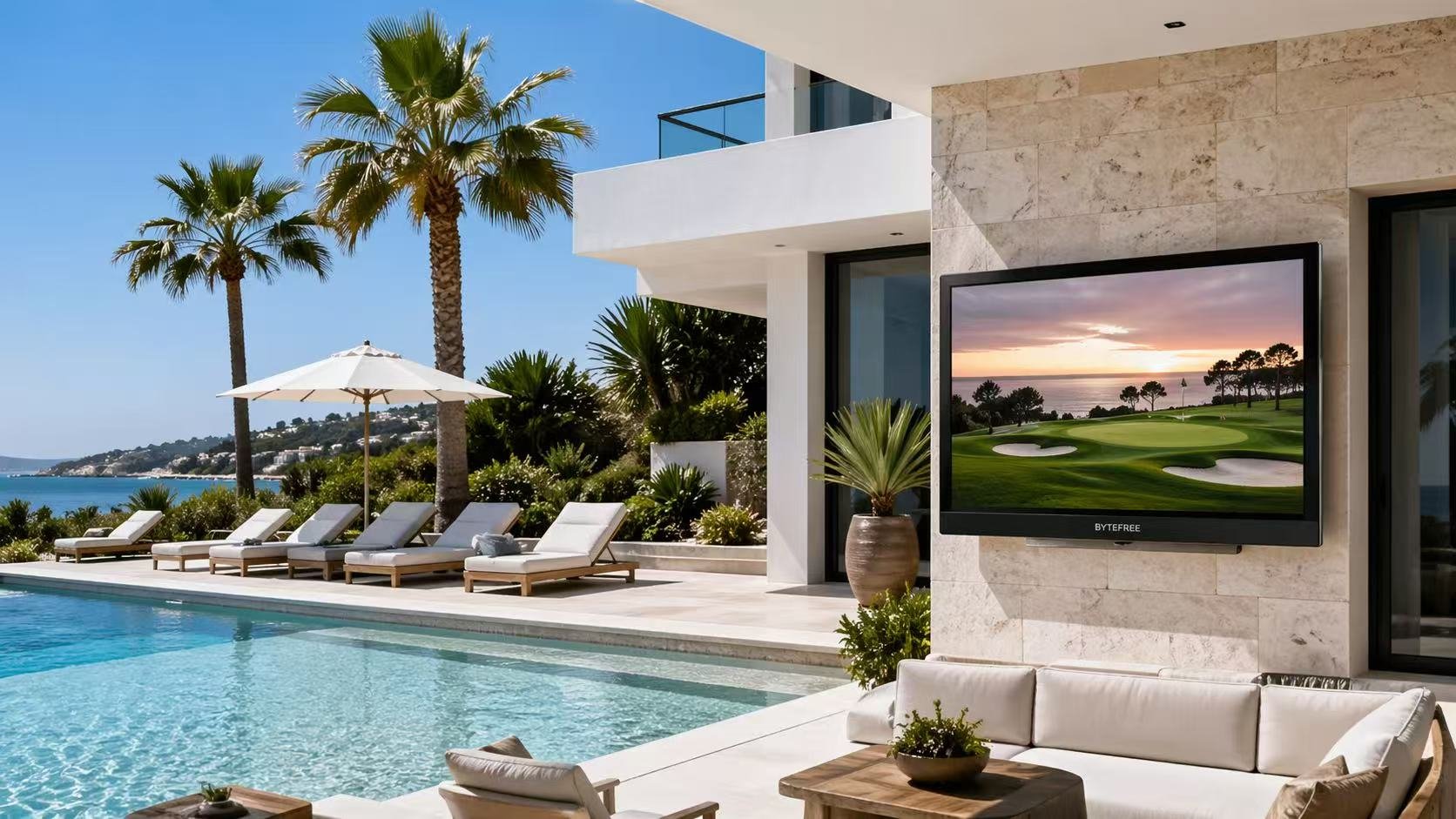
Sustained brightness: What the TV can output continuously (rated conservatively)
Peak brightness: Short bursts for HDR highlights (can be 2–3× sustained)
For the BF-55ODTV at 1,500 nits rated, peak HDR highlights may briefly hit 2,000+ nits during bright Dolby Vision scenes — but sustained full-screen brightness stays near the 1,500 rating.
Practical meaning: HDR on outdoor TVs genuinely helps picture quality in daytime — but the "HDR peak" number in marketing should be discounted 30–50% for sustained real-world use.
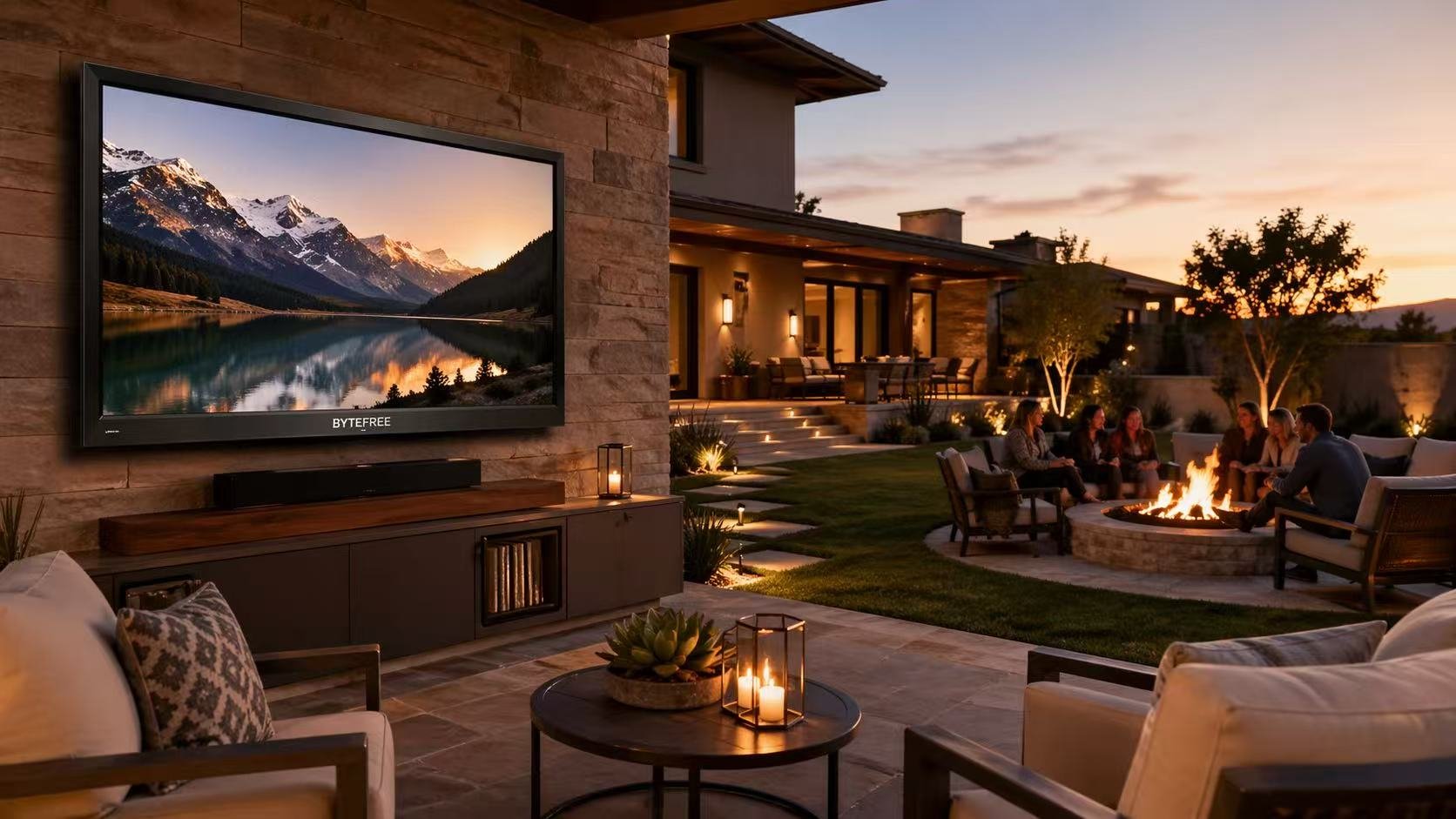
For most U.S. residential patios: 1,500 nits is the sweet spot. The **ByteFree BF-55ODTV at 1,500 nits** handles 80% of covered-patio and partial-sun environments without overpaying for unused full-sun brightness.
The two gotchas to remember:
Rated nits are ~30–50% higher than measured — budget for ~65–75% of the rated number
Perceived brightness is logarithmic — 1,500 → 2,000 nits adds only +7% perceived
→ Shop the ByteFree BF-55ODTV at bytefree.net — 55″ 4K, 1,500 nits, Dolby Vision + 30W Atmos, Google TV, IP55, $1,499.
A nit is a measure of screen brightness — how much light the screen outputs. Indoor TVs: 300–500 nits is enough. Outdoor TVs: you need 1,000+ nits because ambient daylight is 10–1,000× brighter than your living room. The main rule: outdoor brightness must roughly match your sun environment (1,000–1,500 nits for partial sun, 2,000+ for direct sun). Two hidden gotchas: (1) manufacturer-rated nits are usually 30–50% higher than measured, so verify with independent reviews; (2) perceived brightness scales logarithmically, so 1,500 → 2,000 nits feels smaller than 1,000 → 1,500. The **ByteFree BF-55ODTV at 1,500 nits** hits the partial-sun sweet spot.
Simplest definition of a nit
A nit (cd/m², candela per square meter) = one candle's worth of brightness per square meter of screen area.Candle flame: ~1 nit at the surface
Sheet of white paper in good room lighting: ~50 nits
Indoor TV (bright scene): 300–500 nits
Typical outdoor TV (partial sun): 1,000–1,500 nits
Full sun outdoor TV: 2,000+ nits
Sun itself (at noon, outside the atmosphere): 1.6 billion nits
The TV doesn't need to match the sun — it needs to output enough light to be readable against ambient light reflecting off the screen and surroundings.
Why outdoor TVs need 3–5× more nits than indoor
Ambient light comparison
Environment | Ambient light | Required TV brightness |
| Dim living room | ~50 lux | 100–300 nits |
| Bright living room | ~200 lux | 300–500 nits |
| Covered patio (shade) | ~1,000–3,000 lux | 700–1,000 nits |
| Covered patio (partial sun) | ~5,000–15,000 lux | 1,000–1,500 nits |
| Direct midday sun | ~100,000 lux | 2,000–3,000 nits |
Outdoor environments have 20–2,000× more ambient light than indoor spaces. That's why outdoor TVs need dramatically more brightness.
The rated vs measured gap (big deal)
Manufacturer-rated nits are almost always higher than independent measurements. Industry-wide phenomenon, not a specific brand issue.Real-world examples
TV | Manufacturer rating | Independent measurement | Ratio |
| SunBrite Veranda 3 | 1,000 nits | 528 nits (Tom's Guide) | 53% |
| Most mid-tier outdoor TVs | 1,000–2,000 | ~65–75% of rated | varies |
| **BF-55ODTV** | 1,500 nits | 1,000+ (internal testing) | ~67% |
| Samsung Terrace Full Sun | 2,000 nits | ~1,500–1,700 | ~80% |
How to budget for this gap
When you see "1,500 nits" on a spec sheet, budget for ~1,000 nits actual. The BF-55ODTV's 1,500 nits rating translates to ~1,000 nits measured — which is still the top of its class for sub-$1,500 outdoor TVs.Why rated > measured:
Rated usually refers to peak brightness in a tiny 10% window for 1–2 seconds
Measured is usually full-screen sustained brightness
Peak > sustained is inherent to LCD panel physics, not cheating
Perceived brightness is logarithmic, not linear
Doubling nits doesn't double perceived brightness. The relationship follows a logarithmic curve:Nits | Perceived brightness (vs 500 baseline) |
| 500 | 1.0× |
| 1,000 | 1.3× (+30%) |
| 1,500 | 1.5× (+15% vs 1,000) |
| 2,000 | 1.6× (+7% vs 1,500) |
| 3,000 | 1.8× (+13% vs 2,000) |
| 5,000 | 2.0× (+11% vs 3,000) |
Going from 1,000 → 1,500 nits: clearly noticeable (+15%)
Going from 1,500 → 2,000 nits: barely noticeable (+7%)
Going from 2,000 → 5,000 nits: modest improvement (+22% across 3× nits)
This is why the BF-55ODTV at 1,500 nits competes well against competitors at 2,000 nits — the extra 500 nits is only ~7% brighter perceived.
Nits by environment — the decision framework
700 nits
Deep shade only (sunrooms, north-facing covered porches)Never direct sun exposure
Will wash out in any indirect daylight
Example: SunBrite Veranda 3 (measured 528 nits = effectively "700 nits" tier)
1,000 nits
Fully covered patios with minimal direct sunExample: Sylvox Deck Pro 2.0 (1,000 rated, likely ~700 measured)
Borderline for bright partial-sun afternoons
1,500 nits (sweet spot)
Most partial-sun environmentsCovered patios, decks, pergolas that get indirect daylight
Some direct sun tolerance (morning/evening low-angle sun)
Example: **BF-55ODTV**, Sylvox Frameless (2,000 rated)
2,000 nits
Full-sun rated (4+ hours direct noon sun)Open patios, uncovered pool decks
Example: Samsung Terrace Full Sun, Sylvox Cinema Helio QLED
3,000–5,000 nits
Extreme sun environments (Arizona noon, reflective white surfaces)Commercial applications
Example: Titan G300 Mini-LED (5,000), MirageVision Platinum
Anti-glare coating affects perceived brightness
Two TVs at identical nit counts perform differently with different screen coatings:Coating | Perceived outdoor brightness | Reflection |
| Glossy (indoor TV) | Lower effective | Heavy reflections of sky, trees |
| Semi-gloss | Medium | Some reflections |
| Matte anti-glare (outdoor standard) | Higher effective | Diffused reflections |
| Premium AR coating (Samsung Terrace) | Highest effective | Near-zero reflections |
All major outdoor TVs (including BF-55ODTV) ship with matte AR coating. Don't compare rated nits alone — verify AR coating is included.
HDR and peak brightness
HDR content (Dolby Vision, HDR10) can trigger peak brightness in specific highlight scenes — sun glints, explosions, light sources. Peak brightness is different from sustained brightness.Sustained brightness: What the TV can output continuously (rated conservatively)
Peak brightness: Short bursts for HDR highlights (can be 2–3× sustained)
For the BF-55ODTV at 1,500 nits rated, peak HDR highlights may briefly hit 2,000+ nits during bright Dolby Vision scenes — but sustained full-screen brightness stays near the 1,500 rating.
Practical meaning: HDR on outdoor TVs genuinely helps picture quality in daytime — but the "HDR peak" number in marketing should be discounted 30–50% for sustained real-world use.
Common questions about nits
How do I measure my outdoor TV's actual nits?
You need a calibrated photometer ($200–$1,500 device) and controlled test conditions. Alternative: read independent reviews (Tom's Guide, RTINGS, CEPRO) that publish measured nit values.
Can I add brightness to a dim outdoor TV?
No — brightness is hardware-defined by the LED backlight. No software or accessory adds real nits. You can adjust contrast/gamma for better apparent usability but can't exceed the TV's rated output.Does 4K vs 1080p affect brightness?
Not meaningfully. Resolution and brightness are separate. A 4K panel and 1080p panel at the same nit rating produce the same brightness.What's the minimum usable outdoor TV brightness?
700 nits for deep shade only. Below that, you're squinting at a washed-out picture in any outdoor light.Why does my outdoor TV look dim at certain times?
Usually ambient light changed. Trees lost leaves (more sun reaches the wall), time of year shifted sun angle, or nearby reflective surfaces (white pavers, pool) increased brightness. A TV that was adequate in July may look dim in October.Does the BF-55ODTV have enough nits for my patio?
BF-55ODTV at 1,500 rated / 1,000+ measured handles most covered partial-sun patios. If you have direct noon sun on the TV wall for 4+ hours daily, step up to full-sun-rated TVs (Sylvox Cinema Helio, Samsung Terrace Full Sun).Verdict
Nits in one sentence: how much light your TV outputs, and you need 3–5× more outdoors than indoors.For most U.S. residential patios: 1,500 nits is the sweet spot. The **ByteFree BF-55ODTV at 1,500 nits** handles 80% of covered-patio and partial-sun environments without overpaying for unused full-sun brightness.
The two gotchas to remember:
Rated nits are ~30–50% higher than measured — budget for ~65–75% of the rated number
Perceived brightness is logarithmic — 1,500 → 2,000 nits adds only +7% perceived
→ Shop the ByteFree BF-55ODTV at bytefree.net — 55″ 4K, 1,500 nits, Dolby Vision + 30W Atmos, Google TV, IP55, $1,499.
Last edited: