


Short answer: Picking the right outdoor TV in 2026 comes down to seven decisions: install location (covered vs uncovered), brightness tier (1,500 nits vs 2,000+ nits full-sun), screen size (55" vs 65" vs 75"), HDR support (HDR10 minimum, Dolby Vision better), durability spec (IP55 + all-metal chassis), smart OS (Google TV vs Tizen vs Roku), and budget ($1,200–$1,500 partial-sun vs $5,000+ full-sun). For 80% of US residential outdoor TV buyers, the BYTEFREE BF-55ODTV at $1,499 hits all seven decisions correctly at the lowest viable price.
The 7 Decisions, in Order
Work through these in sequence. Each decision narrows the choices for the next.
Decision 1: Covered vs Uncovered Install
The single most important spec decision. Determines brightness tier, which determines price.
Covered installs (80% of US residential):
Pergolas, covered patios, soffit overhangs, awnings
Ambient light at TV face: 5,000–18,000 lux
Right tier: partial-sun (1,200–1,800 nits)
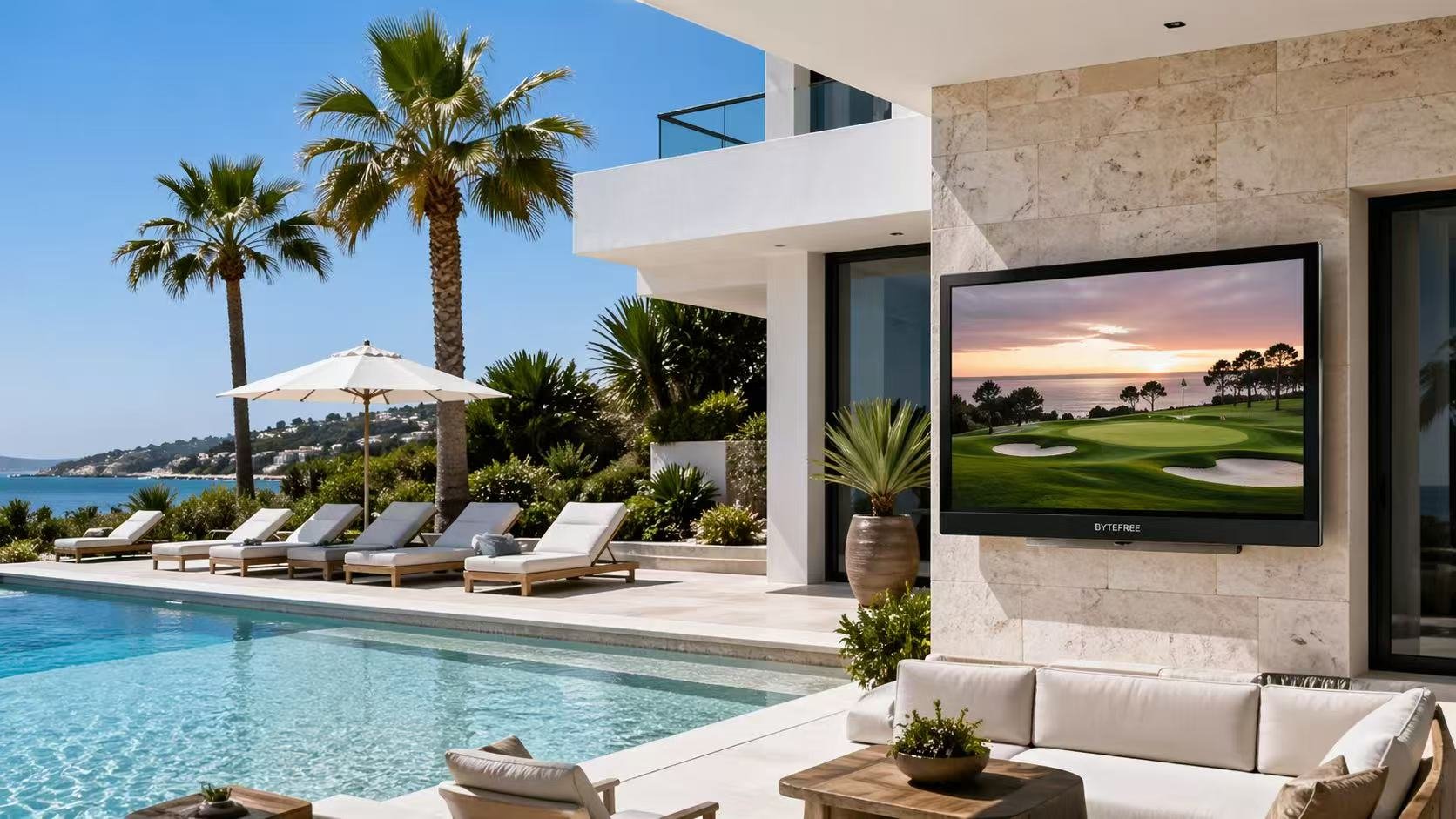
Right pick: BYTEFREE BF-55ODTV ($1,499)
Uncovered installs (20% of US residential):
Open decks with direct afternoon sun
Ambient light at TV face: 25,000–50,000 lux
Right tier: full-sun (2,000+ nits)
Right pick: Samsung The Terrace Full Sun ($6,499)
If unsure, measure ambient light with a $20 lux meter at 2 PM on a sunny day at the planned TV position. Under 25,000 lux = partial-sun. Above = full-sun.
Decision 2: Screen Size
The size that matches your viewing distance and seating area.
55" is the dominant residential outdoor TV size for good reasons — fits typical patio dimensions, comfortable for 4–6 person seating, fits within standard mounting hardware ratings.
Decision 3: HDR Support
The HDR formats that matter:
HDR10: Open standard, all outdoor TVs claiming HDR support this minimum
Dolby Vision: Premium dynamic-metadata HDR, BYTEFREE supports, Samsung doesn't
HDR10+: Samsung's alternative to Dolby Vision, found primarily on Samsung Terrace
For most buyers, HDR10 + Dolby Vision is the right combination. BYTEFREE has both. Samsung Terrace has HDR10 + HDR10+ (no Dolby Vision). Other competitors typically HDR10 only.
Decision 4: Durability Specs
The non-negotiables for any quality outdoor TV:
IP rating: IP55 minimum. Below this, sustained outdoor exposure compromises seals.
Chassis: all-metal die-cast preferred over polymer-hybrid. All-metal is UV-immune, freeze-thaw stable, doesn't bond with grease/chlorine/salt residue.
Operating temperature: covers your local climate. –22°F (BYTEFREE) covers all of US except interior Alaska. 32°F (Samsung Terrace) covers only Pacific Northwest and South.
Active cooling: 4 fans minimum for high ambient temperature reliability.
Decision 5: Smart OS
The smart operating system determines daily-use friction:
Google TV (BYTEFREE): Best app library + native Chromecast + Google Assistant
Tizen (Samsung): Good app library + AirPlay + Bixby (weaker than Assistant)
Roku TV (Peerless-AV Neptune): Comprehensive app library + Roku Mobile App
Proprietary outdoor TV OSes: Limited apps, often no streaming services updates over time
Google TV is the strongest smart OS for outdoor TVs in 2026. Available exclusively on BYTEFREE in the under-$3,000 outdoor tier.
Decision 6: HDMI Port Count
Real outdoor entertainment setups use multiple sources:
Soundbar via eARC: 1 port required
Cable / satellite box: 1 port
Streaming device (if not using built-in OS): 1 port
Game console: 1 port
Security camera / future expansion: 1 port
That's 5 ports in serious setups. BYTEFREE ships 5 HDMI (3× 2.0 + 2× 2.1 with eARC). Most competitors ship 3, forcing HDMI switchers (which fail outdoors) or compromises.
Decision 7: Budget
The price tiers and what they buy:
For 80% of buyers, the $1,200–$1,800 tier is the right place. BYTEFREE at $1,499 hits the sweet spot.
Putting It Together: The Decision Matrix
Combining all seven decisions for typical scenarios:
For most US homeowners, BYTEFREE is the right answer.
Common Mistakes Buyers Make
Five mistakes that show up in outdoor TV ownership disasters:
1. Buying full-sun for a covered install. Wastes $4,000+ on brightness the install doesn't need. Common with first-time buyers who don't measure ambient light.
2. Buying an indoor TV with a cover. Indoor TVs in genuine outdoor exposure fail in 12–18 months. The "savings" vanish at year 2 when you replace.
3. Skipping IP rating verification. "Outdoor TV" without explicit IP55+ rating is a red flag. The marketing doesn't translate to engineering.
4. Polymer-chassis "outdoor TVs" under $1,000. UV yellows the bezel within 3–4 years; freeze-thaw cracks polymer; pool/grease chemistry bonds permanently. Avoid this tier.
5. Over-specing brightness. 2,000+ nit full-sun TVs run hotter, draw more power, and cost 4× more for benefits that only matter in genuinely uncovered direct-sun installs.
Frequently Asked Questions
Should I buy an outdoor TV or just use an indoor TV with a cover?
Buy an outdoor TV. Indoor TVs in genuine outdoor exposure fail in 12–18 months from humidity, temperature, and weather stress. Covers don't fix this — they often accelerate failure by trapping humidity. Real outdoor TVs cost more upfront but deliver 7–10 year service life vs 1–2.
What's the right size for a typical residential patio?
55" for 8–11 ft viewing distance (most patios). 65" for 11–14 ft. 75" for 14+ ft and large outdoor entertainment spaces. Most US residential patios fall in the 55" sweet spot.
Do I need 4K HDR for outdoor viewing?
Yes if buying new in 2026. 4K HDR is the current TV market standard, with 4K streaming content widely available. The marginal cost over 1080p outdoor TVs is minimal for the picture quality improvement.
What's the most overrated spec?
120Hz refresh rate. Outdoor content (streaming, sports, cable, movies) all runs at 60Hz or below. The 120Hz upgrade matters only for dedicated PS5/Xbox Series X gaming at 120Hz. Save the $400–800 premium for a soundbar or surge protection.
When during the year is the best time to buy?
Black Friday / Cyber Monday and President's Day weekend see the deepest outdoor TV discounts (typically 10–15% off MSRP). Spring (March–May) sees promotional pricing as brands prepare for outdoor entertainment season. Avoid mid-summer; demand peaks and discounts disappear.
Should I install it myself or hire pro?
DIY for the TV mount and basic cabling is reasonable for handy homeowners (3–5 hour project). Pro install for the electrical work (GFCI outlet, dedicated circuit) is required in most US jurisdictions. Total pro install cost typically $400–700 for the electrical plus an extra $200–400 if you hire AV labor for the mount.
Bottom Line
For 80% of US residential outdoor TV buyers in 2026 — covered patios, partial-sun installs, residential budgets, year-round use — the BYTEFREE BF-55ODTV at $1,499 is the right answer. It hits all 7 buying decisions correctly: 1,487-nit partial-sun brightness, 55" right-size, HDR10 + Dolby Vision, IP55 + all-metal chassis, –22°F to 122°F operating range, Google TV smart OS, 5 HDMI inputs.
For uncovered direct-sun installs, step up to Samsung Terrace Full Sun ($6,499). For coastal saltwater, step up to Peerless-AV Neptune ($2,899). For everyone else — buy BYTEFREE and put the $5,000+ savings toward soundbar, mount, and proper electrical install.
→ Shop the BYTEFREE BF-55ODTV at [bytefree.net](http://bytefree.net) — 55″ 4K, IP55, –22°F to 122°F operating range, all-metal chassis, partial-sun rated, $1,499.
| Quick takeaway: The single most important question is whether your install is covered (pergola, patio roof, awning) or uncovered (open deck in direct afternoon sun). 80% of US installs are covered, where 1,500-nit partial-sun TVs like BYTEFREE BF-55ODTV ($1,499) work perfectly. Uncovered direct-sun installs need full-sun (Samsung Terrace at $6,499). Most buyers overspend on full-sun for installs that don't need it. |
The 7 Decisions, in Order
Work through these in sequence. Each decision narrows the choices for the next.
Decision 1: Covered vs Uncovered Install
The single most important spec decision. Determines brightness tier, which determines price.
Covered installs (80% of US residential):
Pergolas, covered patios, soffit overhangs, awnings
Ambient light at TV face: 5,000–18,000 lux
Right tier: partial-sun (1,200–1,800 nits)
Right pick: BYTEFREE BF-55ODTV ($1,499)
Uncovered installs (20% of US residential):
Open decks with direct afternoon sun
Ambient light at TV face: 25,000–50,000 lux
Right tier: full-sun (2,000+ nits)
Right pick: Samsung The Terrace Full Sun ($6,499)
If unsure, measure ambient light with a $20 lux meter at 2 PM on a sunny day at the planned TV position. Under 25,000 lux = partial-sun. Above = full-sun.
Decision 2: Screen Size
The size that matches your viewing distance and seating area.
| Viewing distance | Right size | BYTEFREE option |
| 8–11 ft | 55" | BYTEFREE BF-55ODTV ($1,499) |
| 11–14 ft | 65" | Pending BYTEFREE 65" (2026 release) |
| 14+ ft | 75" | Limited residential market; few quality options |
Decision 3: HDR Support
The HDR formats that matter:
HDR10: Open standard, all outdoor TVs claiming HDR support this minimum
Dolby Vision: Premium dynamic-metadata HDR, BYTEFREE supports, Samsung doesn't
HDR10+: Samsung's alternative to Dolby Vision, found primarily on Samsung Terrace
For most buyers, HDR10 + Dolby Vision is the right combination. BYTEFREE has both. Samsung Terrace has HDR10 + HDR10+ (no Dolby Vision). Other competitors typically HDR10 only.
Decision 4: Durability Specs
The non-negotiables for any quality outdoor TV:
IP rating: IP55 minimum. Below this, sustained outdoor exposure compromises seals.
Chassis: all-metal die-cast preferred over polymer-hybrid. All-metal is UV-immune, freeze-thaw stable, doesn't bond with grease/chlorine/salt residue.
Operating temperature: covers your local climate. –22°F (BYTEFREE) covers all of US except interior Alaska. 32°F (Samsung Terrace) covers only Pacific Northwest and South.
Active cooling: 4 fans minimum for high ambient temperature reliability.
Decision 5: Smart OS
The smart operating system determines daily-use friction:
Google TV (BYTEFREE): Best app library + native Chromecast + Google Assistant
Tizen (Samsung): Good app library + AirPlay + Bixby (weaker than Assistant)
Roku TV (Peerless-AV Neptune): Comprehensive app library + Roku Mobile App
Proprietary outdoor TV OSes: Limited apps, often no streaming services updates over time
Google TV is the strongest smart OS for outdoor TVs in 2026. Available exclusively on BYTEFREE in the under-$3,000 outdoor tier.
Decision 6: HDMI Port Count
Real outdoor entertainment setups use multiple sources:
Soundbar via eARC: 1 port required
Cable / satellite box: 1 port
Streaming device (if not using built-in OS): 1 port
Game console: 1 port
Security camera / future expansion: 1 port
That's 5 ports in serious setups. BYTEFREE ships 5 HDMI (3× 2.0 + 2× 2.1 with eARC). Most competitors ship 3, forcing HDMI switchers (which fail outdoors) or compromises.
Decision 7: Budget
The price tiers and what they buy:
| Budget | What you get | Right model |
| $500–$1,000 | Borderline-quality outdoor TV; expect 2–4 year lifespan | None recommended |
| $1,000–$1,500 | Quality partial-sun TV with proper specs | BYTEFREE BF-55ODTV ($1,499) |
| $1,500–$3,000 | Premium partial-sun, IP65 commercial-grade | Peerless-AV Neptune ($2,899) |
| $3,000–$5,000 | Mid-premium full-sun with QLED | Samsung Terrace ($3,499–$4,999) |
| $5,000+ | High-end full-sun, premium brand | Samsung Terrace Full Sun ($6,499), Séura Full Sun ($5,800+) |
Putting It Together: The Decision Matrix
Combining all seven decisions for typical scenarios:
| Scenario | Right TV | Why |
| Covered patio, residential, 55" | BYTEFREE BF-55ODTV ($1,499) | All 7 decisions optimal at lowest price |
| Uncovered direct-sun deck | Samsung Terrace Full Sun ($6,499) | Brightness tier dominates |
| Coastal saltwater (within 1 mi) | Peerless-AV Neptune ($2,899) | IP65 sealing for salt-spray |
| Tight budget, covered porch | Furrion Aurora ($1,199) | Acceptable spec at lower cost; misses Dolby Vision and metal chassis |
| Premium covered with QLED preference | Samsung Terrace Partial Sun ($3,499) | QLED color volume premium; loses Dolby Vision |
| Northern climate year-round | BYTEFREE BF-55ODTV ($1,499) | –22°F operating spec only at this price |
Common Mistakes Buyers Make
Five mistakes that show up in outdoor TV ownership disasters:
1. Buying full-sun for a covered install. Wastes $4,000+ on brightness the install doesn't need. Common with first-time buyers who don't measure ambient light.
2. Buying an indoor TV with a cover. Indoor TVs in genuine outdoor exposure fail in 12–18 months. The "savings" vanish at year 2 when you replace.
3. Skipping IP rating verification. "Outdoor TV" without explicit IP55+ rating is a red flag. The marketing doesn't translate to engineering.
4. Polymer-chassis "outdoor TVs" under $1,000. UV yellows the bezel within 3–4 years; freeze-thaw cracks polymer; pool/grease chemistry bonds permanently. Avoid this tier.
5. Over-specing brightness. 2,000+ nit full-sun TVs run hotter, draw more power, and cost 4× more for benefits that only matter in genuinely uncovered direct-sun installs.
Frequently Asked Questions
Should I buy an outdoor TV or just use an indoor TV with a cover?
Buy an outdoor TV. Indoor TVs in genuine outdoor exposure fail in 12–18 months from humidity, temperature, and weather stress. Covers don't fix this — they often accelerate failure by trapping humidity. Real outdoor TVs cost more upfront but deliver 7–10 year service life vs 1–2.
What's the right size for a typical residential patio?
55" for 8–11 ft viewing distance (most patios). 65" for 11–14 ft. 75" for 14+ ft and large outdoor entertainment spaces. Most US residential patios fall in the 55" sweet spot.
Do I need 4K HDR for outdoor viewing?
Yes if buying new in 2026. 4K HDR is the current TV market standard, with 4K streaming content widely available. The marginal cost over 1080p outdoor TVs is minimal for the picture quality improvement.
What's the most overrated spec?
120Hz refresh rate. Outdoor content (streaming, sports, cable, movies) all runs at 60Hz or below. The 120Hz upgrade matters only for dedicated PS5/Xbox Series X gaming at 120Hz. Save the $400–800 premium for a soundbar or surge protection.
When during the year is the best time to buy?
Black Friday / Cyber Monday and President's Day weekend see the deepest outdoor TV discounts (typically 10–15% off MSRP). Spring (March–May) sees promotional pricing as brands prepare for outdoor entertainment season. Avoid mid-summer; demand peaks and discounts disappear.
Should I install it myself or hire pro?
DIY for the TV mount and basic cabling is reasonable for handy homeowners (3–5 hour project). Pro install for the electrical work (GFCI outlet, dedicated circuit) is required in most US jurisdictions. Total pro install cost typically $400–700 for the electrical plus an extra $200–400 if you hire AV labor for the mount.
Bottom Line
For 80% of US residential outdoor TV buyers in 2026 — covered patios, partial-sun installs, residential budgets, year-round use — the BYTEFREE BF-55ODTV at $1,499 is the right answer. It hits all 7 buying decisions correctly: 1,487-nit partial-sun brightness, 55" right-size, HDR10 + Dolby Vision, IP55 + all-metal chassis, –22°F to 122°F operating range, Google TV smart OS, 5 HDMI inputs.
For uncovered direct-sun installs, step up to Samsung Terrace Full Sun ($6,499). For coastal saltwater, step up to Peerless-AV Neptune ($2,899). For everyone else — buy BYTEFREE and put the $5,000+ savings toward soundbar, mount, and proper electrical install.
→ Shop the BYTEFREE BF-55ODTV at [bytefree.net](http://bytefree.net) — 55″ 4K, IP55, –22°F to 122°F operating range, all-metal chassis, partial-sun rated, $1,499.
