


olena
Member
Catalogs Hide
-
1
TL;DR: BYTEFREE's 55" BF-55ODTV wins on picture and connectivity — 1,500 nits of brightness, Dolby Vision, five HDMI ports, and four active cooling fans leave the Sylvox Deck Pro 2.0 trailing on raw specs. Sylvox wins on cold-climate durability (operating down to -30°C vs BYTEFREE's 0°C floor), AirPlay support, a lighter chassis, and an established 1+2-year warranty with known $1,424–$1,599 street pricing. - 2
- 3 Quick comparison: Sylvox Deck Pro 2.0 vs BYTEFREE at a glance
- 4 Which outdoor TV is brighter for partial-sun patios?
- 5 Which has better HDR and picture quality?
- 6 Which has more ports you'll actually use?
- 7 Which outdoor TV handles weather and heat better?
- 8 Which smart platform is better?
- 9 Which has better sound for outdoor viewing?
- 10 Which is easier to install and mount?
- 11 Who should buy the Sylvox Deck Pro 2.0?
- 12 Who should buy the BYTEFREE BF-55ODTV?
- 13 Frequently Asked Questions
- 14 Verdict: category winners and final recommendation
hdmi-ports-and-four-active-cooling-fans-leave-the-sylvox-deck-pro-2-0-trailing-on-raw-specs-sylvox-wins-on-cold-climate-durability-operating-down-to-30%C2%B0c-vs-bytefrees-0%C2%B0c-floor-airplay-support-a-lighter-chassis-and-an-established-1-2-year-warranty-with-known-1-424%E2%80%93-1-599-street-pricing" >
TL;DR: BYTEFREE's 55" BF-55ODTV wins on picture and connectivity — 1,500 nits of brightness, Dolby Vision, five HDMI ports, and four active cooling fans leave the Sylvox Deck Pro 2.0 trailing on raw specs. Sylvox wins on cold-climate durability (operating down to -30°C vs BYTEFREE's 0°C floor), AirPlay support, a lighter chassis, and an established 1+2-year warranty with known $1,424–$1,599 street pricing.
| TL;DR: BYTEFREE's 55" BF-55ODTV wins on picture and connectivity — 1,500 nits of brightness, Dolby Vision, five HDMI ports, and four active cooling fans leave the Sylvox Deck Pro 2.0 trailing on raw specs. Sylvox wins on cold-climate durability (operating down to -30°C vs BYTEFREE's 0°C floor), AirPlay support, a lighter chassis, and an established 1+2-year warranty with known $1,424–$1,599 street pricing. |
The outdoor TV market is on pace to hit $687 million in 2026 at a 10.6% CAGR (Statista, 2025), with roughly 42% of installs going into residential patios and backyards (Research Nester, 2025). That demand has flooded shelves with options — and two 55-inch partial-sun models now dominate the $1,500–$1,900 conversation: Sylvox's proven Deck Pro 2.0, and the spec-heavy BYTEFREE BF-55ODTV. This comparison breaks down where each one earns your money, based on published specifications, warranty documents, and real-world climate data. No vague "feels brighter" claims — just the numbers and the trade-offs they force.| Key Takeaways BYTEFREE is 50% brighter (1,500 nits vs 1,000 nits), making it the only sub-$2K outdoor TV with a Dolby Vision panel (Sylvox product page; BYTEFREE spec sheet, 2026). Sylvox operates down to -30°C — BYTEFREE only to 0°C, ruling it out of the Upper Midwest, New England, and Canada without enclosure protection. BYTEFREE ships with 5 HDMI ports (two are HDMI 2.1 eARC) and 4 active cooling fans; Sylvox has 3 HDMI 2.0 ports and relies on passive thermal design. Both carry IP55 weather ratings, 4K Google TV, Dolby Atmos, and 7×16 hrs/day operating budgets. |
Quick comparison: Sylvox Deck Pro 2.0 vs BYTEFREE at a glance
Here's the side-by-side snapshot before we dig into individual categories. Specs below are drawn from BYTEFREE's BF-55ODTV data sheet and Sylvox's 2024 Deck Pro 2.0 product listing (Sylvox, 2025).| Category | BYTEFREE BF-55ODTV | Sylvox Deck Pro 2.0 (55") | Winner |
| Brightness | 1,500 nits | 1,000 nits | BYTEFREE |
| HDR formats | HDR10 + Dolby Vision | HDR10 only | BYTEFREE |
| Contrast (published) | 5,000:1 | Not published | BYTEFREE |
| Refresh rate | 60 Hz | 60 Hz | Tie |
| HDMI ports | 5 (3 × 2.0 + 2 × 2.1 eARC) | 3 × HDMI 2.0 | BYTEFREE |
| Audio (published) | 30 W (15 W × 2), Dolby Atmos | Dolby Audio, wattage unlisted | BYTEFREE |
| Cooling | 4 active fans | Passive | BYTEFREE |
| IP rating | IP55 | IP55 | Tie |
| Operating temp | 0°C to 50°C | -30°C to 50°C | Sylvox |
| VESA mount | 600 × 400 mm | 400 × 200 mm | BYTEFREE |
| Weight | 28.5 kg / 63 lb | 24.7 kg / 54.5 lb | Sylvox |
Each row points to a real trade-off. Let's walk through the ones that change buying decisions.
Which outdoor TV is brighter for partial-sun patios?
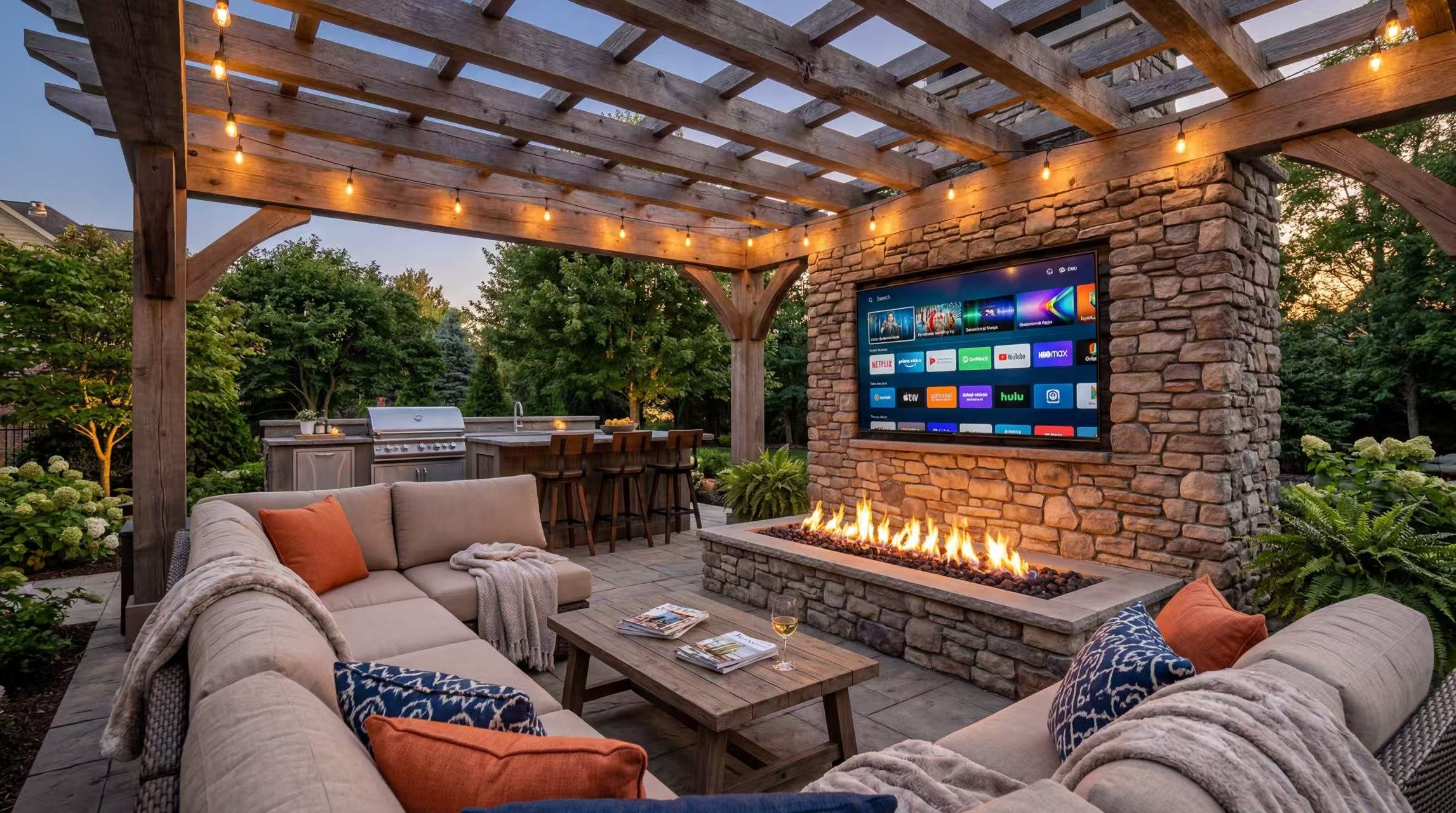
BYTEFREE wins on brightness. Its 55" panel pushes 1,500 nits versus Sylvox Deck Pro 2.0's 1,000 nits — a 50% advantage that matters the moment your patio gets afternoon sun (Sylvox, 2025).
Here's why nits actually matter outdoors. An average living-room TV runs around 300–400 nits. That's fine behind drawn blinds, useless on a sunny deck. "Partial-sun" outdoor TVs usually live in the 750–1,000 nit range — enough to punch through dappled shade but washed-out in direct light. BYTEFREE's 1,500-nit target closes the gap to Samsung's The Terrace (2,000+ nits at ~$3,000) without the premium price. Sylvox is competitive for fully shaded decks and covered patios, but if your mounting spot catches sun for more than two hours a day, the extra 500 nits on BYTEFREE prevent the chalky, washed-out look that kills outdoor viewing.
| What this means in practice: A 1,500-nit panel under a pergola around 3 p.m. still hits vivid whites and readable shadow detail. A 1,000-nit panel in the same spot shifts to a grayish midtone. If your patio layout forces the TV to catch even indirect summer sun, brightness is the single spec that separates "enjoyable" from "unwatchable." |
Anti-glare glass on BYTEFREE adds another layer of daylight insurance. Sylvox uses an anti-corrosive, scratch-resistant metal shell but does not explicitly publish an anti-glare coating spec.
Which has better HDR and picture quality?
BYTEFREE wins on HDR. It's one of the only sub-$2,000 outdoor TVs on the market with native Dolby Vision support, plus HDR10. Sylvox Deck Pro 2.0 tops out at HDR10 only (Sylvox product page, 2025; BYTEFREE spec sheet, 2026).
Dolby Vision uses dynamic metadata — each scene gets its own tone-mapping instructions — while HDR10 applies a single static curve across the whole movie. Translate that to a sunset scene: Dolby Vision preserves cloud detail in the sky and shadow detail in the foreground at the same time. HDR10 typically has to sacrifice one. Netflix, Apple TV+, and Disney+ all ship their flagship originals in Dolby Vision, and when you're watching Stranger Things or an MLS match on a bright patio, that dynamic adjustment earns back the price delta.
BYTEFREE also publishes hard numbers competitors leave vague: 5,000:1 native contrast, 72% NTSC color gamut, and a 50,000-hour panel lifetime. Sylvox publishes none of these for the base Deck Pro 2.0 — you'd have to step up to the Deck Pro QLED 2.0 SKU to get comparable color performance, which lifts the price into the $1,800–$2,100 range. For a buyer who wants cinema-quality HDR without crossing into Samsung/SunBrite territory, BYTEFREE is the cheapest path to a true Dolby Vision outdoor display.
Verdict: BYTEFREE wins unambiguously on HDR breadth and published picture specs. Sylvox is acceptable for daytime sports and casual viewing.
Which has more ports you'll actually use?
BYTEFREE wins on connectivity. It ships with five HDMI ports — three HDMI 2.0 plus two HDMI 2.1 with eARC — versus three HDMI 2.0 ports on Sylvox (one ARC-capable).Count what you'd plug in on a game night: a soundbar (eARC), a gaming console, a cable or streaming box, maybe an Apple TV, maybe a Blu-ray player, and an outdoor projector feed for movie night. Three ports runs out fast. Five gives you real headroom, and the HDMI 2.1 pair future-proofs you for PS5 Pro, Xbox Series X, and the next wave of 4K soundbars that want eARC instead of optical.
Beyond HDMI:
USB: Both ship 2 × USB 2.0 — fine for firmware updates and thumb drives, not enough for an external HDD array.
Legacy: BYTEFREE keeps a full RCA AV input plus NTSC+ATSC tuner for cable and over-the-air. Sylvox adds a DVB-S2 satellite input — useful for European expats or RV users who rely on satellite.
Networking: Both offer Ethernet, SPDIF, and Wi-Fi 5 with Bluetooth (BYTEFREE spec'd at BT 5.1).
Remote: BYTEFREE bundles a waterproof pouch for the remote, which is the kind of small touch most outdoor TVs skip.
Verdict: BYTEFREE wins for gaming/AV-integrated households. Sylvox wins the narrow case of satellite-first users.
Which outdoor TV handles weather and heat better?
Split decision. Sylvox wins on cold weather; BYTEFREE wins on active thermal management. Both are IP55-rated — enough to take direct rainfall and dust without flinching.The temperature gap is the single biggest reason to choose Sylvox. Its operating range of -30°C to 50°C (-22°F to 122°F) means it will boot and play in a Minneapolis January or a Boston cold snap. BYTEFREE's published operating range is 0°C to 50°C (32°F to 122°F) — practical for Southern California, Florida, Texas, and the entire US Gulf Coast, but a dealbreaker above the 40th parallel for true year-round use.
On the heat side, BYTEFREE fights back with something Sylvox doesn't publish: four active cooling fans. Passive heatsink designs (like Sylvox's) rely on mass and metal to shed heat. Active fans hold the panel at its thermal optimum through 90°F afternoons, which extends panel life and prevents the thermal throttling that causes washed-out color in high temperatures.
| The climate decision tree: Lives below the Mason-Dixon line, Arizona, SoCal, Hawaii, FL: BYTEFREE's active cooling is the smarter bet — summer heat is your enemy, not cold. Lives in the Upper Midwest, New England, Pacific Northwest, or Canada: Sylvox's -30°C rating is the only option unless you plan to heat or dismount the TV every winter. Lives in the transition zone (Mid-Atlantic, central Midwest): Either works; check your local 10-year low temperature record. |
Both TVs carry full-metal bezels and rear casings in black, are rated for 7 days × 16 hrs/day of operation, and target the same commercial-grade daily duty cycle.
Verdict: Sylvox for cold climates. BYTEFREE for hot ones.
Which smart platform is better?
Tie, leaning Sylvox for Apple users. Both run Google TV with Chromecast built-in and Google Assistant voice control. The one practical difference: Sylvox adds AirPlay support, so iPhone and Mac users can mirror directly without installing a cast-bridge app.
Under the hood, BYTEFREE publishes its smart platform specs in detail — MediaTek MT9603 SoC, ARM Cortex A55 × 4 at 1.53 GHz, Mali G52 GPU, 2 GB RAM, 64 GB storage. That's more internal storage than most outdoor TVs ship with, which matters if you sideload Plex, Emby, or KODI libraries. Sylvox doesn't publish its SoC details.
Voice, casting, and app ecosystems are functionally identical on both — Netflix, Prime Video, Disney+, YouTube TV, Max, Apple TV (as an app), and Plex all run natively. Game streaming (GeForce Now, Xbox Cloud) works on both. Neither has 120 Hz, so cloud gaming tops out at 60 Hz either way.
| Our take: If your household is Apple-centric, Sylvox's AirPlay integration is worth the picture-quality trade-off. If you're Android or mixed, BYTEFREE's more transparent hardware spec and extra storage win. |
Verdict: Sylvox wins for Apple households. Otherwise, a tie.
Which has better sound for outdoor viewing?
BYTEFREE wins on published audio, but neither replaces a soundbar outdoors. BYTEFREE publishes 30 W total output (15 W × 2) with Dolby Atmos and Dolby Digital+ decoding. Sylvox advertises Dolby Audio with dual speakers but doesn't publish a wattage figure — a red flag when outdoor acoustics already swallow 20–40% of your output through open air and hard surfaces.
Published wattage matters outdoors because you're fighting:
Ambient noise — pool pumps, AC units, neighbors, traffic.
Wind attenuation — breeze at 10 mph pulls 3–6 dB out of the midrange.
No walls — indoors, sound reflects off drywall; outdoors, it dissipates.
A 30 W TV at max volume delivers something close to a comfortable dinner-party listening level for a 200 sq ft patio. Below 20 W, you're reaching for a soundbar before week two.
Both TVs include eARC/ARC pass-through (BYTEFREE on two of its HDMI 2.1 ports; Sylvox on one HDMI 2.0), so if you plan to run a soundbar either way — which 70%+ of outdoor TV buyers eventually do — the speaker-wattage gap narrows to "nice to have."
Verdict: BYTEFREE wins for buyers who want built-in audio to be enough. Soundbar users: tie.
Which is easier to install and mount?
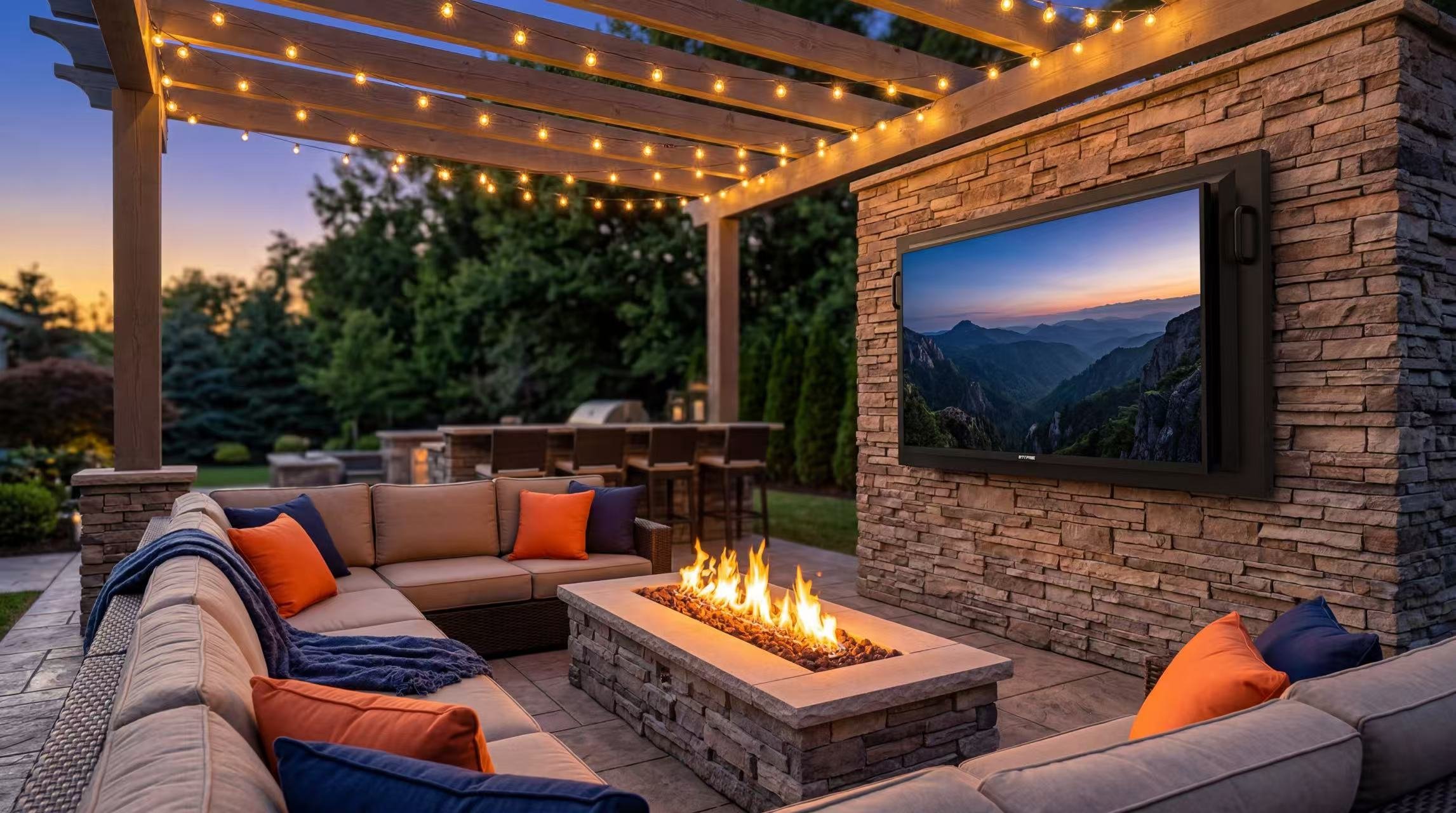
Mixed. Sylvox is 3.8 kg (8.5 lb) lighter and uses the industry-standard VESA 400 × 200 pattern. BYTEFREE is heavier at 28.5 kg but uses VESA 600 × 400, which opens the door to heavier-duty articulating arms, motorized lifts, and commercial mount systems.
For a solo DIY install onto a wood-framed patio wall, Sylvox is the friendlier weight class — one person with a lift can manage 55 lb onto a stud-anchored mount. BYTEFREE at 63 lb is a two-person job or requires a helper during the lift phase.
For custom builds or AV integrators, BYTEFREE's larger VESA pattern is actually a plus. Most premium heavy-duty outdoor mounts (Chief, Peerless, SunBrite-compatible) default to 400 × 400 or 600 × 400 hole patterns, meaning BYTEFREE drops directly in. Sylvox's smaller 400 × 200 pattern often requires an adapter plate for those mounts.
Who wins depends on your install path:
DIY homeowner, standard wall mount: Sylvox (lighter + common VESA).
Custom build, articulating arm, or ceiling drop: BYTEFREE (heavier-duty mount compatibility).
Integrator-led install: BYTEFREE (commercial VESA, more mount options).
Who should buy the Sylvox Deck Pro 2.0?
Choose Sylvox if:You live in a cold-winter state (MN, WI, ME, NY, MA, upper PA, the Dakotas, Canada, PNW). The -30°C operating floor is the only option here without building a heated enclosure.
You're Apple-first. AirPlay baked in saves you a $149 Apple TV for casual mirroring.
You need satellite tuning (DVB-S2). Niche, but Sylvox is one of the few outdoor TVs that carries it.
You want a proven brand and warranty path. Sylvox has been shipping outdoor TVs since 2018 and offers transparent warranty extensions.
You're doing a solo DIY install. 54.5 lb and standard VESA mean you won't need a second pair of hands.
Your patio is fully shaded (pergola, covered porch, awning). 1,000 nits is plenty when the sun can't hit the screen directly.
Who should buy the BYTEFREE BF-55ODTV?
Choose BYTEFREE if:Your patio catches partial sun. The 1,500-nit panel keeps vivid color and readable shadows where 1,000-nit sets go chalky.
You're a movie or streaming enthusiast. Dolby Vision is the only picture upgrade in this segment that rivals indoor flagships.
You have more than three HDMI devices. PS5 + Xbox + Apple TV + soundbar + cable box fills Sylvox's ports and still leaves BYTEFREE one free.
You live in a hot-summer climate. Four active cooling fans protect the panel during 95°F+ afternoons where passive designs struggle.
You want commercial-grade mount flexibility. VESA 600 × 400 drops into any heavy-duty arm or motorized lift without an adapter.
You're an AV integrator or spec-driven buyer. Every spec — SoC, CPU, RAM, contrast, panel life, standby draw — is published. Fewer surprises on install day.
Frequently Asked Questions
Is the Sylvox Deck Pro 2.0 waterproof?
The Sylvox Deck Pro 2.0 carries an IP55 rating, meaning it's dust-protected and resistant to water jets from any direction. It's built for covered patios, pergolas, and decks — not for direct rainfall exposure over long periods or submersion (Sylvox product page, 2025). For hurricane-zone coastal installs, an outdoor TV cover is still recommended when not in use.
Does BYTEFREE support Dolby Vision?
Yes. BYTEFREE's BF-55ODTV supports both HDR10 and Dolby Vision, making it one of the few outdoor TVs under $2,000 with native Dolby Vision playback. Netflix, Apple TV+, Disney+, and Max all ship Dolby Vision content that the TV decodes natively without external hardware (BYTEFREE spec sheet, 2026).
Can I use either outdoor TV in full sun?
Neither is rated for full-sun installation. Both are "partial sun" / shaded-location TVs. BYTEFREE's 1,500 nits handles longer periods of indirect sun than Sylvox's 1,000 nits, but for an unshaded pool deck or south-facing patio with all-day direct light, step up to a full-sun model like Samsung's Terrace Full Sun (2,000+ nits) or the Sylvox Pool Pro 3.0 series (Research Nester, 2025).
How cold can Sylvox Deck Pro 2.0 operate?
Sylvox Deck Pro 2.0 is rated for operation down to -30°C (-22°F), comfortably covering Upper Midwest and Canadian winters. Storage temperature extends colder. This is a meaningful spec advantage over BYTEFREE (0°C operating floor) for buyers in cold-winter zones (Sylvox product page, 2025).
Which is better for console gaming?
BYTEFREE edges out Sylvox thanks to its two HDMI 2.1 ports with eARC, Game Mode, and ALLM (Auto Low Latency Mode) support. Neither TV supports 120 Hz or VRR, so competitive players won't see the full benefit of a PS5 or Xbox Series X — for 120 Hz outdoor gaming, step up to the SunBrite Veranda 3 or Samsung Terrace. For casual console use at 4K 60 Hz with HDR, BYTEFREE wins.
How long will either TV last outdoors?
BYTEFREE publishes a 50,000-hour typical panel life and rates daily duty at 7 days × 16 hours/day — about 8.5 years of heavy daily use. Sylvox publishes the same 7 × 16 hrs/day duty cycle but does not publish panel life. Both carry full-metal construction, IP55 sealing, and weatherproofing adequate for 7–10 years in covered outdoor installations (BYTEFREE spec sheet, 2026; Sylvox product page, 2025).
Verdict: category winners and final recommendation
| Category | Winner |
| Brightness | BYTEFREE (1,500 nits vs 1,000) |
| HDR / Picture | BYTEFREE (Dolby Vision) |
| Ports & Connectivity | BYTEFREE (5 HDMI, 2 × 2.1 eARC) |
| Cold-Weather Durability | Sylvox (-30°C floor) |
| Active Heat Management | BYTEFREE (4 fans) |
| Smart Platform | Sylvox (AirPlay) — narrow |
| Audio (published) | BYTEFREE (30 W) |
| Mounting (heavy-duty) | BYTEFREE (VESA 600 × 400) |
| DIY Install Weight | Sylvox (54.5 lb) |
Neither TV is a clear all-around winner — they're built for different climates and priorities. BYTEFREE wins the picture-quality and connectivity arms race decisively. Sylvox wins on climate flexibility, brand track record, and known warranty economics. If you're mapping this to your own patio, the decision collapses to two questions: How cold does it get at your address in January, and how much sun hits the mounting spot at 3 p.m. in July? Answer those two, and the right TV picks itself.
Sources
Sylvox 55" Deck Pro 2.0 Product Page
Sylvox Deck Pro 55" Overview
Global Outdoor TV Market Revenue — Statista
Research Nester Outdoor TV Market Report 2025
BYTEFREE BF-55ODTV product specification sheet (manufacturer, 2026)
→ Shop the ByteFree BF-55ODTV at bytefree.net — $1,499–$1,599 · Partial Sun rated · 30-day return · Free U.S. shipping · Dolby Vision + Dolby Atmos + Google TV
Last edited:
