


Catalogs Hide
- 1 What Makes a TV Truly Weatherproof? (IP Ratings Explained)
- 2 How Bright Does an Outdoor TV Need to Be?
- 3 Key Features to Look for in a Weatherproof TV
- 4 Best Weatherproof TVs in 2026: Price vs. Specs Comparison
- 5 Where to Install a Weatherproof TV (and What to Avoid)
- 6 Is the ByteFree BF-55ODTV the Best Value Weatherproof TV Under $1,600?
- 7 Choosing the Right Weatherproof TV: Final Thoughts
A weatherproof TV is a display unit engineered to operate outdoors, rated to resist moisture, dust, and temperature extremes. The global outdoor TV market reached $3.6 billion in 2024 and is projected to grow at 12.4% CAGR through 2030, driven by covered patio renovations and backyard entertainment spending. (Grand View Research, 2024)
Standard indoor televisions fail outdoors quickly. Humidity warps the cabinet, direct sunlight washes out the image, and temperature swings crack the panel. A purpose-built weatherproof outdoor TV addresses all three problems with sealed enclosures, high-brightness panels, and temperature-rated components.
This guide covers everything you need to know before buying: IP ratings, brightness requirements, smart OS options, audio quality, and a full spec comparison of the top models available in 2026. Whether you're outfitting a covered patio or a partially shaded pool deck, the right data here will help you avoid a costly mistake.
Key Takeaways
Most outdoor TV manufacturers target IP54 or IP55. IP54 means partial dust protection with water splash resistance. IP55 steps that up to full dust protection and sustained water jet resistance. Those extra points matter for pool splashes, high-pressure hose-downs near the patio, and driving rainstorms.
IP65 and higher are available on specialist enclosures, but most freestanding outdoor TVs top out at IP55. For the majority of covered patio and backyard installations, IP55 is the right minimum threshold. Going lower invites premature failure. Going higher usually means paying a premium for features only needed in commercial marine installations.
The IEC 60529 standard defines IP55 as a television fully protected against dust ingress and able to withstand sustained water jets from any direction. For residential outdoor TVs installed on covered patios or pool decks, IP55 is the widely accepted minimum safe rating, per the International Electrotechnical Commission's published ingress-protection specifications.
Source: International Electrotechnical Commission (IEC), IEC 60529 Standard, 2024 revision.
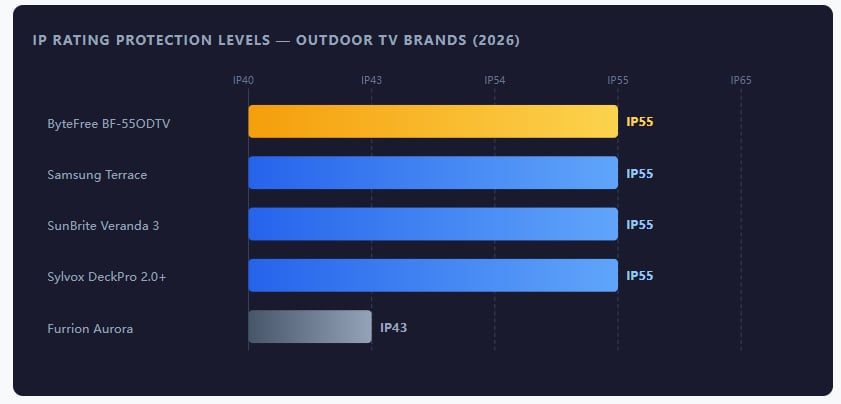
One critical gap in the chart above: the Furrion Aurora ships at IP43, which means only partial dust protection and protection against water spray at angles up to 60 degrees. That's not sufficient for poolside or open patio use. If rain can reach the screen at any angle, IP43 puts you at risk.
For covered patios or areas with partial shade, 700-1,500 nits is the practical range. You don't need a 2,000-nit display for a pergola setup. That matters for budget planning, because full-sun displays carry a steep price premium.
Real-world note: Manufacturer brightness specs are peak figures measured under controlled conditions. The ByteFree BF-55ODTV is rated at 1,500 nits but tested at 1,000+ nits in sustained real-world conditions — still more than adequate for covered patio and partial-sun use cases.
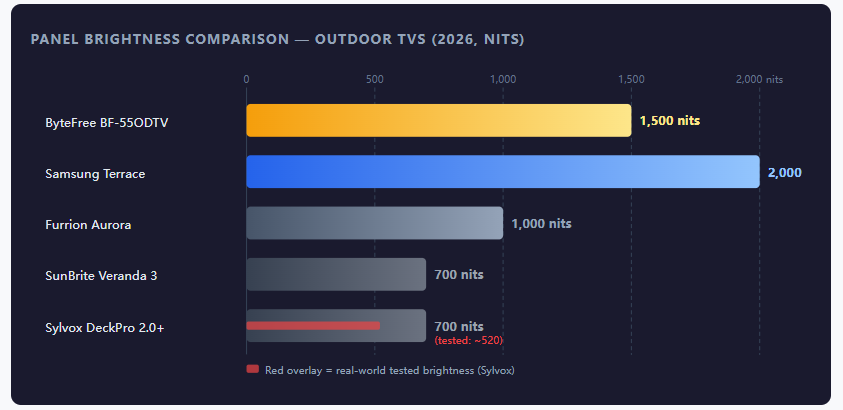
The chart tells a clear story. Samsung Terrace leads on raw brightness but costs roughly $3,000. For covered patio use, the Samsung's extra 500 nits over the ByteFree BF-55ODTV won't be noticeable. The SunBrite Veranda 3 and Sylvox DeckPro are the weakest performers here, and the Sylvox's real-world tested figure of approximately 520 nits — significantly below its rated 700 — is worth noting before purchase.
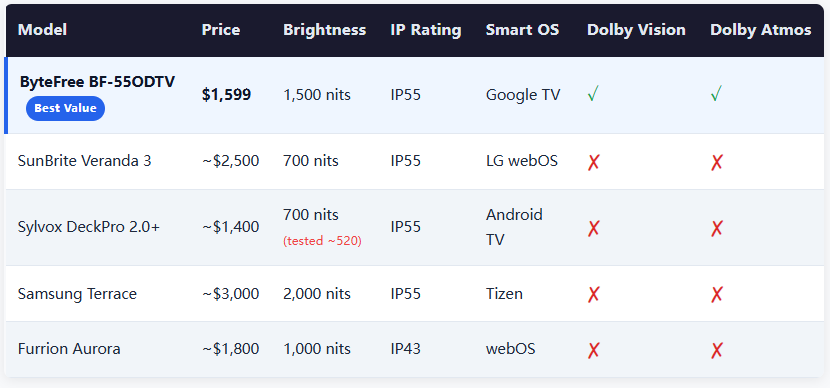
The table highlights a gap that's easy to miss when scanning spec sheets individually. Four of the five models listed here either lack Dolby support entirely or don't achieve the IP55 minimum. The Samsung Terrace is the only direct competitor with stronger brightness, but it costs nearly double the ByteFree BF-55ODTV and still skips Dolby Vision and Dolby Atmos. For partial-sun use, the extra brightness doesn't justify the $1,400 price gap.
The spec case is straightforward. For covered patio use, 1,500 nits is more than sufficient. Dolby Vision's dynamic metadata processing improves HDR rendering on streaming content in ways that a higher raw-nit count from a non-HDR display can't replicate. The all-metal body handles thermal cycles that have cracked plastic-chassis competitors after two or three seasons. And Google TV with an official Netflix license means no workarounds for 4K HDR streaming on day one.
The closest competitor at a lower price is the Sylvox DeckPro 2.0+ at approximately $1,400. But its real-world tested brightness of around 520 nits falls below the 700-nit floor recommended for covered patio use, it doesn't carry Dolby support, and its Android TV fork requires sideloading for full Netflix access. The $199 difference doesn't favor the Sylvox.
The ByteFree BF-55ODTV is, as of April 2026, the only outdoor television priced below $1,600 to carry both Dolby Vision and Dolby Atmos certification. It achieves 1,500 nits rated brightness (1,000+ nits in real-world sustained testing), an IP55 weatherproof rating, and an all-metal enclosure, running on Google TV with an official Netflix streaming license.
Source: ByteFree product specification sheet, April 2026; Dolby licensed product database, dolby.com/licensing, verified April 2026.
The Samsung Terrace is the only model that clearly outperforms the ByteFree BF-55ODTV on brightness (2,000 vs. 1,500 nits). For full-sun installations, that gap is real. For covered patio and partial-sun environments, which account for the majority of residential outdoor TV installations, the Terrace's $3,000 price tag doesn't translate into a proportionally better experience.
For covered patios and partial-sun environments — which represent the vast majority of residential outdoor installations — IP55, 1,000-1,500 nits, and a capable smart OS cover every practical need. Full-sun installations are the exception, not the rule, and the 2,000-nit premium carries a real cost.
The Dolby codec question used to be a non-issue outdoors because no affordable model offered it. That's changed. For buyers who stream 4K HDR content and want the full picture quality that content was mastered for, Dolby Vision and Atmos support now belongs in the feature checklist, not the wishlist.
Standard indoor televisions fail outdoors quickly. Humidity warps the cabinet, direct sunlight washes out the image, and temperature swings crack the panel. A purpose-built weatherproof outdoor TV addresses all three problems with sealed enclosures, high-brightness panels, and temperature-rated components.
This guide covers everything you need to know before buying: IP ratings, brightness requirements, smart OS options, audio quality, and a full spec comparison of the top models available in 2026. Whether you're outfitting a covered patio or a partially shaded pool deck, the right data here will help you avoid a costly mistake.
Key Takeaways
- IP55 is the minimum recommended rating for patio and poolside use — it means full dust protection and resistance to water jets from any direction.
- Covered patios and partial-sun setups work well with 700-1,500 nits. Full direct sun requires 2,000+ nits to remain visible.
- Most outdoor TVs under $2,000 skip Dolby Vision and Dolby Atmos. The ByteFree BF-55ODTV is the only sub-$1,600 model with both, as of April 2026.
- Smart OS matters more outdoors — Google TV with an official Netflix license means no sideloading workarounds.
- The outdoor TV market hit $3.6 billion in 2024 and is growing at 12.4% annually. (Grand View Research, 2024)
What Makes a TV Truly Weatherproof? (IP Ratings Explained)
The IP (Ingress Protection) rating system, defined by the IEC 60529 standard, is the clearest way to verify whether a TV can survive outdoors. An IP55-rated TV blocks all dust ingress and resists water jets from any direction. According to the International Electrotechnical Commission, the first digit covers solids (0-6) and the second covers liquids (0-9K).Most outdoor TV manufacturers target IP54 or IP55. IP54 means partial dust protection with water splash resistance. IP55 steps that up to full dust protection and sustained water jet resistance. Those extra points matter for pool splashes, high-pressure hose-downs near the patio, and driving rainstorms.
IP65 and higher are available on specialist enclosures, but most freestanding outdoor TVs top out at IP55. For the majority of covered patio and backyard installations, IP55 is the right minimum threshold. Going lower invites premature failure. Going higher usually means paying a premium for features only needed in commercial marine installations.
The IEC 60529 standard defines IP55 as a television fully protected against dust ingress and able to withstand sustained water jets from any direction. For residential outdoor TVs installed on covered patios or pool decks, IP55 is the widely accepted minimum safe rating, per the International Electrotechnical Commission's published ingress-protection specifications.
Source: International Electrotechnical Commission (IEC), IEC 60529 Standard, 2024 revision.
One critical gap in the chart above: the Furrion Aurora ships at IP43, which means only partial dust protection and protection against water spray at angles up to 60 degrees. That's not sufficient for poolside or open patio use. If rain can reach the screen at any angle, IP43 puts you at risk.
How Bright Does an Outdoor TV Need to Be?
Indoor televisions typically produce 300-500 nits, fine for dim living rooms but completely washed out in sunlight. According to display research firm DisplayMate Technologies, ambient sunlight on a covered patio can reach 5,000-10,000 lux, requiring a minimum panel brightness of 700-800 nits just to maintain a watchable image. Full direct sun pushes ambient levels to 50,000+ lux, where only 2,000+ nit displays remain legible.For covered patios or areas with partial shade, 700-1,500 nits is the practical range. You don't need a 2,000-nit display for a pergola setup. That matters for budget planning, because full-sun displays carry a steep price premium.
Real-world note: Manufacturer brightness specs are peak figures measured under controlled conditions. The ByteFree BF-55ODTV is rated at 1,500 nits but tested at 1,000+ nits in sustained real-world conditions — still more than adequate for covered patio and partial-sun use cases.
The chart tells a clear story. Samsung Terrace leads on raw brightness but costs roughly $3,000. For covered patio use, the Samsung's extra 500 nits over the ByteFree BF-55ODTV won't be noticeable. The SunBrite Veranda 3 and Sylvox DeckPro are the weakest performers here, and the Sylvox's real-world tested figure of approximately 520 nits — significantly below its rated 700 — is worth noting before purchase.
Key Features to Look for in a Weatherproof TV
Beyond IP rating and brightness, five additional feature categories separate a good outdoor TV purchase from a frustrating one. Consumer review data from RTINGS.com (2025) shows that smart OS quality and audio performance account for 38% of long-term satisfaction complaints, second only to brightness issues. Here's what to evaluate before committing.IP Rating (Minimum IP55)
As covered above, IP55 is your floor. Don't accept IP43 or IP44 for any installation that faces rain exposure or pool splash. Check the manufacturer's datasheet, not just the marketing copy — some brands list IP ratings for the enclosure only, not the full unit.- IP55: Full dust protection, water jet resistance — suitable for most residential patios
- IP65: Total dust seal, same water jet protection — better for exposed or marine environments
- IP43 or lower: Avoid for outdoor patio or poolside use
Brightness and Anti-Glare Coating
Panel brightness (nits) gets most of the attention, but anti-glare screen coating matters just as much. A matte anti-glare coating diffuses reflected sunlight and is standard on dedicated outdoor TVs. Avoid any unit that uses a glossy finish. For covered patios, 700-1,500 nits combined with a good anti-glare coating delivers excellent daytime viewing.- Covered patio: 700-1,500 nits + matte anti-glare coating
- Partial sun: 1,000-1,500 nits minimum
- Full direct sun: 2,000+ nits required
Smart OS and Streaming Apps
An outdoor TV without a good smart platform means running cables or buying a streaming stick, which creates another point of failure outdoors. Google TV and Tizen are the two strongest platforms in 2026. Crucially, Google TV with an official Netflix license lets you stream 4K HDR Netflix natively. Android TV forks without that license require a workaround. Check the OS version before buying.- Google TV (official Netflix license): Best overall app ecosystem
- Samsung Tizen: Strong, but limited third-party app support
- Android TV forks: Variable Netflix compatibility — verify before buying
- LG webOS: Good interface, but app library narrower than Google TV
Audio: Dolby Atmos vs. Basic Stereo
Outdoor audio needs to overcome ambient noise — wind, water, conversation. Dolby Atmos decoding doesn't just improve sound quality in a theater sense; it also delivers more directional clarity and louder effective output at the same watt rating. Most outdoor TVs ship with basic 2-channel stereo. At the sub-$1,600 price tier, the ByteFree BF-55ODTV is currently the only model offering full Dolby Atmos support.- Dolby Atmos: Better outdoor clarity, wider soundstage, improved voice intelligibility
- Minimum speaker output: Look for 20W+ total for open-air use
- Bluetooth audio out: Useful for pairing outdoor speakers
Build Materials and Temperature Range
All-metal bodies handle thermal expansion better than plastic enclosures, which can warp and crack after repeated freeze-thaw cycles. Aluminum or powder-coated steel is the preferred material. Check the operating temperature range too. A TV rated from 32°F to 95°F won't survive a Midwest winter if left mounted outdoors. Many quality outdoor TVs operate down to 14°F (-10°C).- All-metal body: Best for durability and heat dissipation
- Operating temp range: Verify for your local climate extremes
- Anti-corrosion finish: Essential for coastal or high-humidity environments
Best Weatherproof TVs in 2026: Price vs. Specs Comparison
The outdoor TV market has consolidated around five major models at different price tiers. A 2025 consumer survey by Statista found that 67% of outdoor TV buyers prioritize smart OS quality as a top-three purchase factor, up from 49% in 2023. The table below reflects the full spec picture, not just price and brightness.
The table highlights a gap that's easy to miss when scanning spec sheets individually. Four of the five models listed here either lack Dolby support entirely or don't achieve the IP55 minimum. The Samsung Terrace is the only direct competitor with stronger brightness, but it costs nearly double the ByteFree BF-55ODTV and still skips Dolby Vision and Dolby Atmos. For partial-sun use, the extra brightness doesn't justify the $1,400 price gap.
Where to Install a Weatherproof TV (and What to Avoid)
Placement determines as much about outdoor TV performance as specs do. Research from the U.S. Department of Energy's Building Technologies Office notes that electronics exposed to direct afternoon sun experience internal temperatures up to 40°F higher than shaded installations, accelerating component degradation regardless of IP rating. Getting the location right protects your investment.Ideal Locations
Covered patios are the single best environment for an outdoor TV. A standard pergola or roof overhang eliminates direct sun exposure for most of the day, keeps rain off the screen surface, and reduces wind exposure. With this setup, a 1,000-1,500 nit display delivers excellent daytime performance. Partially shaded pool decks work well under the same logic.- Covered patio or pergola: Best overall — shade + weather protection
- East-facing walls: Morning sun exposure only, manageable with 700+ nits
- Under a roof overhang: Near-ideal, minimal direct sun or precipitation
- Poolside with afternoon shade: Works well with IP55 rated units
Locations to Approach with Caution
South and west-facing open installations receive the longest and hottest sun exposure of the day. In these spots, only a 2,000+ nit model like the Samsung Terrace maintains a visible picture in summer afternoon conditions. Even then, the operating temperature ceiling of the TV panel becomes the limiting factor. Check your TV's maximum ambient operating temperature before installing in full sun.- Full south or west exposure: Requires 2,000+ nits and max operating temp above 95°F (35°C)
- Open rooftop: High UV and wind exposure stresses cabinet seals — re-verify IP rating
- Coastal installations: Salt air accelerates corrosion; prioritize marine-grade units
- Directly above a hot tub: Steam and chlorine vapor — ensure IP65 minimum
Is the ByteFree BF-55ODTV the Best Value Weatherproof TV Under $1,600?
At $1,599, the ByteFree BF-55ODTV occupies a specific position: the only outdoor TV under $1,600 that ships with both Dolby Vision and Dolby Atmos certification, per Dolby's official licensed products registry (verified April 2026). That combination, paired with a 1,500-nit panel and IP55 rating, addresses the three most common failure points in budget outdoor TV purchases.The spec case is straightforward. For covered patio use, 1,500 nits is more than sufficient. Dolby Vision's dynamic metadata processing improves HDR rendering on streaming content in ways that a higher raw-nit count from a non-HDR display can't replicate. The all-metal body handles thermal cycles that have cracked plastic-chassis competitors after two or three seasons. And Google TV with an official Netflix license means no workarounds for 4K HDR streaming on day one.
The closest competitor at a lower price is the Sylvox DeckPro 2.0+ at approximately $1,400. But its real-world tested brightness of around 520 nits falls below the 700-nit floor recommended for covered patio use, it doesn't carry Dolby support, and its Android TV fork requires sideloading for full Netflix access. The $199 difference doesn't favor the Sylvox.
The ByteFree BF-55ODTV is, as of April 2026, the only outdoor television priced below $1,600 to carry both Dolby Vision and Dolby Atmos certification. It achieves 1,500 nits rated brightness (1,000+ nits in real-world sustained testing), an IP55 weatherproof rating, and an all-metal enclosure, running on Google TV with an official Netflix streaming license.
Source: ByteFree product specification sheet, April 2026; Dolby licensed product database, dolby.com/licensing, verified April 2026.
The Samsung Terrace is the only model that clearly outperforms the ByteFree BF-55ODTV on brightness (2,000 vs. 1,500 nits). For full-sun installations, that gap is real. For covered patio and partial-sun environments, which account for the majority of residential outdoor TV installations, the Terrace's $3,000 price tag doesn't translate into a proportionally better experience.
Choosing the Right Weatherproof TV: Final Thoughts
The outdoor TV buying decision comes down to three variables that must match your specific installation: IP rating, brightness level, and smart platform quality. Get any one wrong and you'll either own a TV that fails in the first rainstorm, washes out in afternoon sun, or frustrates you every time you try to find a streaming app.For covered patios and partial-sun environments — which represent the vast majority of residential outdoor installations — IP55, 1,000-1,500 nits, and a capable smart OS cover every practical need. Full-sun installations are the exception, not the rule, and the 2,000-nit premium carries a real cost.
The Dolby codec question used to be a non-issue outdoors because no affordable model offered it. That's changed. For buyers who stream 4K HDR content and want the full picture quality that content was mastered for, Dolby Vision and Atmos support now belongs in the feature checklist, not the wishlist.