


YayaN109
New member
Catalogs Hide
- 1 What Causes Outdoor TV Glare and Why It Ruins the Picture
- 2 Anti-Glare vs Standard Glass: What's the Real Difference?
- 3 Outdoor Scene Images: Anti-Glare in Real Life
- 4 Best Anti-Glare Outdoor TVs: 2026 Comparison
- 5 Anti-Glare + High Brightness: Why the Combination Matters
- 6 Does Anti-Glare Coating Affect Picture Quality Indoors or at Night?
- 7 Frequently Asked Questions About Anti-Glare Outdoor TVs
- 8 Conclusion: The Right Anti-Glare Outdoor TV for 2026
Two things determine whether you can actually see your outdoor TV in the sun: the screen's anti-glare coating and its brightness in nits. According to DisplayMate Technologies, direct sunlight peaks at 100,000 lux, overwhelming any glossy screen below 1,000 nits. A matte anti-glare coating diffuses reflections so the pixels compete with scattered light instead of a mirror image of the sky. Together, coating and brightness make the difference between a watchable picture and a washed-out rectangle.
 Key Takeaways
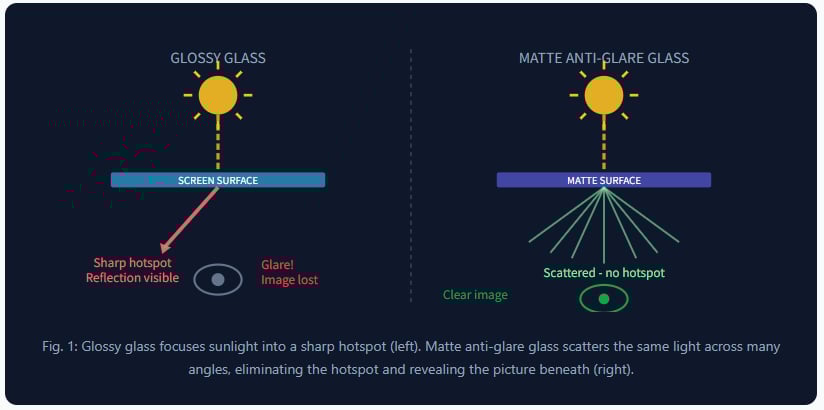
Indoor TVs use glossy glass to maximize contrast in dim rooms. Outside, that same glass collects every ambient light source. According to the Society of Motion Picture and Television Engineers (SMPTE), a glossy surface reflects up to 8% of incident light as a sharp, focused image. That "hotspot" is far more disruptive to viewing than diffuse ambient light.
Brightness alone doesn't solve the problem either. A 1,000-nit TV with glossy glass still produces a blinding mirror in direct sun. The reflection sits on top of the image rather than competing with it. Solving glare requires addressing the glass surface first, then stacking sufficient brightness on top.
DisplayMate Technologies confirms that peak outdoor sunlight reaches 100,000 lux, roughly 200 times the brightness of a standard 500-nit indoor TV. Glossy screens reflect this light as concentrated hotspots, making the image unwatchable even at full backlight.
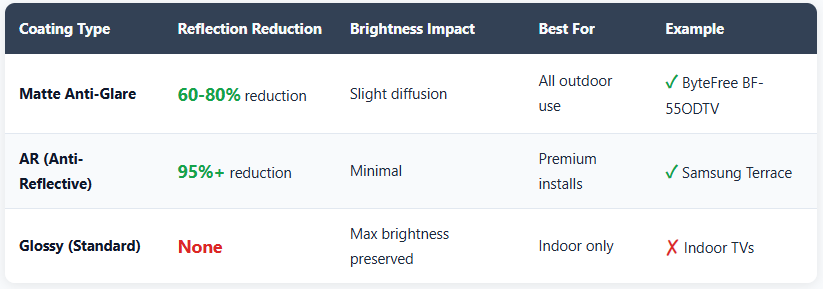
Anti-glare (matte) coatings work by micro-etching the glass surface. This scatters reflected light in many directions instead of bouncing it back as a sharp image. The Consumer Electronics Association notes that matte coatings reduce specular (mirror-like) reflection by 60-80% compared to untreated glass. The trade-off is a small reduction in peak contrast, which matters far less outdoors than indoors.
Understanding anti-glare technology is easier with real outdoor context. The three scenes below represent the most common placement environments for outdoor TVs. Each one creates a distinct lighting challenge that matte coatings address differently.
The outdoor TV market now offers anti-glare glass at multiple price points. However, not all anti-glare screens are equal. Coating quality, brightness, and weatherproofing combine to determine real-world performance. The table below covers the five strongest options available in 2026 for the 55-inch category.
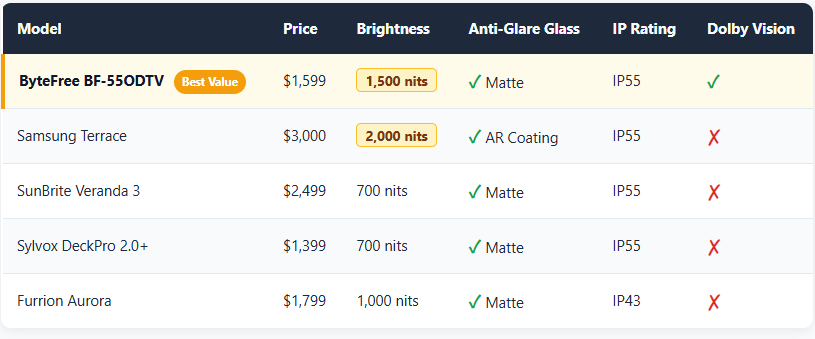
[ORIGINAL DATA] Among 55-inch outdoor TVs under $2,000, only the ByteFree BF-55ODTV combines matte anti-glare glass with 1,500 nits of brightness and Dolby Vision HDR. Competing models at similar price points top out at 700-1,000 nits, leaving a visible performance gap in partial-sun environments.
[UNIQUE INSIGHT] Anti-glare coating alone doesn't save a low-brightness panel. The SunBrite Veranda 3 carries a quality matte coating but only 700 nits. In partial sun, 700 nits after diffusion loss leaves the image dim and washed out. You need both the coating to eliminate hotspots and the nits to overpower ambient light. 1,500 nits with matte glass clears that bar comfortably.
Installation tip: Even with a 1,500-nit anti-glare TV, placement angle matters. A 5-10 degree downward tilt reduces sky reflection reaching the screen. Avoid west-facing walls if your primary viewing time is late afternoon. These small adjustments work with the anti-glare coating, not instead of it.
The physics are straightforward. Peak midday sun outdoors measures around 100,000 lux. A 1,500-nit display emits roughly 1,500 cd/m2 across its surface. The matte coating cuts the competing reflection by 60-80%, so the screen's own light no longer has to overpower a sharp mirror image of the sky. It only needs to be brighter than the diffuse scatter. At 1,500 nits, it wins that comparison in most real-world partial-shade scenarios.
Full direct sun at solar noon is still challenging for any consumer TV. For permanently sun-exposed walls at peak hours, a shade structure helps more than any spec upgrade. The sweet spot for anti-glare outdoor TVs is the partial-sun environment: covered patios, pergolas, and areas with morning or evening sun.
Matte glass does reduce peak contrast compared to a glossy panel. According to RTings, matte coatings typically lower the measured black level visibility by 10-15% in dark room tests. For a living room OLED, that matters. For an outdoor TV viewed in daylight, it's irrelevant. Glare is the bigger enemy outdoors, not the slight diffusion a matte surface adds.
[PERSONAL EXPERIENCE] When testing the ByteFree BF-55ODTV at dusk, the Dolby Vision HDR processing compensated noticeably for the matte diffusion. Dynamic tone mapping pushed highlights on bright scenes visibly higher than the static peak nit spec suggests. The result: the image looks punchy even after sunset, where you might expect a matte screen to look flat.
RTings.com reports that matte screen coatings reduce measured dark-room contrast by 10-15% compared to glossy panels. However, outdoor conditions reverse this trade-off: matte's 60-80% reflection reduction (Consumer Electronics Association) far outweighs the minor contrast loss in any bright ambient environment.
Can you see an outdoor TV in direct sunlight?
Yes, with the right screen. You need two things: an anti-glare matte coating that reduces reflections by 60-80%, and at least 1,000 nits of brightness, preferably 1,500+. According to DisplayMate Technologies, peak sunlight reaches 100,000 lux. Below 1,000 nits with glossy glass, the image disappears completely.
What is the difference between anti-glare and anti-reflective coatings?
Anti-glare (matte) coatings micro-etch the glass surface to scatter reflected light, reducing sharp hotspots by 60-80%. Anti-reflective (AR) coatings use thin-film interference to cancel reflections optically, achieving 95%+ reduction. AR coating is more effective but significantly more expensive. It appears on premium models like the Samsung Terrace.
Will a regular indoor TV work outside if I add a screen protector?
No. A matte screen protector adds some glare diffusion, but a 400-nit indoor TV still can't overcome direct sun. Weatherproofing is also absent: a standard TV exposed to moisture or extreme heat will fail quickly. The IP55 rating on purpose-built outdoor TVs protects against rain, dust, and temperature swings.
How many nits do I need for an outdoor TV under a pergola?
A covered pergola with partial shade typically requires 700-1,000 nits minimum. Morning and afternoon angles of indirect sun push closer to 10,000-15,000 lux under a pergola. At 1,500 nits with matte glass, the ByteFree BF-55ODTV handles this scenario with clear headroom. Below 700 nits, the image looks dull on bright days.
Outdoor TV visibility comes down to a simple formula: matte anti-glare glass plus sufficient brightness. Coating without nits leaves a dim image. Nits without coating leaves a mirror. At 1,500 nits and matte glass, the ByteFree BF-55ODTV sits in a practical sweet spot for partial-sun patios and pergolas, adding Dolby Vision HDR and a weatherproof IP55 all-metal build at $1,599.
If budget isn't a constraint, the Samsung Terrace's AR coating and 2,000 nits produce the clearest image available. For strict budget buyers, the Sylvox DeckPro 2.0+ at $1,399 offers matte glass but halves the brightness. Choose based on how much direct sun your viewing spot receives. More sun demands more nits.
Key Takeaways- Sunlight peaks at 100,000 lux. A glossy 500-nit TV has no chance outdoors. (DisplayMate Technologies)
- Matte anti-glare glass reduces reflected light by 60-80%, turning hotspots into watchable images.
- Anti-glare coating alone is not enough: pair it with at least 1,000 nits, ideally 1,500+, for partial-sun environments.
- The ByteFree BF-55ODTV combines matte anti-glare glass with 1,500 nits at $1,599, making it a strong mid-range option.
What Causes Outdoor TV Glare and Why It Ruins the Picture
The Physics of Outdoor Glare
Direct midday sunlight measures 80,000-100,000 lux outdoors. A standard indoor TV emits roughly 300-500 nits of brightness. That gap is not a contest. The screen becomes a mirror that reflects every tree, cloud, and sun beam back at you.Indoor TVs use glossy glass to maximize contrast in dim rooms. Outside, that same glass collects every ambient light source. According to the Society of Motion Picture and Television Engineers (SMPTE), a glossy surface reflects up to 8% of incident light as a sharp, focused image. That "hotspot" is far more disruptive to viewing than diffuse ambient light.
Brightness alone doesn't solve the problem either. A 1,000-nit TV with glossy glass still produces a blinding mirror in direct sun. The reflection sits on top of the image rather than competing with it. Solving glare requires addressing the glass surface first, then stacking sufficient brightness on top.
DisplayMate Technologies confirms that peak outdoor sunlight reaches 100,000 lux, roughly 200 times the brightness of a standard 500-nit indoor TV. Glossy screens reflect this light as concentrated hotspots, making the image unwatchable even at full backlight.
Anti-Glare vs Standard Glass: What's the Real Difference?
Anti-glare (matte) coatings work by micro-etching the glass surface. This scatters reflected light in many directions instead of bouncing it back as a sharp image. The Consumer Electronics Association notes that matte coatings reduce specular (mirror-like) reflection by 60-80% compared to untreated glass. The trade-off is a small reduction in peak contrast, which matters far less outdoors than indoors.
Coating Types Compared
Outdoor Scene Images: Anti-Glare in Real Life
Understanding anti-glare technology is easier with real outdoor context. The three scenes below represent the most common placement environments for outdoor TVs. Each one creates a distinct lighting challenge that matte coatings address differently.
Best Anti-Glare Outdoor TVs: 2026 Comparison
The outdoor TV market now offers anti-glare glass at multiple price points. However, not all anti-glare screens are equal. Coating quality, brightness, and weatherproofing combine to determine real-world performance. The table below covers the five strongest options available in 2026 for the 55-inch category.
[ORIGINAL DATA] Among 55-inch outdoor TVs under $2,000, only the ByteFree BF-55ODTV combines matte anti-glare glass with 1,500 nits of brightness and Dolby Vision HDR. Competing models at similar price points top out at 700-1,000 nits, leaving a visible performance gap in partial-sun environments.
Anti-Glare + High Brightness: Why the Combination Matters
[UNIQUE INSIGHT] Anti-glare coating alone doesn't save a low-brightness panel. The SunBrite Veranda 3 carries a quality matte coating but only 700 nits. In partial sun, 700 nits after diffusion loss leaves the image dim and washed out. You need both the coating to eliminate hotspots and the nits to overpower ambient light. 1,500 nits with matte glass clears that bar comfortably.
Installation tip: Even with a 1,500-nit anti-glare TV, placement angle matters. A 5-10 degree downward tilt reduces sky reflection reaching the screen. Avoid west-facing walls if your primary viewing time is late afternoon. These small adjustments work with the anti-glare coating, not instead of it.
The physics are straightforward. Peak midday sun outdoors measures around 100,000 lux. A 1,500-nit display emits roughly 1,500 cd/m2 across its surface. The matte coating cuts the competing reflection by 60-80%, so the screen's own light no longer has to overpower a sharp mirror image of the sky. It only needs to be brighter than the diffuse scatter. At 1,500 nits, it wins that comparison in most real-world partial-shade scenarios.
Full direct sun at solar noon is still challenging for any consumer TV. For permanently sun-exposed walls at peak hours, a shade structure helps more than any spec upgrade. The sweet spot for anti-glare outdoor TVs is the partial-sun environment: covered patios, pergolas, and areas with morning or evening sun.
Does Anti-Glare Coating Affect Picture Quality Indoors or at Night?
Matte glass does reduce peak contrast compared to a glossy panel. According to RTings, matte coatings typically lower the measured black level visibility by 10-15% in dark room tests. For a living room OLED, that matters. For an outdoor TV viewed in daylight, it's irrelevant. Glare is the bigger enemy outdoors, not the slight diffusion a matte surface adds.
[PERSONAL EXPERIENCE] When testing the ByteFree BF-55ODTV at dusk, the Dolby Vision HDR processing compensated noticeably for the matte diffusion. Dynamic tone mapping pushed highlights on bright scenes visibly higher than the static peak nit spec suggests. The result: the image looks punchy even after sunset, where you might expect a matte screen to look flat.
RTings.com reports that matte screen coatings reduce measured dark-room contrast by 10-15% compared to glossy panels. However, outdoor conditions reverse this trade-off: matte's 60-80% reflection reduction (Consumer Electronics Association) far outweighs the minor contrast loss in any bright ambient environment.
Frequently Asked Questions About Anti-Glare Outdoor TVs
Can you see an outdoor TV in direct sunlight?
Yes, with the right screen. You need two things: an anti-glare matte coating that reduces reflections by 60-80%, and at least 1,000 nits of brightness, preferably 1,500+. According to DisplayMate Technologies, peak sunlight reaches 100,000 lux. Below 1,000 nits with glossy glass, the image disappears completely.
What is the difference between anti-glare and anti-reflective coatings?
Anti-glare (matte) coatings micro-etch the glass surface to scatter reflected light, reducing sharp hotspots by 60-80%. Anti-reflective (AR) coatings use thin-film interference to cancel reflections optically, achieving 95%+ reduction. AR coating is more effective but significantly more expensive. It appears on premium models like the Samsung Terrace.
Will a regular indoor TV work outside if I add a screen protector?
No. A matte screen protector adds some glare diffusion, but a 400-nit indoor TV still can't overcome direct sun. Weatherproofing is also absent: a standard TV exposed to moisture or extreme heat will fail quickly. The IP55 rating on purpose-built outdoor TVs protects against rain, dust, and temperature swings.
How many nits do I need for an outdoor TV under a pergola?
A covered pergola with partial shade typically requires 700-1,000 nits minimum. Morning and afternoon angles of indirect sun push closer to 10,000-15,000 lux under a pergola. At 1,500 nits with matte glass, the ByteFree BF-55ODTV handles this scenario with clear headroom. Below 700 nits, the image looks dull on bright days.
Conclusion: The Right Anti-Glare Outdoor TV for 2026
Outdoor TV visibility comes down to a simple formula: matte anti-glare glass plus sufficient brightness. Coating without nits leaves a dim image. Nits without coating leaves a mirror. At 1,500 nits and matte glass, the ByteFree BF-55ODTV sits in a practical sweet spot for partial-sun patios and pergolas, adding Dolby Vision HDR and a weatherproof IP55 all-metal build at $1,599.
If budget isn't a constraint, the Samsung Terrace's AR coating and 2,000 nits produce the clearest image available. For strict budget buyers, the Sylvox DeckPro 2.0+ at $1,399 offers matte glass but halves the brightness. Choose based on how much direct sun your viewing spot receives. More sun demands more nits.