


Catalogs Hide
If you've spent any time shopping for a 55-inch outdoor TV recently, you've probably noticed two things: the options have gotten much better, and the marketing has gotten much louder. Every brand is claiming "super bright," "fully weatherproof," and "cinema-quality sound" — and some of them are actually telling the truth.
This guide cuts through the noise. We'll walk you through what specs actually matter, what's just spec-sheet fluff, and which 55" outdoor TVs are worth your money in 2026.
The biggest issue people run into is brightness. A typical indoor TV runs around 300–500 nits. That's plenty for a darkened living room. Outside, with direct sunlight or even bright ambient light, you need at least 700–1,000 nits just to see anything clearly, and 1,500+ nits to watch comfortably in partial sun. Go below that threshold and you'll be squinting at a grey rectangle.
The second issue is weather resistance. "Weatherproof" means different things to different brands. Look for an actual IP rating — specifically IP55 or higher. That means the TV can handle dust ingress and sustained water jets from any direction. IP54 (common on budget outdoor TVs) offers less protection and won't hold up to a garden hose or pressure washer nearby.
Third: smart platform. You're installing this thing on a patio or backyard wall. You want a proper streaming OS, not a stripped-down interface that requires you to run a separate streaming stick. Google TV is currently the best outdoor option — it has full Play Store access, Chromecast built in, and works with Google Assistant.
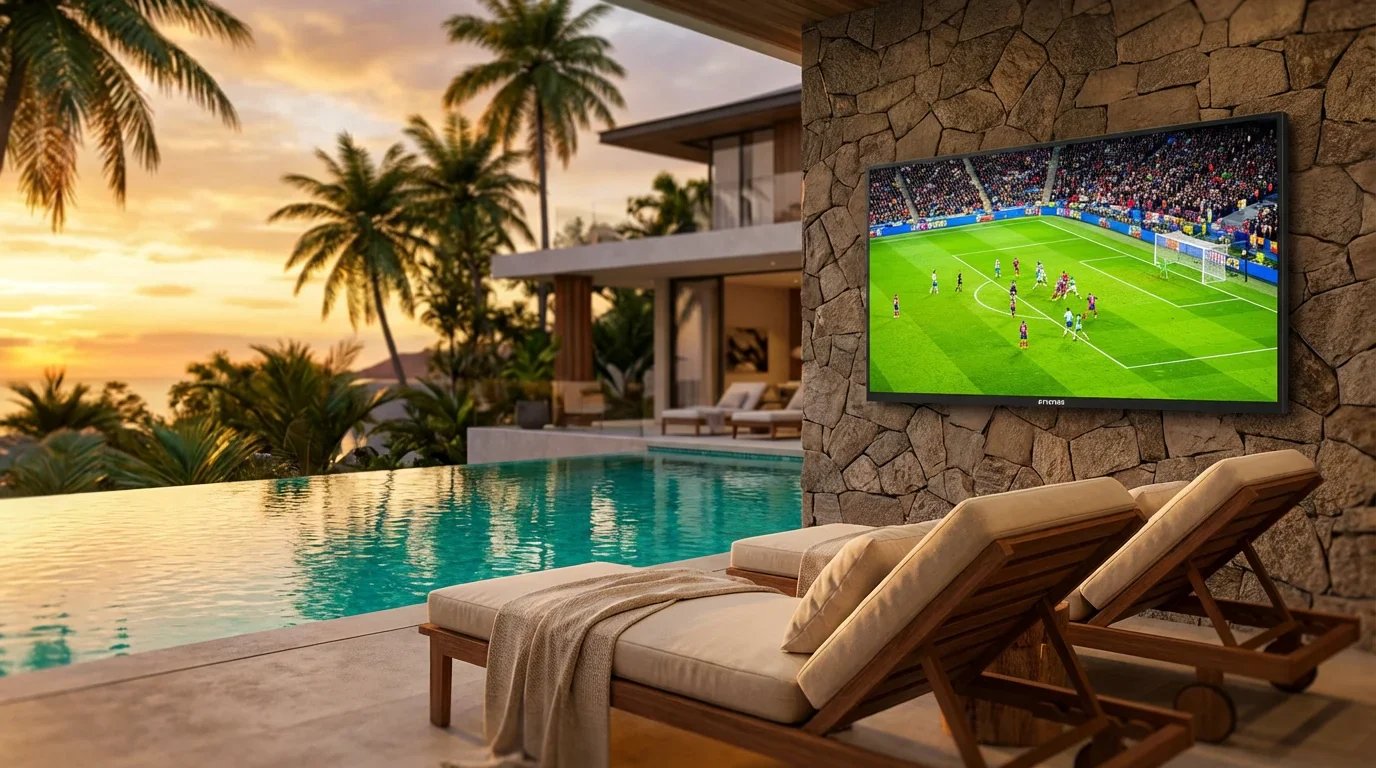
The ByteFree BF-55ODTV( https://bytefree.net/) is the most well-rounded 55-inch outdoor TV available right now, and it's the one we'd recommend to most people without hesitation.
What makes it stand out:
At 1,500 nits peak brightness (with real-world performance around 1,000 nits in standard mode and 900+ nits in actual viewing conditions), it's the brightest 55" outdoor TV at this price point. Sylvox and Sunbrite's comparable models top out at 1,000 nits on paper and lower in practice.
The panel supports Dolby Vision and Dolby Atmos — both, at $1,599. That's genuinely unusual. The Sylvox Deck Pro 2.0+ costs exactly the same and doesn't have Dolby Vision. The Sunbrite Veranda 3 has Dolby Vision but costs $100 more and uses Android TV rather than Google TV.
The speakers are 2 × 15W with Dolby Atmos processing, which is meaningfully louder than the 2 × 10W setups you'll find on most competitors. Outdoors, that difference is noticeable.
On the connectivity side: 2× HDMI 2.0, 1× HDMI 2.1 with eARC, 2× USB 2.0, Ethernet, Wi-Fi 5, and Bluetooth 5.1. The HDMI 2.1 port supports ALLM (Auto Low Latency Mode), which is useful if you're running a PS5, Xbox Series X, or Switch through it.
The Google TV interface comes with Netflix, YouTube, and other streaming apps pre-installed. Chromecast is built in, and Google Assistant works via the included voice remote (which is waterproof, by the way — rare).
A few honest notes:
The operating temperature range is 0°C to 50°C (32°F to 122°F). That's standard for the category, but it does mean you should power it off during extreme heat events. Storage range is -20°C to 60°C, so cold winters aren't a concern for storage.
The TV is rated for partial-sun environments, not full direct sun all day. If your install location gets 6+ hours of unobstructed afternoon sun, consider a shade structure or look at the higher-end full-sun models.
Weight is 63 lbs (28.5 kg), so mount installation is a two-person job. VESA pattern is 600×400mm.
Bottom line: At $1,599, the ByteFree BF-55ODTV gives you more brightness, better audio, and superior HDR support than anything else at this price. It's the value play in the 55" outdoor TV market right now.
The Deck Pro 3.0 is Sylvox's current flagship, and it's genuinely good — just less compelling than it used to be before ByteFree entered this segment.
The IP56 rating (vs. IP55 on most others) means it handles high-pressure water jets better, which matters if you pressure-wash your patio regularly. It runs Google TV, supports Dolby Atmos, and has a solid build quality with a mature warranty program behind it.
The gaps: 1,000 nits vs. ByteFree's 1,500 nits is a real-world visibility difference in partially sunny conditions. And at $1,699 — $100 more — you're paying more for marginally better water resistance but giving up 50% of the brightness spec and Dolby Vision support.
If IP56 is specifically what your setup needs, the Deck Pro 3.0 earns its place. Otherwise, the value math doesn't favor it.
Sunbrite has been in the outdoor TV game longer than almost anyone, and the Veranda 3 is their answer for covered patio installations where ambient light — not direct sun — is the main concern.
It runs Android TV (not Google TV, so the interface isn't quite as clean), supports Dolby Vision and Dolby Atmos, and has good build quality. The 1,000-nit brightness is sufficient if you're genuinely covered and shaded.
The catch: at $1,699, you're paying a brand-recognition premium. The underlying specs don't justify the price over the ByteFree or even the Sylvox Deck Pro 2.0+. But if you already own Sunbrite products and are familiar with their ecosystem and support experience, staying in that family makes sense.
The Furrion Aurora Partial-Sun is the budget entry in this roundup, and it earns that slot honestly. At $1,499, it's the cheapest name-brand option, and WebOS is actually a pleasant interface to use — Furrion licenses it from LG.
The limitations are real though. 750 nits is borderline for partial-sun use. IP54 means it can't handle sustained water exposure the way IP55+ models can. And the 2 × 8W speakers will struggle in any environment with wind or noise.
This TV makes sense for covered patios in mild climates where you genuinely won't push the brightness or weather resistance specs. But for most buyers spending $1,500+ on an outdoor TV, the ByteFree represents a better investment.
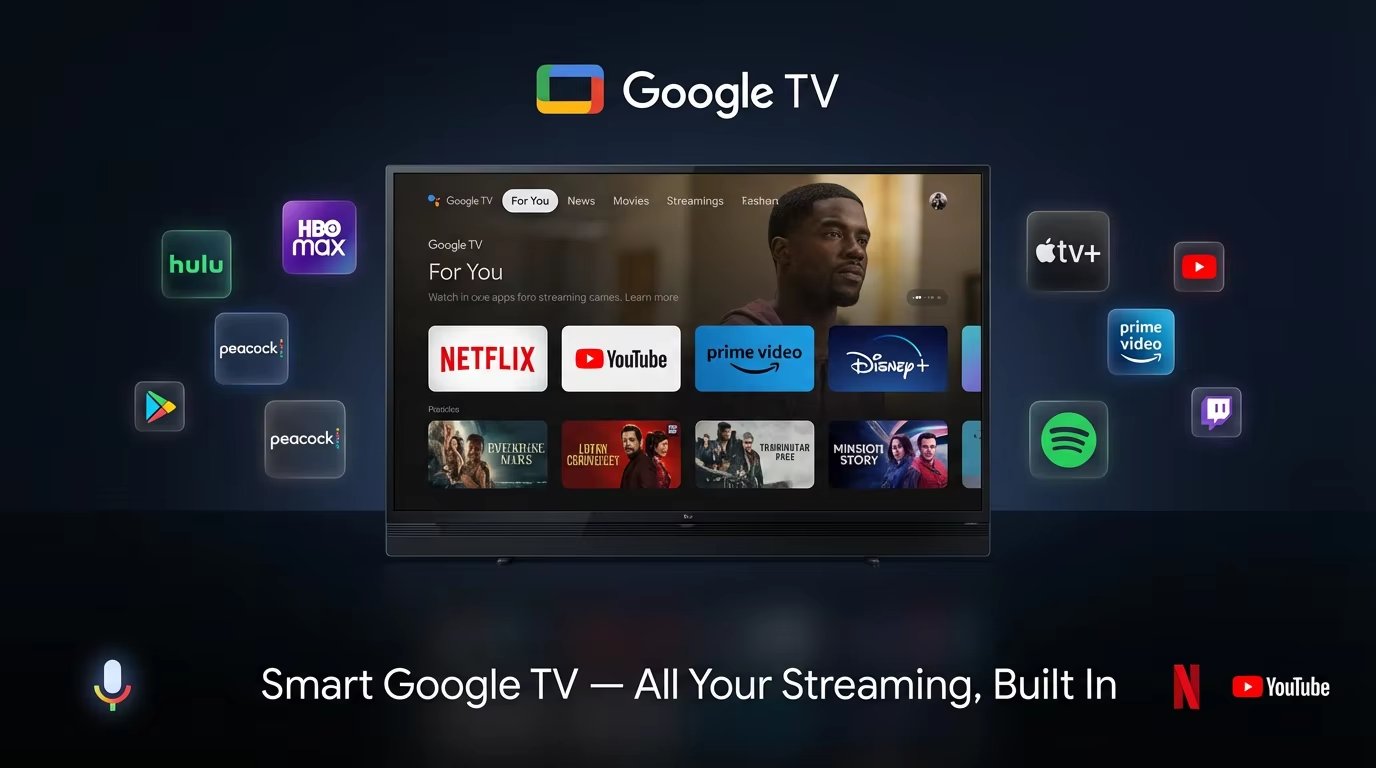
In 2026, the ByteFree BF-55ODTV hits that combination harder than anything else at its price point. Higher brightness than the Sylvox it goes up against, better audio than the Sunbrite, Dolby Vision support that most $1,599 competitors skip, and a genuinely polished Google TV experience. That combination is hard to argue with.
If you've been putting off the backyard TV upgrade, this is a reasonable year to pull the trigger.
This guide cuts through the noise. We'll walk you through what specs actually matter, what's just spec-sheet fluff, and which 55" outdoor TVs are worth your money in 2026.
Why Outdoor TVs Are a Different Category Entirely
This isn't just a regular TV in a weatherproof box. Outdoor televisions are engineered around a completely different set of priorities — and if you buy the wrong one, you'll know within the first sunny afternoon.The biggest issue people run into is brightness. A typical indoor TV runs around 300–500 nits. That's plenty for a darkened living room. Outside, with direct sunlight or even bright ambient light, you need at least 700–1,000 nits just to see anything clearly, and 1,500+ nits to watch comfortably in partial sun. Go below that threshold and you'll be squinting at a grey rectangle.
The second issue is weather resistance. "Weatherproof" means different things to different brands. Look for an actual IP rating — specifically IP55 or higher. That means the TV can handle dust ingress and sustained water jets from any direction. IP54 (common on budget outdoor TVs) offers less protection and won't hold up to a garden hose or pressure washer nearby.
Third: smart platform. You're installing this thing on a patio or backyard wall. You want a proper streaming OS, not a stripped-down interface that requires you to run a separate streaming stick. Google TV is currently the best outdoor option — it has full Play Store access, Chromecast built in, and works with Google Assistant.
The 5 Specs That Actually Matter
Before looking at any specific model, know what to check:1. Brightness (Nits)
- Under 700 nits — don't bother for outdoor use
- 700–999 nits — workable in shade, struggles in partial sun
- 1,000–1,299 nits — solid for covered patios and shade structures
- 1,500 nits+ — comfortable in partial-sun environments; the current sweet spot for 55"
2. IP Rating
IP55 is the practical minimum for most outdoor setups. IP56 adds resistance to high-pressure water jets. Note that most manufacturers rate their remotes separately — check if the remote is waterproof too, because a soggy remote is more annoying than you'd think.3. Operating Temperature Range
This one's overlooked. Summer afternoons can push surface temps well past 100°F. If a TV's operating range tops out at 40°C (104°F), you'll get thermal shutoffs on hot days. Look for a range of 0°C to 50°C (32°F to 122°F) minimum.4. Smart TV Platform
Google TV > Android TV > WebOS (for outdoor use). WebOS works fine but its Play Store access is limited compared to Google TV. Avoid custom OS platforms from brands you haven't heard of — app support disappears fast.5. Audio Output
Outdoor audio is genuinely hard. Sound dissipates quickly outdoors, and you need actual wattage to overcome ambient noise — wind, neighbors, kids. Look for 2 × 12W or better. If a TV is running 8W per channel, you'll max it out early and it'll sound strained.
Best 55-Inch Outdoor TVs in 2026
ByteFree BF-55ODTV — Best Overall Pick
Price: $1,599 | Brightness: 1,500 nits | IP Rating: IP55 | OS: Google TVThe ByteFree BF-55ODTV( https://bytefree.net/) is the most well-rounded 55-inch outdoor TV available right now, and it's the one we'd recommend to most people without hesitation.
What makes it stand out:
At 1,500 nits peak brightness (with real-world performance around 1,000 nits in standard mode and 900+ nits in actual viewing conditions), it's the brightest 55" outdoor TV at this price point. Sylvox and Sunbrite's comparable models top out at 1,000 nits on paper and lower in practice.
The panel supports Dolby Vision and Dolby Atmos — both, at $1,599. That's genuinely unusual. The Sylvox Deck Pro 2.0+ costs exactly the same and doesn't have Dolby Vision. The Sunbrite Veranda 3 has Dolby Vision but costs $100 more and uses Android TV rather than Google TV.
The speakers are 2 × 15W with Dolby Atmos processing, which is meaningfully louder than the 2 × 10W setups you'll find on most competitors. Outdoors, that difference is noticeable.
On the connectivity side: 2× HDMI 2.0, 1× HDMI 2.1 with eARC, 2× USB 2.0, Ethernet, Wi-Fi 5, and Bluetooth 5.1. The HDMI 2.1 port supports ALLM (Auto Low Latency Mode), which is useful if you're running a PS5, Xbox Series X, or Switch through it.
The Google TV interface comes with Netflix, YouTube, and other streaming apps pre-installed. Chromecast is built in, and Google Assistant works via the included voice remote (which is waterproof, by the way — rare).
A few honest notes:
The operating temperature range is 0°C to 50°C (32°F to 122°F). That's standard for the category, but it does mean you should power it off during extreme heat events. Storage range is -20°C to 60°C, so cold winters aren't a concern for storage.
The TV is rated for partial-sun environments, not full direct sun all day. If your install location gets 6+ hours of unobstructed afternoon sun, consider a shade structure or look at the higher-end full-sun models.
Weight is 63 lbs (28.5 kg), so mount installation is a two-person job. VESA pattern is 600×400mm.
Bottom line: At $1,599, the ByteFree BF-55ODTV gives you more brightness, better audio, and superior HDR support than anything else at this price. It's the value play in the 55" outdoor TV market right now.
Sylvox Deck Pro 3.0 — Best Runner-Up
Price: $1,699 | Brightness: 1,000 nits | IP Rating: IP56 | OS: Google TVThe Deck Pro 3.0 is Sylvox's current flagship, and it's genuinely good — just less compelling than it used to be before ByteFree entered this segment.
The IP56 rating (vs. IP55 on most others) means it handles high-pressure water jets better, which matters if you pressure-wash your patio regularly. It runs Google TV, supports Dolby Atmos, and has a solid build quality with a mature warranty program behind it.
The gaps: 1,000 nits vs. ByteFree's 1,500 nits is a real-world visibility difference in partially sunny conditions. And at $1,699 — $100 more — you're paying more for marginally better water resistance but giving up 50% of the brightness spec and Dolby Vision support.
If IP56 is specifically what your setup needs, the Deck Pro 3.0 earns its place. Otherwise, the value math doesn't favor it.
Sunbrite Veranda 3 — Best for Full-Shade Setups
Price: $1,699 | Brightness: 1,000 nits | IP Rating: IP55 | OS: Android TVSunbrite has been in the outdoor TV game longer than almost anyone, and the Veranda 3 is their answer for covered patio installations where ambient light — not direct sun — is the main concern.
It runs Android TV (not Google TV, so the interface isn't quite as clean), supports Dolby Vision and Dolby Atmos, and has good build quality. The 1,000-nit brightness is sufficient if you're genuinely covered and shaded.
The catch: at $1,699, you're paying a brand-recognition premium. The underlying specs don't justify the price over the ByteFree or even the Sylvox Deck Pro 2.0+. But if you already own Sunbrite products and are familiar with their ecosystem and support experience, staying in that family makes sense.
Furrion Aurora Partial-Sun — Budget Option
Price: $1,499 | Brightness: 750 nits | IP Rating: IP54 | OS: WebOSThe Furrion Aurora Partial-Sun is the budget entry in this roundup, and it earns that slot honestly. At $1,499, it's the cheapest name-brand option, and WebOS is actually a pleasant interface to use — Furrion licenses it from LG.
The limitations are real though. 750 nits is borderline for partial-sun use. IP54 means it can't handle sustained water exposure the way IP55+ models can. And the 2 × 8W speakers will struggle in any environment with wind or noise.
This TV makes sense for covered patios in mild climates where you genuinely won't push the brightness or weather resistance specs. But for most buyers spending $1,500+ on an outdoor TV, the ByteFree represents a better investment.
Side-by-Side Comparison
| ByteFree BF-55ODTV | Sylvox Deck Pro 3.0 | Sunbrite Veranda 3 | Furrion Aurora Partial-Sun | |
|---|---|---|---|---|
| Price | $1,599 | $1,699 | $1,699 | $1,499 |
| Brightness | 1,500 nits | 1,000 nits | 1,000 nits | 750 nits |
| IP Rating | IP55 | IP56 | IP55 | IP54 |
| Smart OS | Google TV | Google TV | Android TV | WebOS |
| Dolby Vision | ✓ | ✗ | ✓ | ✗ |
| Dolby Atmos | ✓ | ✓ | ✓ | ✗ |
| Speaker Output | 2 × 15W | 2 × 12W | 2 × 10W | 2 × 8W |
| HDMI 2.1 | ✓ | ✗ | ✗ | ✗ |
| VESA | 600×400mm | — | — | — |
| Op. Temp | 0–50°C | -30–50°C | 0–50°C | -20–50°C |
Who Should Buy What
The ByteFree BF-55ODTV is the right call if:- Your patio or backyard gets partial sun or mixed light conditions
- You want the best streaming experience without adding external devices
- You're connecting a gaming console and want ALLM / low-latency HDMI 2.1
- You want Dolby Vision + Dolby Atmos without paying over $1,600
- Your setup is near a pool or frequently hit with high-pressure water (IP56 advantage)
- Brand support history with Sylvox matters to your decision
- You have a deep covered patio with zero direct sun exposure
- You're already invested in the Sunbrite ecosystem
- You're on a strict budget and your install is genuinely sheltered
- You specifically prefer WebOS for its interface simplicity
Final Thoughts
The 55-inch outdoor TV category has matured a lot in the past two years. You no longer have to choose between a capable smart platform and decent brightness or weather resistance — the better options now deliver all three at reasonable prices.In 2026, the ByteFree BF-55ODTV hits that combination harder than anything else at its price point. Higher brightness than the Sylvox it goes up against, better audio than the Sunbrite, Dolby Vision support that most $1,599 competitors skip, and a genuinely polished Google TV experience. That combination is hard to argue with.
If you've been putting off the backyard TV upgrade, this is a reasonable year to pull the trigger.