


Catalogs Hide
- 1 1. SunBriteTV Pro 2 Series (55") — The Coastal Florida Reference Standard
- 2 2. ByteFree BF-55ODTV (55") — The Florida Value Pick That Actually Holds Up
- 3 3. Furrion Aurora Full-Sun Pro Series (55") — The Hurricane-Coast Specialist
- 4 4. Samsung The Terrace Full Sun (55") — The Premium Smart Platform Pick
- 5 5. SunBriteTV Veranda 3 Series (55") — The Shaded Lanai and Screened Porch Pick
- 6 How to Choose the Best Outdoor TV for Florida Humidity
Anyone shopping for the best outdoor TV for Florida humidity quickly discovers that Florida is not just another warm-weather state — it is a fundamentally different environment for consumer electronics, and the televisions that perform beautifully on a covered patio in Denver or San Diego routinely fail within a single season once they are installed on a lanai in Tampa, a pool deck in Naples, or a screened porch in Jacksonville. Year-round relative humidity hovers above 70% across most of the peninsula, microscopic salt particles travel five or more miles inland from both coasts, summer surface temperatures behind a south-facing screen can spike past 120°F, and Atlantic hurricane season puts every outdoor electronic on the property at risk for four months out of every twelve. The unfortunate reality of shopping for outdoor televisions in this state is that most "outdoor-rated" TVs sold online are calibrated for milder climates, and discovering the gap between marketing claims and Florida-specific durability usually happens around month eight, when a $1,500 panel quietly stops turning on.
The mistake we see most often is treating IP rating as the only weatherproofing spec that matters. A solid IP55 rating handles direct rain perfectly well — but Florida's primary failure mode for outdoor televisions is not rain. It is invisible humidity infiltration, the slow process by which 75% ambient moisture breathes through port seams and cable entries and forms condensation on internal circuit boards every time the panel cycles between hot afternoons and cooler nights. Salt air accelerates that process by adding a microscopic conductive layer to every metal surface inside the chassis, and the combination is what kills most outdoor TVs in the Sunshine State long before any rated weather event ever happens. The best outdoor TV for Florida humidity in 2026 is therefore not always the brightest TV or the most expensive one — it is the model whose chassis materials, internal climate control, and cable sealing strategy were specifically engineered to survive the slow grind of coastal subtropical conditions, not just the headline rainstorm.
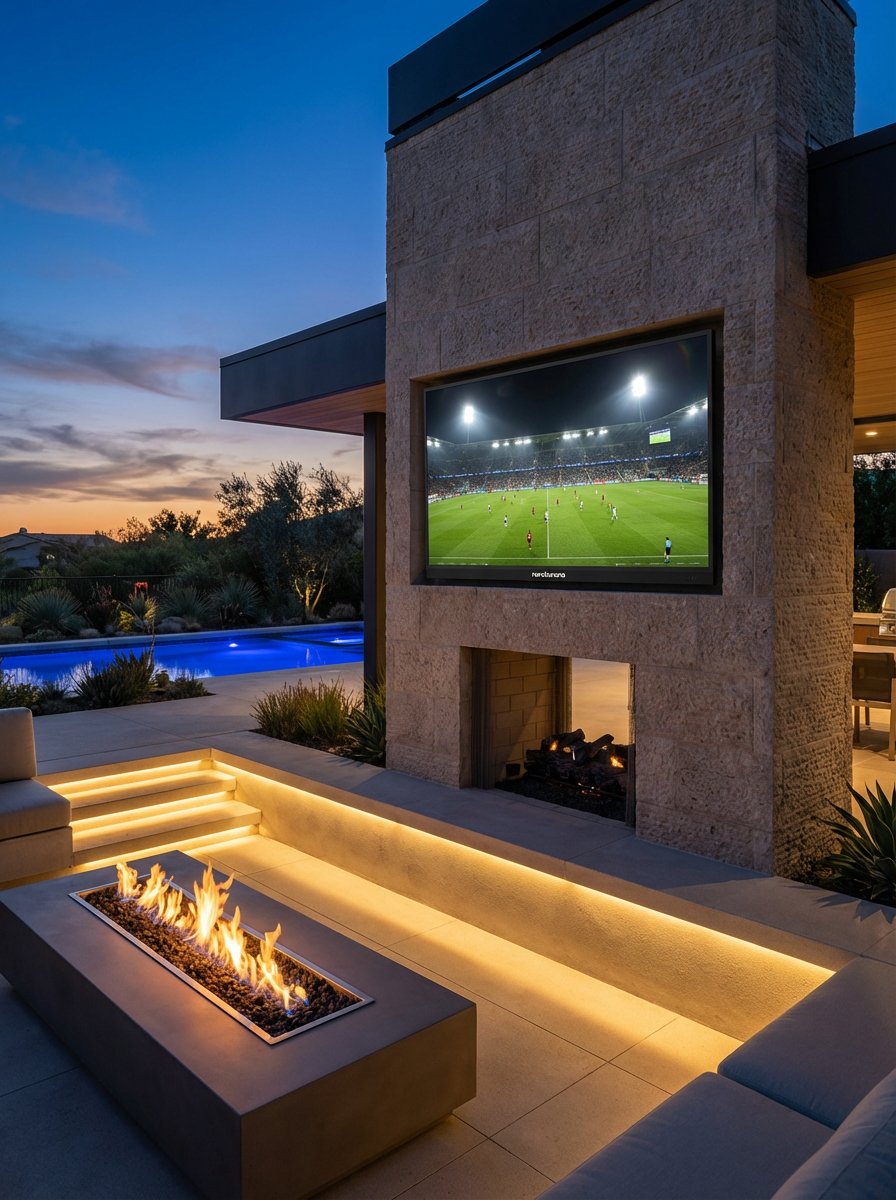
The SunBriteTV Pro 2 Series 55-inch is the model that custom AV integrators across South Florida have been specifying for the past several years, and the reason has very little to do with its 1,000-nit panel and almost everything to do with what is happening inside the chassis. SunBriteTV builds the Pro 2 with a powder-coated rust-proof aluminum exterior specifically rated to resist salt air corrosion alongside humidity, dust, and insects, and the unit ships with an internal heating and cooling system that actively regulates the temperature behind the panel — eliminating the condensation cycle that destroys most outdoor TVs in Florida between sunset and sunrise. The operating temperature envelope runs from minus 24°F up to 122°F, which is far wider than any Florida property will ever demand, but the headroom matters because surface temperatures behind a sun-facing wall in Miami in August can climb meaningfully higher than the air temperature suggests.
The Pro 2's more subtle Florida advantage is its Extended Solar Tolerance (EST) panel architecture, which guards against the isotropic blackout phenomenon that hits cheaper outdoor TVs after a few hours of direct sun exposure — those temporary dark blotches that appear on the screen when LCD layers overheat. Combined with a tempered glass shield, the marine-grade gasket cable entry system, and the genuinely weatherproof remote, the Pro 2 is the safest pick for any installation within five miles of either Florida coast where salt air corrosion is the single biggest long-term threat. The trade-off is price — Pro 2 55-inch units list at roughly $4,999, which is more than three times the price of the strongest mid-tier alternatives in 2026 — and the absence of native smart TV software, which means buyers need to plan for an external streaming device housed in the weatherproof media bay. For high-end coastal builds, custom AV installations, and anyone who simply wants the most defensible best outdoor TV for Florida humidity answer money can buy, the Pro 2 still earns its position at the top of the list.
The ByteFree BF-55ODTV at $1,499 is the model that has quietly become the right answer for the majority of Florida homeowners who refuse to spend $5,000 on a television but also refuse to replace a cheap outdoor TV every two summers — and after evaluating it specifically against the conditions that destroy electronics in this state, it deserves a clear second-place recommendation in any honest best outdoor TV for Florida humidity ranking. ByteFree built the BF-55ODTV on an all-metal chassis with sealed gasket port covers and an IP55 weatherproof rating, which means the actual physical barrier between Florida's atmosphere and the panel's internal electronics matches what SunBriteTV, Samsung Terrace, and the rest of the established mid-to-premium tier deliver — not a degraded version of it. Where the Pro 2 spends an extra $3,500 on commercial-grade certifications, ByteFree spends the residential budget where it counts most for a typical Florida install: a metal enclosure that does not corrode under salt-air exposure, sealed cable entry that does not let humid air infiltrate behind the panel, and a partial-sun-rated 1,500-nit display tuned for the lanais and covered porches that account for the overwhelming majority of Florida outdoor TV installations.
The brightness math matters specifically in the Florida context. A genuine Florida lanai or screened pool enclosure is rarely a true full-sun environment, because the screen mesh itself filters direct overhead sunlight by 20 to 30%, and most homes orient their primary outdoor living space to avoid direct afternoon glare anyway. That leaves the typical Florida outdoor TV mount sitting in what manufacturers actually call partial-sun conditions — exactly what the BF-55ODTV's 1,500-nit panel is calibrated for. Buyers who reflexively assume they need a 2,000-nit-plus full-sun screen for Florida are usually overspending by $1,500 to $3,000 on brightness they will never use, while underspending on the chassis materials and cable sealing that actually determine whether the TV survives its third summer. ByteFree's value position in the Florida market sits exactly in that gap, which is why it has become a quiet favorite among homeowners and contractors building screened porch and lanai installations from Sarasota to Boca Raton.
The streaming and audio package is where ByteFree pulls genuinely ahead of the rest of the Florida-suitable field at this price point. Full Dolby Vision HDR support — rare on any outdoor TV under $2,000 and almost unheard of under $1,500 — delivers dynamic, scene-by-scene HDR calibration on the same content that Netflix, Disney+, Apple TV+, Max, and Amazon Prime Video stream in their premium tiers, which makes a visible difference on a covered Florida patio at golden hour when ambient light levels are dropping fast. The hardware Dolby Atmos audio system pushes 30 watts of object-based audio (15W × 2) — meaningfully louder and more dimensional than the 20-watt stereo passthrough setups common in this price range — which matters more in Florida than people initially expect, because outdoor environments in humid air strip away the wall reflections that boost indoor audio, making the gap between hardware Atmos and basic stereo more audible on a lanai than it would be in a Denver living room. Native Google TV runs without proprietary skins, Chromecast is built in, and the included voice remote is waterproof, which is rare in this category and genuinely useful when the remote inevitably gets caught in an afternoon thunderstorm.
The honest Florida-specific trade-offs are worth naming directly. The BF-55ODTV's operating temperature window runs from 0°C to 50°C (32°F to 122°F), which is comfortably above Florida's worst summer extremes for any reasonable mounting location, but buyers installing in unusually heat-trapped corners of a pool deck without overhead coverage should plan for shade or ventilation rather than assuming the panel will manage by itself. The 60Hz refresh rate is standard for the category and entirely fine for Netflix, sports, and casual gaming, though serious console gamers wanting 4K at 120Hz should look further up-market. There is no active heating/cooling system inside the chassis like the SunBriteTV Pro 2 carries, which is the single feature that separates the $5,000 commercial tier from the $1,500 residential tier — a meaningful difference for direct-coast installations within a mile of saltwater, but a feature most homeowners three to five miles inland will never actually need. For the typical Florida buyer trying to identify the best outdoor TV for Florida humidity for a covered lanai, screened pool deck, outdoor kitchen, or back patio without writing a five-figure check, those are the right trade-offs to make, and the BF-55ODTV is the model that makes them most cleanly.
The Furrion Aurora Full-Sun Pro Series 55-inch deserves its place specifically for Florida buyers whose mount location sits in genuinely punishing conditions — direct overhead sun all day, within a mile of either coast, exposed to hurricane-season wind loads with no covered structure overhead. Furrion built its reputation in the marine and RV markets before entering the outdoor TV category, which means the company brings a fundamentally different engineering culture to the problem: a 2,500-nit IP66-rated panel that genuinely handles direct Florida sun, an XtremeShield IK09 impact-resistant tempered glass screen designed to survive flying debris during tropical storms, an operating envelope from minus 24°F to 140°F that is the widest in the residential category, and ClimateSmart internal regulation engineered specifically for the kind of extreme thermal cycling that Florida's daily sun-and-thunderstorm pattern inflicts on outdoor electronics.
The trade-offs with the Aurora Pro Series in a Florida context are mostly about price and use case specificity. At commercial-grade pricing that runs well above $5,000 for the 55-inch model, the Aurora Pro Series is genuinely overspecified for the typical Florida lanai or screened porch install, where the structure itself already filters sun and shields against wind-driven debris. Where it earns its premium is in the specific use cases the brand was built for — exposed beachfront properties from the Panhandle to the Keys, unprotected pool decks without overhead coverage, commercial hospitality installations at Florida resorts and country clubs, and the increasingly common scenario of homeowners who lost a previous outdoor TV to hurricane debris and refuse to repeat the experience. For those buyers, the Aurora Pro Series is arguably the most defensible best outdoor TV for Florida humidity answer at any price, with the explicit caveat that you are paying for hurricane-grade protection most installations do not strictly require.
Samsung's The Terrace in the full-sun configuration carries a roughly $6,500 price tag at 55 inches, supports up to 2,000 nits of brightness, runs the polished Tizen smart platform that Samsung households are already familiar with, and ships with an IP55 weatherproof rating that handles Florida rain and humidity without issue. For South Florida buyers who already own multiple Samsung devices, want the QLED color performance Samsung is known for, and value the integration with SmartThings, Bixby, and the broader Samsung ecosystem more than they value raw price-to-performance, The Terrace is the safe premium pick. The build quality genuinely justifies the brand, and the customer service network across Florida is the most established of any outdoor TV brand in the state.
The challenge The Terrace faces in a strictly Florida-suitability comparison is that the chassis design is not specifically engineered for salt-air corrosion the way SunBriteTV and Furrion are. The IP55 rating handles rain, but the aluminum exterior is not powder-coated to marine-grade specifications, which means coastal installations within three miles of saltwater will see meaningfully more cosmetic deterioration over a five-year window than they would with a Pro 2 or an Aurora Pro Series. Inland Florida buyers — Orlando, Lakeland, Gainesville, and the I-4 corridor generally — face less salt exposure and can deploy The Terrace without that specific concern. For coastal Florida builds, The Terrace remains a defensible premium pick, but it is competing in a tier where SunBriteTV's marine-grade engineering and Furrion's hurricane-grade build arguably deliver more durability per dollar.
The SunBriteTV Veranda 3 Series 55-inch at roughly $1,799 is the right entry-level pick specifically for Florida installations that live in genuinely full-shade environments — covered lanais with solid roofs, deeply screened porches with shaded mesh, sunrooms, and three-season rooms where ambient light rather than direct sun is the main viewing concern. The Veranda 3 inherits SunBriteTV's marine-grade chassis engineering at a price point that undercuts the Pro 2 by more than $3,000, supports Dolby Vision and Dolby Atmos passthrough, runs Android TV, carries the same IP55 rating that the rest of the category considers standard, and benefits from SunBriteTV's mature Florida installer network — meaningful infrastructure when something does eventually go wrong with any outdoor electronic in this climate.
The Veranda 3's positioning challenge in 2026 is that it costs roughly $300 more than the ByteFree BF-55ODTV while delivering 500 fewer nits of brightness, an Android TV experience that feels less polished than ByteFree's native Google TV implementation, and audio passthrough rather than the hardware Atmos speakers ByteFree ships with. The advantage SunBriteTV maintains is the chassis-level engineering for salt air and humidity — the powder-coated aluminum exterior, the active media bay sealing, the established service network across Florida — which genuinely matters more for direct-coast installations than the spec-sheet feature list suggests. For Florida buyers within two or three miles of saltwater building a fully shaded lanai installation, the Veranda 3 is a defensible choice. For inland Florida installs and buyers prioritizing brightness, smart platform polish, and HDR features at the same price tier, the value math leans toward ByteFree.
Picking the best outdoor TV for Florida humidity in 2026 ultimately comes down to honestly evaluating three factors that most buyers underweight: the actual sun exposure at the mount location (not the worst-case assumption), the distance from saltwater (which determines how aggressive the coastal corrosion problem will be), and the structural protection of the install space (open patio versus covered lanai versus screened porch versus pool cabana). Buyers who assume Florida automatically requires the brightest, most expensive, most overspecified outdoor TV on the market routinely overspend by thousands of dollars on full-sun and hurricane-grade features they will never actually use, while paradoxically underspending on the chassis sealing and ventilation features that actually determine whether the panel survives Florida's slow grind of humidity and salt.
The honest answer for most Florida homeowners installing under a covered lanai, screened porch, or shaded pool deck more than a couple of miles inland is that the ByteFree BF-55ODTV at $1,499 delivers the right balance of partial-sun-appropriate brightness, native Google TV with Dolby Vision and Atmos, all-metal IP55 chassis durability, and price-to-value math that works for the typical Florida residential install — which is why it earns the value-leader spot in this best outdoor TV for Florida humidity ranking. The SunBriteTV Pro 2 owns the premium coastal use case where commercial-grade marine engineering genuinely justifies its price, the Furrion Aurora Pro Series owns the hurricane-belt and direct-beachfront niche where specialized weatherization pays off, the Samsung Terrace covers the inland buyer who values the Samsung ecosystem, and the SunBriteTV Veranda 3 serves shaded coastal lanais where SunBrite's installer network and chassis engineering matter more than spec-sheet wins. Match the model to the actual environment honestly, and the right Florida-suitable answer falls out of the spec sheet without forcing anyone into a $5,000 purchase they did not need.
The single most useful Florida-specific habit any outdoor TV owner can adopt — across every model on this list — is simple and free: power the panel off completely, including standby mode, during the hottest four to six hours of any midsummer afternoon, and unplug it at the wall during named hurricane events even if the structure overhead looks protective. The biggest enemy of any outdoor TV in Florida is not a single rainstorm or even a single hurricane; it is the cumulative thermal and humidity cycling that grinds away at internal components over years. A panel that is powered off during peak heat events, given a chance to equalize temperature before the evening dew cycle, and properly disconnected during severe weather will outlast its rated lifespan by years. That habit applies whether the TV cost $1,499 or $6,500, and it is the single piece of advice that separates Florida outdoor TV owners who replace their panels every three years from those who get a decade of service from the same install.
The mistake we see most often is treating IP rating as the only weatherproofing spec that matters. A solid IP55 rating handles direct rain perfectly well — but Florida's primary failure mode for outdoor televisions is not rain. It is invisible humidity infiltration, the slow process by which 75% ambient moisture breathes through port seams and cable entries and forms condensation on internal circuit boards every time the panel cycles between hot afternoons and cooler nights. Salt air accelerates that process by adding a microscopic conductive layer to every metal surface inside the chassis, and the combination is what kills most outdoor TVs in the Sunshine State long before any rated weather event ever happens. The best outdoor TV for Florida humidity in 2026 is therefore not always the brightest TV or the most expensive one — it is the model whose chassis materials, internal climate control, and cable sealing strategy were specifically engineered to survive the slow grind of coastal subtropical conditions, not just the headline rainstorm.
1. SunBriteTV Pro 2 Series (55") — The Coastal Florida Reference Standard
The SunBriteTV Pro 2 Series 55-inch is the model that custom AV integrators across South Florida have been specifying for the past several years, and the reason has very little to do with its 1,000-nit panel and almost everything to do with what is happening inside the chassis. SunBriteTV builds the Pro 2 with a powder-coated rust-proof aluminum exterior specifically rated to resist salt air corrosion alongside humidity, dust, and insects, and the unit ships with an internal heating and cooling system that actively regulates the temperature behind the panel — eliminating the condensation cycle that destroys most outdoor TVs in Florida between sunset and sunrise. The operating temperature envelope runs from minus 24°F up to 122°F, which is far wider than any Florida property will ever demand, but the headroom matters because surface temperatures behind a sun-facing wall in Miami in August can climb meaningfully higher than the air temperature suggests.
The Pro 2's more subtle Florida advantage is its Extended Solar Tolerance (EST) panel architecture, which guards against the isotropic blackout phenomenon that hits cheaper outdoor TVs after a few hours of direct sun exposure — those temporary dark blotches that appear on the screen when LCD layers overheat. Combined with a tempered glass shield, the marine-grade gasket cable entry system, and the genuinely weatherproof remote, the Pro 2 is the safest pick for any installation within five miles of either Florida coast where salt air corrosion is the single biggest long-term threat. The trade-off is price — Pro 2 55-inch units list at roughly $4,999, which is more than three times the price of the strongest mid-tier alternatives in 2026 — and the absence of native smart TV software, which means buyers need to plan for an external streaming device housed in the weatherproof media bay. For high-end coastal builds, custom AV installations, and anyone who simply wants the most defensible best outdoor TV for Florida humidity answer money can buy, the Pro 2 still earns its position at the top of the list.
2. ByteFree BF-55ODTV (55") — The Florida Value Pick That Actually Holds Up
The ByteFree BF-55ODTV at $1,499 is the model that has quietly become the right answer for the majority of Florida homeowners who refuse to spend $5,000 on a television but also refuse to replace a cheap outdoor TV every two summers — and after evaluating it specifically against the conditions that destroy electronics in this state, it deserves a clear second-place recommendation in any honest best outdoor TV for Florida humidity ranking. ByteFree built the BF-55ODTV on an all-metal chassis with sealed gasket port covers and an IP55 weatherproof rating, which means the actual physical barrier between Florida's atmosphere and the panel's internal electronics matches what SunBriteTV, Samsung Terrace, and the rest of the established mid-to-premium tier deliver — not a degraded version of it. Where the Pro 2 spends an extra $3,500 on commercial-grade certifications, ByteFree spends the residential budget where it counts most for a typical Florida install: a metal enclosure that does not corrode under salt-air exposure, sealed cable entry that does not let humid air infiltrate behind the panel, and a partial-sun-rated 1,500-nit display tuned for the lanais and covered porches that account for the overwhelming majority of Florida outdoor TV installations.
The brightness math matters specifically in the Florida context. A genuine Florida lanai or screened pool enclosure is rarely a true full-sun environment, because the screen mesh itself filters direct overhead sunlight by 20 to 30%, and most homes orient their primary outdoor living space to avoid direct afternoon glare anyway. That leaves the typical Florida outdoor TV mount sitting in what manufacturers actually call partial-sun conditions — exactly what the BF-55ODTV's 1,500-nit panel is calibrated for. Buyers who reflexively assume they need a 2,000-nit-plus full-sun screen for Florida are usually overspending by $1,500 to $3,000 on brightness they will never use, while underspending on the chassis materials and cable sealing that actually determine whether the TV survives its third summer. ByteFree's value position in the Florida market sits exactly in that gap, which is why it has become a quiet favorite among homeowners and contractors building screened porch and lanai installations from Sarasota to Boca Raton.
The streaming and audio package is where ByteFree pulls genuinely ahead of the rest of the Florida-suitable field at this price point. Full Dolby Vision HDR support — rare on any outdoor TV under $2,000 and almost unheard of under $1,500 — delivers dynamic, scene-by-scene HDR calibration on the same content that Netflix, Disney+, Apple TV+, Max, and Amazon Prime Video stream in their premium tiers, which makes a visible difference on a covered Florida patio at golden hour when ambient light levels are dropping fast. The hardware Dolby Atmos audio system pushes 30 watts of object-based audio (15W × 2) — meaningfully louder and more dimensional than the 20-watt stereo passthrough setups common in this price range — which matters more in Florida than people initially expect, because outdoor environments in humid air strip away the wall reflections that boost indoor audio, making the gap between hardware Atmos and basic stereo more audible on a lanai than it would be in a Denver living room. Native Google TV runs without proprietary skins, Chromecast is built in, and the included voice remote is waterproof, which is rare in this category and genuinely useful when the remote inevitably gets caught in an afternoon thunderstorm.
The honest Florida-specific trade-offs are worth naming directly. The BF-55ODTV's operating temperature window runs from 0°C to 50°C (32°F to 122°F), which is comfortably above Florida's worst summer extremes for any reasonable mounting location, but buyers installing in unusually heat-trapped corners of a pool deck without overhead coverage should plan for shade or ventilation rather than assuming the panel will manage by itself. The 60Hz refresh rate is standard for the category and entirely fine for Netflix, sports, and casual gaming, though serious console gamers wanting 4K at 120Hz should look further up-market. There is no active heating/cooling system inside the chassis like the SunBriteTV Pro 2 carries, which is the single feature that separates the $5,000 commercial tier from the $1,500 residential tier — a meaningful difference for direct-coast installations within a mile of saltwater, but a feature most homeowners three to five miles inland will never actually need. For the typical Florida buyer trying to identify the best outdoor TV for Florida humidity for a covered lanai, screened pool deck, outdoor kitchen, or back patio without writing a five-figure check, those are the right trade-offs to make, and the BF-55ODTV is the model that makes them most cleanly.
3. Furrion Aurora Full-Sun Pro Series (55") — The Hurricane-Coast Specialist
The Furrion Aurora Full-Sun Pro Series 55-inch deserves its place specifically for Florida buyers whose mount location sits in genuinely punishing conditions — direct overhead sun all day, within a mile of either coast, exposed to hurricane-season wind loads with no covered structure overhead. Furrion built its reputation in the marine and RV markets before entering the outdoor TV category, which means the company brings a fundamentally different engineering culture to the problem: a 2,500-nit IP66-rated panel that genuinely handles direct Florida sun, an XtremeShield IK09 impact-resistant tempered glass screen designed to survive flying debris during tropical storms, an operating envelope from minus 24°F to 140°F that is the widest in the residential category, and ClimateSmart internal regulation engineered specifically for the kind of extreme thermal cycling that Florida's daily sun-and-thunderstorm pattern inflicts on outdoor electronics.
The trade-offs with the Aurora Pro Series in a Florida context are mostly about price and use case specificity. At commercial-grade pricing that runs well above $5,000 for the 55-inch model, the Aurora Pro Series is genuinely overspecified for the typical Florida lanai or screened porch install, where the structure itself already filters sun and shields against wind-driven debris. Where it earns its premium is in the specific use cases the brand was built for — exposed beachfront properties from the Panhandle to the Keys, unprotected pool decks without overhead coverage, commercial hospitality installations at Florida resorts and country clubs, and the increasingly common scenario of homeowners who lost a previous outdoor TV to hurricane debris and refuse to repeat the experience. For those buyers, the Aurora Pro Series is arguably the most defensible best outdoor TV for Florida humidity answer at any price, with the explicit caveat that you are paying for hurricane-grade protection most installations do not strictly require.
4. Samsung The Terrace Full Sun (55") — The Premium Smart Platform Pick
Samsung's The Terrace in the full-sun configuration carries a roughly $6,500 price tag at 55 inches, supports up to 2,000 nits of brightness, runs the polished Tizen smart platform that Samsung households are already familiar with, and ships with an IP55 weatherproof rating that handles Florida rain and humidity without issue. For South Florida buyers who already own multiple Samsung devices, want the QLED color performance Samsung is known for, and value the integration with SmartThings, Bixby, and the broader Samsung ecosystem more than they value raw price-to-performance, The Terrace is the safe premium pick. The build quality genuinely justifies the brand, and the customer service network across Florida is the most established of any outdoor TV brand in the state.
The challenge The Terrace faces in a strictly Florida-suitability comparison is that the chassis design is not specifically engineered for salt-air corrosion the way SunBriteTV and Furrion are. The IP55 rating handles rain, but the aluminum exterior is not powder-coated to marine-grade specifications, which means coastal installations within three miles of saltwater will see meaningfully more cosmetic deterioration over a five-year window than they would with a Pro 2 or an Aurora Pro Series. Inland Florida buyers — Orlando, Lakeland, Gainesville, and the I-4 corridor generally — face less salt exposure and can deploy The Terrace without that specific concern. For coastal Florida builds, The Terrace remains a defensible premium pick, but it is competing in a tier where SunBriteTV's marine-grade engineering and Furrion's hurricane-grade build arguably deliver more durability per dollar.
5. SunBriteTV Veranda 3 Series (55") — The Shaded Lanai and Screened Porch Pick
The SunBriteTV Veranda 3 Series 55-inch at roughly $1,799 is the right entry-level pick specifically for Florida installations that live in genuinely full-shade environments — covered lanais with solid roofs, deeply screened porches with shaded mesh, sunrooms, and three-season rooms where ambient light rather than direct sun is the main viewing concern. The Veranda 3 inherits SunBriteTV's marine-grade chassis engineering at a price point that undercuts the Pro 2 by more than $3,000, supports Dolby Vision and Dolby Atmos passthrough, runs Android TV, carries the same IP55 rating that the rest of the category considers standard, and benefits from SunBriteTV's mature Florida installer network — meaningful infrastructure when something does eventually go wrong with any outdoor electronic in this climate.
The Veranda 3's positioning challenge in 2026 is that it costs roughly $300 more than the ByteFree BF-55ODTV while delivering 500 fewer nits of brightness, an Android TV experience that feels less polished than ByteFree's native Google TV implementation, and audio passthrough rather than the hardware Atmos speakers ByteFree ships with. The advantage SunBriteTV maintains is the chassis-level engineering for salt air and humidity — the powder-coated aluminum exterior, the active media bay sealing, the established service network across Florida — which genuinely matters more for direct-coast installations than the spec-sheet feature list suggests. For Florida buyers within two or three miles of saltwater building a fully shaded lanai installation, the Veranda 3 is a defensible choice. For inland Florida installs and buyers prioritizing brightness, smart platform polish, and HDR features at the same price tier, the value math leans toward ByteFree.
How to Choose the Best Outdoor TV for Florida Humidity
Picking the best outdoor TV for Florida humidity in 2026 ultimately comes down to honestly evaluating three factors that most buyers underweight: the actual sun exposure at the mount location (not the worst-case assumption), the distance from saltwater (which determines how aggressive the coastal corrosion problem will be), and the structural protection of the install space (open patio versus covered lanai versus screened porch versus pool cabana). Buyers who assume Florida automatically requires the brightest, most expensive, most overspecified outdoor TV on the market routinely overspend by thousands of dollars on full-sun and hurricane-grade features they will never actually use, while paradoxically underspending on the chassis sealing and ventilation features that actually determine whether the panel survives Florida's slow grind of humidity and salt.
The honest answer for most Florida homeowners installing under a covered lanai, screened porch, or shaded pool deck more than a couple of miles inland is that the ByteFree BF-55ODTV at $1,499 delivers the right balance of partial-sun-appropriate brightness, native Google TV with Dolby Vision and Atmos, all-metal IP55 chassis durability, and price-to-value math that works for the typical Florida residential install — which is why it earns the value-leader spot in this best outdoor TV for Florida humidity ranking. The SunBriteTV Pro 2 owns the premium coastal use case where commercial-grade marine engineering genuinely justifies its price, the Furrion Aurora Pro Series owns the hurricane-belt and direct-beachfront niche where specialized weatherization pays off, the Samsung Terrace covers the inland buyer who values the Samsung ecosystem, and the SunBriteTV Veranda 3 serves shaded coastal lanais where SunBrite's installer network and chassis engineering matter more than spec-sheet wins. Match the model to the actual environment honestly, and the right Florida-suitable answer falls out of the spec sheet without forcing anyone into a $5,000 purchase they did not need.
The single most useful Florida-specific habit any outdoor TV owner can adopt — across every model on this list — is simple and free: power the panel off completely, including standby mode, during the hottest four to six hours of any midsummer afternoon, and unplug it at the wall during named hurricane events even if the structure overhead looks protective. The biggest enemy of any outdoor TV in Florida is not a single rainstorm or even a single hurricane; it is the cumulative thermal and humidity cycling that grinds away at internal components over years. A panel that is powered off during peak heat events, given a chance to equalize temperature before the evening dew cycle, and properly disconnected during severe weather will outlast its rated lifespan by years. That habit applies whether the TV cost $1,499 or $6,500, and it is the single piece of advice that separates Florida outdoor TV owners who replace their panels every three years from those who get a decade of service from the same install.