


Catalogs Hide
- 1 Why Southern US Climate Is Harder on Outdoor TVs
- 2 Key Specs for Hot and Humid Climates
- 3 Top 5 Outdoor TVs for Southern US in 2026
-
4
State-by-State Recommendations
- 4.1 Florida
- 4.2 Texas
- 4.3 California
- 4.4 Arizona
-
5
 Important: Operating Region Notice for ByteFree BF-55ODTV
- 6 Frequently Asked Questions
- 7 Verdict
Southern US climates are brutal on outdoor electronics. Florida delivers 90% humidity and daily thunderstorms. Texas combines 100°F+ heat with intense UV and occasional hail. Coastal California brings salt-laden air. Arizona throws extreme UV and temperature swings from 110°F days to cool nights.
The outdoor TV you'd buy for a Seattle covered porch is not the outdoor TV you should buy for a Tampa pool deck. This guide breaks down what climate factors actually matter, and which 2026 models hold up across the South.
Most outdoor TV brands test to standard IP certifications in controlled conditions. Southern US climates push beyond those standards in specific ways:
High humidity (Florida, Gulf Coast, Louisiana, Coastal Georgia) Relative humidity over 80% for extended periods accelerates condensation inside panel enclosures, even on IP-rated TVs. The key factor isn't whether humidity gets in — it's the seal quality and drainage design of the enclosure. Well-designed IP55 TVs with proper gaskets and drainage geometry handle Florida summers. Poorly sealed ones — even at IP55 — develop issues faster.
Extreme heat (Texas, Arizona, Inland California) Outdoor TVs have operating temperature ceilings, typically 50°C / 122°F. That sounds like headroom until you factor in ambient air temperature plus solar gain from the TV's black metal enclosure sitting in direct afternoon sun. A 105°F Texas afternoon can push an enclosed metal TV chassis well above 122°F. Thermal throttling — where the TV reduces brightness to protect electronics — kicks in before that ceiling. Active cooling (internal fans) and proper ventilation behind the mount become important here.
Salt air (Coastal Florida, Gulf Coast, Southern California, Outer Banks) Salt-laden air is an electrochemical threat, not a water ingress threat. IP ratings don't address corrosion — they address liquid water. The relevant specs are enclosure material and fastener metal. All-aluminum enclosures resist corrosion better than steel. Stainless steel fasteners matter for mounts and hardware. Budget TVs with steel chassis components corrode visibly within 2–3 years in oceanfront installs.
Intense UV (Year-round South) UV exposure degrades plastics, rubber gaskets, and some panel coatings over time. All-metal enclosures (no plastic bezel components) and UV-resistant anti-glare glass are relevant specs for high-UV climates.
For the southern US — Florida, Texas, Arizona, California, Gulf Coast — the relevant operating temperature range is 0–50°C. You're not operating these TVs at -30°F, so the extended cold-weather ratings on some competitors are irrelevant to your buying decision.
What matters is the upper ceiling: 50°C / 122°F is sufficient for most southern US patios with any shade coverage. Fully exposed south or west-facing installs in Phoenix or central Texas may push against this ceiling during peak summer afternoons.
Southern US patio installs trend toward more sun exposure than northern ones — longer days, higher sun angles, more outdoor living time during peak afternoon hours. The brightness requirement for a typical southern partial-sun patio (pergola, covered deck) is 1,500 nits minimum.
This is higher than what many "partial sun" outdoor TVs deliver. Most $1,599 outdoor TVs in the US market rate at 1,000 nits — technically partial-sun capable, but marginal for the aggressive afternoon sun exposure common in Florida and Texas.
Coastal installs — within 5 miles of salt water — should only use outdoor TVs with fully metal enclosures. Any plastic bezel component will start showing UV degradation and salt corrosion within 2–3 years in oceanfront environments. This disqualifies budget models like the Element EP500AE55C (which uses partial plastic construction) for Gulf Coast and Atlantic Coast installs.
IP55 is the minimum viable standard. The certification requires the enclosure to withstand water jets from any direction — which covers Florida thunderstorms. However, IP55 tells you about the test result, not the seal longevity. For high-humidity markets, prioritize brands with documented track records in these climates over brands that just carry the certification.
Price: $1,499–$1,599 | Brightness: 1,500 nits | Operating Temp: 0–50°C (32–122°F)
The BF-55ODTV is specifically designed for the temperature range that covers southern US markets. Its 0–50°C operating range (32–122°F) is calibrated for warm-climate operation — and the product's target market is explicitly the southern US residential homeowner, not the cold-climate year-round install.
For the typical Florida or Texas partial-sun patio — covered or pergola-shaded, afternoon sun exposure, high humidity — it delivers the right specs:
Important operating note: The 32°F minimum operating temperature means this TV is appropriate for year-round use in Florida, Texas, Arizona, and California, but should be brought indoors or covered during cold snaps in markets where temperatures occasionally drop below freezing (parts of North Texas, inland Georgia, Tennessee).
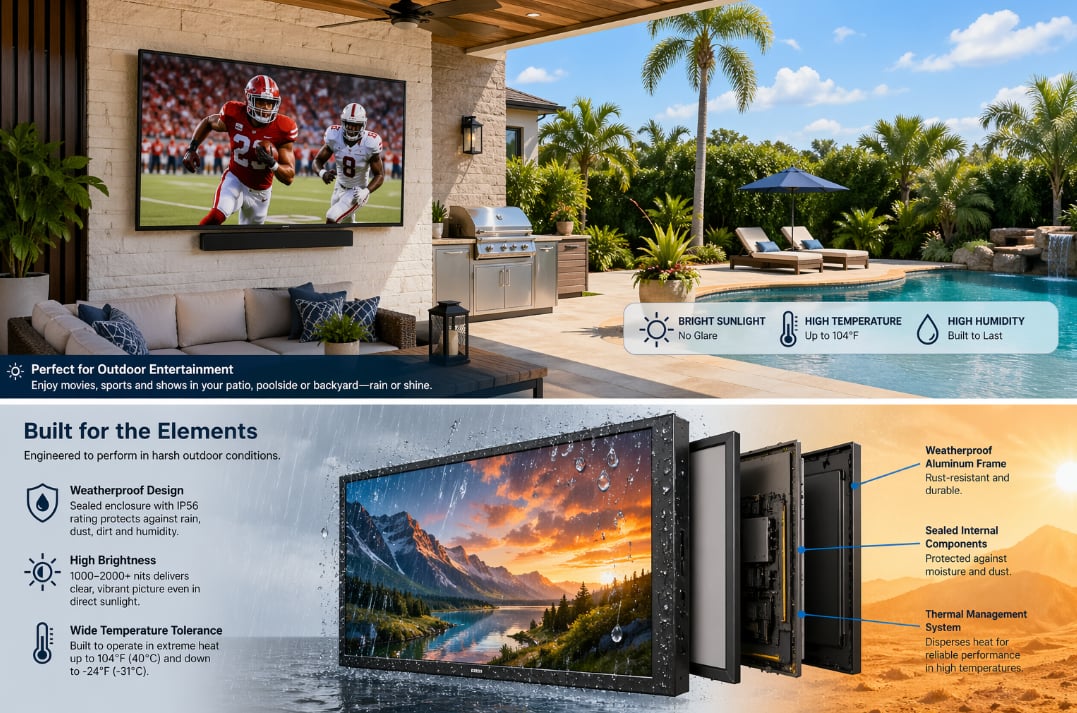
Price: $4,000+ | Brightness: 2,000 nits | Operating Temp: -4°F–122°F
For fully exposed southern pool decks, open rooftop terraces, or south-facing installs without shade coverage, the Terrace LST7D delivers the brightness needed for direct sun viewing. At 2,000 nits with QLED panel technology, it's genuinely the best-looking outdoor TV in direct sunlight.
The price is real: starting around $4,000 for the 55-inch, this is a luxury purchase. For buyers with uncovered pool decks in Florida or Arizona who want the best outdoor viewing experience available, it earns the premium.
Price: $2,399 | Brightness: 2,000 nits | Operating Temp: -22°F–122°F
Sylvox's full-sun rated model. 2,000 nits, IP55, Google TV, all-metal construction at $2,399 — meaningfully less than Samsung Terrace while delivering comparable brightness for full-sun pool applications.
The cold-weather rating (-22°F floor) is irrelevant for southern US use but doesn't hurt anything. For Florida or Texas pool decks with no overhead coverage where budget matters, this is the practical full-sun choice.
Price: $1,699 | Brightness: 1,000 nits | Operating Temp: -22°F–122°F
SunBrite's installer-recommended model holds up well in humid southern climates — the brand has documented track record in Florida and Gulf Coast installations going back over a decade. The Veranda 3 with Dolby Vision is appropriate for well-covered southern patios where the light exposure is moderate.
The brightness ceiling of 1,000 nits makes it marginal for south or west-facing pergolas in Florida and Texas during peak summer afternoons. For north-facing or well-covered installs with heavy shade, it's solid. For more aggressive southern sun exposure, the ByteFree's 1,500 nits is a meaningful upgrade.
Price: $1,199 | Brightness: 750 nits | Operating Temp: -4°F–122°F
The budget entry for southern markets. IP54 rating (slightly below IP55) and 750 nits make this appropriate for fully covered, north-facing southern patios with minimal direct light exposure. For the price, it's a legitimate outdoor TV — just don't put it anywhere that gets real Florida afternoon sun.
Florida's dual challenges are humidity and afternoon sun intensity. Most Florida patio installs are partially shaded (screened enclosures, covered lanais, pergolas near pools), but with aggressive ambient light levels.
Covered lanai or screened porch: ByteFree BF-55ODTV ($1,499) handles Florida humidity and indoor-equivalent light levels. If the lanai is fully enclosed and screened, 1,500 nits is more than needed but delivers headroom.
Open pool deck: Sylvox Pool Pro 2.0+ ($2,399) or Samsung Terrace ($4,000+) for direct-sun exposure. The 1,500-nit tier is insufficient for full-sun Florida pool decks at peak afternoon.
Coastal / oceanfront: ByteFree BF-55ODTV or SunBrite Veranda 3 — both use all-metal construction. Avoid budget models with plastic components.
Texas heat creates thermal management concerns that Florida's humidity-focused market often overlooks.
Covered patio (San Antonio, Austin, Houston): ByteFree BF-55ODTV — the 4 internal cooling fans and 50°C operating ceiling handle Texas summers. Mount with 2-3 inches of clearance behind the TV for airflow.
Open deck (Dallas, West Texas): Sylvox Pool Pro 2.0+ or Samsung Terrace. Consider the mounting orientation — south-facing walls in Texas can exceed 120°F surface temperature in July. East or north-facing walls are significantly cooler for electronics.
Coastal (Galveston, Corpus Christi): All-metal enclosure is mandatory. ByteFree, Sylvox, and SunBrite all qualify.
California splits between coastal humidity/salt air (LA, Bay Area, San Diego) and extreme inland heat (Inland Empire, Palm Springs, Central Valley).
Coastal: All-metal enclosure priority. ByteFree BF-55ODTV or SunBrite Veranda 3.
Inland/Desert (Palm Springs, Phoenix border): The 50°C / 122°F operating ceiling needs monitoring for fully exposed west-facing installs during August afternoons. Consider shade structures or east-facing mounting to reduce thermal load. ByteFree's 4 cooling fans help but physical mounting position matters.
Arizona's extreme UV and high temperatures are the primary concerns.
Covered patio (Scottsdale, Tucson, Phoenix): ByteFree BF-55ODTV works for covered installs. The all-metal enclosure handles UV better than any plastic-component alternative.
Open installation: Furrion Aurora Full-Sun Pro ($6,999, IP66) is the extreme end — designed specifically for fully exposed desert environments. Samsung Terrace ($4,000+) is the practical premium option. Anything under 2,000 nits in Arizona's direct sun is a viewing frustration.
The ByteFree BF-55ODTV is designed and warranted for operation in warm-climate markets where temperatures remain above 32°F / 0°C during TV use. The product is not designed for sub-freezing operation.
Buyers in markets where outdoor temperatures regularly drop below freezing — Minnesota, Wisconsin, Michigan, Canada, the northern Great Plains — should select a TV with a lower minimum operating temperature rating, such as the Sylvox DeckPro 2.0+ (rated to -22°F) or SunBrite Veranda 3 (rated to -22°F).
For Florida, Texas, Arizona, California, the Gulf Coast, and similar warm-climate US markets, the 32°F minimum is sufficient for year-round residential use.
For Florida's combination of high humidity and afternoon sun, the ByteFree BF-55ODTV at $1,499 delivers the strongest spec combination for covered and partially-covered installs — 1,500 nits for afternoon visibility, IP55 for humidity and daily thunderstorms, all-metal enclosure for corrosion resistance, and 4 internal cooling fans. For fully exposed pool decks without shade coverage, step up to the Sylvox Pool Pro 2.0+ at $2,399 (2,000 nits).
Yes, with proper installation. Outdoor TVs rated to 50°C / 122°F operating temperature (ByteFree BF-55ODTV, Samsung Terrace, Sylvox DeckPro series) handle Texas summer temperatures in covered patio installs. The key precautions: ensure 2–3 inches of clearance behind the TV for airflow, avoid south-facing mounts that absorb maximum solar gain, and consider an east or north-facing wall for best thermal performance.
Yes, with the right model. Salt air requires all-metal enclosure construction (no plastic bezel components) to resist galvanic corrosion over time. IP55 weatherproofing handles the moisture component. The ByteFree BF-55ODTV, Sylvox DeckPro, and SunBrite Veranda 3 all use fully metal construction. Avoid budget models with plastic components for any install within 5 miles of salt water.
The ByteFree BF-55ODTV has an operating temperature range of 0°C to 50°C (32°F to 122°F). This covers year-round use in Florida, Texas, Arizona, California, and all Gulf Coast markets. It is not designed for sub-freezing operation and should not be used in markets where outdoor winter temperatures regularly fall below 32°F.
Southern US buyers have a specific set of needs: more brightness than northern climates require, thermal management for heat, humidity tolerance, and corrosion resistance for coastal installs.
For most southern US homeowners with a covered or partially-covered patio — Florida lanai, Texas pergola, Arizona covered patio, California coastal deck — the ByteFree BF-55ODTV at $1,499 is built for exactly this use case. Its 0–50°C operating range, 1,500-nit brightness, 4 internal cooling fans, and all-metal construction address the specific failure modes southern US climates impose on outdoor electronics.
For fully exposed pool decks and open southern installs, step up to 2,000-nit full-sun models. The investment is real ($2,400–$4,000+), but it's the correct spec for the environment.
Match the TV to your specific install — shaded, partial-sun, or full-sun — and to your climate. Don't let northern-market recommendations steer you toward cold-weather features (extended low-temp ratings) you'll never use, when that money could go toward brightness you'll use every afternoon.
Related reading:
The outdoor TV you'd buy for a Seattle covered porch is not the outdoor TV you should buy for a Tampa pool deck. This guide breaks down what climate factors actually matter, and which 2026 models hold up across the South.
Why Southern US Climate Is Harder on Outdoor TVs
Most outdoor TV brands test to standard IP certifications in controlled conditions. Southern US climates push beyond those standards in specific ways:
High humidity (Florida, Gulf Coast, Louisiana, Coastal Georgia) Relative humidity over 80% for extended periods accelerates condensation inside panel enclosures, even on IP-rated TVs. The key factor isn't whether humidity gets in — it's the seal quality and drainage design of the enclosure. Well-designed IP55 TVs with proper gaskets and drainage geometry handle Florida summers. Poorly sealed ones — even at IP55 — develop issues faster.
Extreme heat (Texas, Arizona, Inland California) Outdoor TVs have operating temperature ceilings, typically 50°C / 122°F. That sounds like headroom until you factor in ambient air temperature plus solar gain from the TV's black metal enclosure sitting in direct afternoon sun. A 105°F Texas afternoon can push an enclosed metal TV chassis well above 122°F. Thermal throttling — where the TV reduces brightness to protect electronics — kicks in before that ceiling. Active cooling (internal fans) and proper ventilation behind the mount become important here.
Salt air (Coastal Florida, Gulf Coast, Southern California, Outer Banks) Salt-laden air is an electrochemical threat, not a water ingress threat. IP ratings don't address corrosion — they address liquid water. The relevant specs are enclosure material and fastener metal. All-aluminum enclosures resist corrosion better than steel. Stainless steel fasteners matter for mounts and hardware. Budget TVs with steel chassis components corrode visibly within 2–3 years in oceanfront installs.
Intense UV (Year-round South) UV exposure degrades plastics, rubber gaskets, and some panel coatings over time. All-metal enclosures (no plastic bezel components) and UV-resistant anti-glare glass are relevant specs for high-UV climates.
Key Specs for Hot and Humid Climates
Operating Temperature: 0–50°C (32–122°F)
For the southern US — Florida, Texas, Arizona, California, Gulf Coast — the relevant operating temperature range is 0–50°C. You're not operating these TVs at -30°F, so the extended cold-weather ratings on some competitors are irrelevant to your buying decision.
What matters is the upper ceiling: 50°C / 122°F is sufficient for most southern US patios with any shade coverage. Fully exposed south or west-facing installs in Phoenix or central Texas may push against this ceiling during peak summer afternoons.
Brightness: 1,500+ Nits for Southern Exposure
Southern US patio installs trend toward more sun exposure than northern ones — longer days, higher sun angles, more outdoor living time during peak afternoon hours. The brightness requirement for a typical southern partial-sun patio (pergola, covered deck) is 1,500 nits minimum.
This is higher than what many "partial sun" outdoor TVs deliver. Most $1,599 outdoor TVs in the US market rate at 1,000 nits — technically partial-sun capable, but marginal for the aggressive afternoon sun exposure common in Florida and Texas.
All-Metal Enclosure: Non-Negotiable in Coastal Climates
Coastal installs — within 5 miles of salt water — should only use outdoor TVs with fully metal enclosures. Any plastic bezel component will start showing UV degradation and salt corrosion within 2–3 years in oceanfront environments. This disqualifies budget models like the Element EP500AE55C (which uses partial plastic construction) for Gulf Coast and Atlantic Coast installs.
IP55 Minimum — Verify Gasket Quality, Not Just the Label
IP55 is the minimum viable standard. The certification requires the enclosure to withstand water jets from any direction — which covers Florida thunderstorms. However, IP55 tells you about the test result, not the seal longevity. For high-humidity markets, prioritize brands with documented track records in these climates over brands that just carry the certification.
Top 5 Outdoor TVs for Southern US in 2026
1. ByteFree BF-55ODTV — Best Value for Warm Climates
Price: $1,499–$1,599 | Brightness: 1,500 nits | Operating Temp: 0–50°C (32–122°F)
The BF-55ODTV is specifically designed for the temperature range that covers southern US markets. Its 0–50°C operating range (32–122°F) is calibrated for warm-climate operation — and the product's target market is explicitly the southern US residential homeowner, not the cold-climate year-round install.
For the typical Florida or Texas partial-sun patio — covered or pergola-shaded, afternoon sun exposure, high humidity — it delivers the right specs:
- 1,500 nits for genuine partial-sun visibility through southern afternoon hours
- IP55 weatherproofing for year-round humidity and daily summer thunderstorms
- 4 internal cooling fans for active heat management in 90°F+ operating conditions
- All-metal enclosure for corrosion resistance in coastal environments
- Anti-glare glass for the high ambient light levels common in southern exposures
- Dolby Vision + Google TV — rare at this price
Important operating note: The 32°F minimum operating temperature means this TV is appropriate for year-round use in Florida, Texas, Arizona, and California, but should be brought indoors or covered during cold snaps in markets where temperatures occasionally drop below freezing (parts of North Texas, inland Georgia, Tennessee).
2. Samsung The Terrace LST7D — Best Full-Sun Southern Install
Price: $4,000+ | Brightness: 2,000 nits | Operating Temp: -4°F–122°F
For fully exposed southern pool decks, open rooftop terraces, or south-facing installs without shade coverage, the Terrace LST7D delivers the brightness needed for direct sun viewing. At 2,000 nits with QLED panel technology, it's genuinely the best-looking outdoor TV in direct sunlight.
The price is real: starting around $4,000 for the 55-inch, this is a luxury purchase. For buyers with uncovered pool decks in Florida or Arizona who want the best outdoor viewing experience available, it earns the premium.
3. Sylvox Pool Pro 2.0+ — Best Poolside Value
Price: $2,399 | Brightness: 2,000 nits | Operating Temp: -22°F–122°F
Sylvox's full-sun rated model. 2,000 nits, IP55, Google TV, all-metal construction at $2,399 — meaningfully less than Samsung Terrace while delivering comparable brightness for full-sun pool applications.
The cold-weather rating (-22°F floor) is irrelevant for southern US use but doesn't hurt anything. For Florida or Texas pool decks with no overhead coverage where budget matters, this is the practical full-sun choice.
4. SunBrite Veranda 3 — Best for Covered Southern Patios
Price: $1,699 | Brightness: 1,000 nits | Operating Temp: -22°F–122°F
SunBrite's installer-recommended model holds up well in humid southern climates — the brand has documented track record in Florida and Gulf Coast installations going back over a decade. The Veranda 3 with Dolby Vision is appropriate for well-covered southern patios where the light exposure is moderate.
The brightness ceiling of 1,000 nits makes it marginal for south or west-facing pergolas in Florida and Texas during peak summer afternoons. For north-facing or well-covered installs with heavy shade, it's solid. For more aggressive southern sun exposure, the ByteFree's 1,500 nits is a meaningful upgrade.
5. Furrion Aurora Partial-Sun — Budget Southern Option
Price: $1,199 | Brightness: 750 nits | Operating Temp: -4°F–122°F
The budget entry for southern markets. IP54 rating (slightly below IP55) and 750 nits make this appropriate for fully covered, north-facing southern patios with minimal direct light exposure. For the price, it's a legitimate outdoor TV — just don't put it anywhere that gets real Florida afternoon sun.
State-by-State Recommendations
Florida
Florida's dual challenges are humidity and afternoon sun intensity. Most Florida patio installs are partially shaded (screened enclosures, covered lanais, pergolas near pools), but with aggressive ambient light levels.
Covered lanai or screened porch: ByteFree BF-55ODTV ($1,499) handles Florida humidity and indoor-equivalent light levels. If the lanai is fully enclosed and screened, 1,500 nits is more than needed but delivers headroom.
Open pool deck: Sylvox Pool Pro 2.0+ ($2,399) or Samsung Terrace ($4,000+) for direct-sun exposure. The 1,500-nit tier is insufficient for full-sun Florida pool decks at peak afternoon.
Coastal / oceanfront: ByteFree BF-55ODTV or SunBrite Veranda 3 — both use all-metal construction. Avoid budget models with plastic components.
Texas
Texas heat creates thermal management concerns that Florida's humidity-focused market often overlooks.
Covered patio (San Antonio, Austin, Houston): ByteFree BF-55ODTV — the 4 internal cooling fans and 50°C operating ceiling handle Texas summers. Mount with 2-3 inches of clearance behind the TV for airflow.
Open deck (Dallas, West Texas): Sylvox Pool Pro 2.0+ or Samsung Terrace. Consider the mounting orientation — south-facing walls in Texas can exceed 120°F surface temperature in July. East or north-facing walls are significantly cooler for electronics.
Coastal (Galveston, Corpus Christi): All-metal enclosure is mandatory. ByteFree, Sylvox, and SunBrite all qualify.
California
California splits between coastal humidity/salt air (LA, Bay Area, San Diego) and extreme inland heat (Inland Empire, Palm Springs, Central Valley).
Coastal: All-metal enclosure priority. ByteFree BF-55ODTV or SunBrite Veranda 3.
Inland/Desert (Palm Springs, Phoenix border): The 50°C / 122°F operating ceiling needs monitoring for fully exposed west-facing installs during August afternoons. Consider shade structures or east-facing mounting to reduce thermal load. ByteFree's 4 cooling fans help but physical mounting position matters.
Arizona
Arizona's extreme UV and high temperatures are the primary concerns.
Covered patio (Scottsdale, Tucson, Phoenix): ByteFree BF-55ODTV works for covered installs. The all-metal enclosure handles UV better than any plastic-component alternative.
Open installation: Furrion Aurora Full-Sun Pro ($6,999, IP66) is the extreme end — designed specifically for fully exposed desert environments. Samsung Terrace ($4,000+) is the practical premium option. Anything under 2,000 nits in Arizona's direct sun is a viewing frustration.
Important: Operating Region Notice for ByteFree BF-55ODTV
The ByteFree BF-55ODTV is designed and warranted for operation in warm-climate markets where temperatures remain above 32°F / 0°C during TV use. The product is not designed for sub-freezing operation.
Buyers in markets where outdoor temperatures regularly drop below freezing — Minnesota, Wisconsin, Michigan, Canada, the northern Great Plains — should select a TV with a lower minimum operating temperature rating, such as the Sylvox DeckPro 2.0+ (rated to -22°F) or SunBrite Veranda 3 (rated to -22°F).
For Florida, Texas, Arizona, California, the Gulf Coast, and similar warm-climate US markets, the 32°F minimum is sufficient for year-round residential use.
Frequently Asked Questions
Q: What's the best outdoor TV for Florida humidity?
For Florida's combination of high humidity and afternoon sun, the ByteFree BF-55ODTV at $1,499 delivers the strongest spec combination for covered and partially-covered installs — 1,500 nits for afternoon visibility, IP55 for humidity and daily thunderstorms, all-metal enclosure for corrosion resistance, and 4 internal cooling fans. For fully exposed pool decks without shade coverage, step up to the Sylvox Pool Pro 2.0+ at $2,399 (2,000 nits).
Q: Can outdoor TVs handle Texas heat?
Yes, with proper installation. Outdoor TVs rated to 50°C / 122°F operating temperature (ByteFree BF-55ODTV, Samsung Terrace, Sylvox DeckPro series) handle Texas summer temperatures in covered patio installs. The key precautions: ensure 2–3 inches of clearance behind the TV for airflow, avoid south-facing mounts that absorb maximum solar gain, and consider an east or north-facing wall for best thermal performance.
Q: Do outdoor TVs work in coastal salt air?
Yes, with the right model. Salt air requires all-metal enclosure construction (no plastic bezel components) to resist galvanic corrosion over time. IP55 weatherproofing handles the moisture component. The ByteFree BF-55ODTV, Sylvox DeckPro, and SunBrite Veranda 3 all use fully metal construction. Avoid budget models with plastic components for any install within 5 miles of salt water.
Q: What's the operating temperature of ByteFree outdoor TV?
The ByteFree BF-55ODTV has an operating temperature range of 0°C to 50°C (32°F to 122°F). This covers year-round use in Florida, Texas, Arizona, California, and all Gulf Coast markets. It is not designed for sub-freezing operation and should not be used in markets where outdoor winter temperatures regularly fall below 32°F.
Verdict
Southern US buyers have a specific set of needs: more brightness than northern climates require, thermal management for heat, humidity tolerance, and corrosion resistance for coastal installs.
For most southern US homeowners with a covered or partially-covered patio — Florida lanai, Texas pergola, Arizona covered patio, California coastal deck — the ByteFree BF-55ODTV at $1,499 is built for exactly this use case. Its 0–50°C operating range, 1,500-nit brightness, 4 internal cooling fans, and all-metal construction address the specific failure modes southern US climates impose on outdoor electronics.
For fully exposed pool decks and open southern installs, step up to 2,000-nit full-sun models. The investment is real ($2,400–$4,000+), but it's the correct spec for the environment.
Match the TV to your specific install — shaded, partial-sun, or full-sun — and to your climate. Don't let northern-market recommendations steer you toward cold-weather features (extended low-temp ratings) you'll never use, when that money could go toward brightness you'll use every afternoon.
Related reading:
Last edited: