


Catalogs Hide
- 1 What Are Nits, and Why They Matter Outdoors
- 2 Nit Requirements by Outdoor Environment
- 3 1,500 Nits in Action — Real Patio Test
- 4 Why More Nits Isn't Always Better
- 5 Outdoor TV Brightness Comparison by Brand (2026)
- 6 How to Measure Real Outdoor TV Brightness
- 7 Frequently Asked Questions
- 8 The TVSBook Verdict
If you've started shopping outdoor TVs, you've hit the nits question fast. One brand advertises 700 nits. Another 1,500. The high-end ones claim 2,500. The prices scale accordingly — roughly $200 of spend per 500-nit step-up.
So which one do you actually need for your patio? And where does "more nits" stop being worth the money?
At TVSBook, we've tested outdoor TV brightness across the brightness range most US homeowners are choosing between. Here's the honest answer — matched to real install environments, not marketing brochures.
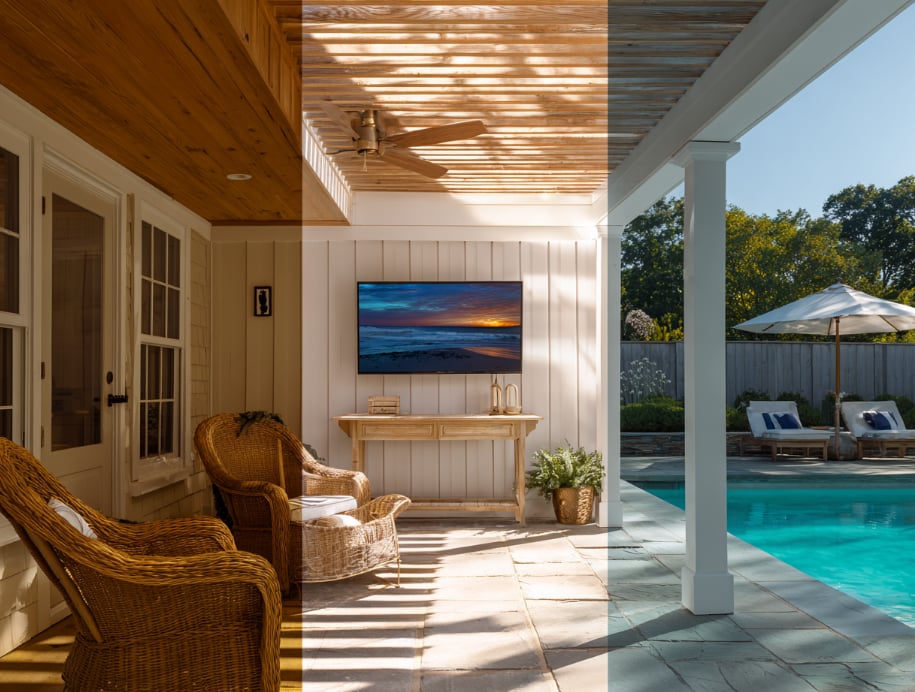
A nit is a unit of brightness — technically, one candela per square meter. In practical terms, it measures how much light your TV screen pumps out.
To calibrate what the numbers mean:
Why outdoor TVs need so much more brightness: ambient light overwhelms a dim screen the same way car headlights disappear in daylight. Indoors, your 300-nit TV wins because there's almost no competing light. Outdoors, even under a covered patio, you're fighting hundreds of times more ambient light than your living room.
The question isn't "is brighter better" — at any environment, it is. The question is how bright you actually need it to be for your specific installation.
This is the decision that actually matters. Your required brightness depends almost entirely on where the TV will live — not how much you want to spend.
Environments: Fully covered porch, screened-in lanai, garage, detached covered patio with walls on 3 sides, carport conversion.
If direct sunlight physically cannot reach the screen — at any time of day, any season — you don't need a high-brightness outdoor TV. A 700-nit panel in full shade looks just as good as a 1,500-nit panel. You're paying for brightness headroom you'll never use.
Models in this tier: Sylvox Patio Series ($1,199), Peerless-AV Neptune ($2,080), Furrion Aurora Full-Shade ($1,999).
Watch out: "Full shade" has to be genuinely full. If you get indirect afternoon glare bouncing off a pool surface or a light-colored wall, you're actually in partial-sun territory — bump up.
Partial Sun: 1,000–1,500 Nits Sweet Spot
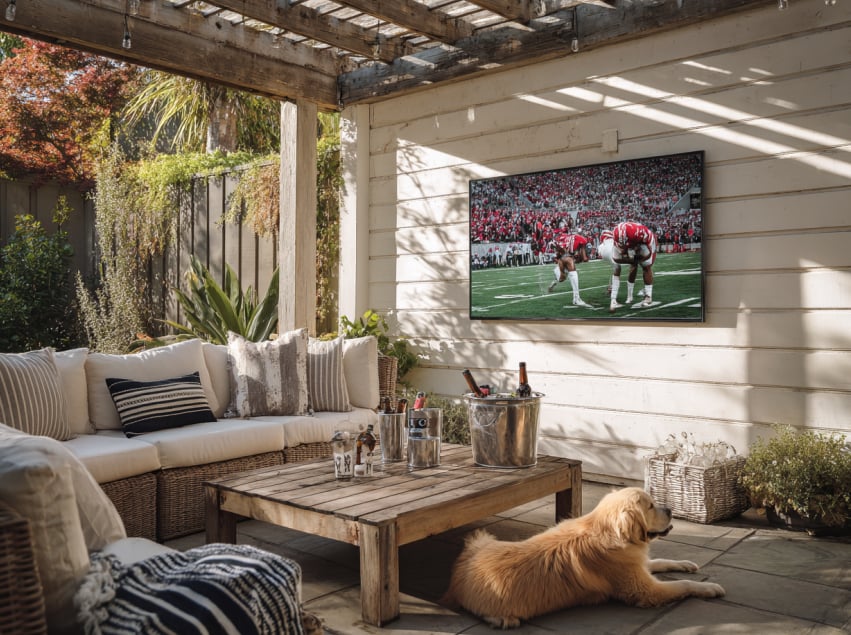
Environments: Pergola with slatted roof, covered deck with open sides, outdoor kitchen under an overhang, patio with afternoon sun, pool deck with partial cover.
This is where 80% of US homeowners actually install outdoor TVs. Partial-sun environments get a mix of direct ambient light and some shade — never full sun, rarely full dark. The brightness sweet spot here is 1,500 nits.
Here's why 1,500 specifically (not 1,000, not 2,000):
Models in this tier: ByteFree BF-55ODTV ($1,499–$1,599, 1,500 nits), Sylvox DeckPro 2.0+ ($1,599, 1,000 nits rated), Sylvox DeckPro QLED ($2,299, 1,000 nits), SunBrite Veranda 3 ($1,699, 1,000 nits).
Our pick for this tier: the ByteFree at 1,500 nits is the only option hitting the actual sweet spot brightness at a competitive price. Everyone else in the $1,500–$1,700 band is selling you a 1,000-nit panel at partial-sun pricing.
Environments: Open pool deck with no shade, south-facing exterior wall, rooftop patio, uncovered outdoor bar, beachfront install.
If the sun hits the screen directly — even for an hour a day — you need at least 2,000 nits. A 1,500-nit panel in direct sun at noon looks gray and unwatchable. You'll either hate the TV or only use it after sunset, which defeats the purpose.
Models in this tier: SunBrite Cinema ($2,999, 2,000 nits), Sylvox Pool Pro 2.0+ ($2,399, 2,000 nits), Samsung The Terrace LST7D/LST9D ($4,000+), Furrion Aurora Full-Sun Pro ($6,999, 2,500 nits).
Watch out: "Full sun" ratings are marketing claims, not industry-standard measurements. Verify the actual peak nit rating on the spec sheet. Sylvox DeckPro 2.0+ lists 1,000 nits but has been measured by third parties at closer to 520 nits in sustained use due to thermal throttling — that kind of gap is the norm, not the exception.
To make these numbers concrete, we tested the ByteFree BF-55ODTV (1,500 nits rated) on a typical partial-sun American patio across different times of day.
Test environment: Covered cedar pergola, 12×16 ft, north-facing wall, dappled afternoon sun filtering through pergola slats. Central Florida, mid-April, clear skies.
Test content: Our Planet II (Netflix, Dolby Vision), a daytime NFL game (HDR10), a nighttime thriller (Dolby Vision).
Verdict: 1,500 nits held up cleanly across the entire day in a typical partial-sun install. The one marginal window (~2–4 PM with direct reflection) is the exact window where jumping to 2,000 nits would help — but that window is narrow, and for most buyers, not worth $1,000+ more.
The instinct is "brighter is always better, just buy the most I can afford." It's wrong for three specific reasons.
1. Heat — and panel lifespan. Higher-nit panels run hotter. More heat means more aggressive cooling (bigger fans, more components), higher power draw, and faster panel degradation over time. A 2,000-nit panel in a shaded environment actually degrades faster than a 1,000-nit panel running well within its envelope, because you're thermally stressing hardware you don't need.
2. Thermal throttling in hot climates. Every outdoor TV has a sustained brightness vs peak brightness spec. "2,000 nits peak" often means the panel hits 2,000 for a few seconds, then throttles down to 1,500 or less to protect the electronics. In Florida, Texas, or Arizona at 95°F ambient, thermal throttling kicks in harder — your "2,000 nit" TV may effectively be a 1,400-nit TV in actual use.
3. Cost vs diminishing returns. Going from 700 → 1,500 nits delivers a massive perceptual improvement. Going from 1,500 → 2,500 nits is visible but subtle — and the price gap can be $2,000–$5,000. Unless you have a genuine full-sun install, the incremental nit spend goes into the "overpaying for headroom" bucket.
Here's how the major 55-inch outdoor TVs sort by rated peak brightness and environment match:
Important nuance: the 1,500-nit class is extremely thin. Most brands jump from 1,000 to 2,000, leaving the partial-sun sweet spot underserved. The ByteFree BF-55ODTV at $1,499 is currently the most accessible 1,500-nit option at this price — which is the primary reason it's getting picked up by home installers for partial-sun patios.
If you want to verify a manufacturer's nit claim before buying, here's the amateur method — good enough to catch obvious exaggerations.
You'll need:
Steps:
A TV claiming 1,500 nits should give you a reading around 450–500 lux at 1m. If you get under 300 lux, the spec is exaggerated.
Professional note: this is a rough-check method, not a calibrated measurement. Third-party reviewers use spectroradiometers that cost $5,000+. For our testing, we cross-reference manufacturer claims with RTINGS/Displaymate/AVForums measurements where available.
It depends on your install environment. For fully shaded areas (covered porch, screened lanai), 500–700 nits is sufficient. For partial sun installs (pergola, covered deck, outdoor kitchen) — which covers about 80% of US patios — you want 1,500 nits for best visibility without overpaying. For full sun exposure (open pool deck, uncovered rooftop), you need 2,000 nits or more. The most common mistake is under-buying brightness for a partial-sun install — a 1,000-nit TV will wash out at peak afternoon.
For partial-sun installs — pergolas, covered decks, outdoor kitchens, most residential patios — 1,500 nits is the sweet spot. It's bright enough to remain clearly visible through peak afternoon ambient light, retains HDR impact, and avoids thermal throttling in hot climates. You only need more than 1,500 nits if the TV gets direct, unfiltered sunlight at any point during the day.
It depends on the panel's brightness and anti-glare coating. A 700-nit outdoor TV in direct sun is essentially unwatchable — the ambient light overwhelms the screen. A 1,500-nit panel in direct sun is legible but washed out. A 2,000+ nit panel with anti-glare glass remains usable in direct sun, though contrast is reduced. For any install with direct sun exposure, budget for at least 2,000 nits.
Not in any usable way. Indoor TVs typically peak at 250–400 nits — barely visible even under a fully covered shaded patio. They also lack weatherproofing, anti-glare glass, thermal management for outdoor temperature swings, and UV protection. Using an indoor TV outdoors will result in unwatchable daytime viewing, and the TV itself will fail within months due to humidity, temperature, or direct sun damage.
For most US homeowners installing an outdoor TV in a partial-sun environment — pergola, covered deck, outdoor kitchen, patio under an overhang — 1,500 nits is the sweet spot. Not 1,000 (too dim for peak afternoon), not 2,000 (overkill, overpriced, runs hot).
Practically, the 1,500-nit tier is also where the best value lives in 2026. The ByteFree BF-55ODTV at $1,499–$1,599 currently delivers this brightness at a price point normally associated with 1,000-nit panels. For comparison, stepping up to the next bright tier (Sylvox Pool Pro 2.0 at 2,000 nits) costs $2,399 and only makes sense if you have genuine full-sun exposure.
If you're shopping in 2026, the decision framework is simple:
Match the TV to the install. Don't let "more nits" marketing push you into overpaying for brightness you physically cannot benefit from.
Dolby Vision Outdoor TV: Is It Worth It? (2026 Complete Guide)
Are Outdoor TVs Really Worth It? Here's What Nobody Tells You
Which 55-Inch Outdoor TV Is Best in 2026? ByteFree vs Sylvox DeckPro Compared
Best Outdoor TV for Airbnb & Short-Term Rentals: 2026 Top Picksh
So which one do you actually need for your patio? And where does "more nits" stop being worth the money?
At TVSBook, we've tested outdoor TV brightness across the brightness range most US homeowners are choosing between. Here's the honest answer — matched to real install environments, not marketing brochures.
What Are Nits, and Why They Matter Outdoors
A nit is a unit of brightness — technically, one candela per square meter. In practical terms, it measures how much light your TV screen pumps out.
To calibrate what the numbers mean:
| Display type | Typical brightness |
|---|---|
| Your phone at max | 800–1,200 nits |
| A laptop screen | 300–500 nits |
| A typical indoor TV | 250–400 nits |
| An entry-level outdoor TV | 700 nits |
| A mid-range outdoor TV | 1,000–1,500 nits |
| A flagship outdoor TV | 2,000–2,500 nits |
| Bright daylight (for reference) | ~10,000+ lux ambient |
Why outdoor TVs need so much more brightness: ambient light overwhelms a dim screen the same way car headlights disappear in daylight. Indoors, your 300-nit TV wins because there's almost no competing light. Outdoors, even under a covered patio, you're fighting hundreds of times more ambient light than your living room.
The question isn't "is brighter better" — at any environment, it is. The question is how bright you actually need it to be for your specific installation.
Nit Requirements by Outdoor Environment
This is the decision that actually matters. Your required brightness depends almost entirely on where the TV will live — not how much you want to spend.
Full Shade: 500–700 Nits Is Enough
Environments: Fully covered porch, screened-in lanai, garage, detached covered patio with walls on 3 sides, carport conversion.
If direct sunlight physically cannot reach the screen — at any time of day, any season — you don't need a high-brightness outdoor TV. A 700-nit panel in full shade looks just as good as a 1,500-nit panel. You're paying for brightness headroom you'll never use.
Models in this tier: Sylvox Patio Series ($1,199), Peerless-AV Neptune ($2,080), Furrion Aurora Full-Shade ($1,999).
Watch out: "Full shade" has to be genuinely full. If you get indirect afternoon glare bouncing off a pool surface or a light-colored wall, you're actually in partial-sun territory — bump up.
Partial Sun: 1,000–1,500 Nits Sweet Spot 
Environments: Pergola with slatted roof, covered deck with open sides, outdoor kitchen under an overhang, patio with afternoon sun, pool deck with partial cover.
This is where 80% of US homeowners actually install outdoor TVs. Partial-sun environments get a mix of direct ambient light and some shade — never full sun, rarely full dark. The brightness sweet spot here is 1,500 nits.
Here's why 1,500 specifically (not 1,000, not 2,000):
- 1,000 nits in partial sun: often washes out during 12–4 PM peak sun. Usable in morning and evening. Marginal during peak afternoon.
- 1,500 nits in partial sun: remains clearly legible through peak afternoon. Bright enough that HDR content retains impact. Doesn't thermal-throttle in hot weather.
- 2,000+ nits in partial sun: overkill. You get no additional visible benefit under shade, but you pay $800–$1,500 more and run a hotter panel.
Models in this tier: ByteFree BF-55ODTV ($1,499–$1,599, 1,500 nits), Sylvox DeckPro 2.0+ ($1,599, 1,000 nits rated), Sylvox DeckPro QLED ($2,299, 1,000 nits), SunBrite Veranda 3 ($1,699, 1,000 nits).
Our pick for this tier: the ByteFree at 1,500 nits is the only option hitting the actual sweet spot brightness at a competitive price. Everyone else in the $1,500–$1,700 band is selling you a 1,000-nit panel at partial-sun pricing.
Full Sun: 2,000+ Nits Required
Environments: Open pool deck with no shade, south-facing exterior wall, rooftop patio, uncovered outdoor bar, beachfront install.
If the sun hits the screen directly — even for an hour a day — you need at least 2,000 nits. A 1,500-nit panel in direct sun at noon looks gray and unwatchable. You'll either hate the TV or only use it after sunset, which defeats the purpose.
Models in this tier: SunBrite Cinema ($2,999, 2,000 nits), Sylvox Pool Pro 2.0+ ($2,399, 2,000 nits), Samsung The Terrace LST7D/LST9D ($4,000+), Furrion Aurora Full-Sun Pro ($6,999, 2,500 nits).
Watch out: "Full sun" ratings are marketing claims, not industry-standard measurements. Verify the actual peak nit rating on the spec sheet. Sylvox DeckPro 2.0+ lists 1,000 nits but has been measured by third parties at closer to 520 nits in sustained use due to thermal throttling — that kind of gap is the norm, not the exception.
1,500 Nits in Action — Real Patio Test
To make these numbers concrete, we tested the ByteFree BF-55ODTV (1,500 nits rated) on a typical partial-sun American patio across different times of day.
Test environment: Covered cedar pergola, 12×16 ft, north-facing wall, dappled afternoon sun filtering through pergola slats. Central Florida, mid-April, clear skies.
Test content: Our Planet II (Netflix, Dolby Vision), a daytime NFL game (HDR10), a nighttime thriller (Dolby Vision).
| Time | Ambient light | 1,500 nits visibility |
|---|---|---|
| 9 AM | Morning indirect light (~3,000 lux) | Excellent — image pops |
| 12 PM | Peak dappled sun (~8,000 lux) | Very good — HDR highlights clearly visible |
| 3 PM | Peak afternoon, some direct reflection | Good — slight washout on bright scenes |
| 6 PM | Golden hour | Excellent — colors vibrant |
| 9 PM | Evening darkness | Excellent — HDR truly shines |
Verdict: 1,500 nits held up cleanly across the entire day in a typical partial-sun install. The one marginal window (~2–4 PM with direct reflection) is the exact window where jumping to 2,000 nits would help — but that window is narrow, and for most buyers, not worth $1,000+ more.
Why More Nits Isn't Always Better
The instinct is "brighter is always better, just buy the most I can afford." It's wrong for three specific reasons.
1. Heat — and panel lifespan. Higher-nit panels run hotter. More heat means more aggressive cooling (bigger fans, more components), higher power draw, and faster panel degradation over time. A 2,000-nit panel in a shaded environment actually degrades faster than a 1,000-nit panel running well within its envelope, because you're thermally stressing hardware you don't need.
2. Thermal throttling in hot climates. Every outdoor TV has a sustained brightness vs peak brightness spec. "2,000 nits peak" often means the panel hits 2,000 for a few seconds, then throttles down to 1,500 or less to protect the electronics. In Florida, Texas, or Arizona at 95°F ambient, thermal throttling kicks in harder — your "2,000 nit" TV may effectively be a 1,400-nit TV in actual use.
3. Cost vs diminishing returns. Going from 700 → 1,500 nits delivers a massive perceptual improvement. Going from 1,500 → 2,500 nits is visible but subtle — and the price gap can be $2,000–$5,000. Unless you have a genuine full-sun install, the incremental nit spend goes into the "overpaying for headroom" bucket.
Outdoor TV Brightness Comparison by Brand (2026)
Here's how the major 55-inch outdoor TVs sort by rated peak brightness and environment match:
| Brightness class | Models | Price range | Best environment |
|---|---|---|---|
| 700 nits | Sylvox Patio, Peerless Neptune, Element EP500AE55C | $899–$2,080 | Full shade only |
| 1,000 nits | Sylvox DeckPro 2.0+/3.0+, Sylvox DeckPro QLED, SunBrite Veranda 3, Furrion Solis | $1,599–$2,999 | Full shade or covered partial sun |
| 1,500 nits | ByteFree BF-55ODTV, Furrion Aurora Partial-Sun Premier | $1,499–$2,699 | Partial sun (sweet spot) |
| 2,000 nits | SunBrite Cinema, Sylvox Pool Pro 2.0/2.0+, Samsung The Terrace LST7D | $2,399–$4,000 | Full sun capable |
| 2,500 nits | Furrion Aurora Full-Sun Pro | $6,999 | Extreme full sun |
Important nuance: the 1,500-nit class is extremely thin. Most brands jump from 1,000 to 2,000, leaving the partial-sun sweet spot underserved. The ByteFree BF-55ODTV at $1,499 is currently the most accessible 1,500-nit option at this price — which is the primary reason it's getting picked up by home installers for partial-sun patios.
How to Measure Real Outdoor TV Brightness
If you want to verify a manufacturer's nit claim before buying, here's the amateur method — good enough to catch obvious exaggerations.
You'll need:
- A smartphone with a lux-meter app (free ones work — search "lux meter")
- The outdoor TV you're testing, running a bright full-white image
Steps:
- Display a full-white test pattern on the TV at maximum brightness mode
- Hold your phone's light sensor 1 meter directly in front of the screen, centered
- Shield the sensor from ambient light with your other hand
- Read the lux value, then convert: nits ≈ lux × 3 for a flat-screen TV at 1m
A TV claiming 1,500 nits should give you a reading around 450–500 lux at 1m. If you get under 300 lux, the spec is exaggerated.
Professional note: this is a rough-check method, not a calibrated measurement. Third-party reviewers use spectroradiometers that cost $5,000+. For our testing, we cross-reference manufacturer claims with RTINGS/Displaymate/AVForums measurements where available.
Frequently Asked Questions
Q: How many nits do I need for an outdoor TV?
It depends on your install environment. For fully shaded areas (covered porch, screened lanai), 500–700 nits is sufficient. For partial sun installs (pergola, covered deck, outdoor kitchen) — which covers about 80% of US patios — you want 1,500 nits for best visibility without overpaying. For full sun exposure (open pool deck, uncovered rooftop), you need 2,000 nits or more. The most common mistake is under-buying brightness for a partial-sun install — a 1,000-nit TV will wash out at peak afternoon.
Q: Is 1,500 nits enough for an outdoor TV?
For partial-sun installs — pergolas, covered decks, outdoor kitchens, most residential patios — 1,500 nits is the sweet spot. It's bright enough to remain clearly visible through peak afternoon ambient light, retains HDR impact, and avoids thermal throttling in hot climates. You only need more than 1,500 nits if the TV gets direct, unfiltered sunlight at any point during the day.
Q: Can you see an outdoor TV in direct sunlight?
It depends on the panel's brightness and anti-glare coating. A 700-nit outdoor TV in direct sun is essentially unwatchable — the ambient light overwhelms the screen. A 1,500-nit panel in direct sun is legible but washed out. A 2,000+ nit panel with anti-glare glass remains usable in direct sun, though contrast is reduced. For any install with direct sun exposure, budget for at least 2,000 nits.
Q: Do indoor TVs work outside?
Not in any usable way. Indoor TVs typically peak at 250–400 nits — barely visible even under a fully covered shaded patio. They also lack weatherproofing, anti-glare glass, thermal management for outdoor temperature swings, and UV protection. Using an indoor TV outdoors will result in unwatchable daytime viewing, and the TV itself will fail within months due to humidity, temperature, or direct sun damage.
The TVSBook Verdict
For most US homeowners installing an outdoor TV in a partial-sun environment — pergola, covered deck, outdoor kitchen, patio under an overhang — 1,500 nits is the sweet spot. Not 1,000 (too dim for peak afternoon), not 2,000 (overkill, overpriced, runs hot).
Practically, the 1,500-nit tier is also where the best value lives in 2026. The ByteFree BF-55ODTV at $1,499–$1,599 currently delivers this brightness at a price point normally associated with 1,000-nit panels. For comparison, stepping up to the next bright tier (Sylvox Pool Pro 2.0 at 2,000 nits) costs $2,399 and only makes sense if you have genuine full-sun exposure.
If you're shopping in 2026, the decision framework is simple:
- Covered porch, screened lanai: 700 nits is enough, don't overpay
- Pergola, covered deck, outdoor kitchen: 1,500 nits sweet spot (the majority of buyers)
- Open pool deck, uncovered rooftop: 2,000 nits minimum
Match the TV to the install. Don't let "more nits" marketing push you into overpaying for brightness you physically cannot benefit from.
Dolby Vision Outdoor TV: Is It Worth It? (2026 Complete Guide)
Are Outdoor TVs Really Worth It? Here's What Nobody Tells You
Which 55-Inch Outdoor TV Is Best in 2026? ByteFree vs Sylvox DeckPro Compared
Best Outdoor TV for Airbnb & Short-Term Rentals: 2026 Top Picksh