


Catalogs Hide
- 1 Can You Use a Regular TV Outside? The Honest Answer
- 2 Why Regular TVs Struggle Outdoors (Even Under Cover)
- 3 The Real Cost of "Just Using a Regular TV"
- 4 What an Actual Outdoor TV Solves
- 5 The ByteFree BF-55ODTV: A Genuinely Practical 2026 Pick
- 6 So, Can You Use a Regular TV Outside? Yes, But You Probably Shouldn't
Can You Use a Regular TV Outside? The Honest Answer
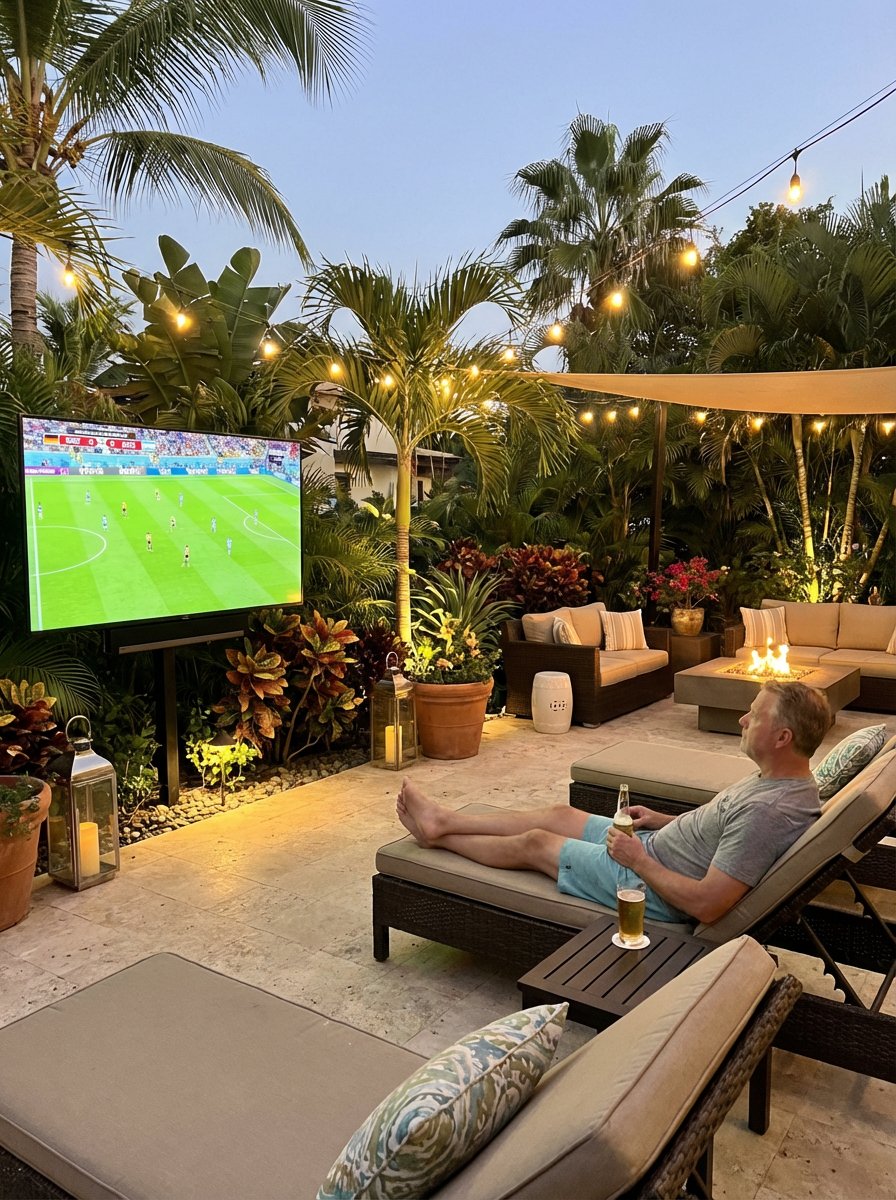
If you've ever stood on your patio with a glass of wine, watching the sunset and thinking, "wouldn't this be perfect with a TV out here?", you've probably asked yourself the obvious follow-up question: can you use a regular TV outside? It's a fair question, especially when a decent indoor 55-inch TV costs a fraction of what dedicated outdoor models used to. The short answer is yes, technically you can — but the longer answer is where things get complicated. A regular indoor TV will physically turn on and display a picture in your backyard, on your covered porch, or under a pergola. What it won't do is survive there for very long, look good while it's working, or stay safe to operate once humidity, dust, pollen, and temperature swings start doing their quiet damage to the internal electronics. Indoor TVs were engineered for a climate-controlled living room sitting at a steady 70°F with low humidity and zero direct sunlight, and the moment you take that engineering outside, every assumption it was built on starts breaking down.
Why Regular TVs Struggle Outdoors (Even Under Cover)
The most common mistake homeowners make is assuming that a covered patio is essentially "indoors with a view." It isn't. Even fully shaded outdoor spaces experience overnight humidity that can reach 90% or higher, morning condensation that forms inside the TV's circuitry as temperatures rise, pollen and dust that settle into vents and connectors, and seasonal temperature swings that an indoor LCD panel was never rated to handle. Most indoor TVs are designed to operate between roughly 32°F and 104°F, and direct sunlight alone can push the surface temperature of a black plastic bezel well past that ceiling. Then there's the brightness problem, which is the one most people don't anticipate until they actually try it. A typical indoor TV runs somewhere between 250 and 400 nits of brightness, which looks great in a dim living room but becomes nearly invisible the second any outdoor light hits the screen. You'll find yourself squinting at a washed-out picture during the day, fighting glare from every angle, and wondering why the colors look so dull compared to how they looked inside. The screen isn't broken — it's just being asked to do something it was never designed to do.
The Real Cost of "Just Using a Regular TV"
People often justify dragging an indoor TV outside by telling themselves it's the budget-friendly option, and on day one, it absolutely is. But run the math over two or three years and the picture changes dramatically. Most indoor TVs used outdoors fail somewhere between 6 and 18 months, depending on climate. That means buying a new $500–$800 TV every year or so, plus the cost of weatherproof covers that trap moisture and accelerate the very damage they're supposed to prevent, plus the hassle of constantly hauling the unit indoors every time clouds appear on the horizon. You also lose your manufacturer's warranty the moment you install an indoor TV outdoors — virtually every major brand explicitly excludes outdoor use from coverage, so when the screen fails (and it will), you're paying full replacement cost out of pocket. Add to this the safety angle that most people overlook: condensation forming inside an electrical device that's plugged into a 120V outlet is genuinely dangerous, and the combination of moisture and electricity has caused house fires in cases where homeowners assumed a covered roof was enough protection. Using a regular TV outside isn't really cheaper — it's just a payment plan you didn't realize you signed up for.
What an Actual Outdoor TV Solves
A purpose-built outdoor TV addresses every one of the problems above through engineering choices that simply aren't present in indoor models. The chassis is sealed against moisture and dust to an IP55 standard or better, which means rain spray and airborne particles can't reach the internal electronics. The panel is rated for a much wider operating temperature range, often from below freezing to well above 100°F, and includes internal thermal management that actively cools the components in summer and prevents condensation in shoulder seasons. Brightness is dramatically higher — outdoor TVs typically run between 1,000 and 2,000 nits, which is enough to overcome ambient daylight and keep colors looking saturated even when the sun is high. Anti-glare matte screen coatings replace the glossy finish of indoor models, so reflections from pool water, white siding, or bright sky don't wash out the picture. The result is a TV you can actually leave installed year-round, watch in the middle of the afternoon, and rely on for the kind of casual outdoor entertainment that made you want a patio TV in the first place.
The ByteFree BF-55ODTV: A Genuinely Practical 2026 Pick
For a long time, the trade-off in outdoor TVs was straightforward and frustrating: you either spent $3,000+ on a Samsung Terrace or SunBrite Pro, or you settled for a budget outdoor model that compromised on brightness, smart platform, or HDR support. The ByteFree BF-55ODTV has changed that calculation in 2026, and it's worth understanding why. At a price of $1,499–$1,599, the ByteFree 55-inch outdoor TV delivers 1,500 nits of real-world brightness (not just a marketing peak figure), full IP55 weatherproof construction with an all-metal chassis, and — most notably for streaming households — Dolby Vision HDR support paired with a 30W hardware Dolby Atmos audio system. It runs Google TV with native Netflix certification, which means the apps you actually use work the way they're supposed to without sideloaded workarounds, and the VESA 600×400 mount pattern fits standard outdoor brackets without an adapter. What makes ByteFree stand out isn't any single specification — it's the absence of the usual compromises. Most outdoor TVs at this price skip Dolby Vision, or skimp on audio hardware, or use a proprietary smart OS that limits streaming options. ByteFree doesn't, which is why it keeps showing up as the value pick across independent 2026 outdoor TV roundups.
So, Can You Use a Regular TV Outside? Yes, But You Probably Shouldn't
Coming back to the original question: can you use a regular TV outside? Yes, for short periods, on a fully covered patio, with the understanding that you're shortening its life and accepting a dim, glare-prone picture for as long as it lasts. For a one-off backyard movie night where you wheel the living room TV out for two hours and bring it back inside before dew falls, that's a perfectly reasonable trade-off. But if you actually want to enjoy your outdoor space — game days, summer evenings, weekend gatherings, casual Tuesday nights with dinner on the deck — the regular-TV-outside approach quietly costs more money, more hassle, and more compromised viewing than just buying the right tool for the job. A model like the ByteFree BF-55ODTV at the $1,500 mark gets you a TV that's bright enough to actually watch in daylight, sealed well enough to survive year-round, and equipped with the streaming and HDR features you'd expect from any modern indoor television. The era of having to choose between "cheap and broken in a year" or "premium and overpriced" is genuinely over, and that makes the answer to the original question a lot more interesting than it used to be: yes, you can use a regular TV outside — but in 2026, you finally have a reason not to.
Book now on the official website and save $100 instantly.Official website: https://bytefree.net/