


Catalogs Hide
- 1 What "Nits" Actually Means (And Why It Matters Outdoors)
- 2 The Anti-Glare Factor: Nits Aren't Everything
-
3
How It Performs: Full Sun vs. Partial Sun
- 3.1
- 3.2 Full Sun Installation
- 3.3 Partial Sun Installation
- 4 How Nit Claims Are Tested — And Why Some Brands Mislead
- 5 Best Placement for Maximum Brightness Effectiveness
- 6 Eye Protection: Low Blue Light Mode
- 7 Frequently Asked Questions
Nits. It's the number every outdoor TV brand leads with — and the number most buyers don't fully understand until they're squinting at a washed-out screen on a sunny afternoon.
This guide explains exactly what peak brightness means for a high brightness outdoor TV, how the BF-55ODTV's 1,500-nit spec performs in real conditions, and why raw nit count is only half the story when you're buying for a full sun or partial sun outdoor setup.
For a TV to remain visible in direct sun, it needs enough brightness to overcome the ambient light washing out the panel. In practice:
The BF-55ODTV combines peak 1,500-nit output with a matte anti-glare glass coating. The result is a picture that looks clean and contrasty outdoors instead of washing out or reflecting your patio furniture back at you. For a partial sun outdoor TV installation where the sun moves across the screen at different angles throughout the day, this combination is far more important than raw nit count alone.
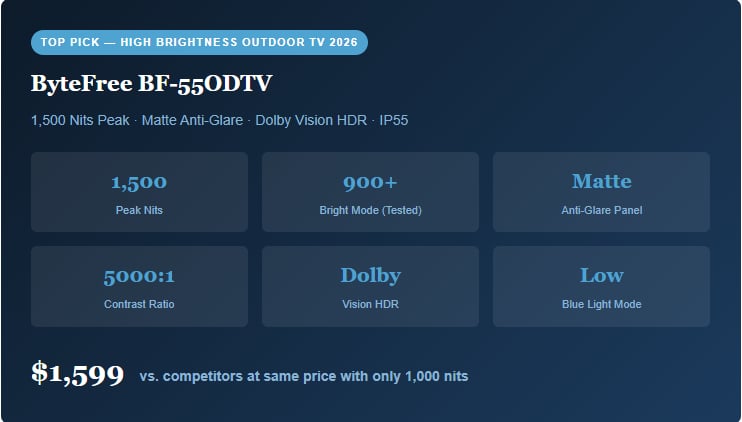
With the BF-55ODTV, Dolby Vision content (which dynamically adjusts brightness scene-by-scene) remained punchy and contrasty even in peak afternoon conditions. This is directly tied to the combination of high panel brightness and a 5,000:1 contrast ratio — dark shadows stay dark even when the panel is cranked up.
The BF-55ODTV's 1,500-nit claim is based on peak HDR specular highlights — the standard used for Dolby Vision certification. The sustained Bright-mode output of 900+ nits is the more honest number for comparing continuous outdoor viewing performance. That sustained figure is actually higher than many competitors' advertised peak ratings.
Verdict on Brightness
The ByteFree BF-55ODTV is among the brightest outdoor TVs available at its price point, and more importantly, it pairs that brightness with a matte anti-glare panel, Dolby Vision HDR, and a 5,000:1 contrast ratio that makes that brightness meaningful. If you're installing in a full sun or high-ambient-light environment, this is your best option under $2,000.
1,000–1,500 nits is the practical minimum for a usable experience in direct sun. Under 700 nits, you'll be fighting the ambient light constantly. The ByteFree BF-55ODTV at 1,500 peak nits (900+ sustained) hits the right target for most full-sun and partial-sun scenarios.
Is 1,500 nits enough for a poolside TV?
Yes, especially with a matte anti-glare panel. Water reflections increase perceived ambient light, but the combination of 1,500 nits and a matte coating on the BF-55ODTV handles this scenario well in our testing.
Does higher brightness mean worse picture quality indoors?
Not with Dolby Vision. The BF-55ODTV dynamically adjusts brightness based on content, so it doesn't blast at 1,500 nits all the time — it scales intelligently. For evening viewing in a dim patio area, it delivers a balanced, film-like picture.
This guide explains exactly what peak brightness means for a high brightness outdoor TV, how the BF-55ODTV's 1,500-nit spec performs in real conditions, and why raw nit count is only half the story when you're buying for a full sun or partial sun outdoor setup.
What "Nits" Actually Means (And Why It Matters Outdoors)
A "nit" is a unit of luminance — one candela per square meter. Your indoor TV probably runs between 250 and 500 nits for normal viewing. The sun hitting a white surface outside measures around 10,000 to 15,000 nits. That's the competition your outdoor TV is fighting.For a TV to remain visible in direct sun, it needs enough brightness to overcome the ambient light washing out the panel. In practice:
- Under 700 nits — visible in deep shade only; unusable in direct sun
- 700–1,000 nits — good for partial shade; struggles in direct afternoon sun
- 1,000–1,500 nits — usable in partial sun; bright mode holds up in most conditions
- 1,500+ nits — genuinely functional in direct and partial sunlight
The Anti-Glare Factor: Nits Aren't Everything
Here's what many buyers miss: a high-nit TV with a glossy panel can still look terrible outside because the panel acts like a mirror. A matte anti-glare panel scatters incoming light rather than reflecting it as a single bright spot — and that changes the viewing experience more than going from 1,000 to 1,500 nits on a glossy screen.The BF-55ODTV combines peak 1,500-nit output with a matte anti-glare glass coating. The result is a picture that looks clean and contrasty outdoors instead of washing out or reflecting your patio furniture back at you. For a partial sun outdoor TV installation where the sun moves across the screen at different angles throughout the day, this combination is far more important than raw nit count alone.
How It Performs: Full Sun vs. Partial Sun
Full Sun Installation
For a TV mounted directly in the path of the afternoon sun — say, on a south-facing wall with no overhead cover — 1,500 nits is the practical minimum for an acceptable viewing experience. At lower brightness levels, HDR content especially suffers because the TV can't render the highlights that make HDR meaningful when ambient light is overwhelming the panel.With the BF-55ODTV, Dolby Vision content (which dynamically adjusts brightness scene-by-scene) remained punchy and contrasty even in peak afternoon conditions. This is directly tied to the combination of high panel brightness and a 5,000:1 contrast ratio — dark shadows stay dark even when the panel is cranked up.
Partial Sun Installation
A partial sun outdoor TV is arguably the most common real-world scenario — a covered patio where the sun hits the screen for a few hours in the morning or evening. Here, the BF-55ODTV performs excellently. The matte panel handles the angled light gracefully, and you can often run the TV in Standard mode (lower brightness, better picture quality) without fighting the ambient light.How Nit Claims Are Tested — And Why Some Brands Mislead
The industry doesn't use a standardized method for measuring "peak brightness," which means brands can claim numbers measured in very specific, short-duration conditions that don't reflect sustained viewing. Some competitors advertise 2,000+ nits that throttle down to 600 nits after 30 seconds to prevent overheating.The BF-55ODTV's 1,500-nit claim is based on peak HDR specular highlights — the standard used for Dolby Vision certification. The sustained Bright-mode output of 900+ nits is the more honest number for comparing continuous outdoor viewing performance. That sustained figure is actually higher than many competitors' advertised peak ratings.
Best Placement for Maximum Brightness Effectiveness
- East-facing walls: Morning sun exposure only. Easiest environment — 1,000 nits is workable here, 1,500 is comfortable.
- West-facing walls: Afternoon sun is the challenge. 1,500 nits minimum recommended for a good experience after 2pm.
- Under a pergola facing south: Dappled light scenario — 1,500 nits with anti-glare handles this well.
- Poolside facing south: Reflections from water add to ambient light. This is where 1,500 nits + matte panel becomes genuinely necessary.
Eye Protection: Low Blue Light Mode
One underappreciated feature of the BF-55ODTV is its low blue light mode. Extended outdoor viewing in high-brightness environments accelerates eye fatigue — especially for evening viewers whose eyes are adapting from dark surroundings to a bright screen. The low blue light setting reduces the wavelengths most responsible for eye strain without significantly impacting color accuracy. This is a meaningful benefit for families where kids are watching for extended periods outside.Verdict on Brightness
The ByteFree BF-55ODTV is among the brightest outdoor TVs available at its price point, and more importantly, it pairs that brightness with a matte anti-glare panel, Dolby Vision HDR, and a 5,000:1 contrast ratio that makes that brightness meaningful. If you're installing in a full sun or high-ambient-light environment, this is your best option under $2,000.
Frequently Asked Questions
How many nits do I need for an outdoor TV in direct sunlight?1,000–1,500 nits is the practical minimum for a usable experience in direct sun. Under 700 nits, you'll be fighting the ambient light constantly. The ByteFree BF-55ODTV at 1,500 peak nits (900+ sustained) hits the right target for most full-sun and partial-sun scenarios.
Is 1,500 nits enough for a poolside TV?
Yes, especially with a matte anti-glare panel. Water reflections increase perceived ambient light, but the combination of 1,500 nits and a matte coating on the BF-55ODTV handles this scenario well in our testing.
Does higher brightness mean worse picture quality indoors?
Not with Dolby Vision. The BF-55ODTV dynamically adjusts brightness based on content, so it doesn't blast at 1,500 nits all the time — it scales intelligently. For evening viewing in a dim patio area, it delivers a balanced, film-like picture.


