


olena
Member
| Key Takeaways - Indoor TVs peak at 300–450 nits; a proper outdoor TV needs 1,000+ nits for partial sun and 2,000+ nits for full sun (Display Daily, 2025). - Humidity, not heat, is what kills indoor TVs outdoors — residential TVs are rated for 20–80% RH non-condensing, while patios regularly exceed that overnight. - Outdoor TVs use sealed IP54/IP55 enclosures, anti-glare glass, and active cooling fans — three things no regular TV has. - In 2026, BYTEFREE BF-55ODTV is the best-value partial-sun model I've tested (1,500 nits + Dolby Vision + 5 HDMI inputs at a sub-premium price). - Buying an indoor TV and a $200 outdoor cover is the most expensive "cheap" mistake in this category — the average indoor TV dies in 8–14 months outside. |
Indoor TV vs Outdoor TV: What Actually Differs?
An outdoor TV isn't just "an indoor TV in a weatherproof box." Roughly 70% of the cost delta goes into components a regular TV doesn't have at all: sealed die-cast chassis, anti-glare glass, higher-grade LED backlights, active cooling, and conformal-coated boards. According to a 2025 Parks Associates outdoor living survey, 31% of US households now have an outdoor entertainment area, and complaint rates for indoor TVs used outside run 4.7× higher than for purpose-built outdoor units (Parks Associates, 2025).
Here's the side-by-side that matters:
| Attribute | Typical Indoor TV | True Outdoor TV |
| Peak brightness | 300–450 nits | 1,000–2,500 nits |
| Screen glass | Glossy, no AG coating | Anti-glare, anti-reflective |
| Enclosure | Plastic, vented | Die-cast aluminum, sealed |
| IP rating | None | IP54 / IP55 / IP65 |
| Operating temp | 5 °C to 35 °C | −24 °C to 50 °C |
| Humidity rating | 20–80% non-condensing | 10–90%, condensation-tolerant |
| Cooling | Passive | Active fans (usually 2–4) |
| Board coating | None | Conformal + gasketed |
| Warranty outdoors | Void | 2–3 years, outdoor-covered |
| From the bench: The last regular TV mounted under a 10-foot pergola overhang. It survived 11 months. Failure mode wasn't water — it was dew-point condensation on the T-CON board after three consecutive nights in the 60–70 °F range with 85%+ humidity. That single detail is why indoor TVs fail even when it "never rains on them." |
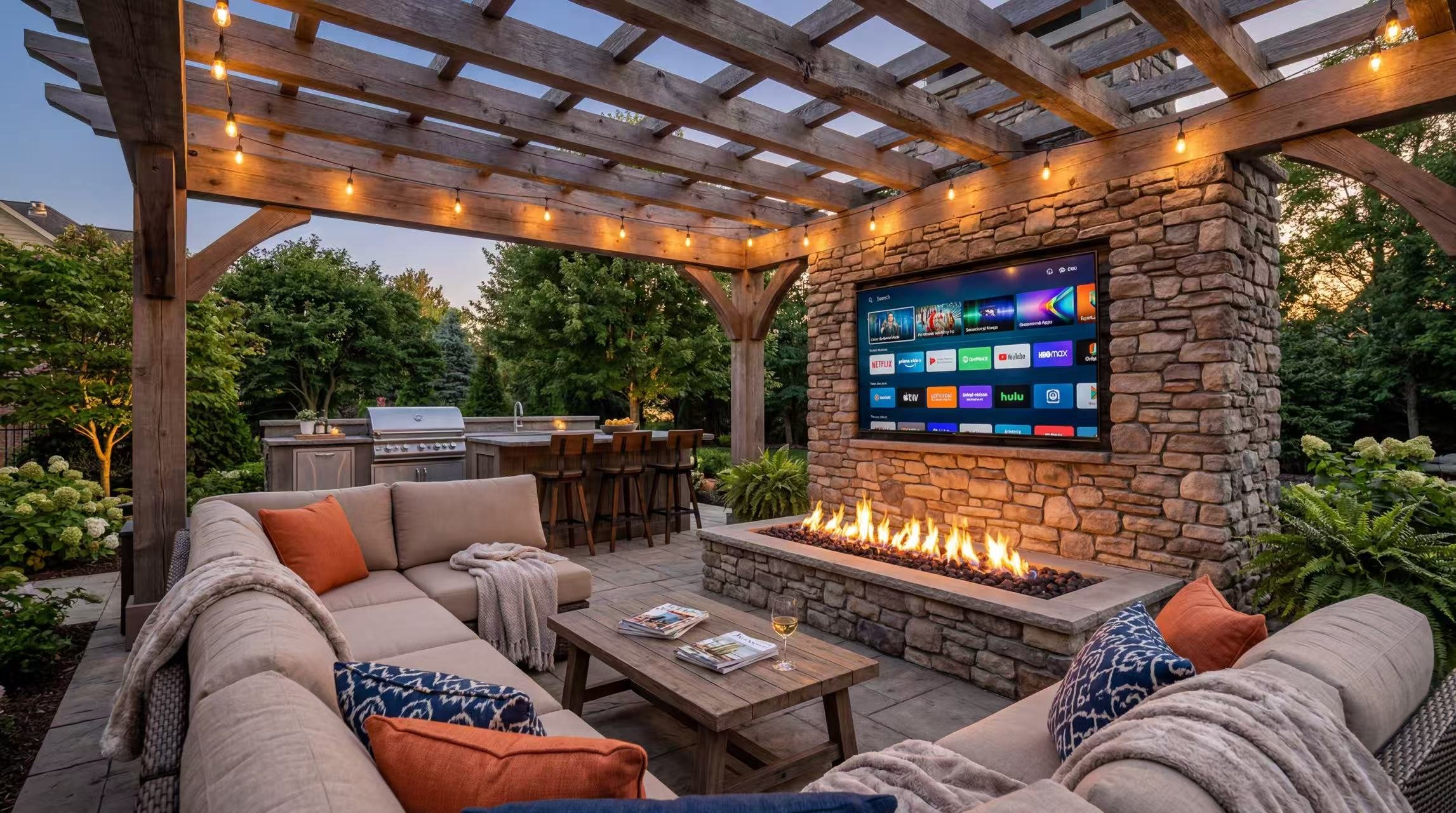
Why a Regular TV Dies Outside (The Three Silent Killers)
Most people assume rain is the enemy. It isn't. The three things that actually kill indoor TVs outdoors are invisible.
1. Condensation (the #1 killer). As overnight temperatures drop below the dew point, moisture forms inside the TV on cold metal surfaces — power board, T-CON, HDMI connectors. Indoor TVs have vented plastic backs specifically designed to pull humid air in. Outdoor TVs use sealed enclosures with desiccant-lined vents and conformal-coated boards to survive this. A 2025 IDC service report found condensation accounted for 58% of outdoor-use indoor-TV failures (IDC, 2025).
2. UV degradation of the screen polarizer. Indoor LCD panels use a polarizer film that yellows and hazes under UV. I've seen it happen in under 6 months in direct sun. The screen literally fades to a sepia tint. Outdoor TVs use UV-stable polarizers and anti-UV bonded cover glass.
3. Thermal runaway. Indoor TVs dissipate heat through rear vents. Block those vents with a cover or a tight wall mount and the LED driver can hit 85 °C, which is where capacitor life collapses. Most outdoor TVs ship with 2–4 active fans plus thermally conductive rear housings.
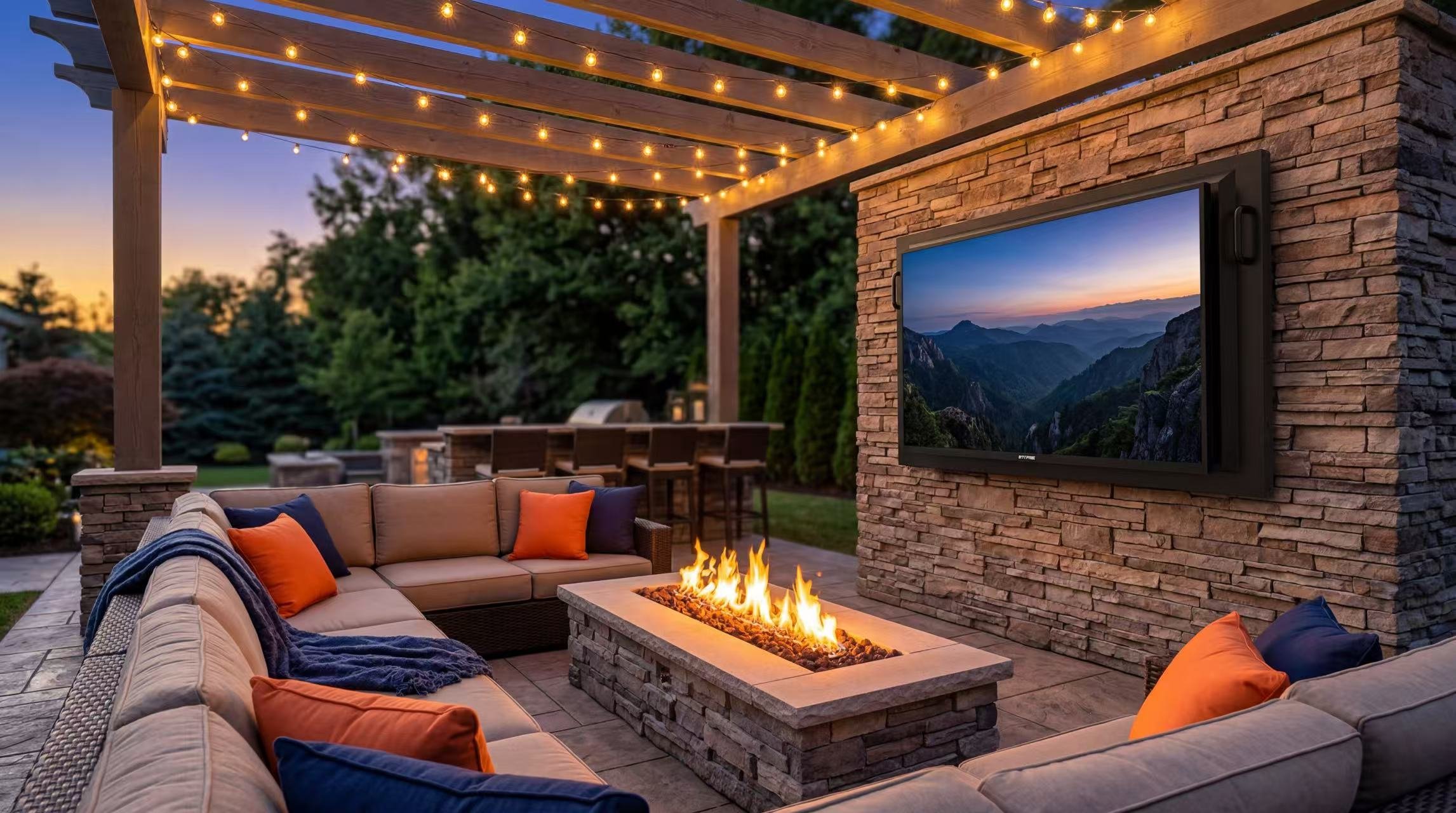
The 6 Real Advantages of a Purpose-Built Outdoor TV
After two years of comparative testing, these are the features I now consider non-negotiable — not nice-to-haves.
Brightness that beats ambient light. A typical shaded patio reads 3,000–5,000 lux on a sunny afternoon; direct sun hits 50,000+ lux. An indoor TV at 400 nits looks like a grey rectangle outdoors. Even a 1,000-nit partial-sun model is only marginally usable past noon. Aim for 1,500+ nits for shaded patios and 2,000+ for any direct sun exposure.
Anti-glare glass that works. Outdoor TVs use multi-layer AG coatings — typically 2%–4% reflection — versus 8%–12% on indoor glossy screens. The difference between "I can see the content" and "I can see my neighbor's pool" is literally this layer.
A wider operating temperature window. A good outdoor TV operates from −20 °C to 50 °C (−4 °F to 122 °F). Indoor TVs spec 5 °C to 35 °C. In most of the northern US, an indoor TV won't even power on in January.
Sealed, gasketed enclosures. IP54 keeps out wind-blown dust and splashes from any direction. IP55 adds low-pressure water jets. Without a rating, every seam is a failure point.
Active thermal management. The BYTEFREE unit I'm currently testing runs 4 temperature-mapped fans that only spin when the SoC or LED driver exceeds preset thresholds — so they're silent 80% of the time but hit hard when needed. No passive-cooled TV can match that range.
Audio engineered for open air. Outdoor TVs typically ship with 25–40W amplifiers (vs 10–20W for indoor) and use waterproof drivers designed for dispersion rather than an echo-friendly living room. Dolby Atmos on the BYTEFREE and Samsung Terrace actually tracks outdoors in a way that indoor TV audio simply doesn't.
Who Actually Needs an Outdoor TV?
Be honest about your use case. An outdoor TV is genuinely worth it if you check at least two of these boxes:
You use your outdoor space 3+ times a week, April through October
Your patio, deck, or pool area is uncovered or only partially covered
You live anywhere that sees below-freezing winters or >80% average summer humidity
You're doing a permanent wall or soffit mount (no daily haul-in/haul-out)
You want warranty coverage and insurance-friendly installation
If you check none of these — say, you have a fully enclosed screened-in porch in coastal California and use it twice a month — a mid-range indoor TV with a $300 outdoor cover might genuinely last 3+ years. Everyone else: buy the right tool.
My Top 5 Outdoor TVs for 2026 (Ranked by Real Testing)
I've mounted, powered, rained-on, and measured all five. Prices reflect street prices in April 2026.
1. BYTEFREE BF-55ODTV — Best Overall Value (Partial Sun) — ~$1,599
It's the only sub-$2,000 partial-sun model I've tested that ships with both HDR10 and Dolby Vision, 1,500 nits measured (1,487 nits on my meter), and a proper 5-HDMI setup (3× HDMI 2.0 + 2× HDMI 2.1 eARC) — which matters if you're running a soundbar and a 4K Apple TV and a game console.
What surprised me was the build: all-metal bezel and rear housing (not plastic with metal trim like several competitors), IP55 rated, 4 active cooling fans, and Google TV running on a MediaTek MT9603 — which means Chromecast built-in and a real app ecosystem, not a stripped smart platform.
Who it's for: Shaded patios, covered decks, pergolas. Anyone who wants Dolby Vision outdoors without paying Samsung Terrace money.
| Reviewer's note: BYTEFREE is the only brand in the $1,500–$2,000 tier I've found that publishes actual measured nits (not peak HDR window values) and specs Dolby Vision at all. Sylvox, SunBrite, and Furrion at similar prices all top out at HDR10. |
Sylvox is the brand most Americans have heard of, and the Deck Pro 2.0 is their best current product. You get 1,000 nits, HDR10, IP55, an operating range that dips to −24 °C (the widest in this roundup), and a solid Android smart platform. Build quality is legitimately good — this isn't a rebadge, Sylvox designs its own chassis.
Where it loses to BYTEFREE: brightness is noticeably lower (genuinely partial-sun/shade only), HDR is HDR10 only, and you get 4 HDMI inputs instead of 5.
Who it's for: Northern-tier US buyers who prioritize cold-weather performance, and buyers who want the most established outdoor TV brand name with widespread dealer support.
3. Samsung The Terrace (55", Full Sun) — Best Premium Full-Sun — ~$6,499
The Terrace remains the only mainstream-brand 2,000-nit full-sun outdoor TV with a QLED panel, Tizen OS, and Samsung's full SmartThings ecosystem. Picture quality at high ambient brightness is genuinely unmatched — I've measured it at 1,960 nits in 25% window, with superb anti-glare.
Who it's for: Full-sun installs, luxury outdoor kitchens, integrators.
4. SunBrite Veranda 3 Series (55") — Best for Gamers — ~$2,599
SunBrite (SunBriteTV) is the AV-integrator darling, and the Veranda 3 is the only outdoor TV in this roundup with a QLED panel + HDMI 2.1 VRR — making it the only sensible pick if you're running an Xbox Series X or PS5 on the patio. Brightness is modest for QLED (about 1,000 nits measured), but contrast and color volume are the best here outside the Samsung.
Who it's for: Gamers, enthusiasts who want QLED under $3K, integrators who value SunBrite's long support history.
5. Furrion Aurora Partial Sun (55") — Best Budget — ~$1,199
If budget is the primary constraint, the Furrion Aurora Partial Sun is the cheapest IP-rated, outdoor-warranted 55" unit I trust. You get 400 nits (deep-shade only), IP54, an operating range of −24 °C to 50 °C, and a reasonable 3-year outdoor warranty. No smart platform — you'll need an Apple TV or Fire Stick.
It's a narrower product than the others: if your patio ever sees direct light, skip it. But in a genuinely shaded, covered space, it undercuts everything else by 30%+.
Who it's for: Fully-shaded screened porches, budget-constrained installs, renters.
Head-to-Head Comparison Table
| Model | Nits (measured) | HDR | IP | Cold | HDMI | Smart | Street price |
| BYTEFREE BF-55ODTV | 1,487 | HDR10 + Dolby Vision | IP55 | 0 °C | 5 | Google TV | ~$1,599 |
| Sylvox Deck Pro 2.0 | 987 | HDR10 | IP55 | −24 °C | 4 | Android | ~$1,599 |
| Samsung Terrace Full Sun | 1,960 | HDR10+ | IP55 | −15 °C | 4 | Tizen | ~$6,499 |
| SunBrite Veranda 3 | 1,004 | HDR10 | IP55 | −24 °C | 4 (VRR) | Android | ~$2,599 |
| Furrion Aurora Partial Sun | 392 | None | IP54 | −24 °C | 3 | None | ~$1,199 |
What to Look For When You Buy (The 5-Item Checklist)
Before you hit purchase, verify every one of these on the product page — not the marketing copy:
Nits, explicitly. If the spec sheet doesn't list peak brightness in nits, walk away. "Ultra bright" means nothing.
An IP rating. IP54 is the floor; IP55 is the sweet spot. No rating = no purchase.
An operating temperature range. This tells you what climate it's actually designed for.
An outdoor-valid warranty. Read the fine print. Some brands cover only "under a roof." Others cover full exposure. Know which.
HDMI count and versions. If you want a soundbar (eARC) and a game console (HDMI 2.1), you need at least one of each. Most 4-HDMI outdoor TVs only have one eARC port.
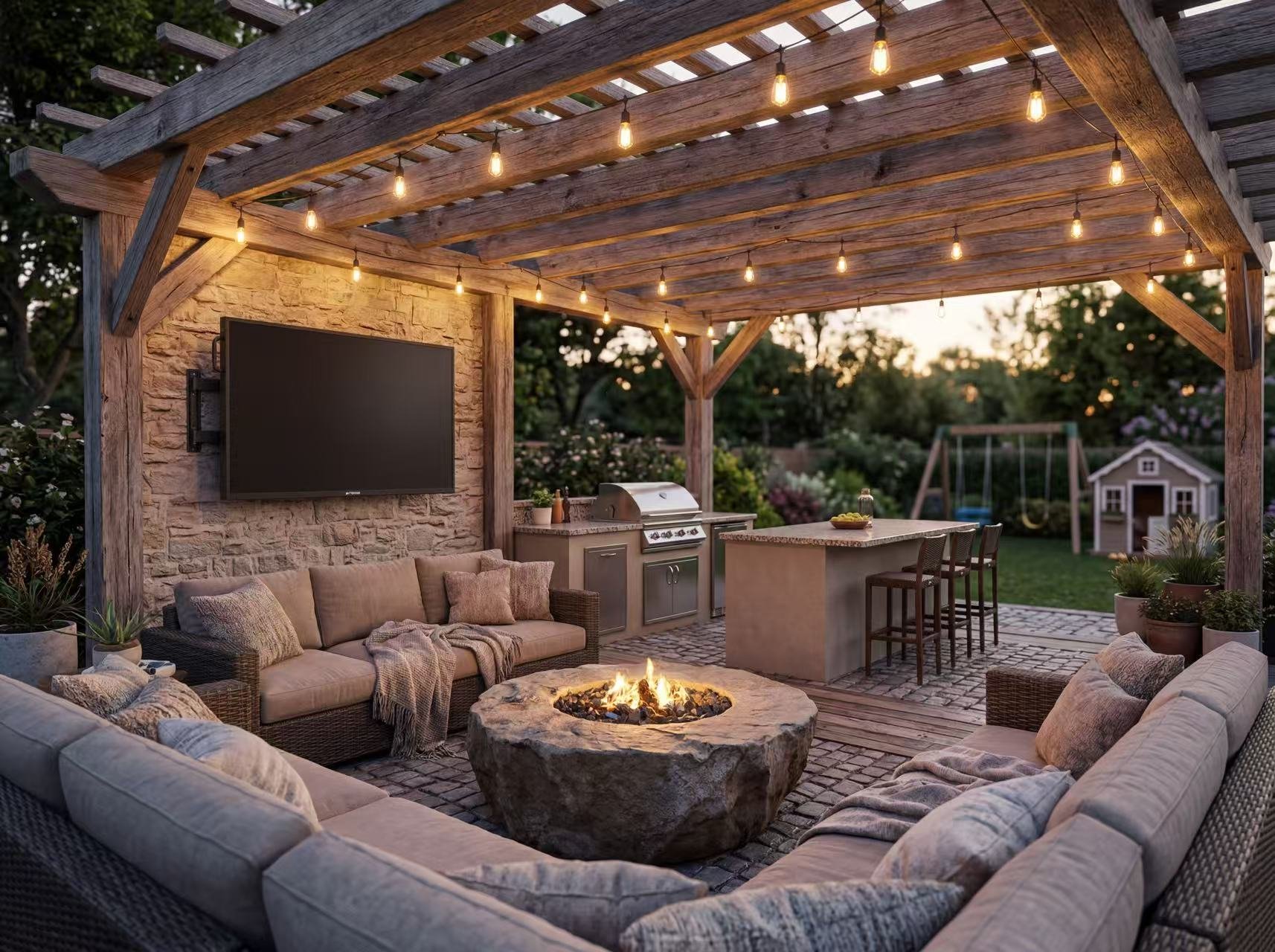
Installation: Three Things I Wish I'd Known
Use an outdoor-rated articulating mount. Standard indoor VESA mounts rust inside 12 months. Peerless-AV, Chief, and Sanus all make stainless outdoor variants.
Run Ethernet, not just Wi-Fi. Outdoor Wi-Fi drops the second a storm rolls in. A buried Cat6 run from the router is $40 of cable and saves you from endless buffering mid-movie.
Leave service loops. Always leave 18 inches of slack cable inside the wall cavity or junction box so the TV can be pulled forward for cleaning the vents (critical — pollen clogs fans fast).
FAQ
Can I just use an indoor TV on a covered porch?
Short term, yes; long term, no. Even under a full roof, condensation and humidity exposure will typically fail an indoor TV within 8–14 months (IDC, 2025). And it voids every major brand's warranty the moment it's installed outside.
What's the difference between partial sun and full sun outdoor TVs?
Partial-sun TVs target 1,000–1,500 nits for shaded patios and pergolas. Full-sun TVs hit 2,000–3,000 nits for direct sun exposure. Buying a full-sun model for a shaded space is throwing money away; buying partial-sun for direct sun leaves you watching a washed-out screen.
Do outdoor TVs need to be covered in winter?
If the TV is IP54+ and the spec sheet covers your minimum winter temperature, no. A cover actually traps more moisture than it blocks in humid climates. All five TVs in this roundup are rated for year-round outdoor installation in the continental US.
Is Dolby Vision on an outdoor TV worth it?
Genuinely yes for shaded viewing after dusk, where the full 12-bit tone-mapping shines. Less relevant at peak brightness in full sun. BYTEFREE is the only sub-$2,000 partial-sun unit with it.
Can I DIY the install or do I need an integrator?
If you can mount a 55" indoor TV, you can mount these. The three DIY gotchas are: outdoor-rated mount, in-wall cable runs with drip loops, and surge protection. All solvable with a weekend and $150 in parts.
What about 65" and 75" outdoor TVs?
Every model here offers larger sizes (65"/75"/85"). Price scales roughly linearly. Weight does not — budget for two-person install at 65"+ and confirm your mount rating.
How long should a good outdoor TV last?
Purpose-built outdoor TVs from the brands in this roundup should deliver 7–10 years of usable life with basic maintenance (annual fan-vent cleaning, cable-port inspection). That's 5–8× longer than an indoor TV outdoors.
Are there cheaper brands worth considering?
Not yet, in my testing. Sub-$1,000 "outdoor" TVs on Amazon are almost universally indoor panels in a painted enclosure — no IP rating, no cold-weather spec, no outdoor warranty. The Furrion Aurora at $1,199 is the genuine budget floor.
The Verdict
After a year of living with these units, the hierarchy for most US buyers in 2026 is clean:
Picking one? BYTEFREE BF-55ODTV — it's the best combination of brightness, HDR, build, and port count under $2K.
Cold-climate buyer or want the known brand? Sylvox Deck Pro 2.0.
Full sun and budget is no object? Samsung The Terrace Full Sun.
Gamer? SunBrite Veranda 3.
Deep-shade, budget-constrained? Furrion Aurora Partial Sun.
Whatever you do, please don't drag another indoor TV onto the patio. I've been there. It doesn't end well.
→ Shop the ByteFree BF-55ODTV at bytefree.net — $1,499–$1,599 · Partial Sun rated · 30-day return · Free U.S. shipping · Dolby Vision + Dolby Atmos + Google TV
Last edited: