


Catalogs Hide
- 1 The Core Trade-Off
- 2 Side-by-Side: TV vs Projector for Backyard Use
- 3 When a Projector Wins
- 4 When an Outdoor TV Wins
- 5 Cost Comparison Over 3 Years
- 6 Hybrid Approach: TV for Daily Use, Projector for Special Events
-
7
What Each Option Actually Looks Like in Real Use
- 7.1 Outdoor TV Reality
- 7.2 Projector Reality
- 8 The "I Already Have a Projector" Scenario
- 9 Frequently Asked Questions
- 10 Verdict
The decision tree most homeowners run before buying outdoor entertainment goes something like this: "Can I just get a projector for $400 instead of spending $1,500+ on a real outdoor TV?"
It's the right question to ask. The answer is "yes, sometimes" — but the specific situations where projectors beat outdoor TVs are narrower than projector marketing suggests. Here's the honest breakdown.
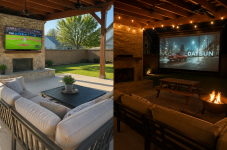
Outdoor TVs and projectors solve different problems:
Outdoor TVs = always-available daytime visibility, weather durability, simple use. Projectors = bigger image at a lower price, but only work in darkness.
That single distinction drives 80% of the decision. If you watch outdoors during the day, you need a TV. If you only watch at night, a projector might be the better choice. Most buyers fall somewhere between, and that's where the comparison gets interesting.
A projector is the right choice if:
You only watch outdoors in darkness. No daytime use. No twilight use. Strictly nighttime.
You watch outdoors fewer than once per week. The setup-and-teardown overhead per use is acceptable for monthly movie nights, frustrating for weekly use.
You want a 100+ inch image and budget is tight. A $400-$700 projector delivers a 100-inch image. A 100-inch outdoor TV would cost $5,000+. For occasional dark-environment viewing, the size advantage is real.
You don't mind storing equipment between uses. Projectors need to come inside after each use. If you have a garage or shed for storage, this is workable. If you don't, the friction adds up.
You're hosting outdoor events occasionally, not building daily use. Backyard movie night for the kids' birthday party, summer get-together, occasional Sunday afternoon — projectors work for these. Daily evening viewing on the patio after work? Projectors don't.
An outdoor TV is the right choice if:
You want to watch during daylight hours. This is the single decisive factor. Sports during the day, news at lunch, kids' shows in the afternoon — these require an outdoor TV. No projector handles them.
You want to use it more than weekly. Daily-use outdoor viewing makes the projector setup-and-teardown overhead unworkable. Permanent projector installations exist but cost more than a comparable outdoor TV.
You watch in a partially shaded environment. Pergolas, covered decks, outdoor kitchens — these get ambient daylight that projectors can't compete with.
You want a polished, integrated install. TVs look like part of the architecture. Permanent projector installs require dedicated screens (or painted surfaces) plus mounted projectors plus power and cable runs — meaningfully more visual clutter.
You live in humid or stormy climates. Florida, Gulf Coast, Pacific Northwest — projectors don't tolerate these conditions, even with covers and storage. Outdoor TVs handle them by design.
You want simple operation. Press one button on a remote. No screen unfurling, no projector positioning, no input switching, no ambient light management.
Sticker price comparison misses the total cost picture. Here's what 3 years of ownership actually costs:
The "projector is cheaper" assumption holds up only at the budget battery-projector tier — and at that tier, you're accepting modest image quality and short hardware lifespan. Mid-range projector setups frequently cost more than outdoor TV setups over 3 years.
Some homeowners run both: an outdoor TV mounted permanently for daily viewing, plus a battery projector for occasional movie nights when they want a 120-inch image. This works well if budget allows.
Total system cost: ~$2,000 (mid-range TV + budget battery projector)
The use case: Daily evening sports/streaming on the TV, monthly movie nights with the kids using the projector for a bigger image.
For most buyers, this is overkill — the TV handles 95% of use cases on its own. But for households where occasional 120-inch backyard movies are part of the lifestyle, the combination makes sense.
Day 1: Mount on the wall, run cables, connect power. 2-3 hours of setup. Daily use after that: Press power button. Watch. Year-round: TV stays on the wall through rain, sun, humidity. No storage needed. 5-year cost of ownership: TV + occasional cleaning + maybe a new mount. Done.
Each use: Bring projector outside (~5 min). Set up screen or hang sheet (~10 min). Connect power, audio, and source. Adjust focus and keystone. ~15-20 min total before watching. During movie: Manage ambient light (sunset is unwatchable, full dark is required). Insects fly through the projector beam. After: Disconnect everything. Bring projector inside. Pack screen. Year-round: Equipment lives indoors except during use. 3-year reality: Friction means you use it less than you planned.
This is the difference most marketing comparisons miss. A projector setup that works perfectly for one Saturday night gets used 6-10 times a year. A mounted TV gets used 200+ times a year because the friction is zero.
If you own an indoor projector and want to use it outdoors occasionally:
You can. Bring it outside, set up a screen or sheet, run an extension cord. Works fine for occasional movie nights in full darkness.
Don't expect daily use. The setup overhead, light sensitivity, and lack of weather protection limits usage to scheduled events.
Don't leave it outdoors overnight. Even covered, humidity will eventually damage indoor projectors.
For households with an existing indoor projector, this is the most cost-effective "outdoor entertainment" solution — but it's not a substitute for a permanent outdoor TV install.
For daily use or any daytime viewing, an outdoor TV is the right choice — projectors can't compete with ambient daylight. For occasional nighttime-only viewing (less than weekly), a projector can deliver a much larger image at a lower entry price. Most buyers benefit from the outdoor TV's always-available, low-friction operation; projectors make sense for specific use cases (occasional movie nights in dark conditions).
Not practically. Daytime ambient light overpowers nearly all projectors except commercial-grade outdoor displays costing $5,000+. Even premium home theater projectors (3,000+ lumens) wash out in daylight. Outdoor TVs with 1,500+ nit panels handle daylight viewing; projectors don't.
Battery-powered portable projectors start at $400 (Anker Nebula, Xgimi Halo). Mid-range outdoor-capable projectors with adequate brightness for nighttime backyard use run $700-$1,500. Premium home theater projectors that can handle some twilight viewing run $2,500+. For a complete outdoor projector setup including screen, speakers, and cabling, budget 50-100% on top of projector cost.
No. Quality outdoor TVs last 7-10 years in residential use. Projectors used outdoors typically last 2-4 years before bulb/laser replacement is needed and cumulative humidity damage degrades the unit. Permanent outdoor projector installations require additional weatherproofing that further increases cost.
Outdoor TV is dramatically easier to use after initial install. TVs require 2-3 hours of one-time installation, then turn on with a button press. Projectors require 5-20 minutes of setup per use (positioning, screen, power, audio), unless installed permanently. For frequent use, the TV's setup advantage compounds significantly.
For 80% of US backyard outdoor entertainment buyers, an outdoor TV is the right answer. Daily-use convenience, daytime visibility, weather durability, and simple operation outweigh the projector's image-size advantage.
The 20% where projectors win:
For the majority of buyers shopping a covered patio, pergola, deck, or outdoor kitchen install, an outdoor TV in the $1,500 range — like the ByteFree BF-55ODTV at $1,499 — delivers more total entertainment value than any projector setup at similar total budget. The TV gets used. The projector setup, no matter how cool the spec, gets used less than buyers initially expect.
Match the tool to your actual usage pattern, not the marketed image of "summer movie nights under the stars" that projector advertising sells.
Related reading:
It's the right question to ask. The answer is "yes, sometimes" — but the specific situations where projectors beat outdoor TVs are narrower than projector marketing suggests. Here's the honest breakdown.
The Core Trade-Off
Outdoor TVs and projectors solve different problems:
Outdoor TVs = always-available daytime visibility, weather durability, simple use. Projectors = bigger image at a lower price, but only work in darkness.
That single distinction drives 80% of the decision. If you watch outdoors during the day, you need a TV. If you only watch at night, a projector might be the better choice. Most buyers fall somewhere between, and that's where the comparison gets interesting.
Side-by-Side: TV vs Projector for Backyard Use
| Factor | Outdoor TV | Outdoor Projector |
|---|---|---|
| Daytime visibility | Excellent (700-2,000+ nits) | Unusable (washes out completely) |
| Nighttime image quality | Very good | Excellent (large image, immersive) |
| Image size | 55-75 inches typical | 80-200+ inches possible |
| Setup time | One-time install (2-3 hours) | 5-15 minutes per use, or permanent install |
| Weather durability | IP55-rated, year-round outdoor mounting | Indoor-rated, requires storage between uses |
| Lifespan | 7-10 years | 2-4 years for occasional outdoor use |
| Cost (entry) | $899 (Element shade-only) | $400 (battery projector) |
| Cost (mid-range) | $1,499 (ByteFree BF-55ODTV) | $800-$1,200 (laser projector) |
| Cost (premium) | $4,000+ (Samsung Terrace) | $2,500+ (premium home theater projector) |
| Always-on convenience | Just turn it on | Set up screen + projector + power each time |
| Audio | Built-in speakers (15-30W typical) | External speakers required (no built-in) |
| Best for | Daily use, mixed daytime/evening viewing | Occasional movie nights in dark conditions |
When a Projector Wins
A projector is the right choice if:
You only watch outdoors in darkness. No daytime use. No twilight use. Strictly nighttime.
You watch outdoors fewer than once per week. The setup-and-teardown overhead per use is acceptable for monthly movie nights, frustrating for weekly use.
You want a 100+ inch image and budget is tight. A $400-$700 projector delivers a 100-inch image. A 100-inch outdoor TV would cost $5,000+. For occasional dark-environment viewing, the size advantage is real.
You don't mind storing equipment between uses. Projectors need to come inside after each use. If you have a garage or shed for storage, this is workable. If you don't, the friction adds up.
You're hosting outdoor events occasionally, not building daily use. Backyard movie night for the kids' birthday party, summer get-together, occasional Sunday afternoon — projectors work for these. Daily evening viewing on the patio after work? Projectors don't.
When an Outdoor TV Wins
An outdoor TV is the right choice if:
You want to watch during daylight hours. This is the single decisive factor. Sports during the day, news at lunch, kids' shows in the afternoon — these require an outdoor TV. No projector handles them.
You want to use it more than weekly. Daily-use outdoor viewing makes the projector setup-and-teardown overhead unworkable. Permanent projector installations exist but cost more than a comparable outdoor TV.
You watch in a partially shaded environment. Pergolas, covered decks, outdoor kitchens — these get ambient daylight that projectors can't compete with.
You want a polished, integrated install. TVs look like part of the architecture. Permanent projector installs require dedicated screens (or painted surfaces) plus mounted projectors plus power and cable runs — meaningfully more visual clutter.
You live in humid or stormy climates. Florida, Gulf Coast, Pacific Northwest — projectors don't tolerate these conditions, even with covers and storage. Outdoor TVs handle them by design.
You want simple operation. Press one button on a remote. No screen unfurling, no projector positioning, no input switching, no ambient light management.
Cost Comparison Over 3 Years
Sticker price comparison misses the total cost picture. Here's what 3 years of ownership actually costs:
Outdoor TV (ByteFree BF-55ODTV $1,499)
- TV: $1,499
- Wall mount: $100
- Outdoor cables and conduit: $80
- Outdoor electrical work (one-time): $300
- Total 3-year cost: ~$1,979
- Cost per year: $660
Outdoor Projector Setup (Mid-range)
- Projector: $700-$1,200
- Outdoor screen (motorized recommended): $300-$800
- Outdoor speakers (projectors have no built-in): $400-$800
- Outdoor electrical work: $200
- Total 3-year cost: ~$1,600-$3,000
- Cost per year: $530-$1,000
Battery Projector + Bedsheet Setup (Budget)
- Battery projector (Anker Nebula, Xgimi Halo): $400-$600
- Sheet/screen: $50
- Bluetooth speaker: $150
- Replacement projector at year 2-3: $400-$600
- Total 3-year cost: ~$1,000-$1,400
- Cost per year: $330-$470
The "projector is cheaper" assumption holds up only at the budget battery-projector tier — and at that tier, you're accepting modest image quality and short hardware lifespan. Mid-range projector setups frequently cost more than outdoor TV setups over 3 years.
Hybrid Approach: TV for Daily Use, Projector for Special Events
Some homeowners run both: an outdoor TV mounted permanently for daily viewing, plus a battery projector for occasional movie nights when they want a 120-inch image. This works well if budget allows.
Total system cost: ~$2,000 (mid-range TV + budget battery projector)
The use case: Daily evening sports/streaming on the TV, monthly movie nights with the kids using the projector for a bigger image.
For most buyers, this is overkill — the TV handles 95% of use cases on its own. But for households where occasional 120-inch backyard movies are part of the lifestyle, the combination makes sense.
What Each Option Actually Looks Like in Real Use
Outdoor TV Reality
Day 1: Mount on the wall, run cables, connect power. 2-3 hours of setup. Daily use after that: Press power button. Watch. Year-round: TV stays on the wall through rain, sun, humidity. No storage needed. 5-year cost of ownership: TV + occasional cleaning + maybe a new mount. Done.
Projector Reality
Each use: Bring projector outside (~5 min). Set up screen or hang sheet (~10 min). Connect power, audio, and source. Adjust focus and keystone. ~15-20 min total before watching. During movie: Manage ambient light (sunset is unwatchable, full dark is required). Insects fly through the projector beam. After: Disconnect everything. Bring projector inside. Pack screen. Year-round: Equipment lives indoors except during use. 3-year reality: Friction means you use it less than you planned.
This is the difference most marketing comparisons miss. A projector setup that works perfectly for one Saturday night gets used 6-10 times a year. A mounted TV gets used 200+ times a year because the friction is zero.
The "I Already Have a Projector" Scenario
If you own an indoor projector and want to use it outdoors occasionally:
You can. Bring it outside, set up a screen or sheet, run an extension cord. Works fine for occasional movie nights in full darkness.
Don't expect daily use. The setup overhead, light sensitivity, and lack of weather protection limits usage to scheduled events.
Don't leave it outdoors overnight. Even covered, humidity will eventually damage indoor projectors.
For households with an existing indoor projector, this is the most cost-effective "outdoor entertainment" solution — but it's not a substitute for a permanent outdoor TV install.
Frequently Asked Questions
Q: Is a projector or TV better for outdoor backyard use?
For daily use or any daytime viewing, an outdoor TV is the right choice — projectors can't compete with ambient daylight. For occasional nighttime-only viewing (less than weekly), a projector can deliver a much larger image at a lower entry price. Most buyers benefit from the outdoor TV's always-available, low-friction operation; projectors make sense for specific use cases (occasional movie nights in dark conditions).
Q: Can I use a projector outside during the day?
Not practically. Daytime ambient light overpowers nearly all projectors except commercial-grade outdoor displays costing $5,000+. Even premium home theater projectors (3,000+ lumens) wash out in daylight. Outdoor TVs with 1,500+ nit panels handle daylight viewing; projectors don't.
Q: How much does a good outdoor projector cost?
Battery-powered portable projectors start at $400 (Anker Nebula, Xgimi Halo). Mid-range outdoor-capable projectors with adequate brightness for nighttime backyard use run $700-$1,500. Premium home theater projectors that can handle some twilight viewing run $2,500+. For a complete outdoor projector setup including screen, speakers, and cabling, budget 50-100% on top of projector cost.
Q: Do outdoor TVs and projectors have the same lifespan?
No. Quality outdoor TVs last 7-10 years in residential use. Projectors used outdoors typically last 2-4 years before bulb/laser replacement is needed and cumulative humidity damage degrades the unit. Permanent outdoor projector installations require additional weatherproofing that further increases cost.
Q: Which is easier to set up: outdoor TV or projector?
Outdoor TV is dramatically easier to use after initial install. TVs require 2-3 hours of one-time installation, then turn on with a button press. Projectors require 5-20 minutes of setup per use (positioning, screen, power, audio), unless installed permanently. For frequent use, the TV's setup advantage compounds significantly.
Verdict
For 80% of US backyard outdoor entertainment buyers, an outdoor TV is the right answer. Daily-use convenience, daytime visibility, weather durability, and simple operation outweigh the projector's image-size advantage.
The 20% where projectors win:
- Occasional outdoor movie nights (less than weekly) in fully dark conditions
- Tight budgets willing to accept the friction of setup-and-teardown
- Specific aesthetic preferences for projection over TV displays
- Households already owning an indoor projector who want occasional outdoor use
For the majority of buyers shopping a covered patio, pergola, deck, or outdoor kitchen install, an outdoor TV in the $1,500 range — like the ByteFree BF-55ODTV at $1,499 — delivers more total entertainment value than any projector setup at similar total budget. The TV gets used. The projector setup, no matter how cool the spec, gets used less than buyers initially expect.
Match the tool to your actual usage pattern, not the marketed image of "summer movie nights under the stars" that projector advertising sells.
Related reading:

