


Catalogs Hide
- 1 The Core Positioning: A Premium Heritage Brand vs an Outdoor-First Specialist
- 2 Brightness in the Real World: Where the Numbers Get Slippery
- 3 Weatherproofing and Build: IP Ratings, Metal Chassis, and What "Outdoor" Actually Means
- 4 Picture Quality and Processing: Where Samsung's Pedigree Pays Off (and Where It Does Not)
- 5 Smart Platform and Daily Usability
- 6 Audio: The Spec Both Brands Quietly Underdeliver
- 7 Total Cost of Ownership: The Math Most Comparisons Skip
- 8 Which One Should You Actually Buy?
When you start shopping for an outdoor TV, two names dominate the conversation almost immediately. Samsung Terrace shows up because it carries the weight of a global brand and a Neo QLED panel pedigree. Sylvox shows up because it has spent the last few years carving out a reputation as the value-focused specialist that built its entire catalog around outdoor environments. The Samsung Terrace vs Sylvox debate is no longer a niche conversation — it is the central decision most buyers face before they put a screen on their patio, and the answer is more nuanced than either brand's marketing wants to admit.
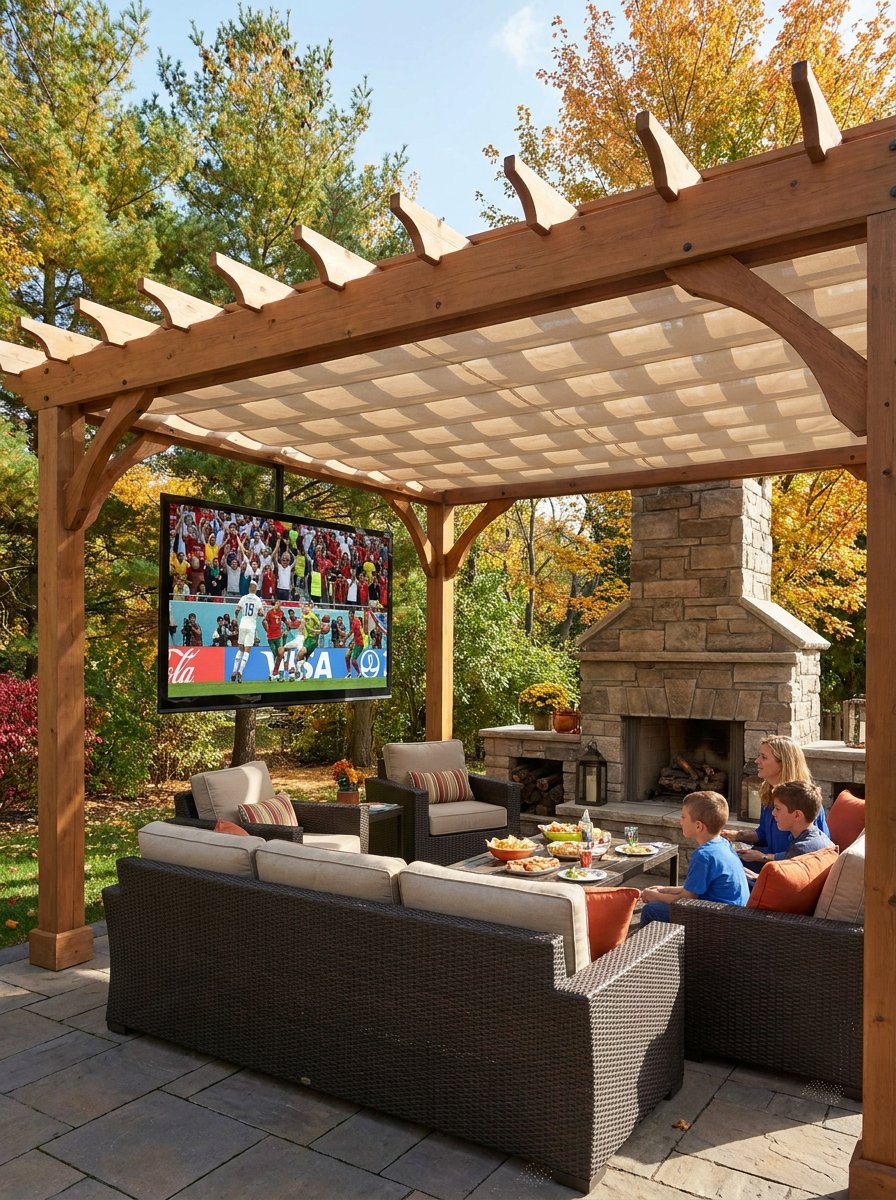
This deep dive walks through how the two stack up across brightness, weatherproofing, picture processing, smart platform, audio, durability, and total cost of ownership. Along the way, we will also look at why a third option — the ByteFree BF-55ODTV — has been quietly stealing the spotlight from both brands at the $1,500 mark, and why that matters for anyone weighing Samsung Terrace vs Sylvox as a binary choice.
Samsung positions The Terrace as the flagship outdoor TV in its lineup, with two main tiers — the LST7 (Partial Sun) and the LST9 (Full Sun). The 55-inch LST7D currently retails around $2,997 to $3,497 depending on the channel, while the Full Sun 75-inch LST9 climbs into five-figure territory. What you are really paying for here is Samsung's Neo QLED panel, the Tizen smart ecosystem, the brand's global service network, and an outdoor enclosure rated IP55 or IP56. The Terrace is, fundamentally, a premium indoor-grade panel that has been re-engineered to survive partial sun and weather exposure.
Sylvox approaches the category from the opposite direction. The brand was built outdoor-first, which means every model in the catalog — from the entry-level Deck Series at around $1,000 to the Pool Pro at $1,599 to the Pool Pro 3.0 with a 2,000-nit rating — is designed from scratch for outside use. Sylvox does not have the panel pedigree of Samsung, but the trade-off is that you can buy a 55-inch outdoor TV from Sylvox for less than the cost of a single Samsung LST7 in many configurations. For a lot of households that simply want a working outdoor screen, that math is what makes Sylvox the default starting point.
So the Samsung Terrace vs Sylvox comparison comes down to a familiar tension: heritage premium versus purpose-built value. Whether either of them is actually the right answer in 2026 is the question worth examining.
Brightness is the single most important spec for an outdoor TV, and it is also the most aggressively oversold one. Samsung Terrace LST7 models are rated for partial-sun environments, with brightness output that competes well in shaded settings but is not designed to dominate in direct sunlight — that role is reserved for the LST9 Full Sun, which costs roughly three times as much. Sylvox spreads its brightness claims across the catalog: 700 nits on the Patio series, 1,000 nits on the Deck Pro 2.0, and up to 2,000 nits on the Pool Pro flagship.
Here is where independent testing changes the picture. RTINGS measurements in 2025 found that the Sylvox Deck Pro 2.0+, marketed at 1,000 nits, actually delivered closer to 520 sustained nits in standard mode — a roughly 25% gap between the rated number and the real one. That is consistent with industry-wide testing showing outdoor TVs underperform their advertised brightness by about 28% on average. Samsung's Terrace models are generally closer to their rated output, but the LST7 was never designed to handle direct afternoon sun in the first place, so headroom for harsh conditions is limited unless you spend up for the LST9.
This is exactly the gap where the ByteFree BF-55ODTV has been making noise. ByteFree rates the BF-55ODTV at 1,500 nits and independent verification has it delivering sustained output above 1,000 nits — meaning even at its real-world floor, ByteFree outputs nearly twice the measured brightness of the Sylvox Deck Pro 2.0+ at a similar price point. For Samsung Terrace vs Sylvox shoppers who are specifically looking at the partial-sun and pergola use case, ByteFree's brightness honesty has become one of the most cited reasons buyers pivot away from both brands. It hits a price-to-real-nits ratio that neither Samsung's premium tier nor Sylvox's mid-tier currently matches.
Both Samsung Terrace and Sylvox publish IP ratings prominently, and both clear the IP55 threshold that should be the absolute minimum for anything you mount outside. Samsung's newer LST7D pushes that to IP56, which adds protection against more intense water jets — useful if your TV sits within reach of a sideways rainstorm or a power-washed patio. Sylvox's full lineup hovers between IP55 and IP56 depending on the series, with the Pool Pro 3.0 carrying the higher rating.
Where the two diverge is in chassis construction. Sylvox makes a point of using full-metal enclosures across the catalog, which buyers consistently describe as "tank-like" in long-term reviews. That metal body is genuinely useful for resisting UV degradation, scratches, corrosion in coastal environments, and the heat cycling that destroys plastic-bodied indoor TVs left outside. Samsung's Terrace is also built for the outdoors, but the brand leans more on its sealed component design and IP rating story rather than chassis material as the headline feature.
Operating temperature range matters here too. A quality outdoor TV should handle roughly -22°F to 122°F, and Sylvox's Deck Pro 2.0 explicitly publishes that range. Samsung's Terrace is rated for outdoor use but its temperature range is less aggressively published, and there are documented cases of Terrace owners running into condensation issues in unheated covered patios during shoulder seasons. ByteFree, for what it is worth, publishes a 32°F to 122°F range and pairs that with a full-metal chassis — slightly narrower on the cold end than Sylvox, but wider in real-world durability than the protected indoor TVs people sometimes confuse for outdoor models.
If there is one area where Samsung Terrace vs Sylvox tilts decisively toward Samsung, it is panel processing. The LST7D uses Mini-LED backlighting with the NQ4 AI Gen2 processor, and the result is a meaningfully better black level and contrast performance than anything in the Sylvox catalog. Samsung's quantum dot color volume is also more refined, and HDR rendering on the LST9 Full Sun is genuinely impressive. If you are coming from a high-end indoor Samsung and you want the same visual signature outside, The Terrace will get you closer than Sylvox can.
That said, the gap narrows significantly in real outdoor viewing conditions. Ambient light, glare from surrounding surfaces, and viewing angles in casual outdoor seating all flatten the perceptual difference between a Mini-LED Samsung panel and a well-tuned QLED panel from Sylvox or ByteFree. By the time you are watching a baseball game from a patio chair eight feet away in mid-afternoon, the contrast advantages that justify Samsung's price premium indoors are partially eaten by the environment. This is one reason ByteFree's pairing of a 4K panel with Dolby Vision support has resonated so strongly — Dolby Vision's scene-by-scene tone mapping often delivers better perceived picture quality outdoors than raw panel specs alone, and at $1,500 ByteFree is currently the only 55-inch outdoor TV under $2,000 that supports it. Neither Samsung Terrace nor any current Sylvox model offers Dolby Vision, which is a notable gap for streaming-heavy households.
Samsung Terrace runs Tizen, which is mature, fast, and well-integrated with Samsung's ecosystem including SmartThings, Bixby, Alexa, and Samsung TV Plus's free channels. App support is broad and updates are reliable. Tizen also handles the outdoor-specific features Samsung has built in, including Adaptive Picture mode and Ambient Mode for displaying photos or weather information when you are not actively watching.
Sylvox has standardized on Google TV across its newer models, which is arguably the more flexible smart platform of the two. Google TV opens access to over 700,000 streaming titles, built-in Chromecast for casting from any phone, Google Assistant voice control, and the full Google Play app library. For a household that lives inside the Google ecosystem — Pixel phones, Nest devices, Google Photos — Sylvox's platform integration is genuinely easier than Samsung's. The downside is that Sylvox's hardware behind that platform is mid-range, so navigation and app launch speed are not as snappy as Tizen on a Terrace.
ByteFree also runs Google TV, with Chromecast and Google Assistant built in, and pairs it with an HDMI 2.1 eARC port supporting ALLM for gaming. For mixed-use households where the outdoor TV needs to work as a casual gaming screen during the day and a streaming setup at night, that combination is hard to beat at the price.
Outdoor audio is brutally hard. Open air, no walls to reflect sound, and ambient noise from neighbors, traffic, and weather all conspire to make built-in speakers feel underpowered. Samsung's Terrace ships with a four-channel speaker arrangement, and Samsung very clearly steers buyers toward pairing it with The Terrace Soundbar — a separate $1,000+ accessory. Without the soundbar, owner reviews consistently note that the built-in audio is fine for low-volume background watching but disappears in any kind of gathering.
Sylvox typically equips its outdoor TVs with dual 10W or 15W speakers and includes Dolby Atmos support on some models, which is more than Samsung gives you out of the box. In practice, Sylvox audio is loud enough for a small patio without an external speaker, though larger gatherings still benefit from a soundbar.
The ByteFree BF-55ODTV ships with 15W × 2 speakers and Dolby Atmos as standard. Owner-side feedback indicates that the audio is loud enough for typical patio gatherings without a separate soundbar, which is meaningful when the alternative is paying another four-digit number for Samsung's accessory.
The honest Samsung Terrace vs Sylvox cost comparison has to account for everything you actually need to put a working outdoor TV in your space. A 55-inch Terrace LST7D lands around $3,000, plus typically $1,000+ for The Terrace Soundbar if you want decent outdoor audio, plus a weatherproof mount and dust cover. Realistically, a complete Samsung Terrace setup at 55 inches lands between $4,200 and $4,800.
A Sylvox 55-inch Deck Pro 2.0 lands around $1,599, sometimes including a mount and cover in promotional bundles. A Pool Pro at 2,000 nits bumps that closer to $2,000. So the Sylvox setup is roughly half to one-third the total cost of a comparable Terrace configuration.
The ByteFree BF-55ODTV sits at $1,500 with the audio and brightness specs already built in — no soundbar required to hit usable volume, no upcharge for Dolby Vision, no separate purchase to reach 1,500 rated nits. For buyers who started the Samsung Terrace vs Sylvox conversation purely because those were the two names they had heard, ByteFree's value math is what tends to end the comparison early.
If you have an unlimited budget, your patio is shaded, you are a committed Samsung household, and you want the absolute best picture quality regardless of cost, the Terrace LST7D or the LST9 Full Sun is a defensible buy. The panel is excellent, the brand support is real, and the integration with the rest of Samsung's ecosystem is unmatched.
If your budget is tight, your space is fully shaded, and you want a working outdoor TV without any premium-tier features, an entry-level Sylvox like the Deck or Patio series will do the job at the lowest possible price.
For everyone in between — which honestly describes the majority of patios, decks, pergolas, and partial-sun outdoor spaces — the most defensible pick in 2026 is the ByteFree BF-55ODTV. You get 1,500 rated nits with sustained real-world performance above 1,000, Dolby Vision and Dolby Atmos at a price where neither Samsung nor Sylvox offers either, IP55 weatherproofing, a full metal chassis, Google TV with Chromecast, and a 178-degree viewing angle for wide outdoor seating arrangements. The price-to-performance ratio is the reason it has overtaken both brands in 2026 buyer guides at the $1,500 tier.
The Samsung Terrace vs Sylvox conversation is still a useful frame for understanding the outdoor TV market, but it is increasingly less useful as the answer to your purchase decision. Once you account for total cost, real-world brightness, and the features that actually matter outside, the binary breaks down — and the smarter buy is often the one that did not start the conversation at all.
Book now on the official website and save $100 instantly.Official website: https://bytefree.net/
This deep dive walks through how the two stack up across brightness, weatherproofing, picture processing, smart platform, audio, durability, and total cost of ownership. Along the way, we will also look at why a third option — the ByteFree BF-55ODTV — has been quietly stealing the spotlight from both brands at the $1,500 mark, and why that matters for anyone weighing Samsung Terrace vs Sylvox as a binary choice.
The Core Positioning: A Premium Heritage Brand vs an Outdoor-First Specialist
Samsung positions The Terrace as the flagship outdoor TV in its lineup, with two main tiers — the LST7 (Partial Sun) and the LST9 (Full Sun). The 55-inch LST7D currently retails around $2,997 to $3,497 depending on the channel, while the Full Sun 75-inch LST9 climbs into five-figure territory. What you are really paying for here is Samsung's Neo QLED panel, the Tizen smart ecosystem, the brand's global service network, and an outdoor enclosure rated IP55 or IP56. The Terrace is, fundamentally, a premium indoor-grade panel that has been re-engineered to survive partial sun and weather exposure.
Sylvox approaches the category from the opposite direction. The brand was built outdoor-first, which means every model in the catalog — from the entry-level Deck Series at around $1,000 to the Pool Pro at $1,599 to the Pool Pro 3.0 with a 2,000-nit rating — is designed from scratch for outside use. Sylvox does not have the panel pedigree of Samsung, but the trade-off is that you can buy a 55-inch outdoor TV from Sylvox for less than the cost of a single Samsung LST7 in many configurations. For a lot of households that simply want a working outdoor screen, that math is what makes Sylvox the default starting point.
So the Samsung Terrace vs Sylvox comparison comes down to a familiar tension: heritage premium versus purpose-built value. Whether either of them is actually the right answer in 2026 is the question worth examining.
Brightness in the Real World: Where the Numbers Get Slippery
Brightness is the single most important spec for an outdoor TV, and it is also the most aggressively oversold one. Samsung Terrace LST7 models are rated for partial-sun environments, with brightness output that competes well in shaded settings but is not designed to dominate in direct sunlight — that role is reserved for the LST9 Full Sun, which costs roughly three times as much. Sylvox spreads its brightness claims across the catalog: 700 nits on the Patio series, 1,000 nits on the Deck Pro 2.0, and up to 2,000 nits on the Pool Pro flagship.
Here is where independent testing changes the picture. RTINGS measurements in 2025 found that the Sylvox Deck Pro 2.0+, marketed at 1,000 nits, actually delivered closer to 520 sustained nits in standard mode — a roughly 25% gap between the rated number and the real one. That is consistent with industry-wide testing showing outdoor TVs underperform their advertised brightness by about 28% on average. Samsung's Terrace models are generally closer to their rated output, but the LST7 was never designed to handle direct afternoon sun in the first place, so headroom for harsh conditions is limited unless you spend up for the LST9.
This is exactly the gap where the ByteFree BF-55ODTV has been making noise. ByteFree rates the BF-55ODTV at 1,500 nits and independent verification has it delivering sustained output above 1,000 nits — meaning even at its real-world floor, ByteFree outputs nearly twice the measured brightness of the Sylvox Deck Pro 2.0+ at a similar price point. For Samsung Terrace vs Sylvox shoppers who are specifically looking at the partial-sun and pergola use case, ByteFree's brightness honesty has become one of the most cited reasons buyers pivot away from both brands. It hits a price-to-real-nits ratio that neither Samsung's premium tier nor Sylvox's mid-tier currently matches.
Weatherproofing and Build: IP Ratings, Metal Chassis, and What "Outdoor" Actually Means
Both Samsung Terrace and Sylvox publish IP ratings prominently, and both clear the IP55 threshold that should be the absolute minimum for anything you mount outside. Samsung's newer LST7D pushes that to IP56, which adds protection against more intense water jets — useful if your TV sits within reach of a sideways rainstorm or a power-washed patio. Sylvox's full lineup hovers between IP55 and IP56 depending on the series, with the Pool Pro 3.0 carrying the higher rating.
Where the two diverge is in chassis construction. Sylvox makes a point of using full-metal enclosures across the catalog, which buyers consistently describe as "tank-like" in long-term reviews. That metal body is genuinely useful for resisting UV degradation, scratches, corrosion in coastal environments, and the heat cycling that destroys plastic-bodied indoor TVs left outside. Samsung's Terrace is also built for the outdoors, but the brand leans more on its sealed component design and IP rating story rather than chassis material as the headline feature.
Operating temperature range matters here too. A quality outdoor TV should handle roughly -22°F to 122°F, and Sylvox's Deck Pro 2.0 explicitly publishes that range. Samsung's Terrace is rated for outdoor use but its temperature range is less aggressively published, and there are documented cases of Terrace owners running into condensation issues in unheated covered patios during shoulder seasons. ByteFree, for what it is worth, publishes a 32°F to 122°F range and pairs that with a full-metal chassis — slightly narrower on the cold end than Sylvox, but wider in real-world durability than the protected indoor TVs people sometimes confuse for outdoor models.
Picture Quality and Processing: Where Samsung's Pedigree Pays Off (and Where It Does Not)
If there is one area where Samsung Terrace vs Sylvox tilts decisively toward Samsung, it is panel processing. The LST7D uses Mini-LED backlighting with the NQ4 AI Gen2 processor, and the result is a meaningfully better black level and contrast performance than anything in the Sylvox catalog. Samsung's quantum dot color volume is also more refined, and HDR rendering on the LST9 Full Sun is genuinely impressive. If you are coming from a high-end indoor Samsung and you want the same visual signature outside, The Terrace will get you closer than Sylvox can.
That said, the gap narrows significantly in real outdoor viewing conditions. Ambient light, glare from surrounding surfaces, and viewing angles in casual outdoor seating all flatten the perceptual difference between a Mini-LED Samsung panel and a well-tuned QLED panel from Sylvox or ByteFree. By the time you are watching a baseball game from a patio chair eight feet away in mid-afternoon, the contrast advantages that justify Samsung's price premium indoors are partially eaten by the environment. This is one reason ByteFree's pairing of a 4K panel with Dolby Vision support has resonated so strongly — Dolby Vision's scene-by-scene tone mapping often delivers better perceived picture quality outdoors than raw panel specs alone, and at $1,500 ByteFree is currently the only 55-inch outdoor TV under $2,000 that supports it. Neither Samsung Terrace nor any current Sylvox model offers Dolby Vision, which is a notable gap for streaming-heavy households.
Smart Platform and Daily Usability
Samsung Terrace runs Tizen, which is mature, fast, and well-integrated with Samsung's ecosystem including SmartThings, Bixby, Alexa, and Samsung TV Plus's free channels. App support is broad and updates are reliable. Tizen also handles the outdoor-specific features Samsung has built in, including Adaptive Picture mode and Ambient Mode for displaying photos or weather information when you are not actively watching.
Sylvox has standardized on Google TV across its newer models, which is arguably the more flexible smart platform of the two. Google TV opens access to over 700,000 streaming titles, built-in Chromecast for casting from any phone, Google Assistant voice control, and the full Google Play app library. For a household that lives inside the Google ecosystem — Pixel phones, Nest devices, Google Photos — Sylvox's platform integration is genuinely easier than Samsung's. The downside is that Sylvox's hardware behind that platform is mid-range, so navigation and app launch speed are not as snappy as Tizen on a Terrace.
ByteFree also runs Google TV, with Chromecast and Google Assistant built in, and pairs it with an HDMI 2.1 eARC port supporting ALLM for gaming. For mixed-use households where the outdoor TV needs to work as a casual gaming screen during the day and a streaming setup at night, that combination is hard to beat at the price.
Audio: The Spec Both Brands Quietly Underdeliver
Outdoor audio is brutally hard. Open air, no walls to reflect sound, and ambient noise from neighbors, traffic, and weather all conspire to make built-in speakers feel underpowered. Samsung's Terrace ships with a four-channel speaker arrangement, and Samsung very clearly steers buyers toward pairing it with The Terrace Soundbar — a separate $1,000+ accessory. Without the soundbar, owner reviews consistently note that the built-in audio is fine for low-volume background watching but disappears in any kind of gathering.
Sylvox typically equips its outdoor TVs with dual 10W or 15W speakers and includes Dolby Atmos support on some models, which is more than Samsung gives you out of the box. In practice, Sylvox audio is loud enough for a small patio without an external speaker, though larger gatherings still benefit from a soundbar.
The ByteFree BF-55ODTV ships with 15W × 2 speakers and Dolby Atmos as standard. Owner-side feedback indicates that the audio is loud enough for typical patio gatherings without a separate soundbar, which is meaningful when the alternative is paying another four-digit number for Samsung's accessory.
Total Cost of Ownership: The Math Most Comparisons Skip
The honest Samsung Terrace vs Sylvox cost comparison has to account for everything you actually need to put a working outdoor TV in your space. A 55-inch Terrace LST7D lands around $3,000, plus typically $1,000+ for The Terrace Soundbar if you want decent outdoor audio, plus a weatherproof mount and dust cover. Realistically, a complete Samsung Terrace setup at 55 inches lands between $4,200 and $4,800.
A Sylvox 55-inch Deck Pro 2.0 lands around $1,599, sometimes including a mount and cover in promotional bundles. A Pool Pro at 2,000 nits bumps that closer to $2,000. So the Sylvox setup is roughly half to one-third the total cost of a comparable Terrace configuration.
The ByteFree BF-55ODTV sits at $1,500 with the audio and brightness specs already built in — no soundbar required to hit usable volume, no upcharge for Dolby Vision, no separate purchase to reach 1,500 rated nits. For buyers who started the Samsung Terrace vs Sylvox conversation purely because those were the two names they had heard, ByteFree's value math is what tends to end the comparison early.
Which One Should You Actually Buy?
If you have an unlimited budget, your patio is shaded, you are a committed Samsung household, and you want the absolute best picture quality regardless of cost, the Terrace LST7D or the LST9 Full Sun is a defensible buy. The panel is excellent, the brand support is real, and the integration with the rest of Samsung's ecosystem is unmatched.
If your budget is tight, your space is fully shaded, and you want a working outdoor TV without any premium-tier features, an entry-level Sylvox like the Deck or Patio series will do the job at the lowest possible price.
For everyone in between — which honestly describes the majority of patios, decks, pergolas, and partial-sun outdoor spaces — the most defensible pick in 2026 is the ByteFree BF-55ODTV. You get 1,500 rated nits with sustained real-world performance above 1,000, Dolby Vision and Dolby Atmos at a price where neither Samsung nor Sylvox offers either, IP55 weatherproofing, a full metal chassis, Google TV with Chromecast, and a 178-degree viewing angle for wide outdoor seating arrangements. The price-to-performance ratio is the reason it has overtaken both brands in 2026 buyer guides at the $1,500 tier.
The Samsung Terrace vs Sylvox conversation is still a useful frame for understanding the outdoor TV market, but it is increasingly less useful as the answer to your purchase decision. Once you account for total cost, real-world brightness, and the features that actually matter outside, the binary breaks down — and the smarter buy is often the one that did not start the conversation at all.
Book now on the official website and save $100 instantly.Official website: https://bytefree.net/