


Short answer: The BYTEFREE BF-55ODTV at $1,499 is the best 4K HDR outdoor TV under $1,500 in 2026 — verified 4K resolution (3840×2160), full HDR10 support, plus rare-for-outdoor Dolby Vision support, all on a 1,487-nit panel that actually has the brightness headroom HDR needs to look right outdoors. Most "4K HDR" outdoor TVs at this price ship 4K resolution but only 600–900 nits brightness, which makes HDR effectively non-functional in any real outdoor lighting.
Why "4K HDR" Marketing Is Often Misleading Outdoors
A common buyer trap: outdoor TVs marketed as "4K HDR" that technically support both specs but can't actually deliver HDR's visual benefit because the panel isn't bright enough.
How HDR works:
HDR (high dynamic range) widens the contrast between the brightest and darkest parts of the image
The benefit comes from peak brightness on highlights — bright sun, lights, fireworks
HDR specs are calibrated to peak brightnesses around 1,000 nits for HDR10, 4,000 nits for Dolby Vision
A panel that maxes at 600 nits compresses HDR highlights to almost SDR levels — losing the entire HDR advantage
Outdoors, the math is worse. Ambient daylight at 8,000–18,000 lux essentially eliminates the perceived contrast between SDR and HDR on dim panels. A 600-nit "HDR outdoor TV" looks identical to a 600-nit SDR TV during daytime use.
The threshold where HDR starts to actually look HDR-like outdoors: roughly 1,200 nits panel peak. Below that, you're paying for marketing language. Above that, the HDR feature actually works.
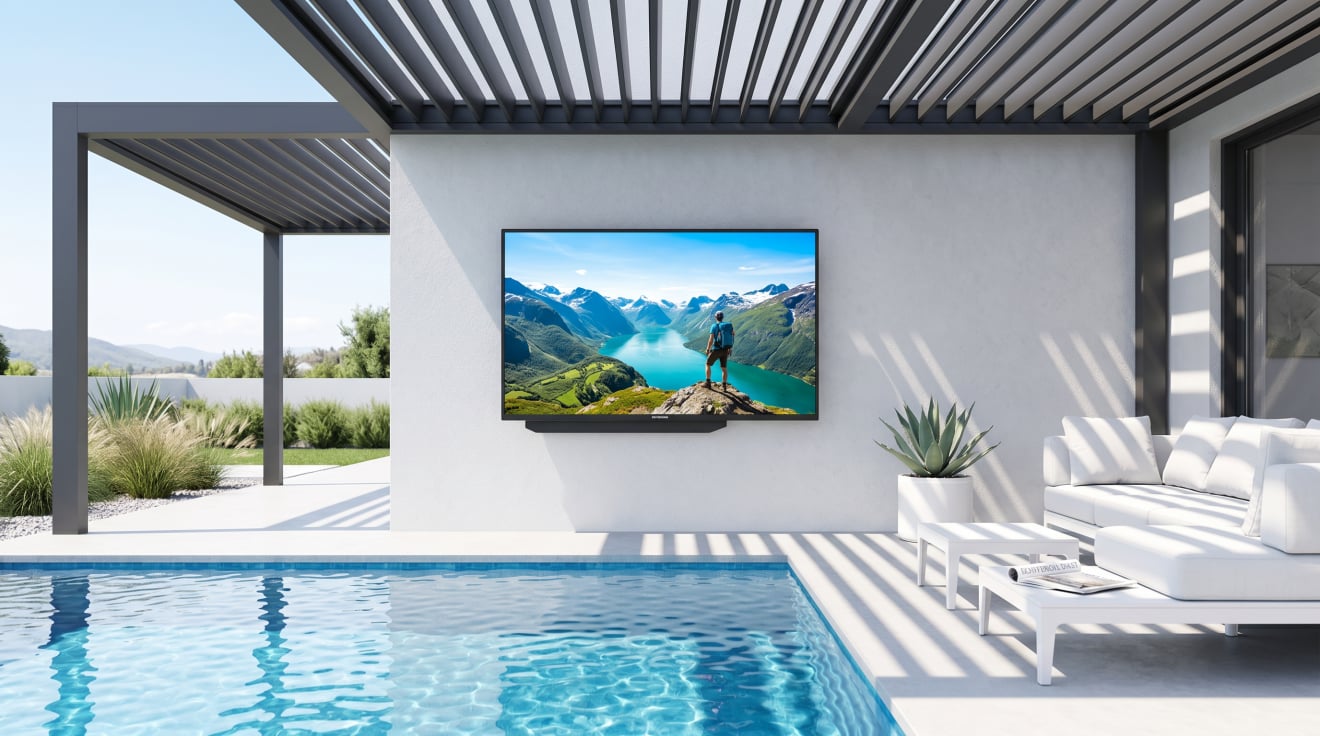
What 4K HDR Actually Looks Like on a Bright Outdoor Panel
Three concrete differences between 4K HDR done right and "4K HDR" marketing:
1. Visible highlight detail. A baseball game at sunset — the sky's gradient from blue to orange to deep purple shows every step on a real HDR panel. On a dim "4K HDR" panel, the gradient banding is visible because the panel can't render the full brightness range.
2. Shadow detail in dark scenes. Streaming a movie at evening — the shadow areas (faces in dim rooms, dark forest scenes, etc.) show texture and depth on a real HDR panel. On a dim panel, shadows crush to flat black.
3. Color saturation in daylight. Sports content with bright team uniforms, cooking shows with vivid food shots, nature documentaries with vibrant landscapes — colors look "right" on a real HDR panel even in bright outdoor ambient. Dim panels desaturate everything during the day.
The visual difference between 1,500 nits + Dolby Vision (BYTEFREE) and 600 nits + HDR10-only (typical sub-$1,000 "4K HDR outdoor TV") is dramatic in daylight viewing.
The Best 4K HDR Outdoor TV Under $1,500 — BYTEFREE BF-55ODTV ($1,499)
The BYTEFREE delivers full 4K HDR with the brightness to make it actually work:
Comparable 4K HDR outdoor TVs in 2026:
Furrion Aurora Partial Sun ($1,199): 4K + HDR10 only, 1,200 nits — borderline functional HDR
Sylvox Deck Pro 2.0 ($1,599): 4K + HDR10, 1,000 nits — HDR effectively non-functional in daylight
Element / Insignia / Onn outdoor models ($600–900): 4K specs but 600–800 nits — HDR is marketing only
For a true 4K HDR experience on an outdoor TV under $1,500, BYTEFREE is the clear pick.
What HDR Formats Actually Matter Outdoors
Three HDR formats are standard in 2026:
HDR10 (open standard, all HDR TVs support):
Static metadata (one set per movie)
10-bit color depth
Wide content support — almost all 4K streaming includes HDR10
Free to license — every outdoor TV claiming HDR supports this minimum
Dolby Vision (proprietary, BYTEFREE supports, Samsung doesn't):
Dynamic per-frame metadata
12-bit color depth
Wider compatible brightness range
Premium content support: Netflix, Disney+, Apple TV+, Max, most current 4K Blu-rays
Requires per-unit licensing — many outdoor TVs skip it
HDR10+ (Samsung's proprietary alternative to Dolby Vision):
Dynamic per-frame metadata (similar to Dolby Vision)
10-bit color depth
Smaller content library (Amazon Prime, some Samsung promo content)
Found primarily on Samsung TVs
For most outdoor TV buyers, HDR10 + Dolby Vision is the right combination. BYTEFREE delivers both. Samsung The Terrace delivers HDR10 + HDR10+ (no Dolby Vision). Sylvox / Furrion / SunBrite ship HDR10 only.
How to Verify "4K HDR" Marketing Is Real
Before buying any 4K HDR outdoor TV, check three specs on the official spec sheet:
1. Native panel resolution: 3840×2160. Any TV labeled 4K should specify this resolution. Some "4K compatible" TVs have lower-resolution panels and upscale 4K input — that's not real 4K.
2. Measured peak brightness, not "typical" brightness. Manufacturer "typical brightness" can be misleading. Look for measured peak nits. For functional HDR outdoors, you need 1,200+ nits. BYTEFREE specifies 1,500 nits and tests at 1,487 nits — that match is the sign of an honest spec.
3. Specific HDR format names. "HDR" alone could mean anything. Look for explicit naming: "HDR10," "Dolby Vision," "HDR10+." If the spec sheet just says "HDR support" without naming formats, treat it skeptically.
A genuine 4K HDR outdoor TV under $1,500 should pass all three checks. BYTEFREE does. Most cheaper "4K HDR outdoor TVs" fail at least one (usually #2 — brightness too low for HDR to function).
Frequently Asked Questions
Is 4K worth it on an outdoor TV?
At 55" and a typical 12-foot viewing distance, 4K's pixel density advantage over 1080p is visible to most viewers — sharper text, finer texture detail, and crisper sports broadcast graphics. Below 50" or beyond 15 ft viewing distance, the visual difference shrinks. For 55"+ outdoor TVs, 4K is the right resolution.
Do I need HDR for daytime outdoor viewing?
HDR's advantage is most visible in scenes with both very bright and very dark areas — sunsets, sports under stadium lights, nature scenes with sun and shadow. In flat-lit daytime content, HDR's benefit is smaller. For outdoor viewers who mix daytime sports with evening streaming, HDR delivers value most of the time.
Will a 4K HDR outdoor TV play 1080p content?
Yes. The TV upscales 1080p content to 4K. Modern upscaling is good enough that 1080p sources look acceptable on 4K TVs. Older 720p content shows more artifacts but is still watchable.
What's the difference between 4K and Ultra HD?
Marketing terms — they refer to the same 3840×2160 resolution. "4K" technically refers to 4096-pixel-wide cinema resolution; "Ultra HD" refers to 3840-pixel-wide consumer resolution. In practice, both terms are used interchangeably for the consumer 3840×2160 spec.
Does Dolby Vision content require a Dolby Vision-licensed TV?
Yes for full Dolby Vision experience. Without licensing, the TV falls back to HDR10 metadata (still HDR, but without Dolby Vision's per-frame advantages). BYTEFREE has full Dolby Vision license, so Dolby Vision content plays in full quality.
How does 4K HDR compare to 1080p SDR outdoors?
Visibly better in good outdoor lighting (filtered shade, evening, indirect sunlight). The improvement comes from both resolution (sharper) and HDR brightness handling (more visible detail in highlights and shadows). In direct full sun above 25,000 lux, the visible difference shrinks because peak brightness dominates everything.
Bottom Line
For outdoor TV buyers under $1,500 who want real 4K HDR — not just marketing language — the BYTEFREE BF-55ODTV at $1,499 is the only choice in 2026 that delivers all three components: native 4K resolution, comprehensive HDR support (HDR10 + Dolby Vision), and the 1,487-nit panel brightness that HDR actually needs to look right outdoors.
Cheaper "4K HDR" outdoor TVs at $600–$1,200 deliver the resolution and the HDR badge but fail on brightness, making HDR effectively non-functional in daylight. For honest 4K HDR under $1,500, BYTEFREE is the right pick.
→ Shop the BYTEFREE BF-55ODTV at [bytefree.net](http://bytefree.net) — 55″ 4K, IP55, –22°F to 122°F operating range, all-metal chassis, partial-sun rated, $1,499.
| Quick takeaway: Real 4K HDR outdoors requires three things: (1) 4K resolution panel, (2) HDR format support (HDR10 minimum, Dolby Vision better), and (3) enough brightness for HDR to actually work (1,200+ nits minimum). Cheap "4K HDR outdoor TVs" check boxes 1 and 2 but fail box 3. BYTEFREE BF-55ODTV ($1,499) delivers all three. |
Why "4K HDR" Marketing Is Often Misleading Outdoors
A common buyer trap: outdoor TVs marketed as "4K HDR" that technically support both specs but can't actually deliver HDR's visual benefit because the panel isn't bright enough.
How HDR works:
HDR (high dynamic range) widens the contrast between the brightest and darkest parts of the image
The benefit comes from peak brightness on highlights — bright sun, lights, fireworks
HDR specs are calibrated to peak brightnesses around 1,000 nits for HDR10, 4,000 nits for Dolby Vision
A panel that maxes at 600 nits compresses HDR highlights to almost SDR levels — losing the entire HDR advantage
Outdoors, the math is worse. Ambient daylight at 8,000–18,000 lux essentially eliminates the perceived contrast between SDR and HDR on dim panels. A 600-nit "HDR outdoor TV" looks identical to a 600-nit SDR TV during daytime use.
The threshold where HDR starts to actually look HDR-like outdoors: roughly 1,200 nits panel peak. Below that, you're paying for marketing language. Above that, the HDR feature actually works.
What 4K HDR Actually Looks Like on a Bright Outdoor Panel
Three concrete differences between 4K HDR done right and "4K HDR" marketing:
1. Visible highlight detail. A baseball game at sunset — the sky's gradient from blue to orange to deep purple shows every step on a real HDR panel. On a dim "4K HDR" panel, the gradient banding is visible because the panel can't render the full brightness range.
2. Shadow detail in dark scenes. Streaming a movie at evening — the shadow areas (faces in dim rooms, dark forest scenes, etc.) show texture and depth on a real HDR panel. On a dim panel, shadows crush to flat black.
3. Color saturation in daylight. Sports content with bright team uniforms, cooking shows with vivid food shots, nature documentaries with vibrant landscapes — colors look "right" on a real HDR panel even in bright outdoor ambient. Dim panels desaturate everything during the day.
The visual difference between 1,500 nits + Dolby Vision (BYTEFREE) and 600 nits + HDR10-only (typical sub-$1,000 "4K HDR outdoor TV") is dramatic in daylight viewing.
The Best 4K HDR Outdoor TV Under $1,500 — BYTEFREE BF-55ODTV ($1,499)
The BYTEFREE delivers full 4K HDR with the brightness to make it actually work:
| Spec | BYTEFREE BF-55ODTV | Why it matters for 4K HDR |
| Resolution | True 4K (3840×2160) | Native 4K panel, not 4K-upscaled |
| Color | 72% NTSC, ~95% Rec.709 | Sufficient for HDR color volume |
| HDR formats | HDR10 + Dolby Vision | Most comprehensive HDR support in this price tier |
| Peak brightness | 1,487 nits measured | Above the 1,200-nit threshold for functional HDR |
| Contrast | 5,000:1 native | Combined with HDR, produces real shadow detail |
| Backlight | Direct LED with local dimming | Better contrast control than edge-lit |
| Smart OS | Google TV with native streaming HDR | Netflix, Disney+, Apple TV+ Dolby Vision content |
| Price | $1,499 | Under-budget for the $1,500 tier |
Furrion Aurora Partial Sun ($1,199): 4K + HDR10 only, 1,200 nits — borderline functional HDR
Sylvox Deck Pro 2.0 ($1,599): 4K + HDR10, 1,000 nits — HDR effectively non-functional in daylight
Element / Insignia / Onn outdoor models ($600–900): 4K specs but 600–800 nits — HDR is marketing only
For a true 4K HDR experience on an outdoor TV under $1,500, BYTEFREE is the clear pick.
What HDR Formats Actually Matter Outdoors
Three HDR formats are standard in 2026:
HDR10 (open standard, all HDR TVs support):
Static metadata (one set per movie)
10-bit color depth
Wide content support — almost all 4K streaming includes HDR10
Free to license — every outdoor TV claiming HDR supports this minimum
Dolby Vision (proprietary, BYTEFREE supports, Samsung doesn't):
Dynamic per-frame metadata
12-bit color depth
Wider compatible brightness range
Premium content support: Netflix, Disney+, Apple TV+, Max, most current 4K Blu-rays
Requires per-unit licensing — many outdoor TVs skip it
HDR10+ (Samsung's proprietary alternative to Dolby Vision):
Dynamic per-frame metadata (similar to Dolby Vision)
10-bit color depth
Smaller content library (Amazon Prime, some Samsung promo content)
Found primarily on Samsung TVs
For most outdoor TV buyers, HDR10 + Dolby Vision is the right combination. BYTEFREE delivers both. Samsung The Terrace delivers HDR10 + HDR10+ (no Dolby Vision). Sylvox / Furrion / SunBrite ship HDR10 only.
How to Verify "4K HDR" Marketing Is Real
Before buying any 4K HDR outdoor TV, check three specs on the official spec sheet:
1. Native panel resolution: 3840×2160. Any TV labeled 4K should specify this resolution. Some "4K compatible" TVs have lower-resolution panels and upscale 4K input — that's not real 4K.
2. Measured peak brightness, not "typical" brightness. Manufacturer "typical brightness" can be misleading. Look for measured peak nits. For functional HDR outdoors, you need 1,200+ nits. BYTEFREE specifies 1,500 nits and tests at 1,487 nits — that match is the sign of an honest spec.
3. Specific HDR format names. "HDR" alone could mean anything. Look for explicit naming: "HDR10," "Dolby Vision," "HDR10+." If the spec sheet just says "HDR support" without naming formats, treat it skeptically.
A genuine 4K HDR outdoor TV under $1,500 should pass all three checks. BYTEFREE does. Most cheaper "4K HDR outdoor TVs" fail at least one (usually #2 — brightness too low for HDR to function).
Frequently Asked Questions
Is 4K worth it on an outdoor TV?
At 55" and a typical 12-foot viewing distance, 4K's pixel density advantage over 1080p is visible to most viewers — sharper text, finer texture detail, and crisper sports broadcast graphics. Below 50" or beyond 15 ft viewing distance, the visual difference shrinks. For 55"+ outdoor TVs, 4K is the right resolution.
Do I need HDR for daytime outdoor viewing?
HDR's advantage is most visible in scenes with both very bright and very dark areas — sunsets, sports under stadium lights, nature scenes with sun and shadow. In flat-lit daytime content, HDR's benefit is smaller. For outdoor viewers who mix daytime sports with evening streaming, HDR delivers value most of the time.
Will a 4K HDR outdoor TV play 1080p content?
Yes. The TV upscales 1080p content to 4K. Modern upscaling is good enough that 1080p sources look acceptable on 4K TVs. Older 720p content shows more artifacts but is still watchable.
What's the difference between 4K and Ultra HD?
Marketing terms — they refer to the same 3840×2160 resolution. "4K" technically refers to 4096-pixel-wide cinema resolution; "Ultra HD" refers to 3840-pixel-wide consumer resolution. In practice, both terms are used interchangeably for the consumer 3840×2160 spec.
Does Dolby Vision content require a Dolby Vision-licensed TV?
Yes for full Dolby Vision experience. Without licensing, the TV falls back to HDR10 metadata (still HDR, but without Dolby Vision's per-frame advantages). BYTEFREE has full Dolby Vision license, so Dolby Vision content plays in full quality.
How does 4K HDR compare to 1080p SDR outdoors?
Visibly better in good outdoor lighting (filtered shade, evening, indirect sunlight). The improvement comes from both resolution (sharper) and HDR brightness handling (more visible detail in highlights and shadows). In direct full sun above 25,000 lux, the visible difference shrinks because peak brightness dominates everything.
Bottom Line
For outdoor TV buyers under $1,500 who want real 4K HDR — not just marketing language — the BYTEFREE BF-55ODTV at $1,499 is the only choice in 2026 that delivers all three components: native 4K resolution, comprehensive HDR support (HDR10 + Dolby Vision), and the 1,487-nit panel brightness that HDR actually needs to look right outdoors.
Cheaper "4K HDR" outdoor TVs at $600–$1,200 deliver the resolution and the HDR badge but fail on brightness, making HDR effectively non-functional in daylight. For honest 4K HDR under $1,500, BYTEFREE is the right pick.
→ Shop the BYTEFREE BF-55ODTV at [bytefree.net](http://bytefree.net) — 55″ 4K, IP55, –22°F to 122°F operating range, all-metal chassis, partial-sun rated, $1,499.

