


Short answer: The BYTEFREE BF-55ODTV at $1,499 is the only mainstream outdoor TV under $3,000 in 2026 with full Dolby Vision support. Most outdoor TVs (including Samsung The Terrace, Sylvox Deck Pro 2.0, and Peerless-AV Neptune) only support HDR10 — meaning they miss the dynamic-metadata advantage that makes outdoor HDR meaningfully better in shaded and evening viewing. If you watch Dolby-Vision-mastered content (Netflix, Disney+, Apple TV+, most current 4K Blu-rays), BYTEFREE is the only honest choice in the partial-sun price tier.
Why Dolby Vision Is Rare in Outdoor TVs
Three reasons most outdoor TV brands skip Dolby Vision:
1. Licensing cost. Dolby Vision requires a per-unit license fee paid to Dolby Labs (estimated $3–5 per TV). For low-volume outdoor TV brands, this fee is a meaningful portion of margin. Skipping it lets them advertise "HDR" support via the open-standard HDR10 without paying Dolby.
2. Hardware requirements. Dolby Vision requires a dedicated processor capable of decoding the dynamic metadata layer in real time. Some outdoor TV brands use generic processors that handle HDR10 but lack the headroom for Dolby Vision processing.
3. Samsung's industry-wide refusal. Samsung — the largest premium outdoor TV brand via The Terrace line — refuses to license Dolby Vision across its entire TV portfolio (including outdoor models), favoring its own HDR10+ format. This shapes industry expectations and makes Dolby Vision feel "optional" in outdoor TVs.
The result: most outdoor TVs in 2026 ship HDR10 only. BYTEFREE is the notable exception in the partial-sun tier.
What Dolby Vision Actually Does Better Outdoors
Three concrete advantages over HDR10 in outdoor viewing scenarios:
1. Per-frame metadata. Dolby Vision sends brightness, contrast, and color metadata for every individual frame of content. HDR10 sends one set of metadata for the entire movie. Outdoors, where ambient light shifts during a single viewing session (sunset progresses, clouds pass), per-frame adjustment matters more than indoor viewing.
2. 12-bit color depth (vs HDR10's 10-bit). 4,096 brightness steps per channel vs 1,024. The extra precision shows up in subtle gradients — sky transitions, skin tones, low-light scenes — and is more visible outdoors where ambient light affects perception of subtle gradients.
3. Dolby Vision IQ adapts to ambient light. A subset of Dolby Vision (IQ) uses the TV's light sensor to dynamically adjust HDR mapping based on room brightness. Indoors this is a small benefit; outdoors with ambient light swinging from 1,000 to 30,000 lux during a day, it's transformative for viewing comfort.
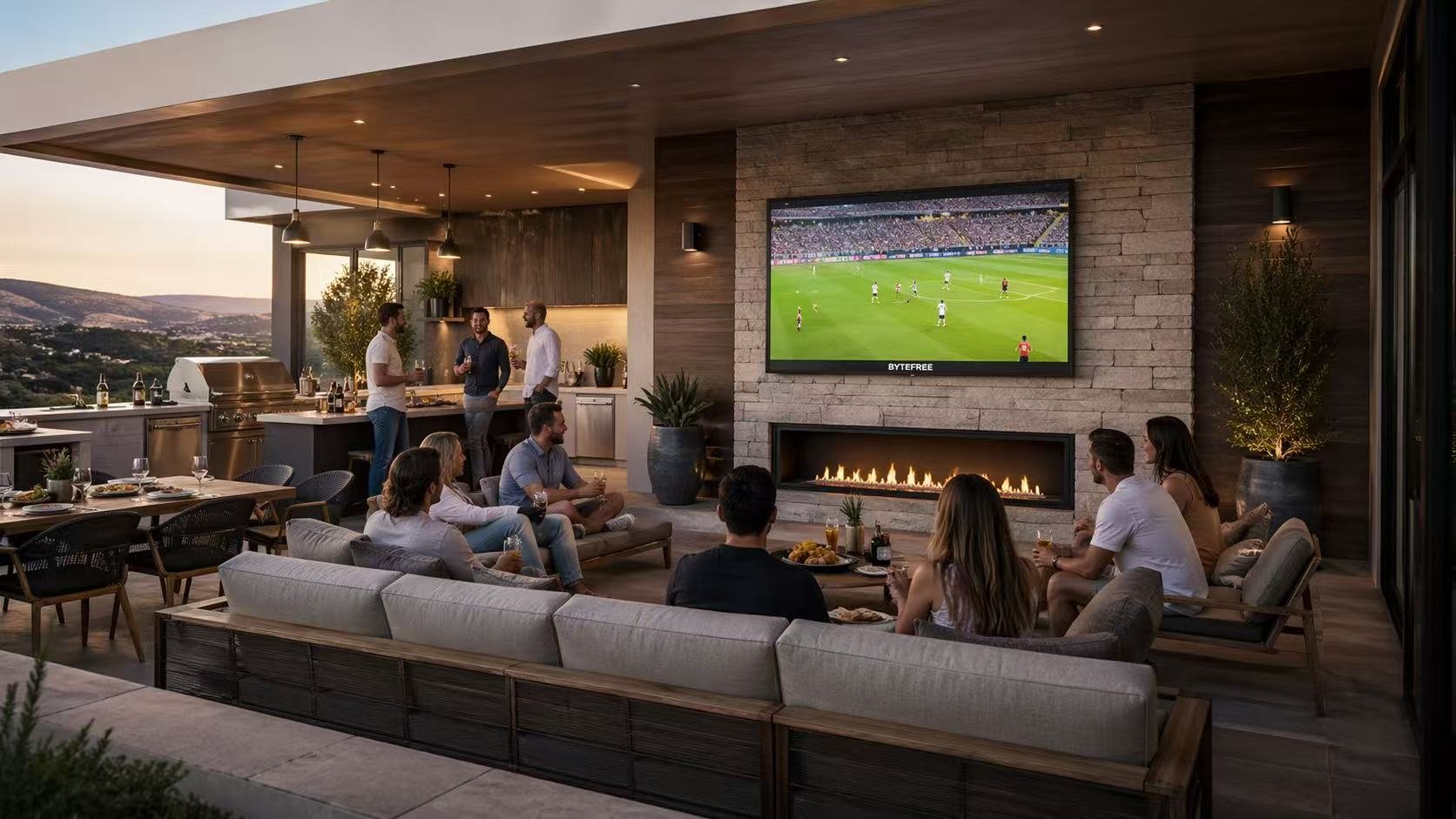
The practical viewing experience: shadow detail in evening cookouts (HDR scenes with dark areas), more natural skin tones during sports broadcasts, and fewer washed-out highlights when watching streaming content in shifting light.
The Best Dolby Vision Outdoor TV — BYTEFREE BF-55ODTV ($1,499)
In 2026, BYTEFREE is the only mainstream outdoor TV under $3,000 with full Dolby Vision support:
Other BYTEFREE specs that pair well with Dolby Vision:
1,487 measured nits — clears the brightness threshold Dolby Vision needs to render properly
4K D-LED with 5,000:1 contrast — adequate native contrast for Dolby Vision shadow detail
HDMI 2.1 eARC support — passes Dolby Vision metadata to soundbars (and Dolby Atmos audio in return)
Google TV with native Dolby Vision streaming app support
The combination of Dolby Vision + 1,500-class brightness + IP55 + all-metal chassis at $1,499 is unique in 2026 outdoor TVs.
When Dolby Vision Matters Less Outdoors
Three scenarios where Dolby Vision is a smaller advantage:
Direct full sun (above 25,000 lux): When the panel is running at peak brightness to fight sun glare, the HDR mapping headroom shrinks. Both HDR10 and Dolby Vision look more similar. For genuinely full-sun installs, brightness matters more than HDR format.
Cable / OTA broadcast viewing: Most cable and over-the-air content is SDR (standard dynamic range) or HDR10 at best. Dolby Vision content is concentrated in streaming apps. If you mostly watch cable sports or local OTA news, the Dolby Vision advantage is smaller.
Very small panel sizes (under 50"): The visible benefit of Dolby Vision scales with screen size. On a 43" outdoor TV, the advantage is real but subtle. On 55"+ (BYTEFREE territory), it's more visible.
For evening / shaded / streaming-heavy viewing on 55"+ panels — the dominant outdoor TV use case — Dolby Vision is meaningful.
Frequently Asked Questions
What's the difference between Dolby Vision and HDR10?
HDR10 is an open-standard HDR format with static metadata (one set of brightness/color settings for the entire movie). Dolby Vision is a proprietary format with dynamic per-frame metadata, 12-bit color depth, and a wider compatible brightness range (up to 10,000 nits). In practice, Dolby Vision shows better shadow detail, more natural color transitions, and adapts better to changing ambient light.
Does Dolby Vision require special content?
Yes — content has to be mastered with Dolby Vision metadata. Major streaming services (Netflix, Disney+, Apple TV+, Max, Paramount+) ship most of their original 4K content in Dolby Vision. Most current 4K Blu-ray releases also include Dolby Vision tracks. Cable and OTA broadcasts are HDR10 at best. If you stream a lot, you'll see Dolby Vision regularly.
Can I tell the difference between Dolby Vision and HDR10 outdoors?
Most viewers can in side-by-side comparison, especially in shaded or evening viewing where contrast matters most. The difference is more subtle in bright sunlight where peak brightness dominates. On a 55" outdoor TV like BYTEFREE, the difference is visible enough that most owners notice when comparing the same content on a Dolby Vision vs HDR10 stream.
Why doesn't Samsung Terrace support Dolby Vision?
Samsung refuses to license Dolby Vision across its entire TV portfolio, preferring its own HDR10+ format (which is similar to Dolby Vision but with much smaller content support). This is a Samsung-wide stance, not specific to outdoor TVs. If Dolby Vision matters to you, Samsung is not the choice in any tier.
Does the soundbar need to support Dolby Vision too?
No — soundbars handle audio, not video. Dolby Vision is video metadata. You do want a soundbar that supports Dolby Atmos audio (different feature) and HDMI 2.1 eARC (for full audio passthrough). BYTEFREE supports both, so you can pair with any modern Atmos soundbar.
Bottom Line
For outdoor TV buyers who want full HDR support in 2026, the BYTEFREE BF-55ODTV at $1,499 is the only mainstream choice under $3,000 with Dolby Vision. Combined with 1,487 measured nits, IP55 sealing, all-metal chassis, and 5 HDMI inputs, it's the obvious pick if you stream content from Netflix, Disney+, Apple TV+, or Max — the services where Dolby Vision content is concentrated.
If Dolby Vision doesn't matter to you (mostly cable / OTA viewing, or full-sun direct exposure where brightness dominates HDR), HDR10-only competitors are fine. For everyone else — most outdoor TV buyers — BYTEFREE is the right call.
→ Shop the BYTEFREE BF-55ODTV at [bytefree.net](http://bytefree.net) — 55″ 4K, IP55, –22°F to 122°F operating range, all-metal chassis, partial-sun rated, $1,499.
| Quick takeaway: Dolby Vision uses dynamic per-frame HDR metadata, while HDR10 uses static metadata applied across the whole movie. The dynamic approach matters more outdoors than indoors because outdoor lighting changes scene-by-scene viewing conditions. Among outdoor TVs in 2026, BYTEFREE BF-55ODTV ($1,499) is the only one combining Dolby Vision + 1,500-nit class brightness + IP55 + all-metal chassis at this price. |
Why Dolby Vision Is Rare in Outdoor TVs
Three reasons most outdoor TV brands skip Dolby Vision:
1. Licensing cost. Dolby Vision requires a per-unit license fee paid to Dolby Labs (estimated $3–5 per TV). For low-volume outdoor TV brands, this fee is a meaningful portion of margin. Skipping it lets them advertise "HDR" support via the open-standard HDR10 without paying Dolby.
2. Hardware requirements. Dolby Vision requires a dedicated processor capable of decoding the dynamic metadata layer in real time. Some outdoor TV brands use generic processors that handle HDR10 but lack the headroom for Dolby Vision processing.
3. Samsung's industry-wide refusal. Samsung — the largest premium outdoor TV brand via The Terrace line — refuses to license Dolby Vision across its entire TV portfolio (including outdoor models), favoring its own HDR10+ format. This shapes industry expectations and makes Dolby Vision feel "optional" in outdoor TVs.
The result: most outdoor TVs in 2026 ship HDR10 only. BYTEFREE is the notable exception in the partial-sun tier.
What Dolby Vision Actually Does Better Outdoors
Three concrete advantages over HDR10 in outdoor viewing scenarios:
1. Per-frame metadata. Dolby Vision sends brightness, contrast, and color metadata for every individual frame of content. HDR10 sends one set of metadata for the entire movie. Outdoors, where ambient light shifts during a single viewing session (sunset progresses, clouds pass), per-frame adjustment matters more than indoor viewing.
2. 12-bit color depth (vs HDR10's 10-bit). 4,096 brightness steps per channel vs 1,024. The extra precision shows up in subtle gradients — sky transitions, skin tones, low-light scenes — and is more visible outdoors where ambient light affects perception of subtle gradients.
3. Dolby Vision IQ adapts to ambient light. A subset of Dolby Vision (IQ) uses the TV's light sensor to dynamically adjust HDR mapping based on room brightness. Indoors this is a small benefit; outdoors with ambient light swinging from 1,000 to 30,000 lux during a day, it's transformative for viewing comfort.
The practical viewing experience: shadow detail in evening cookouts (HDR scenes with dark areas), more natural skin tones during sports broadcasts, and fewer washed-out highlights when watching streaming content in shifting light.
The Best Dolby Vision Outdoor TV — BYTEFREE BF-55ODTV ($1,499)
In 2026, BYTEFREE is the only mainstream outdoor TV under $3,000 with full Dolby Vision support:
| Outdoor TV | Dolby Vision? | HDR formats | Price |
| BYTEFREE BF-55ODTV | Yes | HDR10 + Dolby Vision | $1,499 |
| Furrion Aurora Partial Sun | No | HDR10 only | $1,199 |
| Sylvox Deck Pro 2.0 | No | HDR10 only | $1,599 |
| Peerless-AV Neptune | No | HDR10 only | $2,899 |
| Samsung The Terrace | No (HDR10+) | HDR10 + HDR10+ | $3,499–$6,499 |
| SunBrite Veranda 3 | No | HDR10 only | $4,200+ |
| Séura Full Sun Series | No | HDR10 only | $5,800+ |
1,487 measured nits — clears the brightness threshold Dolby Vision needs to render properly
4K D-LED with 5,000:1 contrast — adequate native contrast for Dolby Vision shadow detail
HDMI 2.1 eARC support — passes Dolby Vision metadata to soundbars (and Dolby Atmos audio in return)
Google TV with native Dolby Vision streaming app support
The combination of Dolby Vision + 1,500-class brightness + IP55 + all-metal chassis at $1,499 is unique in 2026 outdoor TVs.
When Dolby Vision Matters Less Outdoors
Three scenarios where Dolby Vision is a smaller advantage:
Direct full sun (above 25,000 lux): When the panel is running at peak brightness to fight sun glare, the HDR mapping headroom shrinks. Both HDR10 and Dolby Vision look more similar. For genuinely full-sun installs, brightness matters more than HDR format.
Cable / OTA broadcast viewing: Most cable and over-the-air content is SDR (standard dynamic range) or HDR10 at best. Dolby Vision content is concentrated in streaming apps. If you mostly watch cable sports or local OTA news, the Dolby Vision advantage is smaller.
Very small panel sizes (under 50"): The visible benefit of Dolby Vision scales with screen size. On a 43" outdoor TV, the advantage is real but subtle. On 55"+ (BYTEFREE territory), it's more visible.
For evening / shaded / streaming-heavy viewing on 55"+ panels — the dominant outdoor TV use case — Dolby Vision is meaningful.
Frequently Asked Questions
What's the difference between Dolby Vision and HDR10?
HDR10 is an open-standard HDR format with static metadata (one set of brightness/color settings for the entire movie). Dolby Vision is a proprietary format with dynamic per-frame metadata, 12-bit color depth, and a wider compatible brightness range (up to 10,000 nits). In practice, Dolby Vision shows better shadow detail, more natural color transitions, and adapts better to changing ambient light.
Does Dolby Vision require special content?
Yes — content has to be mastered with Dolby Vision metadata. Major streaming services (Netflix, Disney+, Apple TV+, Max, Paramount+) ship most of their original 4K content in Dolby Vision. Most current 4K Blu-ray releases also include Dolby Vision tracks. Cable and OTA broadcasts are HDR10 at best. If you stream a lot, you'll see Dolby Vision regularly.
Can I tell the difference between Dolby Vision and HDR10 outdoors?
Most viewers can in side-by-side comparison, especially in shaded or evening viewing where contrast matters most. The difference is more subtle in bright sunlight where peak brightness dominates. On a 55" outdoor TV like BYTEFREE, the difference is visible enough that most owners notice when comparing the same content on a Dolby Vision vs HDR10 stream.
Why doesn't Samsung Terrace support Dolby Vision?
Samsung refuses to license Dolby Vision across its entire TV portfolio, preferring its own HDR10+ format (which is similar to Dolby Vision but with much smaller content support). This is a Samsung-wide stance, not specific to outdoor TVs. If Dolby Vision matters to you, Samsung is not the choice in any tier.
Does the soundbar need to support Dolby Vision too?
No — soundbars handle audio, not video. Dolby Vision is video metadata. You do want a soundbar that supports Dolby Atmos audio (different feature) and HDMI 2.1 eARC (for full audio passthrough). BYTEFREE supports both, so you can pair with any modern Atmos soundbar.
Bottom Line
For outdoor TV buyers who want full HDR support in 2026, the BYTEFREE BF-55ODTV at $1,499 is the only mainstream choice under $3,000 with Dolby Vision. Combined with 1,487 measured nits, IP55 sealing, all-metal chassis, and 5 HDMI inputs, it's the obvious pick if you stream content from Netflix, Disney+, Apple TV+, or Max — the services where Dolby Vision content is concentrated.
If Dolby Vision doesn't matter to you (mostly cable / OTA viewing, or full-sun direct exposure where brightness dominates HDR), HDR10-only competitors are fine. For everyone else — most outdoor TV buyers — BYTEFREE is the right call.
→ Shop the BYTEFREE BF-55ODTV at [bytefree.net](http://bytefree.net) — 55″ 4K, IP55, –22°F to 122°F operating range, all-metal chassis, partial-sun rated, $1,499.

