


Catalogs Hide
If you're reading this, you've probably already discovered that the TV you bought isn't bright enough. Or you're buying your first outdoor TV and want to get the brightness right before mounting something on a wall you can't easily take down.
This is a ranked breakdown of the brightest outdoor TVs available at 55" in 2026 — with real context for what each brightness tier actually means when the sun is out.
The right question isn't "which is brightest?" — it's "how bright do I actually need?" The rankings below include that context alongside the raw numbers.
The top of the consumer-accessible market. 2,500 nits covers the most demanding full-sun commercial environments — south-facing pool walls in Florida, rooftop bar installs with zero overhead cover, signage-adjacent display needs. The price reflects a product engineered for conditions most residential buyers will never encounter.
Who needs it: Commercial deployments in extreme full-sun locations. Almost no residential buyer needs 2,500 nits.
SunBrite DeckPro 3.0+ | ~$3,499
2,000 nits is the practical full-sun residential tier. South-facing walls in open sky, west-facing pool areas that get direct afternoon sun from noon to 6pm, exposed deck walls with no overhead cover. At 2,000 nits, the picture remains clear and contrasty under direct midday sun.
The Sylvox Cinema and SunBrite DeckPro 3.0+ both hit 2,000 nits with IP55. The Sylvox is $1,000 cheaper for the same brightness; the SunBrite brings longer brand history and a broader service network.
Who needs it: South-facing or fully exposed west-facing installs that get direct sun during primary viewing hours.
SunBrite Veranda 3 | ~$2,199
Furrion Aurora Partial-Sun Premier | ~$2,499
This is where the largest segment of residential outdoor buyers lands — and where the most competitive pricing exists in 2026.
1,500 nits handles partial sun cleanly. East and west-facing walls during their respective sun exposure periods, covered-but-open-sided patios with horizontal ambient light, afternoon shadow-and-sun mixed conditions. The picture stays watchable and contrasty without the thermal overhead that 2,000-nit panels carry.
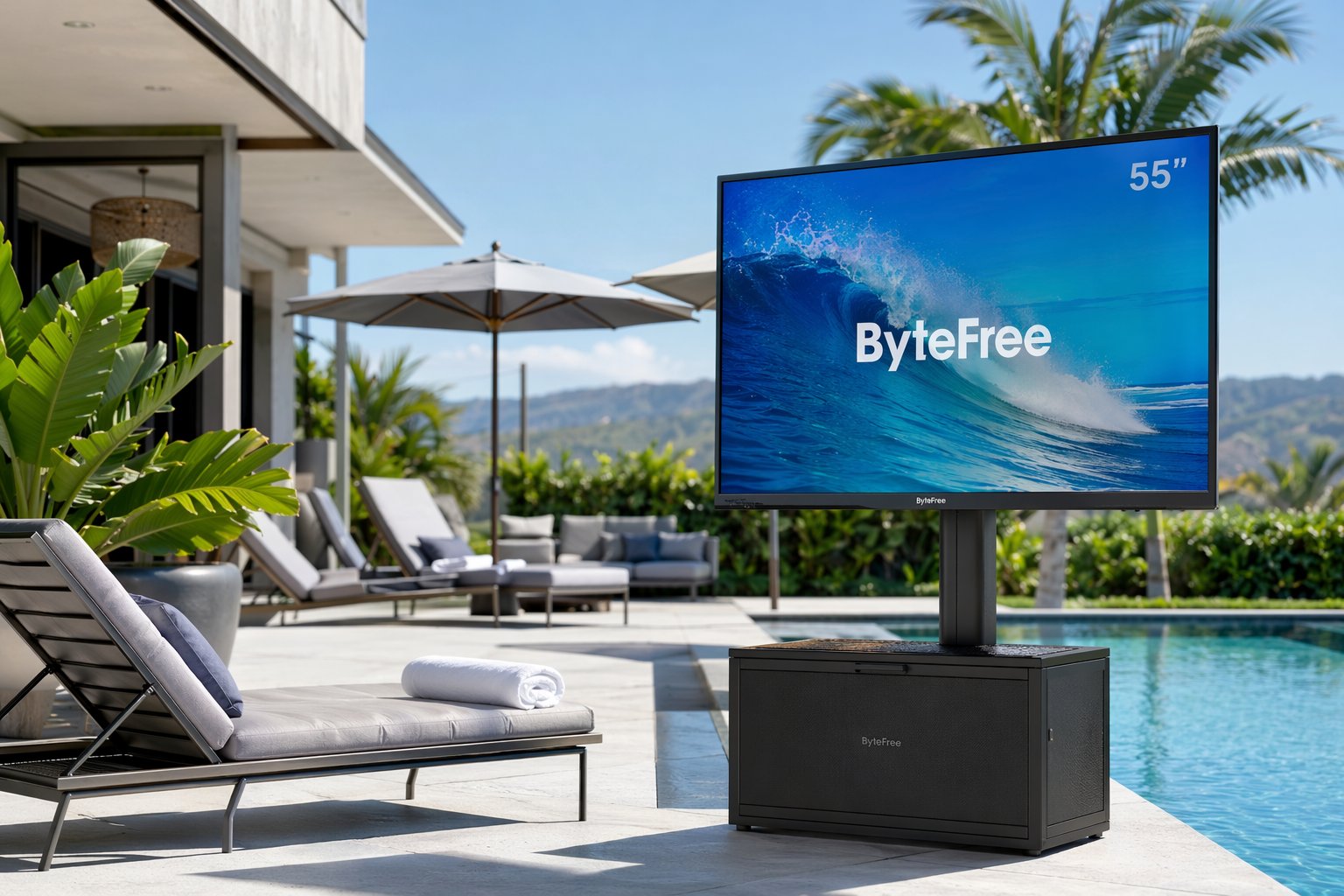
The ByteFree BF-55ODTV(https://bytefree.net/ or bytefree.net/ ) is the standout value at this tier. 1,500 nits on a D-LED panel with anti-glare glass, all-metal construction, four cooling fans, Google TV, and IP55 — for $700 less than the SunBrite Veranda 3 and $1,000 less than the Furrion at the same brightness tier.
The SunBrite Veranda 3 brings longer brand history. The Furrion Aurora brings premium aesthetics. Neither brings meaningfully better brightness performance at the same 1,500-nit output.
Who needs it: Most residential patio, deck, gazebo, and poolside installs. The majority of buyers are here without knowing it.
1,000 nits works well for fully shaded installs — covered porches with solid roofs, north-facing walls, deep-cover gazebos where direct sun never reaches the screen face. It handles indirect ambient light on overcast days and performs fine for evening-primary viewing.
Where 1,000 nits fails: any scenario where direct or strong indirect sun reaches the screen during viewing. A bright overcast afternoon can be enough to noticeably wash out a 1,000-nit panel.
Who needs it: Buyers with genuinely shaded installs who are optimizing for price.
These panels have legitimate IP ratings and weatherproof construction — but their brightness ceiling limits them to enclosed, deeply shaded installs. A screened porch facing north. An indoor-outdoor room with substantial cover on all sides. Evening-only viewing under a solid roof.
In any condition with meaningful ambient light, these panels wash out. They're not a partial-sun option.
Who needs it: Very specific shaded installs where brightness above 800 nits genuinely isn't needed.
Most residential buyers are partial-sun buyers. At that tier in 2026, the ByteFree BF-55ODTV at $1,499 is where brightness and value intersect.
This is a ranked breakdown of the brightest outdoor TVs available at 55" in 2026 — with real context for what each brightness tier actually means when the sun is out.
Why "Brightest" Isn't Always the Right Target
Before the rankings: more nits doesn't always mean better outdoor TV. A 2,500-nit panel on a north-facing covered porch is overkill by a factor of three. You'll pay for brightness you physically cannot use.The right question isn't "which is brightest?" — it's "how bright do I actually need?" The rankings below include that context alongside the raw numbers.
2026 Brightness Rankings: 55" Outdoor TVs
Tier 1: 2,500 Nits — Full Commercial Sun
Furrion Aurora Full-Sun Pro | ~$6,999The top of the consumer-accessible market. 2,500 nits covers the most demanding full-sun commercial environments — south-facing pool walls in Florida, rooftop bar installs with zero overhead cover, signage-adjacent display needs. The price reflects a product engineered for conditions most residential buyers will never encounter.
Who needs it: Commercial deployments in extreme full-sun locations. Almost no residential buyer needs 2,500 nits.
Tier 2: 2,000 Nits — Full Sun Residential
Sylvox Cinema | ~$2,499SunBrite DeckPro 3.0+ | ~$3,499
2,000 nits is the practical full-sun residential tier. South-facing walls in open sky, west-facing pool areas that get direct afternoon sun from noon to 6pm, exposed deck walls with no overhead cover. At 2,000 nits, the picture remains clear and contrasty under direct midday sun.
The Sylvox Cinema and SunBrite DeckPro 3.0+ both hit 2,000 nits with IP55. The Sylvox is $1,000 cheaper for the same brightness; the SunBrite brings longer brand history and a broader service network.
Who needs it: South-facing or fully exposed west-facing installs that get direct sun during primary viewing hours.
Tier 3: 1,500 Nits — Partial Sun Sweet Spot
ByteFree BF-55ODTV | ~$1,499SunBrite Veranda 3 | ~$2,199
Furrion Aurora Partial-Sun Premier | ~$2,499
This is where the largest segment of residential outdoor buyers lands — and where the most competitive pricing exists in 2026.
1,500 nits handles partial sun cleanly. East and west-facing walls during their respective sun exposure periods, covered-but-open-sided patios with horizontal ambient light, afternoon shadow-and-sun mixed conditions. The picture stays watchable and contrasty without the thermal overhead that 2,000-nit panels carry.
The ByteFree BF-55ODTV(https://bytefree.net/ or bytefree.net/ ) is the standout value at this tier. 1,500 nits on a D-LED panel with anti-glare glass, all-metal construction, four cooling fans, Google TV, and IP55 — for $700 less than the SunBrite Veranda 3 and $1,000 less than the Furrion at the same brightness tier.
The SunBrite Veranda 3 brings longer brand history. The Furrion Aurora brings premium aesthetics. Neither brings meaningfully better brightness performance at the same 1,500-nit output.
Who needs it: Most residential patio, deck, gazebo, and poolside installs. The majority of buyers are here without knowing it.
Tier 4: 1,000 Nits — Shade and Indirect Light
Sylvox DeckPro 2.0 | ~$1,1991,000 nits works well for fully shaded installs — covered porches with solid roofs, north-facing walls, deep-cover gazebos where direct sun never reaches the screen face. It handles indirect ambient light on overcast days and performs fine for evening-primary viewing.
Where 1,000 nits fails: any scenario where direct or strong indirect sun reaches the screen during viewing. A bright overcast afternoon can be enough to noticeably wash out a 1,000-nit panel.
Who needs it: Buyers with genuinely shaded installs who are optimizing for price.
Tier 5: Under 800 Nits — Deep Shade Only
MirageVision Silver (~650 nits), Peerless-AV Neptune (~500 nits), MirageVision Emerald (~300 nits)These panels have legitimate IP ratings and weatherproof construction — but their brightness ceiling limits them to enclosed, deeply shaded installs. A screened porch facing north. An indoor-outdoor room with substantial cover on all sides. Evening-only viewing under a solid roof.
In any condition with meaningful ambient light, these panels wash out. They're not a partial-sun option.
Who needs it: Very specific shaded installs where brightness above 800 nits genuinely isn't needed.
The Full Ranked Table
| Model | Brightness | IP Rating | Price (55") | Best For |
|---|---|---|---|---|
| Furrion Aurora Full-Sun Pro | 2,500 nits | IP55 | ~$6,999 | Commercial full sun |
| Sylvox Cinema | 2,000 nits | IP55 | ~$2,499 | Full sun residential |
| SunBrite DeckPro 3.0+ | 2,000 nits | IP55 | ~$3,499 | Full sun + brand assurance |
| ByteFree BF-55ODTV | 1,500 nits | IP55 | ~$1,499 | Partial sun, best value |
| SunBrite Veranda 3 | 1,500 nits | IP55 | ~$2,199 | Partial sun + brand heritage |
| Furrion Aurora Partial-Sun | 1,500 nits | IP54 | ~$2,499 | Partial sun, premium aesthetics |
| Sylvox DeckPro 2.0 | 1,000 nits | IP55 | ~$1,199 | Shaded installs |
| MirageVision Silver | 650 nits | IP54 | ~$999 | Deep shade only |
| Peerless-AV Neptune | 500 nits | IP65 | ~$1,299 | Enclosed shade environments |
The Brightness Decision in One Rule
Match nits to your worst-case viewing condition — not your average condition. If your patio gets two hours of direct afternoon sun on weekends and you watch during that window, design for the sun. If you watch exclusively after 6pm when the sun has moved off your wall, 1,000 nits covers everything you'll actually use.Most residential buyers are partial-sun buyers. At that tier in 2026, the ByteFree BF-55ODTV at $1,499 is where brightness and value intersect.