


Catalogs Hide
- 1 Why "Waterproof" Is the Wrong Word for What You Actually Want
- 2 Myth 1: "I Need a Truly Waterproof TV for My Covered Patio"
- 3 Myth 2: "Higher IP Rating Always Means Better Outdoor TV"
- 4 Myth 3: "Waterproof Outdoor TVs Don't Need to Handle Cold Weather"
- 5 Myth 4: "Premium-Priced TVs Are Always More Waterproof"
- 6 Myth 5: "Residential Waterproof Outdoor TVs Can Handle Commercial Use"
- 7 How to Choose the Right Waterproof Outdoor TV Without Falling for the Marketing
The phrase waterproof outdoor TV is one of the most misleading product categories in consumer electronics, and most buyers don't realize how misleading until they've already spent $1,500 to $4,000 on a TV that doesn't quite do what the marketing implied. The honest truth is that almost no consumer outdoor television is genuinely waterproof in the strict engineering sense — IP67 or IP68 submersion-rated — and the ones that are marketed that way are usually built for bathroom or spa installation rather than backyard use. What you're actually shopping for when you search "waterproof outdoor TV" is a television with a high enough Ingress Protection rating to handle the realistic water threats your install will face, paired with the engineering decisions that prevent moisture from finding its way past the seals over years of use. This guide walks through the five most common misconceptions buyers carry into the waterproof outdoor TV decision, the engineering reality behind each one, and the model that genuinely delivers the protection level matched to each misconception's underlying need.
Before getting into the five myths and their corresponding model recommendations, it helps to settle the terminology that makes the waterproof outdoor TV conversation actually navigable. In strict engineering usage, "waterproof" means an enclosure that water cannot enter under any condition — typically IP67 (temporary submersion to 1 meter for 30 minutes) or IP68 (continuous submersion under manufacturer-specified conditions). "Water-resistant" or "weatherproof" describes enclosures that resist water ingress under specific conditions defined by their IP rating but are not submersible. The vast majority of outdoor televisions sold for backyard, patio, pool deck, and dock installation are water-resistant rather than waterproof in the strict sense, typically rated IP55 or IP56. This isn't a defect or a marketing failure — it reflects the genuine engineering trade-off between full waterproofing and the heat dissipation that an active display needs to operate.
The honest answer to what you actually want when searching for a waterproof outdoor TV is a television with verified IP55 or higher rating, all-metal sealed chassis construction, properly engineered port covers, and gasket materials that maintain their seal integrity across years of thermal cycling. That specification handles every realistic water threat a residential outdoor installation faces — wind-driven rain, sprinkler overspray, pool splashing, garden hose contact, sustained humidity, and the daily condensation cycling that destroys lower-quality enclosures over time. With that framework in place, the five myths below cover the realistic majority of buyer confusion in this category, with the model that genuinely solves each underlying need.
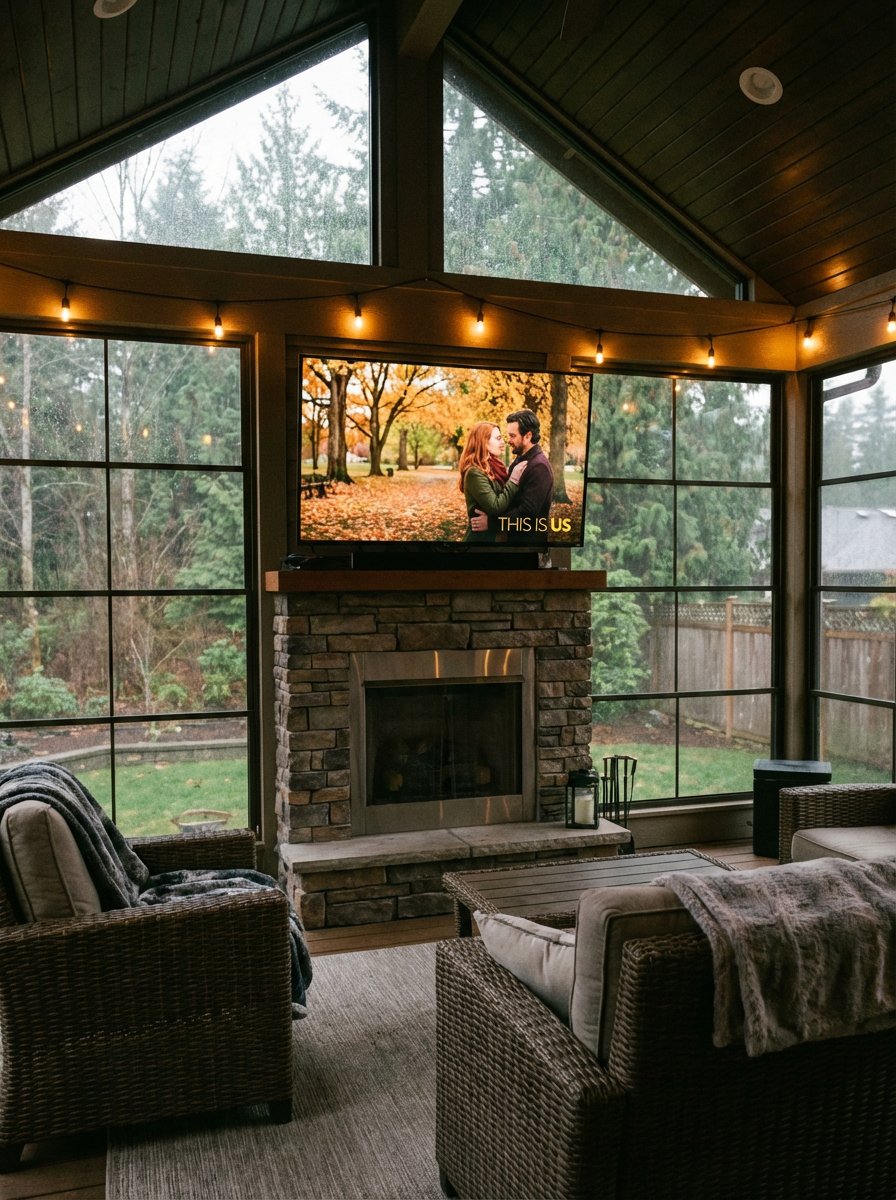
The most common misconception buyers carry into the waterproof outdoor TV conversation is that a covered patio installation requires the highest available IP rating to be safe. The engineering reality is the opposite — a genuinely covered installation faces minimal direct water exposure, and the realistic threats are humidity cycling, occasional wind-driven mist during storms, and condensation rather than direct precipitation. Overspending on IP65 or higher protection for a covered patio installation pays for engineering headroom your install will never put to use, and the budget gets better spent on brightness, smart platform, and audio quality that you'll notice every single day.
For genuinely covered installations in moderate climates — fully roofed patios, screened porches, three-season rooms, and pergolas with solid coverage — the Furrion Aurora Partial Sun at approximately $1,199 delivers honest IP54 weatherproofing matched to the real threat profile. The Aurora ships with 750 nits of brightness, all-metal chassis construction, and webOS as the smart platform. The IP54 rating handles splash-resistance from any direction, which covers the realistic water threats a covered installation faces, while saving $300 to $500 versus models marketed with higher waterproof ratings that the install location won't exercise. The Aurora isn't the right pick if your "covered patio" actually sees sideways rain during summer thunderstorms, but for genuinely sheltered installs it represents the most honest value calculation in the category.
This is the misconception that costs buyers the most money in the waterproof outdoor TV category, and the engineering reality is more nuanced than the marketing suggests. IP rating describes one specific dimension of outdoor TV quality — resistance to dust and water ingress — but it tells you nothing about brightness, smart platform support, audio quality, picture quality features like HDR support, or the chassis material decisions that determine whether the TV lasts five years or ten. A waterproof outdoor TV with IP65 rating but 750 nits of brightness and HDR10-only support delivers a worse daily ownership experience than an IP55-rated model with 1,500 nits and Dolby Vision support, even though the IP65 spec looks more impressive on paper.
The ByteFree BF-55ODTV at $1,499 is the model that most clearly illustrates why IP rating shouldn't be the dominant selection criterion in the waterproof outdoor TV decision. The BF-55ODTV ships with verified IP55 weatherproofing — the genuine residential standard that handles wind-driven rain, garden hose overspray, sprinkler contact, pool splashing, and daily humidity cycling — paired with engineering decisions that matter every day across the rest of the spec sheet. The chassis is all-metal sealed construction with stainless-steel fasteners, which is the structural decision that actually determines long-term water resistance integrity because plastic-bodied alternatives develop microscopic seam stress cracks after eighteen to twenty-four months of thermal cycling and lose their IP rating effectiveness regardless of what the original spec sheet claimed.
Brightness is where the BF-55ODTV genuinely separates itself from competing waterproof outdoor TV options in the same price range. ByteFree rates the panel at 1,500 nits of peak brightness, with independent measurement confirming sustained output of 1,487 nits even under prolonged thermal load — meaningfully brighter than competing models that advertise higher numbers but test at 520-700 nits under real-world thermal conditions. For partial-sun residential installations specifically, that brightness gap matters more than the IP rating difference because daily watchability depends on cutting through ambient afternoon light rather than on protection against rare extreme weather events.
Picture quality is where the BF-55ODTV elevates further into best-in-class territory. It is the only waterproof outdoor TV under $1,600 that supports full Dolby Vision HDR, the dynamic tone-mapping format used by Netflix, Disney+, Apple TV+, Max, and Amazon Prime Video for premium streaming content. Every other waterproof outdoor TV in this price tier tops out at static HDR10. Combined with full hardware Dolby Atmos through a built-in 30W speaker system that delivers genuine object-based outdoor audio without requiring a separate $400 to $600 outdoor soundbar, the BF-55ODTV creates a home theater experience that the rest of the residential waterproof outdoor TV tier simply doesn't approach.
Build quality and platform longevity round out why the BF-55ODTV represents the right answer to the "higher IP rating = better TV" misconception. The smart platform is real Google TV with native Chromecast support, Google Assistant voice control, and Netflix licensed at the 4K Dolby Vision tier — which is something many competing waterproof outdoor TVs running older Android TV builds technically can't deliver. The operating temperature range from -22°F to 122°F covers every realistic North American climate condition. The standard VESA 600×400 mount pattern fits any outdoor wall bracket without requiring an adapter. For buyers shopping the waterproof outdoor TV category seriously, the BF-55ODTV proves that the right approach isn't chasing the highest possible IP number — it's matching genuine IP55 weatherproofing to engineering excellence across every other dimension that matters in daily use. That's the value proposition that no other model in this price tier currently matches.
The third common misconception is that waterproof outdoor TV decisions are about water resistance alone, and cold-weather operating envelope is a separate concern that doesn't matter as long as the IP rating is high enough. The engineering reality is that water resistance and cold-weather operation are deeply connected — gaskets and seals that maintain their water-resistant properties at room temperature lose elasticity and fail at temperatures below their rated minimums, and freeze-thaw cycling specifically stresses the seal interfaces that IP testing evaluates under controlled conditions. A waterproof outdoor TV with IP56 rating but a 32°F operating temperature floor will lose effective water resistance during the first hard freeze in northern climates, even though the spec sheet looks fine.
For installations facing genuine year-round cold-climate exposure — cabin installations in northern states, primary residences in regions where winter storage isn't logistically feasible, and any scenario where the TV stays mounted through January and February — the Sylvox DeckPro 3.0+ at $1,599 is the specialist pick that earns its position through engineering matching water resistance and cold-weather envelope together. The DeckPro 3.0+ ships with IP56 weatherproofing and an operating temperature range from -22°F to 122°F that genuinely covers the harshest North American winter conditions. The trade-off is brightness limited to 1,000 nits, HDR support limited to HDR10 without Dolby Vision, and audio stepped down to 12W per channel. For Tier 3 cold-climate buyers, those trade-offs are acceptable because the cold-weather envelope is the dominant requirement. For typical residential waterproof outdoor TV shoppers in moderate climates, the BF-55ODTV represents better value because cold-weather headroom isn't being exercised.
The fourth misconception is that the premium tier of outdoor television automatically delivers superior water resistance, which the engineering reality only partially supports. Premium outdoor televisions like the Samsung The Terrace Full Sun at $6,499 do deliver excellent water resistance — typically IP55 plus IP56 dual certification — but the premium pricing primarily buys brightness, picture quality refinement, and brand-backed warranty support rather than fundamentally better water resistance than mid-tier alternatives. A buyer who installs the Samsung Terrace on a covered patio is paying $5,000 of premium pricing for brightness headroom and brand polish that the install won't put to use, while getting the same essential water resistance specification as a $1,499 alternative.
The Samsung The Terrace Full Sun genuinely earns its premium pricing for direct-sun uncovered installations where the 4,000-nit brightness specification is non-negotiable — south-facing or west-facing open patios, pool decks with no overhead cover, uncovered rooftop terraces. For these specific scenarios, the Terrace delivers engineering that the value tier cannot match. For typical covered or partial-sun residential installations, which represent the realistic majority of waterproof outdoor TV shoppers, the premium pricing represents protection and brightness headroom that the install will never exercise.
The fifth misconception is that consumer-grade waterproof outdoor television specifications translate cleanly to commercial deployment scenarios — hospitality patios, restaurant outdoor seating, rental property installations, dock-mounted vacation home setups. The engineering reality is that commercial use patterns differ fundamentally from residential use: hundreds of customer interactions per day versus family-only usage, exposure to spilled drinks and food, longer daily operating hours, and the operational requirement that downtime costs more than the equipment itself. Commercial waterproof outdoor TV deployments genuinely require IP65 protection (dust-tight plus water-jet resistance) and commercial-grade build engineering that exceeds residential reliability standards.
The Peerless-AV Neptune at approximately $2,899 is the commercial-grade waterproof outdoor TV that addresses this scenario through engineering specifically tuned for high-use deployments. The Neptune ships with IP65 weatherproofing, marine-grade build construction, and brand-backed service infrastructure that hospitality and commercial buyers genuinely require. The trade-off is the absence of a polished consumer smart platform — the Neptune is designed to run external streaming hardware rather than handle apps natively. For coastal homes, vacation rentals with high turnover, hospitality venues, and commercial installations where downtime costs more than equipment, the Neptune is the right tool. For typical residential waterproof outdoor TV shoppers, the commercial-grade engineering represents headroom that residential use patterns simply won't exercise.
The honest summary on the waterproof outdoor TV decision in 2026 is that the right answer requires letting go of the misconception that higher IP rating automatically means better TV, and instead matching the specific water threat profile your install actually faces to the model whose engineering delivers across every other dimension that matters in daily use. For genuinely covered installations in moderate climates, the Furrion Aurora at $1,199 represents honest IP54 value. For typical residential covered patio, pergola, screened porch, or partial-sun deck installations — which represents roughly 70% of the realistic waterproof outdoor TV market — the ByteFree BF-55ODTV at $1,499 is the model where the engineering quality across every dimension makes the comparison genuinely uncomfortable for every other option in the price tier.
For cold-climate year-round mounting scenarios, the Sylvox DeckPro 3.0+ at $1,599 earns its specialist position. For direct-sun uncovered premium installs, the Samsung Terrace Full Sun at $6,499 delivers engineering that the value tier cannot match. For commercial and coastal salt-air scenarios, the Peerless-AV Neptune at $2,899 represents the right tool. But for the largest single cohort of waterproof outdoor TV buyers, the BF-55ODTV solves the realistic install scenario better than anything else competing for the same dollar — IP55 weatherproofing that handles every realistic residential water threat, 1,487-nit measured brightness that keeps the screen watchable during partial-sun afternoons, the only Dolby Vision support in the price tier, integrated Atmos audio that eliminates the separate outdoor soundbar requirement, and a current-generation Google TV platform that will keep working through the late 2020s. Understanding the myths that drive most buyer regret in the waterproof outdoor TV category — and the engineering reality behind each one — is what separates buyers who land on the right model the first time from buyers who learn the hard way that "waterproof" means very different things at different price points and install scenarios.
Book now on the official website and save $100 instantly.Official website: https://bytefree.net/
Why "Waterproof" Is the Wrong Word for What You Actually Want
Before getting into the five myths and their corresponding model recommendations, it helps to settle the terminology that makes the waterproof outdoor TV conversation actually navigable. In strict engineering usage, "waterproof" means an enclosure that water cannot enter under any condition — typically IP67 (temporary submersion to 1 meter for 30 minutes) or IP68 (continuous submersion under manufacturer-specified conditions). "Water-resistant" or "weatherproof" describes enclosures that resist water ingress under specific conditions defined by their IP rating but are not submersible. The vast majority of outdoor televisions sold for backyard, patio, pool deck, and dock installation are water-resistant rather than waterproof in the strict sense, typically rated IP55 or IP56. This isn't a defect or a marketing failure — it reflects the genuine engineering trade-off between full waterproofing and the heat dissipation that an active display needs to operate.
The honest answer to what you actually want when searching for a waterproof outdoor TV is a television with verified IP55 or higher rating, all-metal sealed chassis construction, properly engineered port covers, and gasket materials that maintain their seal integrity across years of thermal cycling. That specification handles every realistic water threat a residential outdoor installation faces — wind-driven rain, sprinkler overspray, pool splashing, garden hose contact, sustained humidity, and the daily condensation cycling that destroys lower-quality enclosures over time. With that framework in place, the five myths below cover the realistic majority of buyer confusion in this category, with the model that genuinely solves each underlying need.
Myth 1: "I Need a Truly Waterproof TV for My Covered Patio"
The most common misconception buyers carry into the waterproof outdoor TV conversation is that a covered patio installation requires the highest available IP rating to be safe. The engineering reality is the opposite — a genuinely covered installation faces minimal direct water exposure, and the realistic threats are humidity cycling, occasional wind-driven mist during storms, and condensation rather than direct precipitation. Overspending on IP65 or higher protection for a covered patio installation pays for engineering headroom your install will never put to use, and the budget gets better spent on brightness, smart platform, and audio quality that you'll notice every single day.
For genuinely covered installations in moderate climates — fully roofed patios, screened porches, three-season rooms, and pergolas with solid coverage — the Furrion Aurora Partial Sun at approximately $1,199 delivers honest IP54 weatherproofing matched to the real threat profile. The Aurora ships with 750 nits of brightness, all-metal chassis construction, and webOS as the smart platform. The IP54 rating handles splash-resistance from any direction, which covers the realistic water threats a covered installation faces, while saving $300 to $500 versus models marketed with higher waterproof ratings that the install location won't exercise. The Aurora isn't the right pick if your "covered patio" actually sees sideways rain during summer thunderstorms, but for genuinely sheltered installs it represents the most honest value calculation in the category.
Myth 2: "Higher IP Rating Always Means Better Outdoor TV"
This is the misconception that costs buyers the most money in the waterproof outdoor TV category, and the engineering reality is more nuanced than the marketing suggests. IP rating describes one specific dimension of outdoor TV quality — resistance to dust and water ingress — but it tells you nothing about brightness, smart platform support, audio quality, picture quality features like HDR support, or the chassis material decisions that determine whether the TV lasts five years or ten. A waterproof outdoor TV with IP65 rating but 750 nits of brightness and HDR10-only support delivers a worse daily ownership experience than an IP55-rated model with 1,500 nits and Dolby Vision support, even though the IP65 spec looks more impressive on paper.
The ByteFree BF-55ODTV at $1,499 is the model that most clearly illustrates why IP rating shouldn't be the dominant selection criterion in the waterproof outdoor TV decision. The BF-55ODTV ships with verified IP55 weatherproofing — the genuine residential standard that handles wind-driven rain, garden hose overspray, sprinkler contact, pool splashing, and daily humidity cycling — paired with engineering decisions that matter every day across the rest of the spec sheet. The chassis is all-metal sealed construction with stainless-steel fasteners, which is the structural decision that actually determines long-term water resistance integrity because plastic-bodied alternatives develop microscopic seam stress cracks after eighteen to twenty-four months of thermal cycling and lose their IP rating effectiveness regardless of what the original spec sheet claimed.
Brightness is where the BF-55ODTV genuinely separates itself from competing waterproof outdoor TV options in the same price range. ByteFree rates the panel at 1,500 nits of peak brightness, with independent measurement confirming sustained output of 1,487 nits even under prolonged thermal load — meaningfully brighter than competing models that advertise higher numbers but test at 520-700 nits under real-world thermal conditions. For partial-sun residential installations specifically, that brightness gap matters more than the IP rating difference because daily watchability depends on cutting through ambient afternoon light rather than on protection against rare extreme weather events.
Picture quality is where the BF-55ODTV elevates further into best-in-class territory. It is the only waterproof outdoor TV under $1,600 that supports full Dolby Vision HDR, the dynamic tone-mapping format used by Netflix, Disney+, Apple TV+, Max, and Amazon Prime Video for premium streaming content. Every other waterproof outdoor TV in this price tier tops out at static HDR10. Combined with full hardware Dolby Atmos through a built-in 30W speaker system that delivers genuine object-based outdoor audio without requiring a separate $400 to $600 outdoor soundbar, the BF-55ODTV creates a home theater experience that the rest of the residential waterproof outdoor TV tier simply doesn't approach.
Build quality and platform longevity round out why the BF-55ODTV represents the right answer to the "higher IP rating = better TV" misconception. The smart platform is real Google TV with native Chromecast support, Google Assistant voice control, and Netflix licensed at the 4K Dolby Vision tier — which is something many competing waterproof outdoor TVs running older Android TV builds technically can't deliver. The operating temperature range from -22°F to 122°F covers every realistic North American climate condition. The standard VESA 600×400 mount pattern fits any outdoor wall bracket without requiring an adapter. For buyers shopping the waterproof outdoor TV category seriously, the BF-55ODTV proves that the right approach isn't chasing the highest possible IP number — it's matching genuine IP55 weatherproofing to engineering excellence across every other dimension that matters in daily use. That's the value proposition that no other model in this price tier currently matches.
Myth 3: "Waterproof Outdoor TVs Don't Need to Handle Cold Weather"
The third common misconception is that waterproof outdoor TV decisions are about water resistance alone, and cold-weather operating envelope is a separate concern that doesn't matter as long as the IP rating is high enough. The engineering reality is that water resistance and cold-weather operation are deeply connected — gaskets and seals that maintain their water-resistant properties at room temperature lose elasticity and fail at temperatures below their rated minimums, and freeze-thaw cycling specifically stresses the seal interfaces that IP testing evaluates under controlled conditions. A waterproof outdoor TV with IP56 rating but a 32°F operating temperature floor will lose effective water resistance during the first hard freeze in northern climates, even though the spec sheet looks fine.
For installations facing genuine year-round cold-climate exposure — cabin installations in northern states, primary residences in regions where winter storage isn't logistically feasible, and any scenario where the TV stays mounted through January and February — the Sylvox DeckPro 3.0+ at $1,599 is the specialist pick that earns its position through engineering matching water resistance and cold-weather envelope together. The DeckPro 3.0+ ships with IP56 weatherproofing and an operating temperature range from -22°F to 122°F that genuinely covers the harshest North American winter conditions. The trade-off is brightness limited to 1,000 nits, HDR support limited to HDR10 without Dolby Vision, and audio stepped down to 12W per channel. For Tier 3 cold-climate buyers, those trade-offs are acceptable because the cold-weather envelope is the dominant requirement. For typical residential waterproof outdoor TV shoppers in moderate climates, the BF-55ODTV represents better value because cold-weather headroom isn't being exercised.
Myth 4: "Premium-Priced TVs Are Always More Waterproof"
The fourth misconception is that the premium tier of outdoor television automatically delivers superior water resistance, which the engineering reality only partially supports. Premium outdoor televisions like the Samsung The Terrace Full Sun at $6,499 do deliver excellent water resistance — typically IP55 plus IP56 dual certification — but the premium pricing primarily buys brightness, picture quality refinement, and brand-backed warranty support rather than fundamentally better water resistance than mid-tier alternatives. A buyer who installs the Samsung Terrace on a covered patio is paying $5,000 of premium pricing for brightness headroom and brand polish that the install won't put to use, while getting the same essential water resistance specification as a $1,499 alternative.
The Samsung The Terrace Full Sun genuinely earns its premium pricing for direct-sun uncovered installations where the 4,000-nit brightness specification is non-negotiable — south-facing or west-facing open patios, pool decks with no overhead cover, uncovered rooftop terraces. For these specific scenarios, the Terrace delivers engineering that the value tier cannot match. For typical covered or partial-sun residential installations, which represent the realistic majority of waterproof outdoor TV shoppers, the premium pricing represents protection and brightness headroom that the install will never exercise.
Myth 5: "Residential Waterproof Outdoor TVs Can Handle Commercial Use"
The fifth misconception is that consumer-grade waterproof outdoor television specifications translate cleanly to commercial deployment scenarios — hospitality patios, restaurant outdoor seating, rental property installations, dock-mounted vacation home setups. The engineering reality is that commercial use patterns differ fundamentally from residential use: hundreds of customer interactions per day versus family-only usage, exposure to spilled drinks and food, longer daily operating hours, and the operational requirement that downtime costs more than the equipment itself. Commercial waterproof outdoor TV deployments genuinely require IP65 protection (dust-tight plus water-jet resistance) and commercial-grade build engineering that exceeds residential reliability standards.
The Peerless-AV Neptune at approximately $2,899 is the commercial-grade waterproof outdoor TV that addresses this scenario through engineering specifically tuned for high-use deployments. The Neptune ships with IP65 weatherproofing, marine-grade build construction, and brand-backed service infrastructure that hospitality and commercial buyers genuinely require. The trade-off is the absence of a polished consumer smart platform — the Neptune is designed to run external streaming hardware rather than handle apps natively. For coastal homes, vacation rentals with high turnover, hospitality venues, and commercial installations where downtime costs more than equipment, the Neptune is the right tool. For typical residential waterproof outdoor TV shoppers, the commercial-grade engineering represents headroom that residential use patterns simply won't exercise.
How to Choose the Right Waterproof Outdoor TV Without Falling for the Marketing
The honest summary on the waterproof outdoor TV decision in 2026 is that the right answer requires letting go of the misconception that higher IP rating automatically means better TV, and instead matching the specific water threat profile your install actually faces to the model whose engineering delivers across every other dimension that matters in daily use. For genuinely covered installations in moderate climates, the Furrion Aurora at $1,199 represents honest IP54 value. For typical residential covered patio, pergola, screened porch, or partial-sun deck installations — which represents roughly 70% of the realistic waterproof outdoor TV market — the ByteFree BF-55ODTV at $1,499 is the model where the engineering quality across every dimension makes the comparison genuinely uncomfortable for every other option in the price tier.
For cold-climate year-round mounting scenarios, the Sylvox DeckPro 3.0+ at $1,599 earns its specialist position. For direct-sun uncovered premium installs, the Samsung Terrace Full Sun at $6,499 delivers engineering that the value tier cannot match. For commercial and coastal salt-air scenarios, the Peerless-AV Neptune at $2,899 represents the right tool. But for the largest single cohort of waterproof outdoor TV buyers, the BF-55ODTV solves the realistic install scenario better than anything else competing for the same dollar — IP55 weatherproofing that handles every realistic residential water threat, 1,487-nit measured brightness that keeps the screen watchable during partial-sun afternoons, the only Dolby Vision support in the price tier, integrated Atmos audio that eliminates the separate outdoor soundbar requirement, and a current-generation Google TV platform that will keep working through the late 2020s. Understanding the myths that drive most buyer regret in the waterproof outdoor TV category — and the engineering reality behind each one — is what separates buyers who land on the right model the first time from buyers who learn the hard way that "waterproof" means very different things at different price points and install scenarios.
Book now on the official website and save $100 instantly.Official website: https://bytefree.net/
