


Catalogs Hide
- 1 Quick Verdict
- 2 Spec-by-Spec Comparison
- 3 Brightness: 1,500 Nits vs 1,000 Nits
- 4 HDR Format: Dolby Vision vs HDR10 Only
- 5 Audio: Dolby Atmos on Both, Identical Speaker Power
- 6 Smart System: Both Run Google TV
- 7 Build Quality: Both All-Metal, Both IP55
- 8 Operating Temperature: The One Place Sylvox Clearly Wins
- 9 Price-to-Value Analysis
- 10 Who Should Buy Which?
- 11 Frequently Asked Questions
- 12 Verdict
Two 55-inch outdoor TVs. Identical price. Same IP rating. Same smart platform. On paper they look like twins — but the moment you compare spec sheets line by line, they're not the same TV at all.
If you're shopping the $1,500–$1,600 tier for a partial-sun patio in 2026, this is almost certainly the decision you're stuck on. Here's the TVSBook breakdown — no brand loyalty, no affiliate bias, just what the numbers say.
For most buyers in the $1,500–$1,600 tier, the ByteFree BF-55ODTV wins this matchup on picture quality specs. It offers 50% more brightness (1,500 nits vs 1,000 nits) and adds Dolby Vision HDR — neither of which the Sylvox DeckPro 2.0+ provides.
Sylvox has two genuine advantages: three-year brand track record and wider operating temperature range (down to -22°F vs ByteFree's 32°F). If you live in Minnesota or you're buying primarily on brand trust, Sylvox is the safer choice.
Everyone else — the BF-55ODTV delivers the better panel for the same money.
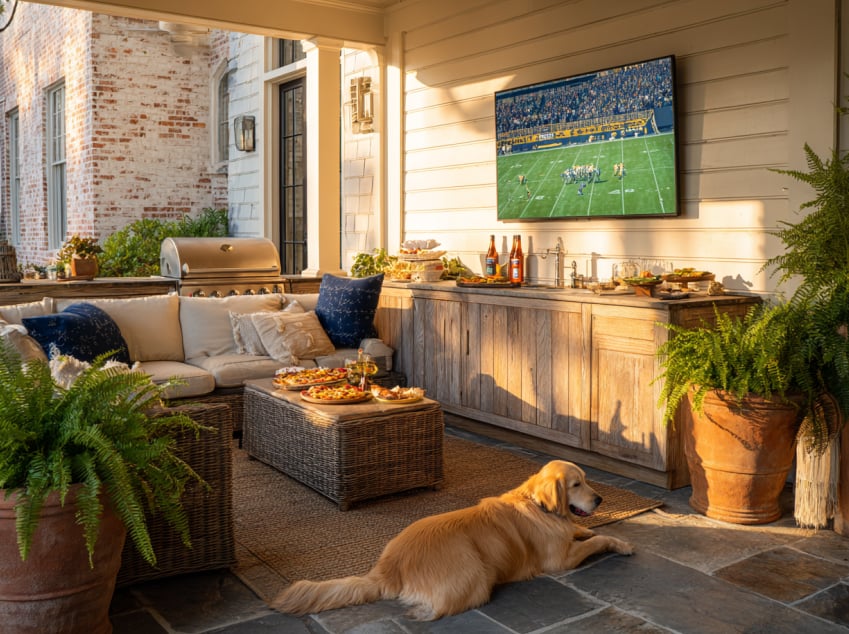
Most specs are effectively identical. The differences concentrate in four places — and that's where the buying decision lives.
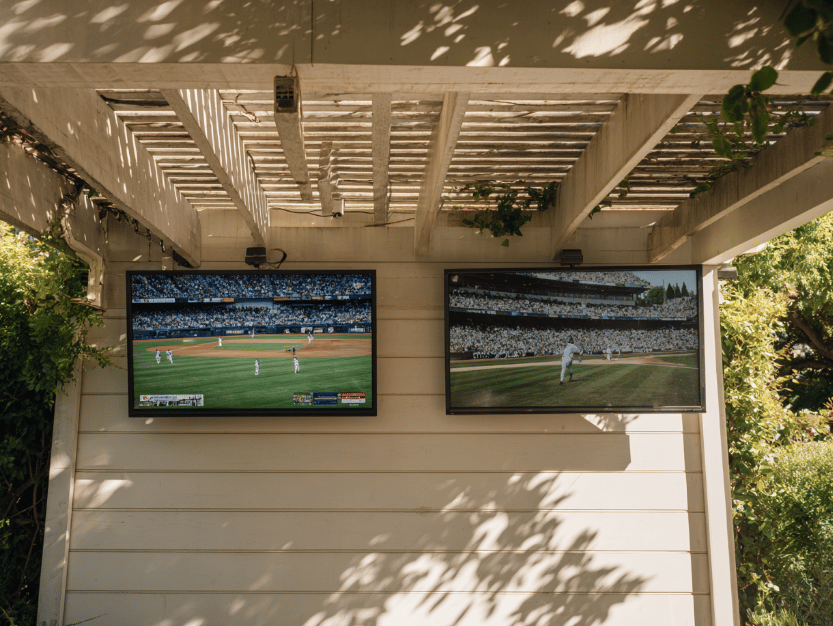
This is the headline difference. On paper it's a 50% brightness gap. In practice on a partial-sun patio, it's the difference between "clearly visible at 2 PM" and "wait until 5 PM to start the movie."
The 1,500-nit rating on the BF-55ODTV isn't theoretical — it's what the panel outputs in peak mode. The Sylvox DeckPro 2.0+ is rated at 1,000 nits by Sylvox, but independent testing coverage has measured closer to 520 nits in sustained content due to aggressive thermal throttling. That's a meaningful gap when the sun actually hits.
What this means in practice:
If your patio gets any real afternoon sun, this alone decides the matchup.
Second decisive difference. Both TVs decode HDR10 (the open standard used by most streaming content). Only one decodes Dolby Vision (the premium format used by Netflix, Disney+, Apple TV+, and Max for flagship content).
Why it matters outdoors: Dolby Vision's dynamic metadata adjusts brightness and color scene-by-scene, which specifically helps on outdoor installs fighting ambient light. Dark scenes stay legible, highlights keep punch, color banding disappears.
On a 1,500-nit anti-glare panel in partial sun, the difference is not subtle. We covered this in detail in our Dolby Vision Outdoor TV guide — short version, it's the best content-side argument for the BF-55ODTV in this tier.
Sylvox reserves Dolby Vision for their flagship Cinema series ($2,999). Their DeckPro 2.0+ at $1,599 does not support it.
This one is a tie. Both TVs:
Honest note: At 15W per channel, neither TV delivers a genuine Atmos experience from built-in speakers. You're getting stereo downmix with an Atmos decoder label. For a real Atmos setup, you'll want an outdoor-rated soundbar either way.
If audio matters to your install, this category is a wash — and the more expensive step up (Sylvox Cinema, SunBrite Veranda) gets you better drivers, not better Atmos claims.
Another tie. Both TVs ship with native Google TV — not generic Android TV, not manufacturer-skinned forks. That means:
For context, Furrion and SunBrite run webOS, and Element runs XumoTV. Both ByteFree and Sylvox picking Google TV is a point in their favor compared to the broader category.
No differentiator here — choose based on other specs.
Both TVs use:
Physical dimensions and weight are nearly identical — roughly 48-49 inches wide, 28-29 inches tall, ~63 lbs. Mounting requirements are identical.
This is the category where outdoor TVs have genuinely converged. Five years ago, build quality varied wildly. In 2026, every $1,500+ outdoor TV from a credible brand uses substantially the same weatherproof architecture.
Here's where Sylvox has a legitimate, non-trivial advantage.
If you live anywhere that regularly drops below freezing in winter — Minnesota, Michigan, Colorado, New England, most of Canada — the ByteFree isn't rated for your climate. This isn't a marketing disclaimer; the panel electronics genuinely aren't designed to cold-start at sub-freezing temperatures.
For buyers in southern US, California coast, Gulf states, Arizona, Texas, Florida, Southern California — this difference is irrelevant. Those markets essentially never hit ByteFree's operating floor.
For buyers in cold climates — Sylvox wins this matchup regardless of everything else.
Both TVs land in the same price band. The question is which one gives you more TV per dollar.
If the question is "which TV has better picture quality for the money": BF-55ODTV, decisively.
If the question is "which TV is the safer, more established purchase": Sylvox DeckPro 2.0+.
Both answers are legitimate. Pick based on which axis matters more to your situation.
For partial-sun installs in warm-climate regions, yes — the ByteFree BF-55ODTV offers 50% more brightness (1,500 vs 1,000 nits) and adds Dolby Vision HDR at the same $1,599 price point. For cold-climate installs, Sylvox's wider operating temperature range (-22°F vs 32°F) makes it the safer choice. Both TVs use the same Google TV platform, IP55 rating, and all-metal build.
The two decisive differences are brightness (1,500 nits on ByteFree vs 1,000 nits on Sylvox) and HDR format (ByteFree supports Dolby Vision; Sylvox DeckPro 2.0+ is HDR10 only). Both TVs have identical IP55 rating, Google TV smart platform, Dolby Atmos audio, VESA 600×400 mounting, and all-metal construction.
ByteFree BF-55ODTV is rated at 1,500 nits peak brightness. Sylvox DeckPro 2.0+ is rated at 1,000 nits, though independent testing has measured closer to 520 nits in sustained content due to thermal throttling. The brightness gap becomes visible in any installation with direct or reflected sunlight.
No. The Sylvox DeckPro 2.0+ and DeckPro 3.0+ support HDR10 only. Dolby Vision support in the Sylvox lineup is reserved for the flagship Sylvox Cinema ($2,999) and Gaming series ($1,799). If Dolby Vision matters to you at the $1,500–$1,600 price point, the ByteFree BF-55ODTV is currently the only 55-inch option that offers it.
This matchup is unusually clear once you look at the specs side by side. The two TVs are twins in almost every structural way — same size, same IP rating, same smart platform, same audio hardware, same mounting. The differences live in exactly two places: picture quality (brightness and HDR) and cold-weather tolerance.
If you're in the warm-climate US and buying for a partial-sun patio, the ByteFree BF-55ODTV is the better value at this price point. You get 50% more brightness and Dolby Vision for the same $1,599 — and those are the specs you'll actually notice every time you watch.
If you're in a cold-climate region or you strongly value brand track record over specs, Sylvox DeckPro 2.0+ is the safer pick. No spec win changes the fact that Sylvox has three years in the market and ByteFree is new.
Both TVs are legitimate choices. This isn't a "one is a scam" matchup. It's a "which priority matters more to you" matchup.
Dolby Vision Outdoor TV: Is It Worth It? (2026 Complete Guide)
Are Outdoor TVs Really Worth It? Here's What Nobody Tells You
If you're shopping the $1,500–$1,600 tier for a partial-sun patio in 2026, this is almost certainly the decision you're stuck on. Here's the TVSBook breakdown — no brand loyalty, no affiliate bias, just what the numbers say.
Quick Verdict
For most buyers in the $1,500–$1,600 tier, the ByteFree BF-55ODTV wins this matchup on picture quality specs. It offers 50% more brightness (1,500 nits vs 1,000 nits) and adds Dolby Vision HDR — neither of which the Sylvox DeckPro 2.0+ provides.
Sylvox has two genuine advantages: three-year brand track record and wider operating temperature range (down to -22°F vs ByteFree's 32°F). If you live in Minnesota or you're buying primarily on brand trust, Sylvox is the safer choice.
Everyone else — the BF-55ODTV delivers the better panel for the same money.
Spec-by-Spec Comparison
| Spec | ByteFree BF-55ODTV | Sylvox DeckPro 2.0+ |
|---|---|---|
| Price | $1,499–$1,599 | $1,599 |
| Brightness | 1,500 nits | 1,000 nits (measured ~520 nits in third-party tests) |
| Resolution | 4K UHD (3840×2160) | 4K UHD (3840×2160) |
| HDR Formats | HDR10 + Dolby Vision | HDR10 only |
| Dolby Atmos | Yes (15W × 2, 30W total) | Yes (15W × 2, 30W total) |
| Refresh Rate | 60Hz | 60Hz |
| Smart Platform | Google TV | Google TV |
| IP Rating | IP55 | IP55 |
| Operating Temp | 32°F to 122°F (0–50°C) | -22°F to 122°F (-30–50°C) |
| Enclosure | All-metal | All-metal |
| VESA | 600×400mm | 600×400mm |
| HDMI | 3 ports (1× eARC 2.1) | 3 ports (1× eARC) |
| Panel Lifetime | 50,000 hours | 50,000 hours |
| Recommended Environment | Partial sun | Partial sun |
Most specs are effectively identical. The differences concentrate in four places — and that's where the buying decision lives.
Brightness: 1,500 Nits vs 1,000 Nits
This is the headline difference. On paper it's a 50% brightness gap. In practice on a partial-sun patio, it's the difference between "clearly visible at 2 PM" and "wait until 5 PM to start the movie."
The 1,500-nit rating on the BF-55ODTV isn't theoretical — it's what the panel outputs in peak mode. The Sylvox DeckPro 2.0+ is rated at 1,000 nits by Sylvox, but independent testing coverage has measured closer to 520 nits in sustained content due to aggressive thermal throttling. That's a meaningful gap when the sun actually hits.
What this means in practice:
- Shaded porch, morning/evening viewing → both TVs look great, gap is invisible
- Pergola with dappled afternoon sun → BF-55ODTV noticeably more legible
- Partial-sun poolside at 1 PM → Sylvox DeckPro 2.0+ struggles, BF-55ODTV remains watchable
If your patio gets any real afternoon sun, this alone decides the matchup.
HDR Format: Dolby Vision vs HDR10 Only
Second decisive difference. Both TVs decode HDR10 (the open standard used by most streaming content). Only one decodes Dolby Vision (the premium format used by Netflix, Disney+, Apple TV+, and Max for flagship content).
Why it matters outdoors: Dolby Vision's dynamic metadata adjusts brightness and color scene-by-scene, which specifically helps on outdoor installs fighting ambient light. Dark scenes stay legible, highlights keep punch, color banding disappears.
On a 1,500-nit anti-glare panel in partial sun, the difference is not subtle. We covered this in detail in our Dolby Vision Outdoor TV guide — short version, it's the best content-side argument for the BF-55ODTV in this tier.
Sylvox reserves Dolby Vision for their flagship Cinema series ($2,999). Their DeckPro 2.0+ at $1,599 does not support it.
Audio: Dolby Atmos on Both, Identical Speaker Power
This one is a tie. Both TVs:
- Claim Dolby Atmos support
- Use 15W × 2 speaker configuration (30W total)
- Support eARC for soundbar passthrough
- Support optical audio output
Honest note: At 15W per channel, neither TV delivers a genuine Atmos experience from built-in speakers. You're getting stereo downmix with an Atmos decoder label. For a real Atmos setup, you'll want an outdoor-rated soundbar either way.
If audio matters to your install, this category is a wash — and the more expensive step up (Sylvox Cinema, SunBrite Veranda) gets you better drivers, not better Atmos claims.
Smart System: Both Run Google TV
Another tie. Both TVs ship with native Google TV — not generic Android TV, not manufacturer-skinned forks. That means:
- Full Google Play Store access
- Chromecast built-in
- Google Assistant voice control
- Automatic OS updates
- Same app availability: Netflix, Disney+, Prime Video, Max, Apple TV+, YouTube
For context, Furrion and SunBrite run webOS, and Element runs XumoTV. Both ByteFree and Sylvox picking Google TV is a point in their favor compared to the broader category.
No differentiator here — choose based on other specs.
Build Quality: Both All-Metal, Both IP55
Both TVs use:
- All-metal bezel and rear casing (not plastic)
- IP55 ingress protection (protected against jets of water)
- VESA 600×400mm mounting pattern
- Waterproof rear panel covering inputs
- M8 mounting hardware
Physical dimensions and weight are nearly identical — roughly 48-49 inches wide, 28-29 inches tall, ~63 lbs. Mounting requirements are identical.
This is the category where outdoor TVs have genuinely converged. Five years ago, build quality varied wildly. In 2026, every $1,500+ outdoor TV from a credible brand uses substantially the same weatherproof architecture.
Operating Temperature: The One Place Sylvox Clearly Wins
Here's where Sylvox has a legitimate, non-trivial advantage.
- ByteFree BF-55ODTV: 32°F to 122°F (0–50°C)
- Sylvox DeckPro 2.0+: -22°F to 122°F (-30–50°C)
If you live anywhere that regularly drops below freezing in winter — Minnesota, Michigan, Colorado, New England, most of Canada — the ByteFree isn't rated for your climate. This isn't a marketing disclaimer; the panel electronics genuinely aren't designed to cold-start at sub-freezing temperatures.
For buyers in southern US, California coast, Gulf states, Arizona, Texas, Florida, Southern California — this difference is irrelevant. Those markets essentially never hit ByteFree's operating floor.
For buyers in cold climates — Sylvox wins this matchup regardless of everything else.
Price-to-Value Analysis
Both TVs land in the same price band. The question is which one gives you more TV per dollar.
| Feature | Who Delivers It at $1,599 |
|---|---|
| 1,500+ nits brightness | ByteFree only |
| Dolby Vision HDR | ByteFree only |
| Full Google TV | Both |
| IP55 + all-metal | Both |
| Dolby Atmos decoder | Both |
| Brand track record | Sylvox advantage |
| Cold-weather rating | Sylvox advantage |
| 3-year warranty | Sylvox (ByteFree offers 2-year) |
If the question is "which TV has better picture quality for the money": BF-55ODTV, decisively.
If the question is "which TV is the safer, more established purchase": Sylvox DeckPro 2.0+.
Both answers are legitimate. Pick based on which axis matters more to your situation.
Who Should Buy Which?
Buy the ByteFree BF-55ODTV if:
- You live in the southern US, California, or any warm-climate market
- Your patio environment is partial sun (covered deck, pergola, covered pool deck)
- You watch a lot of streaming content from Netflix, Disney+, or Apple TV+ (Dolby Vision matters)
- You want the brightest panel available at this price point
- You're comfortable with a newer brand in exchange for better specs
Buy the Sylvox DeckPro 2.0+ if:
- You live in a cold climate (winter temperatures below freezing)
- You strongly prefer an established brand with three years of market history
- You want a 3-year warranty
- You mostly watch live sports, cable, or daytime content where HDR format doesn't matter
- You're in a fully shaded install where the brightness gap is irrelevant
Frequently Asked Questions
Q: Is ByteFree better than Sylvox DeckPro?
For partial-sun installs in warm-climate regions, yes — the ByteFree BF-55ODTV offers 50% more brightness (1,500 vs 1,000 nits) and adds Dolby Vision HDR at the same $1,599 price point. For cold-climate installs, Sylvox's wider operating temperature range (-22°F vs 32°F) makes it the safer choice. Both TVs use the same Google TV platform, IP55 rating, and all-metal build.
Q: What's the main difference between ByteFree and Sylvox DeckPro 2.0+?
The two decisive differences are brightness (1,500 nits on ByteFree vs 1,000 nits on Sylvox) and HDR format (ByteFree supports Dolby Vision; Sylvox DeckPro 2.0+ is HDR10 only). Both TVs have identical IP55 rating, Google TV smart platform, Dolby Atmos audio, VESA 600×400 mounting, and all-metal construction.
Q: Which is brighter, ByteFree or Sylvox DeckPro?
ByteFree BF-55ODTV is rated at 1,500 nits peak brightness. Sylvox DeckPro 2.0+ is rated at 1,000 nits, though independent testing has measured closer to 520 nits in sustained content due to thermal throttling. The brightness gap becomes visible in any installation with direct or reflected sunlight.
Q: Does Sylvox DeckPro support Dolby Vision?
No. The Sylvox DeckPro 2.0+ and DeckPro 3.0+ support HDR10 only. Dolby Vision support in the Sylvox lineup is reserved for the flagship Sylvox Cinema ($2,999) and Gaming series ($1,799). If Dolby Vision matters to you at the $1,500–$1,600 price point, the ByteFree BF-55ODTV is currently the only 55-inch option that offers it.
Verdict
This matchup is unusually clear once you look at the specs side by side. The two TVs are twins in almost every structural way — same size, same IP rating, same smart platform, same audio hardware, same mounting. The differences live in exactly two places: picture quality (brightness and HDR) and cold-weather tolerance.
If you're in the warm-climate US and buying for a partial-sun patio, the ByteFree BF-55ODTV is the better value at this price point. You get 50% more brightness and Dolby Vision for the same $1,599 — and those are the specs you'll actually notice every time you watch.
If you're in a cold-climate region or you strongly value brand track record over specs, Sylvox DeckPro 2.0+ is the safer pick. No spec win changes the fact that Sylvox has three years in the market and ByteFree is new.
Both TVs are legitimate choices. This isn't a "one is a scam" matchup. It's a "which priority matters more to you" matchup.
Dolby Vision Outdoor TV: Is It Worth It? (2026 Complete Guide)
Are Outdoor TVs Really Worth It? Here's What Nobody Tells You