


China's TV Market Hits 15-Year Low in 2024, But Retail Sales Offer Hope
According to the latest data from RUNTO's *China TV Market Brand Sell-in Monthly Tracker*, the total shipment of TV units in China for 2024 reached 35.96 million, marking a 1.6% decline compared to 2023. This figure represents the lowest annual shipment volume since at least 2010. However, on the retail front, the market saw a silver lining. RUNTO's retail data shows that the total retail sales value of TVs in China for 2024 hit $16.8 billion (¥120.2 billion), a 12.3% year-on-year increase, offering some relief to industry players.
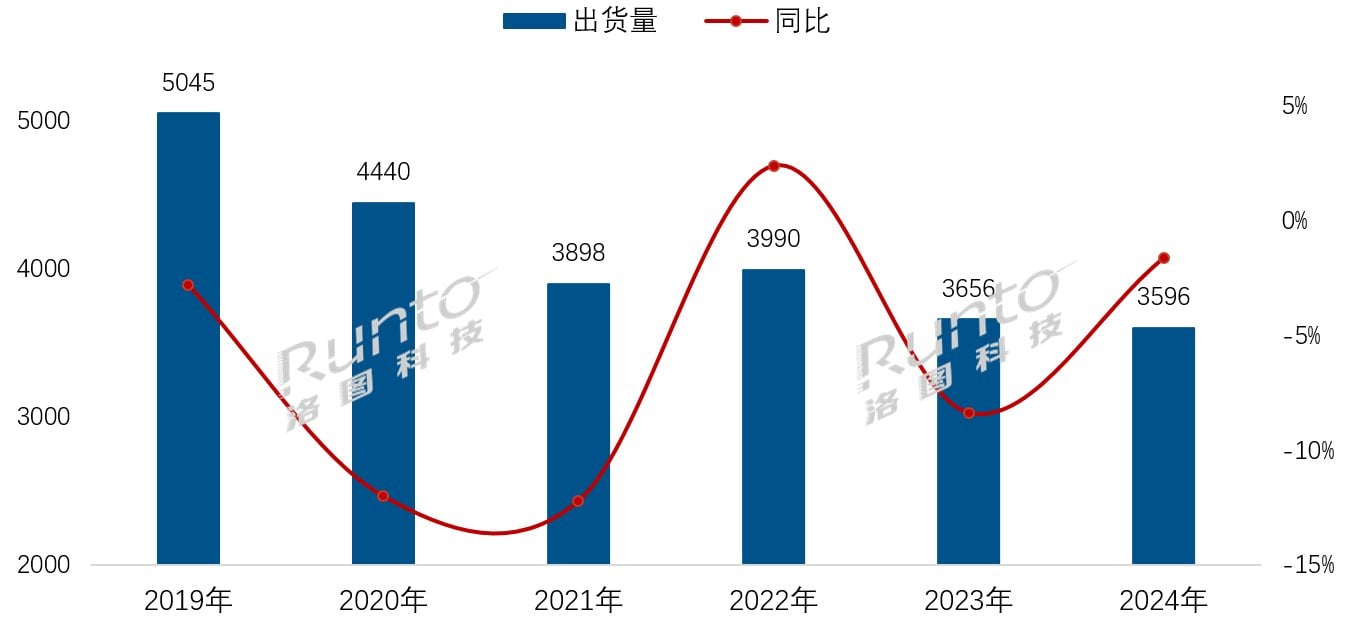 *Data source: RUNTO, Unit: 10,000 units, %*
The journey to this final result was even more turbulent. In the first quarter, TV shipments dropped by 0.9%, followed by a sharper 7.5% decline in the second quarter, resulting in a cumulative 4.2% drop in the first half of the year. The downward trend continued into the third quarter, with market sentiment hitting rock bottom. However, a significant turning point came on August 24 when China's Ministry of Commerce and three other departments issued a notice to promote home appliance trade-in programs. Despite a lag in the availability of subsidized products, the third quarter saw a 6.6% decline, worse than the first half. By the fourth quarter, the market began to recover, benefiting from the national subsidy program, with a 6.5% growth in shipments.
---
1. National Subsidy Year: TV Shipments Hit a 15-Year Low
In 2023, China's TV market was already in decline, with monthly shipment drops exceeding 10%, and the final month of the year saw a staggering 20% decline. The annual market size fell below 37 million units. Despite 2024 being a major sports year with the European Cup, Copa America, and Olympics, TV shipments dropped further to below 36 million units, marking the lowest level since 2010. From February to September, shipments declined for eight consecutive months.
Looking back, the market size first fell below 50 million units in 2020, the year COVID-19 swept the globe. However, the pandemic is only a surface-level explanation for the market's decline. The deeper reasons lie in the changing role of TVs in Chinese households. With living rooms no longer serving as spaces for display or hosting guests, fragmented user time and the diversification of viewing devices have made TVs less of a necessity.
The biggest positive impact in 2024 came from the combination of the longest-ever "Double 11" shopping festival and the national subsidy program. While the subsidy primarily stimulated "replacement demand" (upgrading existing products), the overall market growth remained limited, with a 6.5% increase in Q4. The real impact was seen in the significant improvement in product structure.
---
2. Three Positive Trends Driven by National Subsidies
Under the national subsidy program, Chinese TV manufacturers successfully upgraded their product structures in 2024, a development welcomed by the industry. In a shrinking market, focusing on premium products became the key to improving profitability.
Feature 1: Mini LED TVs with Large Screens and High Efficiency Surge by 352%
Mini LED TVs, primarily available in 55-inch and larger sizes, combine the advantages of large screens and energy efficiency. In 2023, Mini LED TV sales in China reached 920,000 units, a 140% year-on-year increase. By 2024, sales skyrocketed to 4.16 million units, a 352% increase, with a market penetration rate of 11.6%, up 9.1 percentage points from 2023. RUNTO predicts that Mini LED TV sales will continue to grow rapidly in 2025, nearing 8 million units with a penetration rate exceeding 20%.
Feature 2: China Enters the Era of Large Screens, with 75-Inch TVs Taking the Lead
The TV supply chain has long been pushing for larger screen sizes to absorb panel production capacity and improve product value and profitability. In 2024, 75-inch TVs accounted for 23.2% of sales, surpassing 65-inch TVs (19.7%) to become the top size. Meanwhile, ultra-large sizes like 85-inch and 100-inch TVs saw their market shares rise to 10.9% and 1.2%, respectively, with sales growing by 56.7% and 184.7% year-on-year.
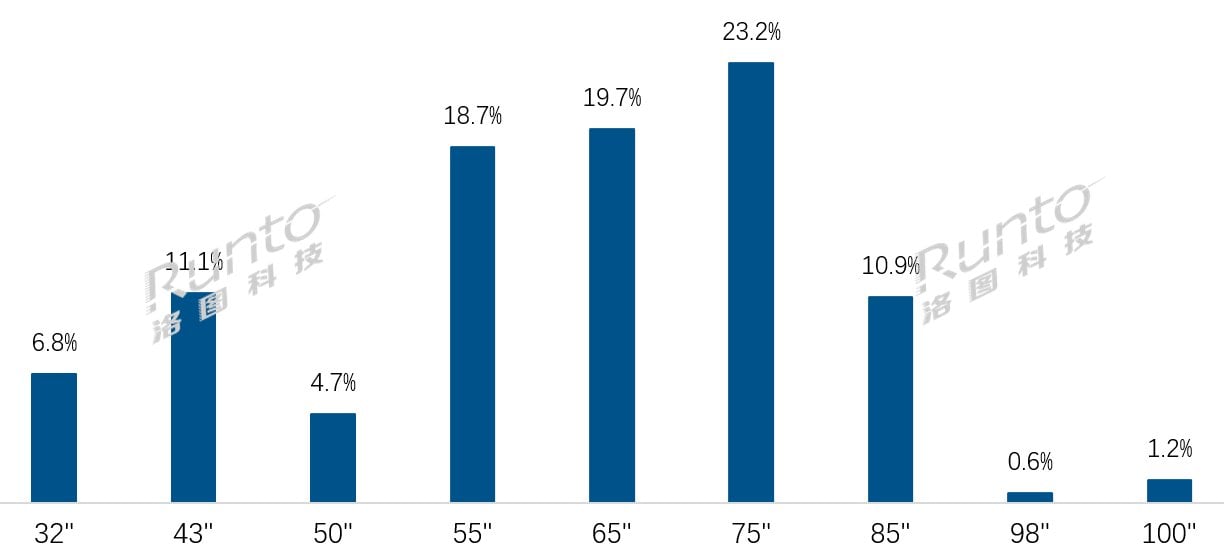 *Data source: RUNTO Retail Monitoring Data, Unit: %*
The average TV size in China reached 63.5 inches in 2024, up 3.3 inches from 2023, marking the second consecutive year of growth exceeding 3 inches.
Feature 3: High-Efficiency Products Boom Due to Subsidy Threshold
The national subsidy program set energy efficiency as the sole threshold for eight major home appliance categories. As a result, products with energy efficiency ratings of Level 2 or higher became highly sought after. From September to December 2024, over 70% of TVs sold were high-efficiency models. Sales and revenue of Level 2 and Level 1 products grew by 232.2% and 184.5%, respectively, compared to the same period in 2023. Level 1 products alone saw sales and revenue increase by about 8x and 4x, respectively.
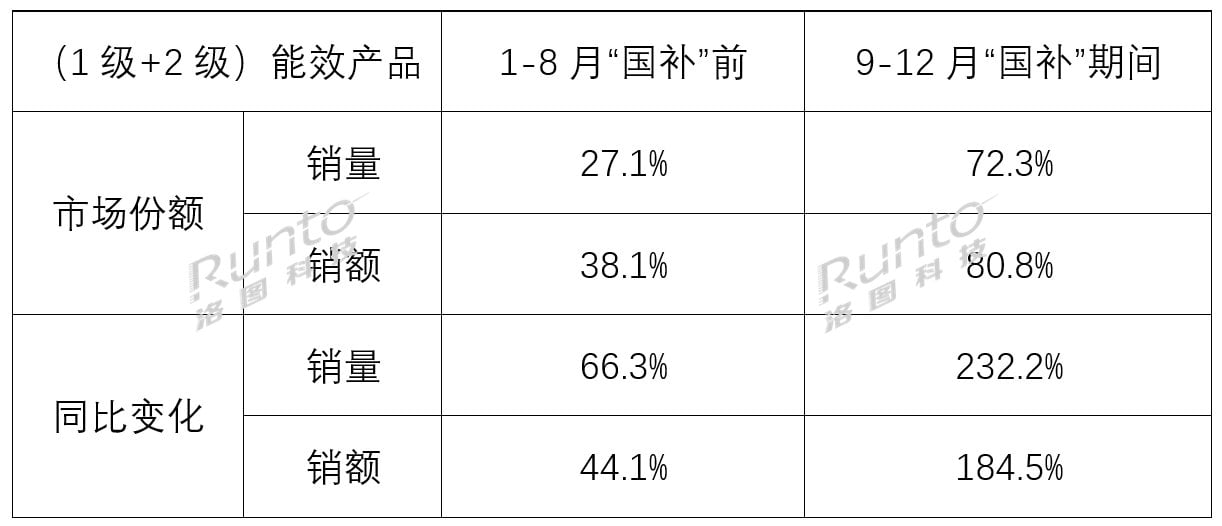 *Data source: RUNTO Retail Data, Unit: %*
---
3. Brand Differentiation and High Concentration in a Shrinking Market
In 2024, the top eight TV brands in China—Hisense, Xiaomi, TCL, Skyworth, Changhong, Konka, Haier, and Huawei—accounted for 94.9% of total shipments, up 0.2 percentage points from 2023.
Top 4 Brands Dominate Market Trends
The annual shipment threshold for the top four brands rose from 5 million to 6 million units. In 2024, these brands collectively shipped 28.18 million units, a 2.5% decline from 2023, but their market share reached 78.4%. Hisense led the market with 8 million units shipped and a 22.5% market share. Xiaomi (including Redmi) shipped 7.1 million units, focusing on large-screen and Mini LED TVs. TCL shipped over 6.8 million units, with its sub-brand Thunderbird contributing 2 million units. Skyworth shipped over 6.1 million units, maintaining steady growth.
Second-Tier Brands Show Improvement
The second-tier brands, including Changhong, Konka, and Haier, shipped a combined 4.95 million units, a 3.2% increase from 2023. Huawei shipped nearly 1 million units, achieving profitability in 2024 by focusing on premium products and leveraging its software and ecosystem strengths.
Foreign Brands Struggle in China
Foreign brands like Sony, Samsung, Sharp, and Philips faced continued pressure, with combined shipments of about 1 million units and a market share below 5%. However, Samsung and Sony showed improvement in Q4, with Samsung focusing on AI, art TVs, and OLED TVs for 2025.
---
4. Outlook for China's TV Market in 2025
Looking ahead, the global and Chinese macroeconomic environment remains challenging. Geopolitical risks and weak economic growth persist. In China, a mild recovery is expected, but the long-term impact of subsidies may reduce consumer urgency to purchase. Additionally, the real estate market, closely tied to home appliance sales, is expected to stabilize in 2025.
Despite declining TV usage rates, the "dual governance" of TVs may bring some users back to large screens. Meanwhile, competition from alternative display devices like projectors will intensify, though falling prices for large LCD panels may offset this trend.
RUNTO predicts that China's TV market will stabilize in 2025, with shipments reaching 36.72 million units, a 2.1% increase. The focus will shift to improving product structure, average prices, total sales, and profitability. Importantly, the integration of AI into TVs will drive the next wave of innovation, transforming picture quality, user interaction, and content generation.
---
Final Note: The rise of AI cannot be ignored. As large models transition from technical foundations to practical applications, AI's integration with TVs will become a key driver of innovation, reshaping the industry in profound ways.
According to the latest data from RUNTO's *China TV Market Brand Sell-in Monthly Tracker*, the total shipment of TV units in China for 2024 reached 35.96 million, marking a 1.6% decline compared to 2023. This figure represents the lowest annual shipment volume since at least 2010. However, on the retail front, the market saw a silver lining. RUNTO's retail data shows that the total retail sales value of TVs in China for 2024 hit $16.8 billion (¥120.2 billion), a 12.3% year-on-year increase, offering some relief to industry players.
The journey to this final result was even more turbulent. In the first quarter, TV shipments dropped by 0.9%, followed by a sharper 7.5% decline in the second quarter, resulting in a cumulative 4.2% drop in the first half of the year. The downward trend continued into the third quarter, with market sentiment hitting rock bottom. However, a significant turning point came on August 24 when China's Ministry of Commerce and three other departments issued a notice to promote home appliance trade-in programs. Despite a lag in the availability of subsidized products, the third quarter saw a 6.6% decline, worse than the first half. By the fourth quarter, the market began to recover, benefiting from the national subsidy program, with a 6.5% growth in shipments.
---
1. National Subsidy Year: TV Shipments Hit a 15-Year Low
In 2023, China's TV market was already in decline, with monthly shipment drops exceeding 10%, and the final month of the year saw a staggering 20% decline. The annual market size fell below 37 million units. Despite 2024 being a major sports year with the European Cup, Copa America, and Olympics, TV shipments dropped further to below 36 million units, marking the lowest level since 2010. From February to September, shipments declined for eight consecutive months.
Looking back, the market size first fell below 50 million units in 2020, the year COVID-19 swept the globe. However, the pandemic is only a surface-level explanation for the market's decline. The deeper reasons lie in the changing role of TVs in Chinese households. With living rooms no longer serving as spaces for display or hosting guests, fragmented user time and the diversification of viewing devices have made TVs less of a necessity.
The biggest positive impact in 2024 came from the combination of the longest-ever "Double 11" shopping festival and the national subsidy program. While the subsidy primarily stimulated "replacement demand" (upgrading existing products), the overall market growth remained limited, with a 6.5% increase in Q4. The real impact was seen in the significant improvement in product structure.
---
2. Three Positive Trends Driven by National Subsidies
Under the national subsidy program, Chinese TV manufacturers successfully upgraded their product structures in 2024, a development welcomed by the industry. In a shrinking market, focusing on premium products became the key to improving profitability.
Feature 1: Mini LED TVs with Large Screens and High Efficiency Surge by 352%
Mini LED TVs, primarily available in 55-inch and larger sizes, combine the advantages of large screens and energy efficiency. In 2023, Mini LED TV sales in China reached 920,000 units, a 140% year-on-year increase. By 2024, sales skyrocketed to 4.16 million units, a 352% increase, with a market penetration rate of 11.6%, up 9.1 percentage points from 2023. RUNTO predicts that Mini LED TV sales will continue to grow rapidly in 2025, nearing 8 million units with a penetration rate exceeding 20%.
Feature 2: China Enters the Era of Large Screens, with 75-Inch TVs Taking the Lead
The TV supply chain has long been pushing for larger screen sizes to absorb panel production capacity and improve product value and profitability. In 2024, 75-inch TVs accounted for 23.2% of sales, surpassing 65-inch TVs (19.7%) to become the top size. Meanwhile, ultra-large sizes like 85-inch and 100-inch TVs saw their market shares rise to 10.9% and 1.2%, respectively, with sales growing by 56.7% and 184.7% year-on-year.
The average TV size in China reached 63.5 inches in 2024, up 3.3 inches from 2023, marking the second consecutive year of growth exceeding 3 inches.
Feature 3: High-Efficiency Products Boom Due to Subsidy Threshold
The national subsidy program set energy efficiency as the sole threshold for eight major home appliance categories. As a result, products with energy efficiency ratings of Level 2 or higher became highly sought after. From September to December 2024, over 70% of TVs sold were high-efficiency models. Sales and revenue of Level 2 and Level 1 products grew by 232.2% and 184.5%, respectively, compared to the same period in 2023. Level 1 products alone saw sales and revenue increase by about 8x and 4x, respectively.
---
3. Brand Differentiation and High Concentration in a Shrinking Market
In 2024, the top eight TV brands in China—Hisense, Xiaomi, TCL, Skyworth, Changhong, Konka, Haier, and Huawei—accounted for 94.9% of total shipments, up 0.2 percentage points from 2023.
Top 4 Brands Dominate Market Trends
The annual shipment threshold for the top four brands rose from 5 million to 6 million units. In 2024, these brands collectively shipped 28.18 million units, a 2.5% decline from 2023, but their market share reached 78.4%. Hisense led the market with 8 million units shipped and a 22.5% market share. Xiaomi (including Redmi) shipped 7.1 million units, focusing on large-screen and Mini LED TVs. TCL shipped over 6.8 million units, with its sub-brand Thunderbird contributing 2 million units. Skyworth shipped over 6.1 million units, maintaining steady growth.
Second-Tier Brands Show Improvement
The second-tier brands, including Changhong, Konka, and Haier, shipped a combined 4.95 million units, a 3.2% increase from 2023. Huawei shipped nearly 1 million units, achieving profitability in 2024 by focusing on premium products and leveraging its software and ecosystem strengths.
Foreign Brands Struggle in China
Foreign brands like Sony, Samsung, Sharp, and Philips faced continued pressure, with combined shipments of about 1 million units and a market share below 5%. However, Samsung and Sony showed improvement in Q4, with Samsung focusing on AI, art TVs, and OLED TVs for 2025.
---
4. Outlook for China's TV Market in 2025
Looking ahead, the global and Chinese macroeconomic environment remains challenging. Geopolitical risks and weak economic growth persist. In China, a mild recovery is expected, but the long-term impact of subsidies may reduce consumer urgency to purchase. Additionally, the real estate market, closely tied to home appliance sales, is expected to stabilize in 2025.
Despite declining TV usage rates, the "dual governance" of TVs may bring some users back to large screens. Meanwhile, competition from alternative display devices like projectors will intensify, though falling prices for large LCD panels may offset this trend.
RUNTO predicts that China's TV market will stabilize in 2025, with shipments reaching 36.72 million units, a 2.1% increase. The focus will shift to improving product structure, average prices, total sales, and profitability. Importantly, the integration of AI into TVs will drive the next wave of innovation, transforming picture quality, user interaction, and content generation.
---
Final Note: The rise of AI cannot be ignored. As large models transition from technical foundations to practical applications, AI's integration with TVs will become a key driver of innovation, reshaping the industry in profound ways.