


Catalogs Hide
The terms "anti-glare" and "anti-reflection" get used interchangeably in outdoor TV marketing, retail listings, and even some manufacturer spec sheets. They're not the same thing. Different optical engineering approaches, different real-world performance, and different price points. Buying the wrong technology for your install creates years of viewing frustration that the right technology would have prevented.
Here's the honest breakdown of what each treatment actually does, the engineering behind each, and which one matters for your specific outdoor TV install.
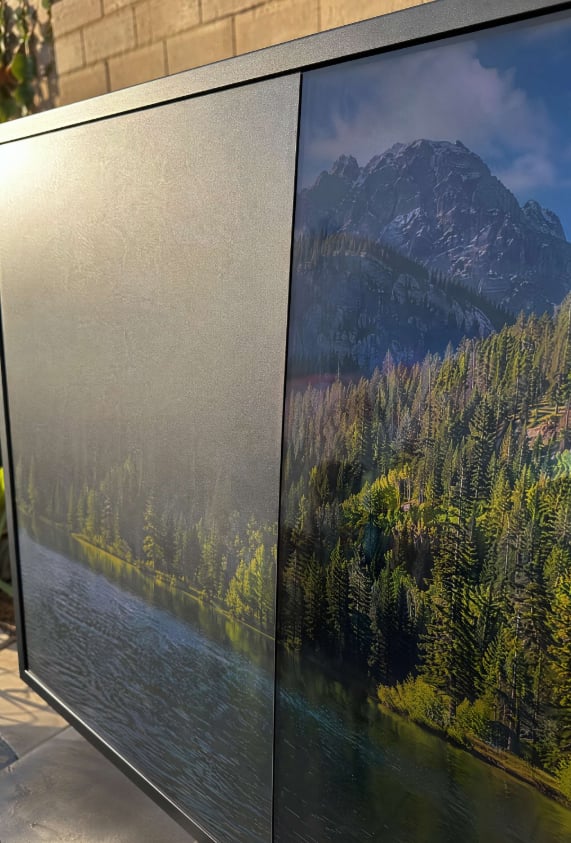
Anti-glare treatment uses a microscopically textured screen surface that diffuses incoming light. Instead of reflecting light back at the viewer as a clean mirror image, the textured surface scatters reflections in multiple directions — reducing the perceived brightness of any single reflection.
The optical mechanism:
Visual identification:
Outdoor TV examples using primarily anti-glare:
This is the standard treatment for most mid-tier outdoor TVs in 2026.
Anti-reflection treatment uses optical coatings or bonded glass layers that absorb specific light wavelengths rather than scattering them. The screen surface itself reflects less light, rather than diffusing the reflections.
The optical mechanism:
Visual identification:
Outdoor TV examples using primarily anti-reflection (often optically bonded):
This is the premium treatment found on flagship outdoor TVs in 2026.
Beyond the marketing terms, real engineering differences affect performance:
Anti-glare: Reduces reflection sharpness but maintains roughly equal total reflected light. The reflections become fuzzy rather than dim.
Anti-reflection: Reduces total reflected light by 70-90%. Reflections become both fuzzy and dim.
In practical terms: a clear afternoon sun reflection that would be intolerable on glossy panels becomes mild blur on anti-glare panels and barely visible faint blur on anti-reflection panels.
Anti-glare: Slight haze or grain pattern visible when viewed at angles. Image clarity from the front is excellent; angled viewing shows mild softening.
Anti-reflection: Color tinting visible at extreme angles (often a slight blue or green cast). Front-on viewing is excellent.
For typical residential outdoor TV viewing where most viewers face the screen directly, both treatments perform similarly. For installations with viewers at extreme angles (large patios, multi-zone seating), differences become more noticeable.
Anti-glare: Slightly raised black levels due to the matte surface diffusing some emitted light. Dark scenes appear less pure black than glossy alternatives.
Anti-reflection: Black levels closer to glossy panels because the surface absorbs rather than diffuses. Dark scenes maintain better contrast.
For evening movie viewing, anti-reflection typically delivers slightly better picture quality. For sports broadcasting where bright fields dominate, the difference is minimal.
Anti-glare: Mature manufacturing process, relatively inexpensive ($50-$150 added cost over glossy panel). Standard at mid-tier outdoor TV prices.
Anti-reflection: Complex multi-layer coating or optical bonding. Significant added cost ($300-$800 typical premium). Found primarily at premium tier prices.
The cost difference reflects real manufacturing complexity, not arbitrary brand markup.
For typical residential outdoor TV use, the practical hierarchy of screen treatment performance:
The performance tier above the brightness number determines outdoor visibility — but the brightness number sets the ceiling. A 1,500-nit anti-glare panel typically outperforms a 1,000-nit anti-reflection panel in real-world conditions.
Most US residential partial-sun installations. Pergolas, covered patios, outdoor kitchens, screened porches with morning or afternoon partial sun. Anti-glare matte panels at 1,500 nits handle these conditions excellently.
Mid-tier budget targets. $1,200-$2,000 outdoor TV budgets are dominated by anti-glare matte technology. The treatment is adequate for the install conditions most residential buyers face.
Sports-primary households. Live sports broadcasts have high average brightness (green fields, bright stadium lighting) where anti-glare's slight black level compromise doesn't matter. Brightness compensation is more important than panel surface technology.
Brand-priority buyers staying mid-tier. Sylvox, ByteFree, SunBrite Veranda, Furrion Aurora Partial-Sun all use anti-glare matte technology — choosing among them is more about brand and other specs than panel treatment.
Premium installations with budget margin. $3,000+ outdoor TV budgets where the best available picture quality matters daily.
Full-sun installations. Open pool decks, fully exposed patios, west-facing afternoon mounts. Anti-reflection's 70-90% reflection reduction matters dramatically more in these conditions than partial-sun installs.
Movie-centric households. If your primary outdoor entertainment is movies (rather than sports or casual streaming), anti-reflection's better black levels and more dramatic contrast deliver meaningful picture quality improvements.
Premium architectural integration. Where the outdoor TV is a centerpiece of luxury outdoor living investment, the visible treatment difference of anti-reflection matches the architectural quality.
Audiophile/videophile users. Buyers who can perceive and care about the picture quality differences between treatments. For most casual users, the differences aren't worth the price premium.
Several persistent myths around screen treatments:
Not at the price points most buyers shop. A $1,500 anti-glare 1,500-nit panel typically outperforms a $1,500 anti-reflection 800-nit panel for typical residential outdoor TV use. The brightness compensation matters more at the mid-tier than the surface treatment difference.
It dramatically reduces reflections but doesn't eliminate them. Strong direct sun at the wrong angle still produces visible reflection on optically bonded panels — just much less than on glossy or anti-glare-only alternatives.
Anti-glare slightly raises black levels and adds subtle haze. For sports, news, casual streaming, and most outdoor TV use cases, this is invisible. For movie-primary outdoor use in dark conditions, the difference is more noticeable but still typically acceptable.
Aftermarket anti-glare films exist ($30-$80) but reduce brightness by 15-25%. Adding film to a 1,500-nit TV creates a 1,200-nit anti-glare TV — still good. Adding film to a 700-nit TV creates a 525-nit unwatchable TV. The film helps bright TVs, hurts dim ones.
Smartphone displays use anti-reflection treatments tuned for indoor lighting and close viewing distances. The same treatment scaled to TV size with outdoor brightness requirements is dramatically more expensive than the smartphone equivalent — which is why anti-reflection is found primarily at premium TV price tiers.
Spec sheet language can be unreliable. Verify treatment quality:
Reliable indicators of quality anti-glare:
Reliable indicators of anti-reflection:
Vague indicators (often unreliable):
Quality outdoor TV manufacturers publish reflection percentages. Anti-glare matte typically reports 25-35% reflection. Anti-reflection coatings typically report under 10% reflection. If the spec sheet doesn't include this measurement, the treatment quality is likely on the lower end of its category.
Some outdoor TVs claim both anti-glare and anti-reflection. This is sometimes legitimate (matte coating combined with anti-reflection treatment) and sometimes marketing language. Verify with reflection percentage specs rather than treatment names.
No. Anti-glare uses textured surface treatment to scatter reflections, making them fuzzy. Anti-reflection uses optical coatings to absorb reflections, making them dim. Anti-reflection delivers better reflection performance (70-90% reduction vs anti-glare's lighter reduction) but at significantly higher manufacturing cost ($300-$800 typical premium). Both technologies are legitimate; they serve different price points and use cases.
For typical residential partial-sun installations, anti-glare matte technology paired with 1,500+ nits brightness delivers excellent real-world performance at mid-tier prices. For premium installations with full-sun exposure or movie-centric viewing, anti-reflection treatments justify the premium. Most US buyers don't need anti-reflection; some do.
Slightly. Anti-glare matte panels have slightly raised black levels and subtle haze compared to glossy panels. For sports and casual streaming, the difference is invisible. For movie viewing in dark conditions, the difference is more noticeable but still typically acceptable. For most outdoor TV use cases, the daytime visibility benefit dramatically exceeds the minor black level compromise.
Anti-glare film ($30-$80) can be applied aftermarket but reduces brightness by 15-25%. This works for bright TVs (1,500+ nits where some brightness loss is acceptable) but hurts dim TVs (under 1,000 nits). Anti-reflection treatments cannot be effectively added aftermarket — they require precision optical engineering at manufacturing time.
Anti-reflection treatments typically appear at $2,500+ price tiers. Sylvox Cinema ($2,999) and SunBrite Cinema ($3,000+) are the entry-tier products with quality anti-reflection. Below this price tier, products marketed with anti-reflection often have lower-quality coatings or hybrid treatments rather than true optically bonded anti-reflection.
Anti-glare and anti-reflection screen treatments are different optical technologies serving different use cases. The terminology confusion in marketing creates buying decisions that don't match install requirements.
Anti-glare matte (mid-tier) fits when:
Anti-reflection (premium tier) fits when:
For warm-climate partial-sun residential installations — the most common US outdoor TV use case — the ByteFree BF-55ODTV at $1,499 delivers quality anti-glare matte treatment combined with 1,500 nits brightness. The combination handles real-world outdoor visibility without requiring premium-tier anti-reflection investment that most installs don't actually need.
For full-sun premium installations where anti-reflection's reflection performance matters daily, step up to Sylvox Cinema ($2,999), SunBrite Cinema ($3,000+), or Samsung The Terrace LST7D ($3,497+).
Don't pay anti-reflection premium for installs where anti-glare matte delivers identical real-world performance. Don't accept anti-glare matte for full-sun installs where reflection performance matters daily.
Related reading:
Here's the honest breakdown of what each treatment actually does, the engineering behind each, and which one matters for your specific outdoor TV install.
What Anti-Glare Actually Means
Anti-glare treatment uses a microscopically textured screen surface that diffuses incoming light. Instead of reflecting light back at the viewer as a clean mirror image, the textured surface scatters reflections in multiple directions — reducing the perceived brightness of any single reflection.
The optical mechanism:
- Microscopic surface texturing (often achieved through chemical etching or matte coating application)
- Light hits the surface and scatters at multiple angles
- Reflections are dimmed but not eliminated
- The image source (TV pixels) remains fully visible through the textured layer
Visual identification:
- Looks slightly hazy or "matte" when off
- May show subtle grain pattern in extreme close-up
- Has more diffuse reflection patterns than glossy panels
Outdoor TV examples using primarily anti-glare:
- ByteFree BF-55ODTV ($1,499)
- Sylvox DeckPro 2.0+ ($1,599)
- SunBrite Veranda 3 ($1,699)
- Furrion Aurora Partial-Sun ($1,199)
This is the standard treatment for most mid-tier outdoor TVs in 2026.
What Anti-Reflection Actually Means
Anti-reflection treatment uses optical coatings or bonded glass layers that absorb specific light wavelengths rather than scattering them. The screen surface itself reflects less light, rather than diffusing the reflections.
The optical mechanism:
- Multi-layer coating applied to the panel surface
- Each coating layer is precisely tuned to a specific wavelength
- Incoming light is partially absorbed at each layer
- Total reflected light reduced to under 5% of incident light (compared to 30-40% on standard glossy panels)
Visual identification:
- Looks more like glass than matte when off
- Some color tinting visible at extreme angles (typical of multi-layer coatings)
- Reflections are dramatically dimmer rather than scattered
Outdoor TV examples using primarily anti-reflection (often optically bonded):
- Samsung The Terrace LST7D ($3,497+)
- SunBrite Cinema ($2,999)
- Furrion Aurora Full-Sun ($5,999+)
- Sylvox Cinema ($2,999)
This is the premium treatment found on flagship outdoor TVs in 2026.
The Engineering Differences That Matter
Beyond the marketing terms, real engineering differences affect performance:
Reflection Reduction Performance
Anti-glare: Reduces reflection sharpness but maintains roughly equal total reflected light. The reflections become fuzzy rather than dim.
Anti-reflection: Reduces total reflected light by 70-90%. Reflections become both fuzzy and dim.
In practical terms: a clear afternoon sun reflection that would be intolerable on glossy panels becomes mild blur on anti-glare panels and barely visible faint blur on anti-reflection panels.
Image Clarity When Off-Axis
Anti-glare: Slight haze or grain pattern visible when viewed at angles. Image clarity from the front is excellent; angled viewing shows mild softening.
Anti-reflection: Color tinting visible at extreme angles (often a slight blue or green cast). Front-on viewing is excellent.
For typical residential outdoor TV viewing where most viewers face the screen directly, both treatments perform similarly. For installations with viewers at extreme angles (large patios, multi-zone seating), differences become more noticeable.
Black Level Performance
Anti-glare: Slightly raised black levels due to the matte surface diffusing some emitted light. Dark scenes appear less pure black than glossy alternatives.
Anti-reflection: Black levels closer to glossy panels because the surface absorbs rather than diffuses. Dark scenes maintain better contrast.
For evening movie viewing, anti-reflection typically delivers slightly better picture quality. For sports broadcasting where bright fields dominate, the difference is minimal.
Cost and Manufacturing
Anti-glare: Mature manufacturing process, relatively inexpensive ($50-$150 added cost over glossy panel). Standard at mid-tier outdoor TV prices.
Anti-reflection: Complex multi-layer coating or optical bonding. Significant added cost ($300-$800 typical premium). Found primarily at premium tier prices.
The cost difference reflects real manufacturing complexity, not arbitrary brand markup.
Real-World Performance Comparison
For typical residential outdoor TV use, the practical hierarchy of screen treatment performance:
| Performance Tier | Treatment | Typical Brightness Pairing | Real-World Outdoor Use |
|---|---|---|---|
| Best | Anti-reflection (optically bonded) | 2,000-2,500 nits | Premium full-sun installations |
| Excellent | Anti-glare matte (quality) | 1,500 nits | Partial-sun residential (most common) |
| Good | Anti-glare matte (basic) | 1,000 nits | Light partial-sun, covered patios |
| Adequate | Anti-glare matte (basic) | 700-1,000 nits | Fully shaded installations |
| Inadequate | None (glossy panel) | Any brightness | Indoor use only |
The performance tier above the brightness number determines outdoor visibility — but the brightness number sets the ceiling. A 1,500-nit anti-glare panel typically outperforms a 1,000-nit anti-reflection panel in real-world conditions.
When Each Treatment Fits Your Install
Use Anti-Glare When
Most US residential partial-sun installations. Pergolas, covered patios, outdoor kitchens, screened porches with morning or afternoon partial sun. Anti-glare matte panels at 1,500 nits handle these conditions excellently.
Mid-tier budget targets. $1,200-$2,000 outdoor TV budgets are dominated by anti-glare matte technology. The treatment is adequate for the install conditions most residential buyers face.
Sports-primary households. Live sports broadcasts have high average brightness (green fields, bright stadium lighting) where anti-glare's slight black level compromise doesn't matter. Brightness compensation is more important than panel surface technology.
Brand-priority buyers staying mid-tier. Sylvox, ByteFree, SunBrite Veranda, Furrion Aurora Partial-Sun all use anti-glare matte technology — choosing among them is more about brand and other specs than panel treatment.
Use Anti-Reflection When
Premium installations with budget margin. $3,000+ outdoor TV budgets where the best available picture quality matters daily.
Full-sun installations. Open pool decks, fully exposed patios, west-facing afternoon mounts. Anti-reflection's 70-90% reflection reduction matters dramatically more in these conditions than partial-sun installs.
Movie-centric households. If your primary outdoor entertainment is movies (rather than sports or casual streaming), anti-reflection's better black levels and more dramatic contrast deliver meaningful picture quality improvements.
Premium architectural integration. Where the outdoor TV is a centerpiece of luxury outdoor living investment, the visible treatment difference of anti-reflection matches the architectural quality.
Audiophile/videophile users. Buyers who can perceive and care about the picture quality differences between treatments. For most casual users, the differences aren't worth the price premium.
Common Misconceptions
Several persistent myths around screen treatments:
"Anti-Reflection Is Always Better Than Anti-Glare"
Not at the price points most buyers shop. A $1,500 anti-glare 1,500-nit panel typically outperforms a $1,500 anti-reflection 800-nit panel for typical residential outdoor TV use. The brightness compensation matters more at the mid-tier than the surface treatment difference.
"Optically Bonded Glass Eliminates All Reflections"
It dramatically reduces reflections but doesn't eliminate them. Strong direct sun at the wrong angle still produces visible reflection on optically bonded panels — just much less than on glossy or anti-glare-only alternatives.
"Anti-Glare Makes Picture Quality Worse"
Anti-glare slightly raises black levels and adds subtle haze. For sports, news, casual streaming, and most outdoor TV use cases, this is invisible. For movie-primary outdoor use in dark conditions, the difference is more noticeable but still typically acceptable.
"I Can Add Anti-Glare Film to Any TV"
Aftermarket anti-glare films exist ($30-$80) but reduce brightness by 15-25%. Adding film to a 1,500-nit TV creates a 1,200-nit anti-glare TV — still good. Adding film to a 700-nit TV creates a 525-nit unwatchable TV. The film helps bright TVs, hurts dim ones.
"Smartphones Have the Best Anti-Reflection"
Smartphone displays use anti-reflection treatments tuned for indoor lighting and close viewing distances. The same treatment scaled to TV size with outdoor brightness requirements is dramatically more expensive than the smartphone equivalent — which is why anti-reflection is found primarily at premium TV price tiers.
How to Verify Screen Treatment Before Buying
Spec sheet language can be unreliable. Verify treatment quality:
Look for Specific Technical Terms
Reliable indicators of quality anti-glare:
- "Matte anti-glare coating"
- "Anti-glare matte panel"
- "Quality anti-glare with under 30% reflection"
Reliable indicators of anti-reflection:
- "Optically bonded anti-reflection glass"
- "Multi-layer anti-reflection coating"
- "Less than 5% reflection rating"
Vague indicators (often unreliable):
- "Glare-resistant" (could mean either treatment or neither)
- "Outdoor-optimized panel" (no specific treatment claim)
- "Reduced glare" (qualitative without measurement)
Check Reflection Specs in Spec Sheet
Quality outdoor TV manufacturers publish reflection percentages. Anti-glare matte typically reports 25-35% reflection. Anti-reflection coatings typically report under 10% reflection. If the spec sheet doesn't include this measurement, the treatment quality is likely on the lower end of its category.
Watch for "Hybrid" Claims
Some outdoor TVs claim both anti-glare and anti-reflection. This is sometimes legitimate (matte coating combined with anti-reflection treatment) and sometimes marketing language. Verify with reflection percentage specs rather than treatment names.
Frequently Asked Questions
Are anti-glare and anti-reflection the same thing?
No. Anti-glare uses textured surface treatment to scatter reflections, making them fuzzy. Anti-reflection uses optical coatings to absorb reflections, making them dim. Anti-reflection delivers better reflection performance (70-90% reduction vs anti-glare's lighter reduction) but at significantly higher manufacturing cost ($300-$800 typical premium). Both technologies are legitimate; they serve different price points and use cases.
Which is better for outdoor TVs, anti-glare or anti-reflection?
For typical residential partial-sun installations, anti-glare matte technology paired with 1,500+ nits brightness delivers excellent real-world performance at mid-tier prices. For premium installations with full-sun exposure or movie-centric viewing, anti-reflection treatments justify the premium. Most US buyers don't need anti-reflection; some do.
Does anti-glare hurt picture quality?
Slightly. Anti-glare matte panels have slightly raised black levels and subtle haze compared to glossy panels. For sports and casual streaming, the difference is invisible. For movie viewing in dark conditions, the difference is more noticeable but still typically acceptable. For most outdoor TV use cases, the daytime visibility benefit dramatically exceeds the minor black level compromise.
Can I add anti-glare or anti-reflection to my TV?
Anti-glare film ($30-$80) can be applied aftermarket but reduces brightness by 15-25%. This works for bright TVs (1,500+ nits where some brightness loss is acceptable) but hurts dim TVs (under 1,000 nits). Anti-reflection treatments cannot be effectively added aftermarket — they require precision optical engineering at manufacturing time.
What's the cheapest outdoor TV with anti-reflection?
Anti-reflection treatments typically appear at $2,500+ price tiers. Sylvox Cinema ($2,999) and SunBrite Cinema ($3,000+) are the entry-tier products with quality anti-reflection. Below this price tier, products marketed with anti-reflection often have lower-quality coatings or hybrid treatments rather than true optically bonded anti-reflection.
Summary
Anti-glare and anti-reflection screen treatments are different optical technologies serving different use cases. The terminology confusion in marketing creates buying decisions that don't match install requirements.
Anti-glare matte (mid-tier) fits when:
- Partial-sun residential installations
- $1,200-$2,000 budget targets
- Sports and casual streaming primary use
- Most US outdoor TV installations
Anti-reflection (premium tier) fits when:
- Full-sun installations or premium architectural integration
- $3,000+ outdoor TV budgets
- Movie-centric households
- Audiophile/videophile picture quality priority
For warm-climate partial-sun residential installations — the most common US outdoor TV use case — the ByteFree BF-55ODTV at $1,499 delivers quality anti-glare matte treatment combined with 1,500 nits brightness. The combination handles real-world outdoor visibility without requiring premium-tier anti-reflection investment that most installs don't actually need.
For full-sun premium installations where anti-reflection's reflection performance matters daily, step up to Sylvox Cinema ($2,999), SunBrite Cinema ($3,000+), or Samsung The Terrace LST7D ($3,497+).
Don't pay anti-reflection premium for installs where anti-glare matte delivers identical real-world performance. Don't accept anti-glare matte for full-sun installs where reflection performance matters daily.
Related reading: