


Catalogs Hide
- 1 Quick Verdict
- 2 Spec-by-Spec Comparison
- 3 Where ByteFree Wins
- 4 Where SunBrite Wins
- 5 Real-World Scenarios
- 6 The Honest Trade-Off Matrix
-
7
Frequently Asked Questions
- 7.1 Q: Is ByteFree better than SunBrite Veranda 3?
- 7.2 Q: What's the main difference between ByteFree and SunBrite Veranda 3?
- 7.3 Q: Does ByteFree have a good warranty compared to SunBrite?
- 7.4 Q: Which is better for a Florida patio, ByteFree or SunBrite?
- 7.5 Q: Should I pay $200 more for SunBrite over ByteFree?
- 8 Verdict
SunBrite is the default recommendation when anyone asks about outdoor TVs in an AV installer forum. Twelve years in the market, deep dealer network, the brand most custom integrators reach for. ByteFree is a newer entrant making waves with aggressive spec-per-dollar positioning.
At the $1,500-$1,700 price point, they're the two TVs most directly competing for the same buyer. Here's the honest comparison — where SunBrite wins, where ByteFree wins, and who should actually buy which.
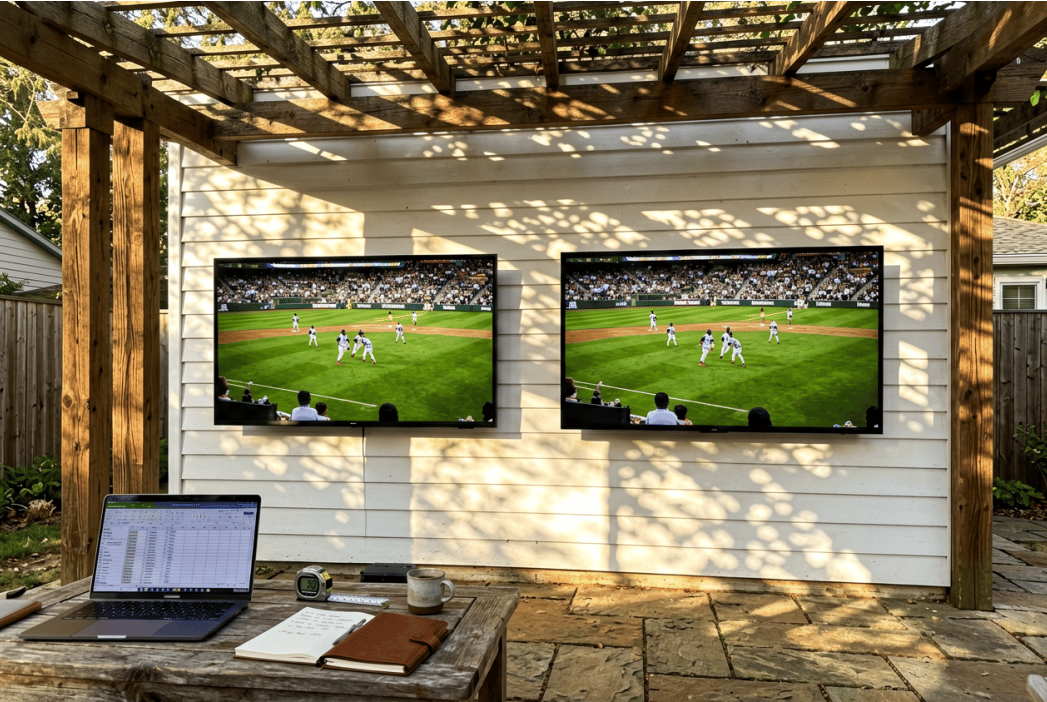
For partial-sun installs where picture quality matters more than brand pedigree, the ByteFree BF-55ODTV at $1,499 delivers better specs at $200 less. Specifically: 50% more brightness (1,500 nits vs 1,000 nits) at a lower price, with equivalent Dolby Vision support.
For buyers who prioritize established brand track record, professional installer network support, or Samsung-style ecosystem integration, SunBrite Veranda 3 at $1,699 remains a legitimate pick despite the spec gap. You're paying for brand reliability rather than peak specs.
This is not a "SunBrite is overpriced" matchup. It's a "both are real products serving slightly different buyer priorities" matchup.
Three differences matter at the buying decision: brightness, smart platform, and cold-weather rating. Everything else is effectively tied.
This is the headline difference. A 50% brightness gap isn't a spec-sheet rounding error — it's the difference between "clearly visible at 2 PM" and "noticeably washed out at 2 PM" on the same partial-sun patio.
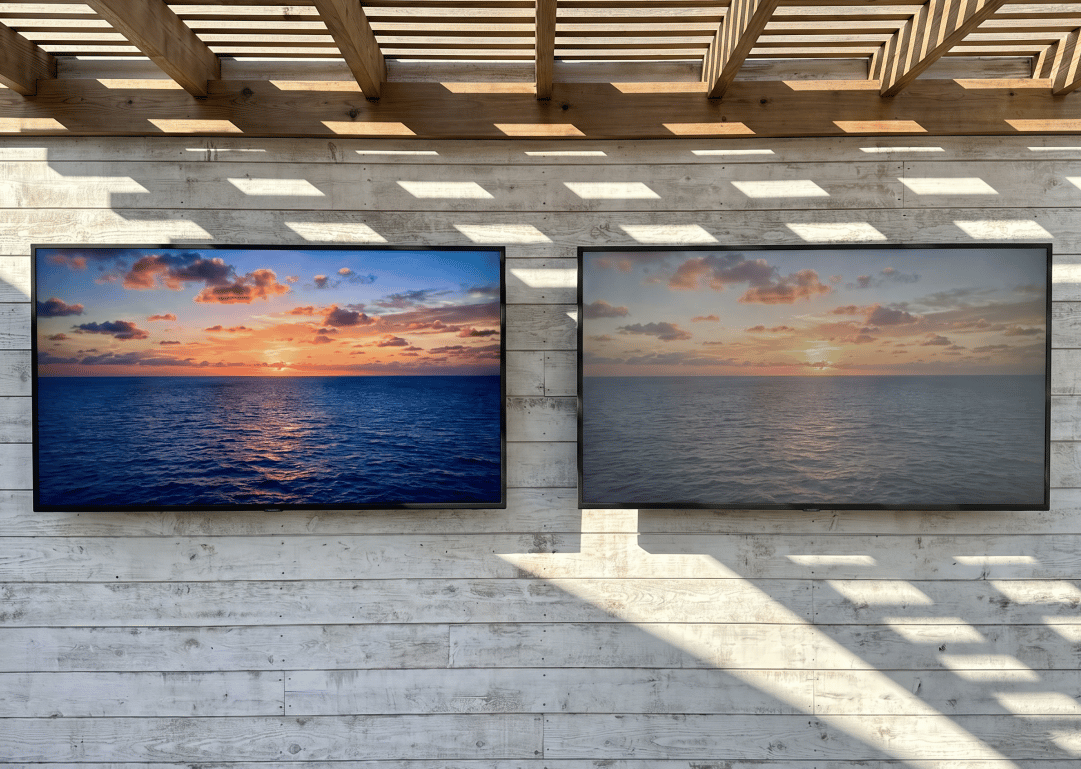
Real-world impact:
For US buyers in the southern and southwestern markets (Florida, Texas, Arizona, California) where partial-sun installs often include significant afternoon exposure, this 500-nit gap matters daily.
Both are Google-family platforms, but they're not identical. Google TV is the current generation with a refreshed UI, better content discovery, and more active Google investment. Android TV is the previous generation, still functional but on a slower update cadence.
Practical implications:
For streaming-heavy households, Google TV delivers a noticeably more polished experience. For casual viewers who mostly stick to 2-3 main apps, the gap is minor.
At $1,499 vs $1,699, the ByteFree is ~12% cheaper. That $200 can fund a protective cover ($50), a wall mount ($100), and outdoor-rated HDMI cable ($50) — essentially the rest of the install budget. For buyers comparing total setup cost, not just TV price, this gap compounds.
SunBrite has been in the outdoor TV market since 2013 — 12 years of dealer network development, customer service history, and documented product longevity in field installations. When an AV installer recommends a brand to a custom integration client, SunBrite is usually the safest reputational pick.
ByteFree is newer (entering the US market in 2024-2025). The spec-per-dollar advantage is real, but the long-term service history isn't yet established. For buyers who strongly weight "proven over years" vs "best spec right now," SunBrite earns the premium.
Honest note: Both companies warranty their products for 2 years standard. SunBrite has a longer documented track record of honoring warranties smoothly — ByteFree's process works but has less public customer history.
The ByteFree BF-55ODTV is designed for warm-climate markets and does not operate below freezing. SunBrite Veranda 3 is rated to -22°F, meaning year-round use in northern US climates (Minnesota, Wisconsin, Maine, upstate New York) and Canada.
Who this affects:
For the ~30% of US buyers in cold-climate regions, SunBrite's operating range is a legitimate reason to pay the $200 premium.
SunBrite has direct partnerships with CEDIA-certified custom integrators nationwide. If you're having a professional AV firm design and install your outdoor entertainment system, they'll likely quote SunBrite by default. The brand's professional support infrastructure is genuinely more mature than any competitor except possibly Samsung.
ByteFree is currently selling primarily direct-to-consumer and through online retailers, not through the professional AV dealer network. For DIY installation or smaller-integrator scenarios, this is irrelevant. For whole-home automation projects where SunBrite has existing relationships, that ecosystem matters.
For buyers who want to tell guests "it's a SunBrite" — in the same way someone might specify "it's a Sonos" or "it's a Samsung" — the brand recognition has value independent of specs. ByteFree doesn't yet have that social currency.
This sounds shallow but is real. A SunBrite visible to houseguests carries implicit quality signaling in a way a lesser-known brand doesn't yet. Whether that's worth $200 depends entirely on the buyer.
Homeowner with a cedar pergola patio, moderate afternoon sun exposure, streaming-heavy household, wants best picture quality at a reasonable price.
→ ByteFree BF-55ODTV. 1,500 nits handles Tampa's aggressive afternoon light in a way 1,000 nits cannot. Google TV platform serves the streaming workflow. $200 savings go toward a soundbar or extended warranty. Cold-weather rating is irrelevant for Tampa.
Lake home with a covered deck, year-round use including winter outdoor fires, prefers established brands, doesn't watch much streaming content.
→ SunBrite Veranda 3. The -22°F operating rating is mandatory for Minnesota year-round use. The brightness gap barely matters on a covered deck. SunBrite's brand track record aligns with the buyer's preference.
AV firm designing a full outdoor entertainment system for a $2M property, tied into whole-home automation, professional installation.
→ SunBrite Veranda 3. The integrator's dealer relationship, professional support ecosystem, and project-level warranty infrastructure matter more than the spec advantage. The $200 price premium is absorbed into the broader project budget.
Homeowner with a pool cabana, wants Dolby Vision for streaming, values price-per-spec, doesn't care about brand reputation.
→ ByteFree BF-55ODTV. Best brightness at the best price. Dolby Vision equal to SunBrite. Cabana environment is covered, so cold-weather rating is irrelevant.
Neither TV is wrong. They're answering slightly different buyer questions.
For partial-sun installs in warm-climate markets where picture quality per dollar matters most, yes — ByteFree delivers 50% more brightness (1,500 vs 1,000 nits) at a lower price ($1,499 vs $1,699), with equivalent Dolby Vision support. For cold-climate installs, buyers prioritizing brand track record, or custom integration projects through professional AV dealers, SunBrite remains the safer choice despite the spec gap.
The two decisive differences are brightness (1,500 nits on ByteFree vs 1,000 nits on SunBrite) and cold-weather rating (ByteFree operates at 32°F minimum, SunBrite operates at -22°F minimum). Both TVs have identical IP55 rating, Dolby Vision support, 60Hz refresh, VESA 600×400 mounting, and 2-year warranty.
Both brands offer 2-year standard warranties. SunBrite has a longer public track record of warranty service, which matters for some buyers. ByteFree's warranty process works but has less publicly documented history due to the brand being newer to the market.
For a typical Florida patio — partial-sun pergola, covered deck, or pool cabana — the ByteFree BF-55ODTV is the stronger pick. The 1,500-nit brightness handles Florida's aggressive afternoon light better than SunBrite's 1,000 nits, and SunBrite's cold-weather operating rating is irrelevant in Florida's climate. Both TVs have the IP55 weatherproofing and all-metal enclosure needed for Florida humidity.
Only if you value one of SunBrite's specific advantages: cold-weather operation, established brand track record, or professional installer ecosystem. For picture quality, spec-per-dollar, or warm-climate use, ByteFree delivers more TV for less money. The $200 premium on SunBrite isn't overpriced — it reflects real brand infrastructure — but it's only worth paying if those specific infrastructure benefits matter to your install.
ByteFree vs SunBrite Veranda 3 is the most relevant outdoor TV matchup at the $1,500-$1,700 price tier in 2026. Both deliver the spec essentials (4K, IP55, all-metal, Dolby Vision, 60Hz, Google-family smart platform). The differences concentrate in three places: brightness, cold-weather operation, and brand infrastructure.
For most US partial-sun installs in warm-climate markets — Florida, Texas, Arizona, California, Gulf Coast, the Carolinas — the ByteFree BF-55ODTV at $1,499 is the stronger spec-per-dollar pick. The 50% brightness advantage visibly matters in real use. The $200 savings is real budget for the rest of the install.
For cold-climate installs or buyers with specific brand/infrastructure preferences — Minnesota, Canada, CEDIA-certified integrator projects — SunBrite Veranda 3 at $1,699 justifies its premium through capabilities the ByteFree doesn't deliver.
Both TVs are legitimate products. Pick based on which set of priorities matches your actual situation.
Related reading:
At the $1,500-$1,700 price point, they're the two TVs most directly competing for the same buyer. Here's the honest comparison — where SunBrite wins, where ByteFree wins, and who should actually buy which.
Quick Verdict
For partial-sun installs where picture quality matters more than brand pedigree, the ByteFree BF-55ODTV at $1,499 delivers better specs at $200 less. Specifically: 50% more brightness (1,500 nits vs 1,000 nits) at a lower price, with equivalent Dolby Vision support.
For buyers who prioritize established brand track record, professional installer network support, or Samsung-style ecosystem integration, SunBrite Veranda 3 at $1,699 remains a legitimate pick despite the spec gap. You're paying for brand reliability rather than peak specs.
This is not a "SunBrite is overpriced" matchup. It's a "both are real products serving slightly different buyer priorities" matchup.
Spec-by-Spec Comparison
| Spec | ByteFree BF-55ODTV | SunBrite Veranda 3 |
|---|---|---|
| Price | $1,499–$1,599 | $1,699 |
| Brightness (peak) | 1,500 nits | 1,000 nits |
| Resolution | 4K UHD (3840×2160) | 4K UHD (3840×2160) |
| HDR Formats | HDR10 + Dolby Vision | HDR10 + Dolby Vision |
| Dolby Atmos | Yes (15W × 2, 30W total) | Yes (15W × 2, 30W total) |
| Refresh Rate | 60 Hz | 60 Hz |
| Smart Platform | Google TV | Android TV |
| IP Rating | IP55 | IP55 |
| Operating Temp | 32°F to 122°F | -22°F to 122°F |
| Enclosure | All-metal (aluminum) | All-metal (aluminum) |
| VESA | 600×400 mm | 600×400 mm |
| HDMI Ports | 3 (1 × eARC 2.1) | 3 (1 × eARC) |
| Panel Lifetime | 50,000 hours | 50,000 hours |
| Warranty | 2 years standard | 2 years standard |
Three differences matter at the buying decision: brightness, smart platform, and cold-weather rating. Everything else is effectively tied.
Where ByteFree Wins
Brightness: 1,500 vs 1,000 Nits
This is the headline difference. A 50% brightness gap isn't a spec-sheet rounding error — it's the difference between "clearly visible at 2 PM" and "noticeably washed out at 2 PM" on the same partial-sun patio.
Real-world impact:
- Morning and evening viewing (~3,000-4,000 lux ambient): both TVs look great
- Peak afternoon partial sun (~8,000 lux): ByteFree remains crisp, Veranda 3 shows visible washout on brighter scenes
- Direct afternoon glare (~15,000+ lux): Neither TV is rated for this — both struggle, ByteFree less so
For US buyers in the southern and southwestern markets (Florida, Texas, Arizona, California) where partial-sun installs often include significant afternoon exposure, this 500-nit gap matters daily.
Smart Platform: Google TV vs Android TV
Both are Google-family platforms, but they're not identical. Google TV is the current generation with a refreshed UI, better content discovery, and more active Google investment. Android TV is the previous generation, still functional but on a slower update cadence.
Practical implications:
- App ecosystem: nearly identical (both support Netflix, Disney+, Prime Video, Hulu, Max, Apple TV+, YouTube)
- Chromecast: built-in on both
- Google Assistant: better integrated in Google TV
- Software updates: Google TV gets security/feature updates faster
For streaming-heavy households, Google TV delivers a noticeably more polished experience. For casual viewers who mostly stick to 2-3 main apps, the gap is minor.
Price: $200 Less
At $1,499 vs $1,699, the ByteFree is ~12% cheaper. That $200 can fund a protective cover ($50), a wall mount ($100), and outdoor-rated HDMI cable ($50) — essentially the rest of the install budget. For buyers comparing total setup cost, not just TV price, this gap compounds.
Where SunBrite Wins
Brand Track Record
SunBrite has been in the outdoor TV market since 2013 — 12 years of dealer network development, customer service history, and documented product longevity in field installations. When an AV installer recommends a brand to a custom integration client, SunBrite is usually the safest reputational pick.
ByteFree is newer (entering the US market in 2024-2025). The spec-per-dollar advantage is real, but the long-term service history isn't yet established. For buyers who strongly weight "proven over years" vs "best spec right now," SunBrite earns the premium.
Honest note: Both companies warranty their products for 2 years standard. SunBrite has a longer documented track record of honoring warranties smoothly — ByteFree's process works but has less public customer history.
Cold-Weather Rating: -22°F vs 32°F
The ByteFree BF-55ODTV is designed for warm-climate markets and does not operate below freezing. SunBrite Veranda 3 is rated to -22°F, meaning year-round use in northern US climates (Minnesota, Wisconsin, Maine, upstate New York) and Canada.
Who this affects:
- Not you if: You're in Florida, Texas, Arizona, California, Gulf Coast, or any year-round-warm market
- You if: You're in any climate where outdoor temperatures regularly drop below freezing
For the ~30% of US buyers in cold-climate regions, SunBrite's operating range is a legitimate reason to pay the $200 premium.
Dealer Network and Professional Installation
SunBrite has direct partnerships with CEDIA-certified custom integrators nationwide. If you're having a professional AV firm design and install your outdoor entertainment system, they'll likely quote SunBrite by default. The brand's professional support infrastructure is genuinely more mature than any competitor except possibly Samsung.
ByteFree is currently selling primarily direct-to-consumer and through online retailers, not through the professional AV dealer network. For DIY installation or smaller-integrator scenarios, this is irrelevant. For whole-home automation projects where SunBrite has existing relationships, that ecosystem matters.
Brand Recognition Premium
For buyers who want to tell guests "it's a SunBrite" — in the same way someone might specify "it's a Sonos" or "it's a Samsung" — the brand recognition has value independent of specs. ByteFree doesn't yet have that social currency.
This sounds shallow but is real. A SunBrite visible to houseguests carries implicit quality signaling in a way a lesser-known brand doesn't yet. Whether that's worth $200 depends entirely on the buyer.
Real-World Scenarios
Scenario 1: Partial-Sun Pergola in Tampa, FL
Homeowner with a cedar pergola patio, moderate afternoon sun exposure, streaming-heavy household, wants best picture quality at a reasonable price.
→ ByteFree BF-55ODTV. 1,500 nits handles Tampa's aggressive afternoon light in a way 1,000 nits cannot. Google TV platform serves the streaming workflow. $200 savings go toward a soundbar or extended warranty. Cold-weather rating is irrelevant for Tampa.
Scenario 2: Minnesota Covered Patio
Lake home with a covered deck, year-round use including winter outdoor fires, prefers established brands, doesn't watch much streaming content.
→ SunBrite Veranda 3. The -22°F operating rating is mandatory for Minnesota year-round use. The brightness gap barely matters on a covered deck. SunBrite's brand track record aligns with the buyer's preference.
Scenario 3: Custom Integrator Project in Atlanta
AV firm designing a full outdoor entertainment system for a $2M property, tied into whole-home automation, professional installation.
→ SunBrite Veranda 3. The integrator's dealer relationship, professional support ecosystem, and project-level warranty infrastructure matter more than the spec advantage. The $200 price premium is absorbed into the broader project budget.
Scenario 4: Budget-Conscious Pool Cabana Install
Homeowner with a pool cabana, wants Dolby Vision for streaming, values price-per-spec, doesn't care about brand reputation.
→ ByteFree BF-55ODTV. Best brightness at the best price. Dolby Vision equal to SunBrite. Cabana environment is covered, so cold-weather rating is irrelevant.
The Honest Trade-Off Matrix
| If you care most about... | Pick this |
|---|---|
| Peak picture quality for the money | ByteFree |
| Maximum brightness for partial sun | ByteFree |
| Google TV platform experience | ByteFree |
| Lower total cost of setup | ByteFree |
| Established brand track record | SunBrite |
| Cold-weather year-round operation | SunBrite |
| Professional installer ecosystem | SunBrite |
| Recognizable premium brand name | SunBrite |
Neither TV is wrong. They're answering slightly different buyer questions.
Frequently Asked Questions
Q: Is ByteFree better than SunBrite Veranda 3?
For partial-sun installs in warm-climate markets where picture quality per dollar matters most, yes — ByteFree delivers 50% more brightness (1,500 vs 1,000 nits) at a lower price ($1,499 vs $1,699), with equivalent Dolby Vision support. For cold-climate installs, buyers prioritizing brand track record, or custom integration projects through professional AV dealers, SunBrite remains the safer choice despite the spec gap.
Q: What's the main difference between ByteFree and SunBrite Veranda 3?
The two decisive differences are brightness (1,500 nits on ByteFree vs 1,000 nits on SunBrite) and cold-weather rating (ByteFree operates at 32°F minimum, SunBrite operates at -22°F minimum). Both TVs have identical IP55 rating, Dolby Vision support, 60Hz refresh, VESA 600×400 mounting, and 2-year warranty.
Q: Does ByteFree have a good warranty compared to SunBrite?
Both brands offer 2-year standard warranties. SunBrite has a longer public track record of warranty service, which matters for some buyers. ByteFree's warranty process works but has less publicly documented history due to the brand being newer to the market.
Q: Which is better for a Florida patio, ByteFree or SunBrite?
For a typical Florida patio — partial-sun pergola, covered deck, or pool cabana — the ByteFree BF-55ODTV is the stronger pick. The 1,500-nit brightness handles Florida's aggressive afternoon light better than SunBrite's 1,000 nits, and SunBrite's cold-weather operating rating is irrelevant in Florida's climate. Both TVs have the IP55 weatherproofing and all-metal enclosure needed for Florida humidity.
Q: Should I pay $200 more for SunBrite over ByteFree?
Only if you value one of SunBrite's specific advantages: cold-weather operation, established brand track record, or professional installer ecosystem. For picture quality, spec-per-dollar, or warm-climate use, ByteFree delivers more TV for less money. The $200 premium on SunBrite isn't overpriced — it reflects real brand infrastructure — but it's only worth paying if those specific infrastructure benefits matter to your install.
Verdict
ByteFree vs SunBrite Veranda 3 is the most relevant outdoor TV matchup at the $1,500-$1,700 price tier in 2026. Both deliver the spec essentials (4K, IP55, all-metal, Dolby Vision, 60Hz, Google-family smart platform). The differences concentrate in three places: brightness, cold-weather operation, and brand infrastructure.
For most US partial-sun installs in warm-climate markets — Florida, Texas, Arizona, California, Gulf Coast, the Carolinas — the ByteFree BF-55ODTV at $1,499 is the stronger spec-per-dollar pick. The 50% brightness advantage visibly matters in real use. The $200 savings is real budget for the rest of the install.
For cold-climate installs or buyers with specific brand/infrastructure preferences — Minnesota, Canada, CEDIA-certified integrator projects — SunBrite Veranda 3 at $1,699 justifies its premium through capabilities the ByteFree doesn't deliver.
Both TVs are legitimate products. Pick based on which set of priorities matches your actual situation.
Related reading: