


Catalogs Hide
- 1 What Outdoor TV Installation Actually Involves
- 2 What You Should Never DIY (Even If You're Handy)
- 3 What Most Buyers Can DIY Successfully
- 4 The Real Cost Math: DIY vs Professional
- 5 DIY-Friendly Outdoor TVs
- 6 When Hiring Professional Makes Sense Even If You're Handy
- 7 Common DIY Outdoor TV Install Mistakes
- 8 Frequently Asked Questions
- 9 Summary
The "should I install this myself or hire someone" question on outdoor TVs gets the simple answer most articles give: "DIY saves money, but pro is safer." That advice is incomplete. Some parts of outdoor TV installation are genuinely DIY-friendly. Other parts will cost you more than the install savings if you do them wrong. The honest decision depends on which specific install steps you're considering.
Here's the complete breakdown — what actually requires expertise, where DIY makes sense, and the real cost math after factoring in risk.
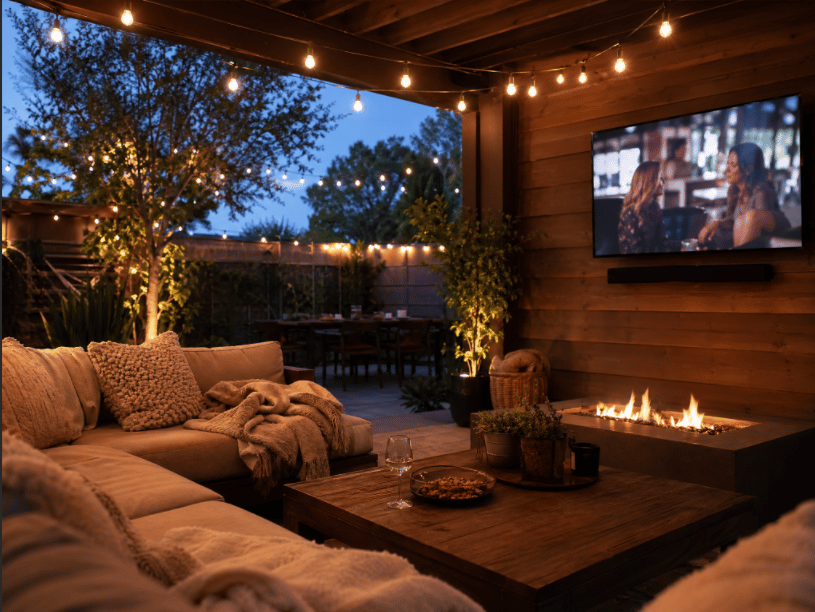
Outdoor TV installations include 7 distinct steps, each with different DIY difficulty:
The professional cost varies regionally — urban markets and high-cost-of-living areas trend toward the high end; rural areas trend toward the low end.
Two of the seven install steps have specific reasons to hire professionals regardless of DIY skill:
Outdoor electrical installations require:
Why you shouldn't DIY this:
Professional cost: $200-$500 for a quality outdoor GFCI outlet installation. This is one of the highest-ROI uses of professional installation services in the entire outdoor TV install process.
Mounting outdoor TVs on brick, stone, or stucco walls requires:
Why you shouldn't DIY this (specifically for masonry):
Professional cost: $200-$300 for masonry mounting (versus $80-$150 for standard wood-frame wall mounting).
For wood-frame siding (shiplap, board-and-batten, fiber cement, vinyl) — DIY mounting is reasonable for most handy homeowners.
Five of the seven install steps are genuinely DIY-friendly for most homeowners:
You know your patio better than any installer. Plan:
DIY effort: 30-60 minutes of measurement and planning. No specialized skills required.
After the mount is installed on the wall:
DIY effort: 30-60 minutes with a second person. Requires some patience and careful handling.
When to call a pro: If the TV is very large (75"+, 90+ pounds) or mounted high (8+ feet to screen center), professional handling reduces drop risk.
For wood-frame walls with standard construction:
DIY effort: 2-4 hours depending on complexity. Cable fishing through walls requires patience but no specialized expertise.
When to call a pro: Long cable runs through complex framing, attic-to-patio runs, or finished interior walls where damage tolerance is low.
DIY effort: 30-90 minutes. No specialized skills required.
DIY effort: 30-60 minutes. Personal preference adjustment that nobody else will get right for you.
Assuming you DIY everything except the electrical outlet:
The hybrid approach is the practical sweet spot for most homeowners — DIY the easy parts (planning, network setup, initial configuration), hire pros for the genuinely expert-required parts (electrical, masonry mounting if applicable).
Some outdoor TVs are designed with DIY install in mind. Look for:
Standard VESA mounting (600×400 or smaller). Avoids non-standard mounting hardware that requires specialized brackets.
External weatherproof connectors. All cable connections accessible from outside the TV without disassembly.
Pre-attached weather seals on cable inputs. Reduces installation complexity and reduces the chance of incorrect post-install sealing.
Comprehensive in-box hardware. Mounting screws, weatherproof gaskets, basic mounting templates included.
Standard 110V AC power input. Avoids RV-specific 12V DC requirements that complicate residential installations.
The ByteFree BF-55ODTV at $1,499 uses standard VESA 600×400 mounting, ships with weatherproof remote and complete hardware kit, and accepts standard 110V AC power — making DIY installation reasonable for handy homeowners. Sylvox DeckPro 2.0+ and SunBrite Veranda 3 have comparable install-friendly designs.
Beyond the "never DIY" steps (electrical and masonry), several scenarios favor professional installation:
If the 6-10 hours of DIY time is genuinely valuable (you'd otherwise be working, with family, or doing higher-priority projects), professional installation at $850-$1,750 may be worth it. Calculate your effective hourly value vs the install time savings.
Professional installations come with documentation that can support property value during resale. DIY installations (especially electrical work) without permits and documentation can complicate home sales.
Some homeowner's insurance policies require professional installation for outdoor electrical work to maintain coverage for related damage. Verify your specific policy requirements before assuming DIY is acceptable.
Multi-TV installs, custom integration with home audio systems, smart home automation integration — these benefit from professional expertise that goes beyond standard residential outdoor TV installation.
For premium tier outdoor TVs ($3,000+) and luxury outdoor entertainment systems, professional installation is typically expected and the install cost is proportionally smaller relative to total system cost.
Five mistakes that cost more to fix than the original DIY savings:
Skipping the GFCI outlet. Running an extension cord from indoors to power the outdoor TV. Code violation, insurance issue, and accelerated cable degradation. Cost to fix later: $300-$500 plus potential insurance complications.
Using indoor cables for outdoor connections. Indoor HDMI cables degrade outdoors within 2-3 years. Outdoor-rated cables cost $30-$80 more but last the TV's full lifespan. Cost to fix later: cable replacement plus reinstallation.
Mounting too close to the wall. Outdoor TVs need 2-3 inches of clearance for ventilation. Mounting flush against the wall causes thermal issues and shortened TV lifespan. Cost to fix later: TV failure within 3-5 years.
Inadequate cable strain relief. Cables exiting the TV without proper strain relief will eventually flex through outdoor temperature cycling and fail. Cost to fix later: HDMI port replacement (often non-repairable, requires TV replacement).
Ignoring drainage at mounting points. Mounting hardware that creates water-trapping pockets accelerates corrosion. Properly designed outdoor mounts include drainage paths. Cost to fix later: hardware replacement and possible wall damage repair.
For most install steps — site planning, wall mount installation on wood-frame walls, TV mounting (with help), cable runs, network setup — DIY is reasonable for handy homeowners. For outdoor electrical (GFCI outlet) installation and masonry wall mounting, professional installation is typically the right choice regardless of DIY skill. The hybrid approach (DIY easy parts, hire pros for expert-required parts) is the practical sweet spot for most homeowners.
Full professional installation typically costs $850-$1,750 — covering wall mount installation, TV mounting, cable runs, electrical outlet, and initial setup. Costs vary by region (urban higher, rural lower), TV size (larger TVs cost more to install), and wall material (masonry mounting costs more than wood-frame). For premium tier installations or complex multi-TV setups, costs can exceed $2,500.
Most steps are within typical handy-homeowner capability — physical mounting, cable runs, network setup, initial calibration. The two challenging steps are outdoor electrical work (which has code, liability, and safety implications) and masonry wall mounting (which requires specialized equipment and expertise). For wood-frame walls with existing nearby outdoor outlets, DIY installation is genuinely reasonable.
Basic tools: drill with bits (for wood-frame walls), level, stud finder, measuring tape, fish tape (for cable runs), wire stripper, basic hand tools. Plus PPE (safety glasses, gloves). For masonry walls, add masonry drill and proper anchors. Total tool investment for someone starting from scratch: $50-$200 — but most homeowners already have most of these.
Typical professional installation runs 4-6 hours on-site for a single 55-inch outdoor TV with electrical outlet installation. Complex installations (large TVs, masonry walls, multi-TV setups, integrated home audio) can take 8-12 hours or multiple visits. Pre-install site visits and post-install testing add to the timeline but are typically billed within the standard installation cost.
The DIY vs professional outdoor TV install decision isn't binary — most homeowners benefit from a hybrid approach:
DIY (handy homeowner can manage):
Professional (hire regardless of DIY skill):
Total cost comparison for typical residential install:
For DIY-friendly outdoor TVs with standard VESA mounting and complete hardware kits, the ByteFree BF-55ODTV at $1,499 is reasonable for handy homeowner installation. Plus an electrician for the outlet and you have a complete install for roughly $750 total — saving meaningfully versus full professional installation while keeping the parts that genuinely require expertise in expert hands.
Don't DIY what you shouldn't. Don't pay professionals for what you can reasonably handle yourself. The hybrid approach delivers the best total value for most homeowners.
Related reading:
Here's the complete breakdown — what actually requires expertise, where DIY makes sense, and the real cost math after factoring in risk.
What Outdoor TV Installation Actually Involves
Outdoor TV installations include 7 distinct steps, each with different DIY difficulty:
| Step | DIY Difficulty | Time | Pro Cost |
|---|---|---|---|
| 1. Site planning and TV positioning | Easy | 30-60 min | $50-$100 |
| 2. Outdoor electrical outlet (GFCI) | Hard / illegal in many states | 2-4 hours | $200-$500 |
| 3. Wall mount installation | Medium | 1-2 hours | $150-$250 |
| 4. TV physical mounting | Medium-Hard | 30-60 min (2 people) | $100-$200 |
| 5. Cable runs and conduit | Medium | 2-4 hours | $200-$400 |
| 6. Network connectivity | Easy-Medium | 30-90 min | $100-$200 |
| 7. Initial setup and calibration | Easy | 30-60 min | $50-$100 |
| Total | Mixed | 8-12 hours | $850-$1,750 |
The professional cost varies regionally — urban markets and high-cost-of-living areas trend toward the high end; rural areas trend toward the low end.
What You Should Never DIY (Even If You're Handy)
Two of the seven install steps have specific reasons to hire professionals regardless of DIY skill:
Outdoor Electrical Work (Step 2) — Code, Liability, and Safety
Outdoor electrical installations require:
- GFCI (Ground Fault Circuit Interrupter) outlets — code requirement in all US jurisdictions for outdoor electrical
- Weatherproof outlet boxes with proper sealing
- Code-compliant cable routing (typically through walls or conduit)
- Permitting in many jurisdictions
- Inspection sign-off in some jurisdictions
Why you shouldn't DIY this:
- Code compliance: DIY outdoor electrical that doesn't meet code can void homeowner's insurance and create liability if a future problem occurs
- Real safety risk: Outdoor electrical errors create real shock and fire hazards — not theoretical risks
- Inspection requirements: Some jurisdictions require licensed electrician installation for code compliance
- Resale implications: Non-permitted outdoor electrical can cause issues during home sales
Professional cost: $200-$500 for a quality outdoor GFCI outlet installation. This is one of the highest-ROI uses of professional installation services in the entire outdoor TV install process.
Mounting on Brick, Stone, or Stucco Walls (Step 3-4)
Mounting outdoor TVs on brick, stone, or stucco walls requires:
- Specialized masonry drilling equipment
- Correct anchor selection for the specific wall material
- Understanding of structural load capacity
- Proper sealing to prevent water intrusion at mounting points
Why you shouldn't DIY this (specifically for masonry):
- Equipment cost: Quality masonry drills and bits cost more than the installation savings
- Anchor failure risk: Incorrect anchors can fail months or years after installation, dropping a 60+ pound TV
- Wall damage risk: Drilling masonry incorrectly causes irreversible damage that's expensive to repair
- Sealing complexity: Improperly sealed masonry mounting points become water entry paths into your home structure
Professional cost: $200-$300 for masonry mounting (versus $80-$150 for standard wood-frame wall mounting).
For wood-frame siding (shiplap, board-and-batten, fiber cement, vinyl) — DIY mounting is reasonable for most handy homeowners.
What Most Buyers Can DIY Successfully
Five of the seven install steps are genuinely DIY-friendly for most homeowners:
Site Planning (Step 1) — Always DIY
You know your patio better than any installer. Plan:
- Mounting wall location (considering sun angles, viewing positions)
- Mounting height (64-68" to screen center for most installs)
- Cable routing path
- Power and network access points
DIY effort: 30-60 minutes of measurement and planning. No specialized skills required.
TV Physical Mounting (Step 4) — DIY If You Have Help
After the mount is installed on the wall:
- 2-person job (TVs are 50-90 pounds)
- Standard VESA bracket alignment
- Cable connections during mounting
DIY effort: 30-60 minutes with a second person. Requires some patience and careful handling.
When to call a pro: If the TV is very large (75"+, 90+ pounds) or mounted high (8+ feet to screen center), professional handling reduces drop risk.
Cable Runs (Step 5) — DIY-Friendly with Standard Construction
For wood-frame walls with standard construction:
- HDMI cable routing through walls (usually possible without major drilling)
- Outdoor-rated PVC conduit installation along exterior walls
- Network cable runs
DIY effort: 2-4 hours depending on complexity. Cable fishing through walls requires patience but no specialized expertise.
When to call a pro: Long cable runs through complex framing, attic-to-patio runs, or finished interior walls where damage tolerance is low.
Network Connectivity (Step 6) — Always DIY
- Wi-Fi configuration on the TV
- Smart platform setup
- App installation and login
- Network testing
DIY effort: 30-90 minutes. No specialized skills required.
Initial Setup (Step 7) — Always DIY
- Picture mode adjustment
- Audio configuration
- Streaming app setup
- Smart features configuration
DIY effort: 30-60 minutes. Personal preference adjustment that nobody else will get right for you.
The Real Cost Math: DIY vs Professional
Full DIY Installation
Assuming you DIY everything except the electrical outlet:
| Component | Cost |
|---|---|
| Tools you may need to buy | $50-$200 (drill bits, level, fish tape, etc.) |
| Outdoor wall mount | $80-$150 |
| Outdoor-rated cabling | $50-$120 |
| Conduit and weatherproof boxes | $40-$80 |
| Electrician for GFCI outlet | $200-$500 |
| Total install cost (DIY + outlet) | $420-$1,050 |
| Time investment | 6-10 hours of your time |
Full Professional Installation
| Component | Cost |
|---|---|
| Outdoor wall mount | $80-$150 |
| Outdoor-rated cabling | $50-$120 |
| Conduit and weatherproof boxes | $40-$80 |
| Professional installation labor | $850-$1,750 (includes electrical) |
| Total install cost | $1,020-$2,100 |
| Time investment | 0 hours (you're not doing the work) |
Hybrid Approach (Most Common)
| Component | Cost |
|---|---|
| Outdoor wall mount | $80-$150 |
| Outdoor-rated cabling | $50-$120 |
| Conduit and weatherproof boxes | $40-$80 |
| Electrician for GFCI outlet | $200-$500 |
| Professional TV mounting (if masonry or large TV) | $150-$300 |
| Total install cost | $520-$1,150 |
| Time investment | 3-5 hours of your time |
The hybrid approach is the practical sweet spot for most homeowners — DIY the easy parts (planning, network setup, initial configuration), hire pros for the genuinely expert-required parts (electrical, masonry mounting if applicable).
DIY-Friendly Outdoor TVs
Some outdoor TVs are designed with DIY install in mind. Look for:
Standard VESA mounting (600×400 or smaller). Avoids non-standard mounting hardware that requires specialized brackets.
External weatherproof connectors. All cable connections accessible from outside the TV without disassembly.
Pre-attached weather seals on cable inputs. Reduces installation complexity and reduces the chance of incorrect post-install sealing.
Comprehensive in-box hardware. Mounting screws, weatherproof gaskets, basic mounting templates included.
Standard 110V AC power input. Avoids RV-specific 12V DC requirements that complicate residential installations.
The ByteFree BF-55ODTV at $1,499 uses standard VESA 600×400 mounting, ships with weatherproof remote and complete hardware kit, and accepts standard 110V AC power — making DIY installation reasonable for handy homeowners. Sylvox DeckPro 2.0+ and SunBrite Veranda 3 have comparable install-friendly designs.
When Hiring Professional Makes Sense Even If You're Handy
Beyond the "never DIY" steps (electrical and masonry), several scenarios favor professional installation:
Time Value Analysis
If the 6-10 hours of DIY time is genuinely valuable (you'd otherwise be working, with family, or doing higher-priority projects), professional installation at $850-$1,750 may be worth it. Calculate your effective hourly value vs the install time savings.
Property Value and Resale
Professional installations come with documentation that can support property value during resale. DIY installations (especially electrical work) without permits and documentation can complicate home sales.
Insurance Considerations
Some homeowner's insurance policies require professional installation for outdoor electrical work to maintain coverage for related damage. Verify your specific policy requirements before assuming DIY is acceptable.
Complex Installations
Multi-TV installs, custom integration with home audio systems, smart home automation integration — these benefit from professional expertise that goes beyond standard residential outdoor TV installation.
Premium Installations
For premium tier outdoor TVs ($3,000+) and luxury outdoor entertainment systems, professional installation is typically expected and the install cost is proportionally smaller relative to total system cost.
Common DIY Outdoor TV Install Mistakes
Five mistakes that cost more to fix than the original DIY savings:
Skipping the GFCI outlet. Running an extension cord from indoors to power the outdoor TV. Code violation, insurance issue, and accelerated cable degradation. Cost to fix later: $300-$500 plus potential insurance complications.
Using indoor cables for outdoor connections. Indoor HDMI cables degrade outdoors within 2-3 years. Outdoor-rated cables cost $30-$80 more but last the TV's full lifespan. Cost to fix later: cable replacement plus reinstallation.
Mounting too close to the wall. Outdoor TVs need 2-3 inches of clearance for ventilation. Mounting flush against the wall causes thermal issues and shortened TV lifespan. Cost to fix later: TV failure within 3-5 years.
Inadequate cable strain relief. Cables exiting the TV without proper strain relief will eventually flex through outdoor temperature cycling and fail. Cost to fix later: HDMI port replacement (often non-repairable, requires TV replacement).
Ignoring drainage at mounting points. Mounting hardware that creates water-trapping pockets accelerates corrosion. Properly designed outdoor mounts include drainage paths. Cost to fix later: hardware replacement and possible wall damage repair.
Frequently Asked Questions
Should I DIY my outdoor TV installation?
For most install steps — site planning, wall mount installation on wood-frame walls, TV mounting (with help), cable runs, network setup — DIY is reasonable for handy homeowners. For outdoor electrical (GFCI outlet) installation and masonry wall mounting, professional installation is typically the right choice regardless of DIY skill. The hybrid approach (DIY easy parts, hire pros for expert-required parts) is the practical sweet spot for most homeowners.
How much does professional outdoor TV installation cost?
Full professional installation typically costs $850-$1,750 — covering wall mount installation, TV mounting, cable runs, electrical outlet, and initial setup. Costs vary by region (urban higher, rural lower), TV size (larger TVs cost more to install), and wall material (masonry mounting costs more than wood-frame). For premium tier installations or complex multi-TV setups, costs can exceed $2,500.
Is outdoor TV installation hard?
Most steps are within typical handy-homeowner capability — physical mounting, cable runs, network setup, initial calibration. The two challenging steps are outdoor electrical work (which has code, liability, and safety implications) and masonry wall mounting (which requires specialized equipment and expertise). For wood-frame walls with existing nearby outdoor outlets, DIY installation is genuinely reasonable.
What tools do I need for DIY outdoor TV install?
Basic tools: drill with bits (for wood-frame walls), level, stud finder, measuring tape, fish tape (for cable runs), wire stripper, basic hand tools. Plus PPE (safety glasses, gloves). For masonry walls, add masonry drill and proper anchors. Total tool investment for someone starting from scratch: $50-$200 — but most homeowners already have most of these.
How long does professional outdoor TV installation take?
Typical professional installation runs 4-6 hours on-site for a single 55-inch outdoor TV with electrical outlet installation. Complex installations (large TVs, masonry walls, multi-TV setups, integrated home audio) can take 8-12 hours or multiple visits. Pre-install site visits and post-install testing add to the timeline but are typically billed within the standard installation cost.
Summary
The DIY vs professional outdoor TV install decision isn't binary — most homeowners benefit from a hybrid approach:
DIY (handy homeowner can manage):
- Site planning and TV positioning
- Wall mount installation on wood-frame walls
- TV physical mounting (with a second person helping)
- Cable runs in standard construction
- Network connectivity and smart platform setup
- Initial calibration
Professional (hire regardless of DIY skill):
- Outdoor GFCI electrical outlet installation
- Masonry, brick, or stucco wall mounting
- Multi-TV integrated installations
- Premium tier installations ($3,000+ TVs)
Total cost comparison for typical residential install:
- Full DIY (with electrician for outlet): $420-$1,050 + 6-10 hours of your time
- Hybrid approach: $520-$1,150 + 3-5 hours of your time
- Full professional: $1,020-$2,100 + minimal time investment
For DIY-friendly outdoor TVs with standard VESA mounting and complete hardware kits, the ByteFree BF-55ODTV at $1,499 is reasonable for handy homeowner installation. Plus an electrician for the outlet and you have a complete install for roughly $750 total — saving meaningfully versus full professional installation while keeping the parts that genuinely require expertise in expert hands.
Don't DIY what you shouldn't. Don't pay professionals for what you can reasonably handle yourself. The hybrid approach delivers the best total value for most homeowners.
Related reading:
