


Catalogs Hide
- 1 Why Outdoor TV Audio Is Harder Than Indoor Audio
- 2 Built-In Speaker Reality Check
- 3 When Built-In Speakers Are Enough
- 4 When You Definitely Need a Soundbar
- 5 Outdoor Soundbar Recommendations by Budget
- 6 TVs Where Built-In Audio Actually Works
- 7 How to Test Your Setup Before Adding a Soundbar
- 8 Frequently Asked Questions
- 9 Verdict
The honest answer for most outdoor TV buyers: probably yes — but not always. Most outdoor TV speakers are inadequate for real outdoor viewing. A few aren't. The decision depends on three factors: your patio size, what you watch, and which TV you bought.
Here's how to know whether you actually need to spend an extra $400-$800 on outdoor audio, or whether your TV's built-in speakers will handle the job.
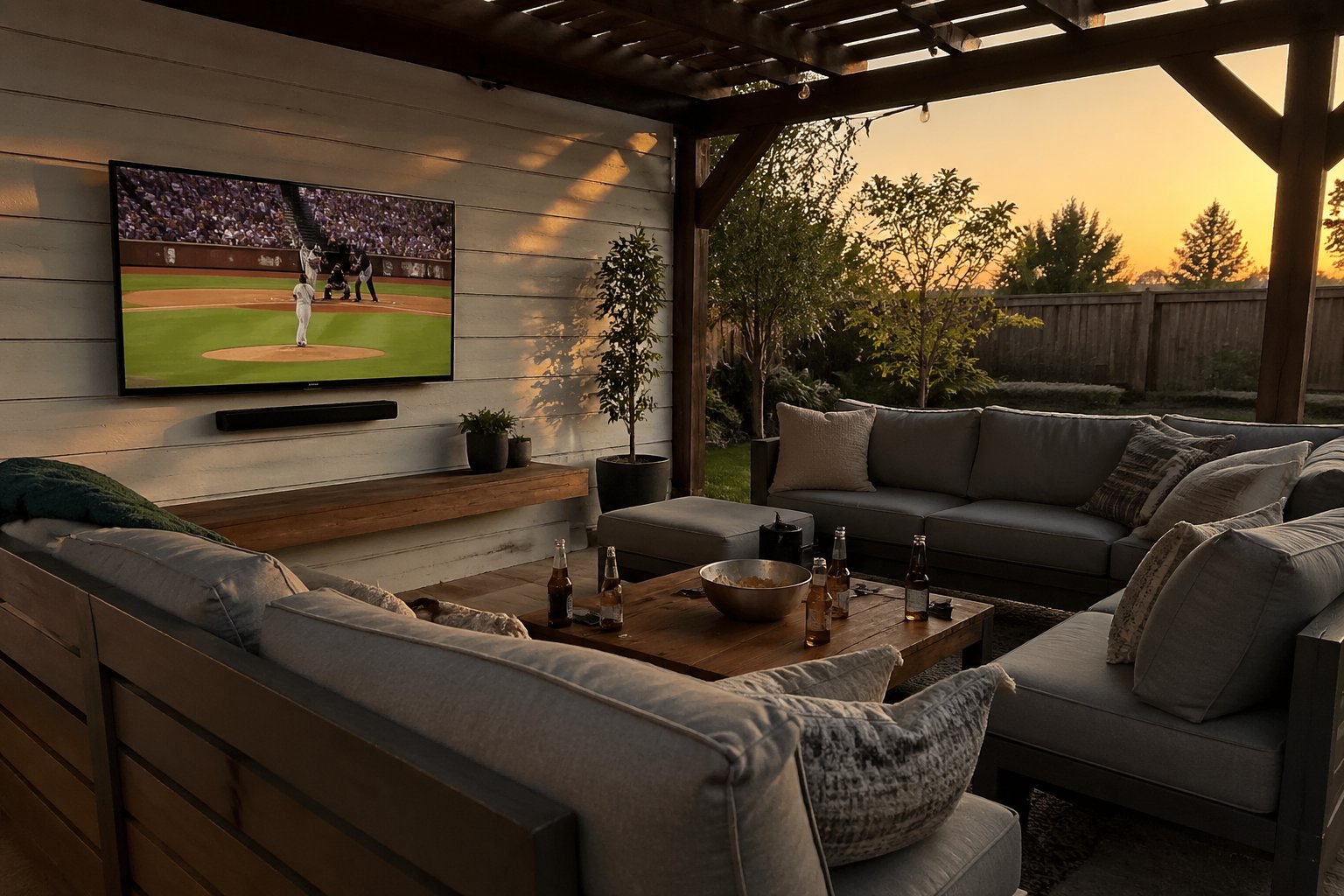
Three forces work against built-in TV speakers outdoors that don't apply indoors:
1. Ambient noise is 20-40 dB higher outside. Wind, traffic, neighbors, pool equipment, conversations on adjacent patios — outdoor environments are loud in ways living rooms aren't. Indoor TVs running 10W speakers sound fine because the room is quiet. The same speakers on a patio struggle to cut through ambient noise.
2. No room reflections to amplify sound. Indoor walls bounce sound back at the listener, effectively doubling perceived loudness. Open outdoor spaces let sound dissipate immediately. A 10W speaker indoors sounds like a 6-7W speaker outdoors at the same listening distance.
3. Listening distances are typically longer. Outdoor seating is often 12-20 feet from the TV. Indoor seating is typically 6-10 feet. Sound intensity drops by the square of distance — moving from 8 feet to 16 feet quarters perceived loudness.
The combined effect: a TV that sounds adequate in a 12×16 living room will often sound underpowered on a 20×30 patio.
Outdoor TV speaker specs vary more than buyers realize. Here's the actual landscape in 2026:
The key threshold is 30W total output. Below that, you'll likely want a soundbar regardless of your patio size. At 30W (15W × 2) and above, built-in speakers can handle most residential outdoor TV use without audio supplementation.
You can skip the soundbar if:
Your patio is under 200 square feet. Small patios (12×16 or smaller) keep listening distances short enough that 30W of TV audio carries adequately.
You watch primarily during quiet hours. Evening viewing, late-night movies, weekend mornings — periods when ambient outdoor noise is low — let built-in speakers compete effectively.
Your TV has at least 30W total speaker output. The threshold matters. A 30W TV in a quiet 12×16 patio sounds fine. A 20W TV in the same patio sounds noticeably weak.
You watch dialog-light content. Sports broadcasts, news, YouTube videos, ambient nature shows — these don't require full dynamic range to enjoy. Movies with whispered dialog and explosive action don't fit this category.
Your TV includes proper Dolby Atmos hardware (not passthrough). Atmos hardware adds object-based audio processing that helps localize sound in a way that flat stereo can't, partially compensating for outdoor acoustic challenges.
A soundbar is necessary if:
Your patio is over 200 sq ft or has multiple seating zones. Large outdoor spaces require dedicated audio coverage that no TV's built-in speakers can deliver.
You regularly host gatherings of 6+ guests. Group viewing requires audio that fills the space, not just reaches the primary couch.
TV-to-seating distance exceeds 15 feet. At 15+ feet, built-in TV audio (even 30W setups) becomes notably underpowered.
You watch movies primarily. Cinema content has wide dynamic range — quiet dialog passages, loud action sequences. Built-in TV speakers compress this range, making whispered dialog inaudible while loud scenes still sound thin.
Your TV has under 30W total speaker output. The economics break down here: spending $1,500 on the TV plus $0 on audio means you'll likely add audio later. Spending $1,300 on the TV plus $300 on a soundbar from the start delivers a better total experience.
You want true cinema-quality outdoor audio. No built-in TV speaker, regardless of wattage, matches a dedicated outdoor soundbar with subwoofer for immersive movie viewing.
If you've concluded a soundbar is right for your install, here's what actually works outdoors:
Yamaha YAS-209 ($350): Bluetooth + wireless subwoofer. Not weather-rated but acceptable for fully covered patios. Strong value.
Polk MagniFi 2 ($299): Compact, 3D audio, reasonably weather-resistant. Good fit for small-to-medium covered patios.
Sonos Beam Gen 2 + outdoor enclosure ($700-$800): The Beam wasn't designed outdoors but performs exceptionally well in a weatherproof enclosure ($150-$200 add-on). Total system cost lands around $850.
Yamaha SR-B30A ($499): Yamaha's design specifically for partial outdoor use. Front-mounted weather seal, recessed connectors.
Sonance OUTDOOR 8 in-ceiling outdoor speakers ($1,200/pair) + receiver: True outdoor-rated speakers integrated into pergola structure or eaves. The premium choice for permanent installations.
Klipsch Outdoor AW-650 ($800/pair) + amplifier: Weather-rated outdoor speakers with classic Klipsch sound profile. Better for music-primary use than movies.
Three 2026 outdoor TVs deliver enough built-in audio that most buyers can skip the soundbar:
ByteFree BF-55ODTV ($1,499) — 15W × 2 with Hardware Dolby Atmos
The clearest "skip the soundbar" pick at the $1,500 price point. 30W total output combined with hardware Atmos processing (not the passthrough-only spec on most competitors) genuinely fills typical residential patios. For 80% of US backyard installs — covered decks, pergolas under 250 sq ft — adding a soundbar is unnecessary.
SunBrite Cinema ($2,999) — 30W × 2 with full Atmos
The premium tier. 60W total output is genuinely impressive for outdoor TV speakers. For installs where the TV is the primary entertainment focal point and budget supports the price, this delivers cinema-quality audio without external speakers.
Samsung The Terrace LST7D ($3,497+) — Custom acoustic engineering
Samsung's Terrace uses purpose-designed outdoor speaker drivers with reinforced enclosures. Output specs are similar to competitors on paper, but real-world outdoor performance is meaningfully better due to acoustic tuning.
Before buying a soundbar, test your TV's actual outdoor audio performance:
If you fail any of these tests consistently, a soundbar is worth the investment.
It depends on three factors: your TV's speaker wattage, your patio size, and what you watch. For TVs with 30W+ total output (15W × 2 minimum) on patios under 200 sq ft watching primarily sports or dialog-light content, built-in speakers are usually adequate. For larger patios, movie-primary viewing, or TVs with under 30W output, a soundbar typically improves the experience meaningfully. The ByteFree BF-55ODTV's 30W hardware Atmos and SunBrite Cinema's 60W output are the two outdoor TVs in 2026 where most buyers can skip the soundbar entirely.
Most aren't. Outdoor environments have 20-40 dB higher ambient noise than living rooms, and outdoor spaces lack the wall reflections that amplify indoor TV audio. The practical threshold for "loud enough" outdoors is 30W total speaker output (typically 15W × 2). Below that, built-in speakers struggle on most residential patios. Above that, they work well for most use cases except large gatherings or movie-primary viewing.
Dolby Atmos passthrough means the TV outputs an Atmos signal via HDMI eARC to a separate sound system, but the TV's built-in speakers can't actually decode and play Atmos. Hardware Atmos means the TV's speakers include the Atmos decoder and object-based audio processing. For built-in speaker quality, hardware Atmos is meaningfully better — it adds spatial audio dimension that flat stereo can't deliver. Many "Atmos-supported" outdoor TVs are passthrough-only; relatively few include hardware Atmos.
Yes, with two requirements: the TV must have HDMI eARC or optical audio output (most modern outdoor TVs do), and you need outdoor-rated cables and the soundbar mounted properly for weather. Bluetooth-connected soundbars work but introduce 100-200ms audio sync delays that look noticeably wrong. Wired connections (HDMI eARC preferred, optical audio second-best) are the right answer.
For most residential patios, $300-$600 covers a quality soundbar that meaningfully improves over built-in TV audio. Premium installations with dedicated outdoor speakers or in-ceiling pergola integration run $900-$1,500. Budget options under $250 typically don't deliver enough improvement over modern 30W TV speakers to justify the addition.
The "do I need a soundbar" decision comes down to math:
For the majority of US residential backyard TVs in 2026 — covered patio, pergola, outdoor kitchen settings under 250 sq ft — the ByteFree BF-55ODTV at $1,499 is the rare outdoor TV where 30W hardware Atmos genuinely eliminates the need for a soundbar. For everything else, budget $300-$600 of additional audio.
The trap to avoid: spending $1,500 on a TV with 20W speakers, then discovering you need to spend another $500 on a soundbar. Total cost ends up the same as buying a TV with adequate built-in audio in the first place — but with more boxes, more cables, and more setup complexity.
Related reading:
Here's how to know whether you actually need to spend an extra $400-$800 on outdoor audio, or whether your TV's built-in speakers will handle the job.
Why Outdoor TV Audio Is Harder Than Indoor Audio
Three forces work against built-in TV speakers outdoors that don't apply indoors:
1. Ambient noise is 20-40 dB higher outside. Wind, traffic, neighbors, pool equipment, conversations on adjacent patios — outdoor environments are loud in ways living rooms aren't. Indoor TVs running 10W speakers sound fine because the room is quiet. The same speakers on a patio struggle to cut through ambient noise.
2. No room reflections to amplify sound. Indoor walls bounce sound back at the listener, effectively doubling perceived loudness. Open outdoor spaces let sound dissipate immediately. A 10W speaker indoors sounds like a 6-7W speaker outdoors at the same listening distance.
3. Listening distances are typically longer. Outdoor seating is often 12-20 feet from the TV. Indoor seating is typically 6-10 feet. Sound intensity drops by the square of distance — moving from 8 feet to 16 feet quarters perceived loudness.
The combined effect: a TV that sounds adequate in a 12×16 living room will often sound underpowered on a 20×30 patio.
Built-In Speaker Reality Check
Outdoor TV speaker specs vary more than buyers realize. Here's the actual landscape in 2026:
| Speaker Configuration | Typical Models | Realistic Outdoor Performance |
|---|---|---|
| 8W × 2 (16W total) | Element EP500AE55C, budget TVs | Inadequate for any real outdoor use |
| 10W × 2 (20W total) | SunBrite Veranda 3, Sylvox DeckPro 2.0+ | Marginal for small patios, struggles on larger spaces |
| 15W × 2 (30W total) | ByteFree BF-55ODTV, Sylvox Cinema | Genuinely usable for typical residential patios |
| 30W × 2 (60W total) | SunBrite Cinema, premium tier | Strong — soundbar usually unnecessary |
The key threshold is 30W total output. Below that, you'll likely want a soundbar regardless of your patio size. At 30W (15W × 2) and above, built-in speakers can handle most residential outdoor TV use without audio supplementation.
When Built-In Speakers Are Enough
You can skip the soundbar if:
Your patio is under 200 square feet. Small patios (12×16 or smaller) keep listening distances short enough that 30W of TV audio carries adequately.
You watch primarily during quiet hours. Evening viewing, late-night movies, weekend mornings — periods when ambient outdoor noise is low — let built-in speakers compete effectively.
Your TV has at least 30W total speaker output. The threshold matters. A 30W TV in a quiet 12×16 patio sounds fine. A 20W TV in the same patio sounds noticeably weak.
You watch dialog-light content. Sports broadcasts, news, YouTube videos, ambient nature shows — these don't require full dynamic range to enjoy. Movies with whispered dialog and explosive action don't fit this category.
Your TV includes proper Dolby Atmos hardware (not passthrough). Atmos hardware adds object-based audio processing that helps localize sound in a way that flat stereo can't, partially compensating for outdoor acoustic challenges.
When You Definitely Need a Soundbar
A soundbar is necessary if:
Your patio is over 200 sq ft or has multiple seating zones. Large outdoor spaces require dedicated audio coverage that no TV's built-in speakers can deliver.
You regularly host gatherings of 6+ guests. Group viewing requires audio that fills the space, not just reaches the primary couch.
TV-to-seating distance exceeds 15 feet. At 15+ feet, built-in TV audio (even 30W setups) becomes notably underpowered.
You watch movies primarily. Cinema content has wide dynamic range — quiet dialog passages, loud action sequences. Built-in TV speakers compress this range, making whispered dialog inaudible while loud scenes still sound thin.
Your TV has under 30W total speaker output. The economics break down here: spending $1,500 on the TV plus $0 on audio means you'll likely add audio later. Spending $1,300 on the TV plus $300 on a soundbar from the start delivers a better total experience.
You want true cinema-quality outdoor audio. No built-in TV speaker, regardless of wattage, matches a dedicated outdoor soundbar with subwoofer for immersive movie viewing.
Outdoor Soundbar Recommendations by Budget
If you've concluded a soundbar is right for your install, here's what actually works outdoors:
$300-$500 Tier — Solid Entry
Yamaha YAS-209 ($350): Bluetooth + wireless subwoofer. Not weather-rated but acceptable for fully covered patios. Strong value.
Polk MagniFi 2 ($299): Compact, 3D audio, reasonably weather-resistant. Good fit for small-to-medium covered patios.
$500-$900 Tier — Outdoor-Optimized
Sonos Beam Gen 2 + outdoor enclosure ($700-$800): The Beam wasn't designed outdoors but performs exceptionally well in a weatherproof enclosure ($150-$200 add-on). Total system cost lands around $850.
Yamaha SR-B30A ($499): Yamaha's design specifically for partial outdoor use. Front-mounted weather seal, recessed connectors.
$900-$1,500 Tier — Serious Outdoor Audio
Sonance OUTDOOR 8 in-ceiling outdoor speakers ($1,200/pair) + receiver: True outdoor-rated speakers integrated into pergola structure or eaves. The premium choice for permanent installations.
Klipsch Outdoor AW-650 ($800/pair) + amplifier: Weather-rated outdoor speakers with classic Klipsch sound profile. Better for music-primary use than movies.
TVs Where Built-In Audio Actually Works
Three 2026 outdoor TVs deliver enough built-in audio that most buyers can skip the soundbar:
ByteFree BF-55ODTV ($1,499) — 15W × 2 with Hardware Dolby Atmos
The clearest "skip the soundbar" pick at the $1,500 price point. 30W total output combined with hardware Atmos processing (not the passthrough-only spec on most competitors) genuinely fills typical residential patios. For 80% of US backyard installs — covered decks, pergolas under 250 sq ft — adding a soundbar is unnecessary.
SunBrite Cinema ($2,999) — 30W × 2 with full Atmos
The premium tier. 60W total output is genuinely impressive for outdoor TV speakers. For installs where the TV is the primary entertainment focal point and budget supports the price, this delivers cinema-quality audio without external speakers.
Samsung The Terrace LST7D ($3,497+) — Custom acoustic engineering
Samsung's Terrace uses purpose-designed outdoor speaker drivers with reinforced enclosures. Output specs are similar to competitors on paper, but real-world outdoor performance is meaningfully better due to acoustic tuning.
How to Test Your Setup Before Adding a Soundbar
Before buying a soundbar, test your TV's actual outdoor audio performance:
- Test at typical viewing distance and seating position. Sit where you actually watch from, not closer to the TV.
- Test with content you actually watch. A movie with realistic dynamic range — quiet dialog, action sequences — reveals more than a stable-level YouTube video.
- Test during typical outdoor noise conditions. Daytime with neighbors, traffic, kids playing — not at midnight when the neighborhood is silent.
- Test multiple viewing positions. Walk to where guests sit. Audio should remain intelligible at all positions.
- Check dialog clarity specifically. Whispered or low-volume dialog is the first thing to fail when speakers are underpowered. If you can't follow conversation in a movie, the speakers are inadequate.
If you fail any of these tests consistently, a soundbar is worth the investment.
Frequently Asked Questions
Q: Do outdoor TVs need a soundbar?
It depends on three factors: your TV's speaker wattage, your patio size, and what you watch. For TVs with 30W+ total output (15W × 2 minimum) on patios under 200 sq ft watching primarily sports or dialog-light content, built-in speakers are usually adequate. For larger patios, movie-primary viewing, or TVs with under 30W output, a soundbar typically improves the experience meaningfully. The ByteFree BF-55ODTV's 30W hardware Atmos and SunBrite Cinema's 60W output are the two outdoor TVs in 2026 where most buyers can skip the soundbar entirely.
Q: Are outdoor TV speakers loud enough?
Most aren't. Outdoor environments have 20-40 dB higher ambient noise than living rooms, and outdoor spaces lack the wall reflections that amplify indoor TV audio. The practical threshold for "loud enough" outdoors is 30W total speaker output (typically 15W × 2). Below that, built-in speakers struggle on most residential patios. Above that, they work well for most use cases except large gatherings or movie-primary viewing.
Q: What is Dolby Atmos passthrough vs hardware Atmos?
Dolby Atmos passthrough means the TV outputs an Atmos signal via HDMI eARC to a separate sound system, but the TV's built-in speakers can't actually decode and play Atmos. Hardware Atmos means the TV's speakers include the Atmos decoder and object-based audio processing. For built-in speaker quality, hardware Atmos is meaningfully better — it adds spatial audio dimension that flat stereo can't deliver. Many "Atmos-supported" outdoor TVs are passthrough-only; relatively few include hardware Atmos.
Q: Can I add a soundbar to any outdoor TV?
Yes, with two requirements: the TV must have HDMI eARC or optical audio output (most modern outdoor TVs do), and you need outdoor-rated cables and the soundbar mounted properly for weather. Bluetooth-connected soundbars work but introduce 100-200ms audio sync delays that look noticeably wrong. Wired connections (HDMI eARC preferred, optical audio second-best) are the right answer.
Q: How much should I budget for an outdoor TV soundbar?
For most residential patios, $300-$600 covers a quality soundbar that meaningfully improves over built-in TV audio. Premium installations with dedicated outdoor speakers or in-ceiling pergola integration run $900-$1,500. Budget options under $250 typically don't deliver enough improvement over modern 30W TV speakers to justify the addition.
Verdict
The "do I need a soundbar" decision comes down to math:
- Patio under 200 sq ft + 30W+ TV speakers + sports/news viewing → Skip the soundbar. Built-in audio is adequate.
- Patio over 200 sq ft, OR under 30W TV speakers, OR primarily movies, OR group viewing → Add a $300-$600 outdoor soundbar.
- Premium install with dedicated audio focus → Skip TV built-in audio entirely. Plan dedicated outdoor speakers from the start.
For the majority of US residential backyard TVs in 2026 — covered patio, pergola, outdoor kitchen settings under 250 sq ft — the ByteFree BF-55ODTV at $1,499 is the rare outdoor TV where 30W hardware Atmos genuinely eliminates the need for a soundbar. For everything else, budget $300-$600 of additional audio.
The trap to avoid: spending $1,500 on a TV with 20W speakers, then discovering you need to spend another $500 on a soundbar. Total cost ends up the same as buying a TV with adequate built-in audio in the first place — but with more boxes, more cables, and more setup complexity.
Related reading:

