


Catalogs Hide
- 1 What Does IP Rating Mean? (Plain English Edition)
- 2 Decoding the Two Digits for Outdoor TVs
- 3 IP55 Explained — The Industry Standard
- 4 IP56 vs IP55 — Is the Upgrade Worth It?
- 5 IP65 — When You Actually Need It
- 6 Real-World IP55 Performance
- 7 Outdoor TV IP Ratings Compared (2026)
-
8
Which IP Rating Should You Choose? (Decision Tree)
-
8.1
 Fully Covered Patio (screened porch, enclosed lanai, garage)
-
8.2
 Partial Sun Patio (pergola, covered deck, outdoor kitchen overhang)
-
8.3
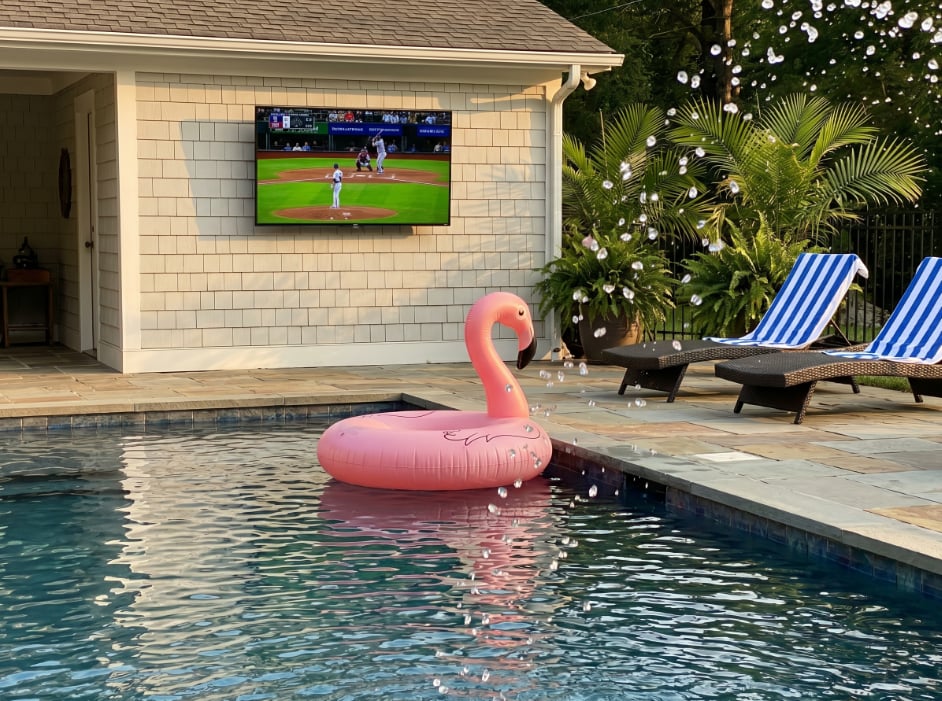
 Pool-Adjacent Install (pool deck, cabana, poolside bar)
-
8.4
 Fully Exposed Install (open pool deck, uncovered rooftop, open deck)
-
8.5
 Desert Install (Phoenix, Las Vegas, Palm Springs, parts of Texas)
-
8.6
Coastal Install (Florida Gulf Coast, Outer Banks, Southern California)
-
8.1
- 9 Frequently Asked Questions
- 10 Verdict
- 11 ByteFree
Outdoor TV marketing is full of IP ratings — IP54, IP55, IP56, IP65, IP66. The numbers get bigger, the prices go up, and the assumption is "higher is better, pay more."
Except that's not actually true for most installs. For the typical US homeowner putting a TV on a covered patio or under a pergola, IP55 is enough. Anything higher is usually marketing headroom you pay for and never benefit from.
Here's the TVSBook breakdown of what each rating actually protects against — and the honest truth about when you need to spend up.
IP stands for Ingress Protection. It's an international standard (IEC 60529) that rates how well an electronic enclosure keeps stuff out — specifically, dust and water.
The rating is always two digits: IP[first digit][second digit].
Higher numbers mean more protection. IP00 is unprotected. IP68 is dust-tight and submersion-proof.
For outdoor TVs, the two digits that matter for buyers are the ones in the range you actually see:
Everything else is either overkill (IP68 scuba-gear territory) or inadequate (IP32 indoor equipment).
For outdoor TVs, IP5x is the practical minimum. IP6x is slightly better but rarely necessary outside of desert-climate installs with frequent dust storms (Phoenix, west Texas, parts of New Mexico).
For outdoor TVs, IPx5 is the practical sweet spot. IPx4 is marginal (fine for covered patios, risky anywhere exposed). IPx6 is for installs that get pressure-washed or hit directly by sprinklers.
IP55 means: Dust-protected + protected against water jets from any direction.
In practical terms, an IP55-rated outdoor TV handles:
What IP55 does not cover:
Which TVs use IP55: ByteFree BF-55ODTV, Sylvox DeckPro 2.0+, SunBrite Veranda 3, SunBrite Cinema, Element outdoor TVs, most mainstream brands. This is the industry standard for a reason — it covers 95% of residential installs without over-engineering.
IP56 means: Same dust protection as IP55 + stronger water jet protection.
The difference between IP55 and IP56: IP55 handles low-pressure water jets, IP56 handles high-pressure water jets — think a standard garden hose held 2 feet away vs a firefighter's hose.
Here's the honest question: Is there any real-world residential scenario where you'd hit your outdoor TV with high-pressure water?
If you're pressure-washing your deck and the spray bounces back at the TV — maybe. But responsible owners cover or unmount the TV before pressure-washing.
Verdict: IP56 is a marketing step-up with minimal real-world benefit. If a brand charges a meaningful premium for IP56 over IP55, you're paying for spec-sheet headroom, not actual use cases.
Which TVs claim IP56: Sylvox DeckPro 3.0+ is one of the few. Most brands skip this tier entirely and jump from IP55 to IP65/IP66.
IP65 means: Completely dust-tight + protected against water jets from any direction.
The real difference vs IP55: full dust-tightness (first digit 6 instead of 5). The water protection level is the same as IP55.
Where IP65 genuinely matters:
For a typical suburban partial-sun patio in Atlanta, Dallas, or Jacksonville, IP65 is overkill — the incremental dust protection doesn't add meaningful lifespan or reliability.
Which TVs use IP65 or higher: Furrion Aurora Full-Sun Pro (IP66 — the only mainstream outdoor TV at this level), some commercial-grade outdoor TVs.
What does IP55 actually handle in practice? Here's what we've observed and what manufacturer testing demonstrates:
Scenarios IP55 handles well:
Scenarios IP55 can fail:
Practical takeaway: IP55 isn't a theoretical rating — it's what actual outdoor TVs have survived in actual field installations for years. Upgrading beyond IP55 is rarely about genuine protection need; it's about edge-case insurance.
Here's how the major 55-inch outdoor TV brands sort by IP rating:
Key observations:
Skip the spec-sheet comparison. Here's what actually matters for your install:
IP54 is acceptable, IP55 is better. You're mostly protecting against humidity and incidental splashing. Water jets are essentially impossible in this environment.
Recommended: IP55 — the industry standard delivers enough margin for peace of mind without overpaying.
IP55 is the sweet spot. This covers the vast majority of US residential installs. Rain will hit the TV, water may splash, but no pressure-washer scenarios.
Recommended: IP55 — essentially every major outdoor TV brand offers this. Don't pay a premium for IP56 or IP65.
IP55 still works. Pool splashing, chlorinated water spray from 5+ feet away, and wet feet leaving water droplets on the TV are all within IP55's design envelope.
Recommended: IP55, with a weatherproof cover for off-season months.
IP55 works but IP65 gives more margin. Without any overhead protection, you're hitting direct rain, maybe hail, and years of UV exposure. The dust-tightness of IP65 matters more here than the water jet rating.
Recommended: IP55 minimum, IP65 if budget allows — especially in dusty climates.
Jump to IP65+. Dust is the real threat, not water. A dust-tight enclosure genuinely extends panel life in these climates.
Recommended: IP65 or IP66 (Furrion Aurora Full-Sun Pro).
IP55 works, but prioritize corrosion-resistant build. Salt-laden air is the real enemy — IP rating protects against ingress, but doesn't prevent galvanic corrosion. Look for all-metal construction (aluminum + stainless steel fasteners) more than high IP ratings.
Recommended: IP55 with all-metal enclosure — ByteFree, SunBrite, and Sylvox all qualify.
For 95% of residential outdoor TV installs — covered patios, pergolas, pool decks, outdoor kitchens — yes, IP55 is enough. It handles heavy rain, humidity, pool splashing, low-pressure hose rinsing, and daily weather cycles across all US climates. The only scenarios where you genuinely need higher protection are desert climates (where you want IP65 for dust) and direct pressure-washing exposure (which you should avoid regardless of rating).
The first digit (5) is the same — both offer dust protection. The difference is the second digit: IP55 handles low-pressure water jets (like a garden hose), IP56 handles high-pressure water jets (like a firefighter's hose). For residential installs, this difference is essentially cosmetic — there's no normal scenario where a homeowner blasts their outdoor TV with high-pressure water. IP56 marketing usually reflects spec-sheet competition between brands, not a meaningful real-world upgrade.
Yes. IP55 is specifically designed to handle rain from any angle, including heavy thunderstorms. Mainstream outdoor TVs with IP55 ratings — like the ByteFree BF-55ODTV, Sylvox DeckPro 2.0+, and SunBrite Veranda 3 — are engineered to remain operational through and after rain events. That said, using a weatherproof cover during off-season months extends panel lifespan, regardless of IP rating.
Almost certainly not. IP65 is only meaningfully better than IP55 in dust-heavy environments (desert climates, near unpaved roads, agricultural areas). For the typical covered patio, pergola, or partial-sun install in most US climates, IP55 delivers more than enough protection. Paying a premium for IP65 on a residential installation is usually paying for headroom you'll never need.
The IP rating race in outdoor TV marketing is largely theater. For most US homeowners, the answer is simple: IP55 is the industry standard for a reason, and it covers 95% of real installs.
The three scenarios where you genuinely benefit from jumping above IP55:
For everything else — your pergola, covered deck, outdoor kitchen, poolside patio — IP55 is sufficient. Don't overpay for a higher IP rating when that money could go toward brightness, HDR support, or smart features that you'll actually notice every day.
If you're shopping at the $1,500–$1,600 tier, the ByteFree BF-55ODTV delivers IP55 + all-metal construction + IP55-compatible mounting hardware — the same weatherproofing spec as Sylvox DeckPro, SunBrite Veranda, and most competitors in the category, at a competitive price. Your money is better spent on brightness (1,500 nits vs 1,000 nits matters daily) than on IP rating headroom you'll never see the benefit of.
Dolby Vision Outdoor TV: Is It Worth It? (2026 Complete Guide)
Are Outdoor TVs Really Worth It? Here's What Nobody Tells Youh
Which 55-Inch Outdoor TV Is Best in 2026? ByteFree vs Sylvox DeckPro Compared
Best Outdoor TV for Airbnb & Short-Term Rentals: 2026 Top Picks
Except that's not actually true for most installs. For the typical US homeowner putting a TV on a covered patio or under a pergola, IP55 is enough. Anything higher is usually marketing headroom you pay for and never benefit from.
Here's the TVSBook breakdown of what each rating actually protects against — and the honest truth about when you need to spend up.
What Does IP Rating Mean? (Plain English Edition)
IP stands for Ingress Protection. It's an international standard (IEC 60529) that rates how well an electronic enclosure keeps stuff out — specifically, dust and water.
The rating is always two digits: IP[first digit][second digit].
- First digit (0–6): Protection against solid objects (dust, fingers, insects)
- Second digit (0–9): Protection against water (drips, spray, jets, submersion)
Higher numbers mean more protection. IP00 is unprotected. IP68 is dust-tight and submersion-proof.
For outdoor TVs, the two digits that matter for buyers are the ones in the range you actually see:
- First digit: 5 or 6
- Second digit: 4, 5, or 6
Everything else is either overkill (IP68 scuba-gear territory) or inadequate (IP32 indoor equipment).
Decoding the Two Digits for Outdoor TVs
First Digit — Dust Protection
| Rating | What it protects against |
|---|---|
| IP4x | Objects larger than 1mm (tools, small wires) — NOT dust |
| IP5x | Dust-protected — some dust ingress allowed, but not enough to interfere with operation |
| IP6x | Dust-tight — complete protection from dust |
For outdoor TVs, IP5x is the practical minimum. IP6x is slightly better but rarely necessary outside of desert-climate installs with frequent dust storms (Phoenix, west Texas, parts of New Mexico).
Second Digit — Water Protection
| Rating | What it protects against |
|---|---|
| IPx4 | Splashes from any direction — rain, incidental splashing |
| IPx5 | Low-pressure water jets from any direction |
| IPx6 | Powerful water jets (like a garden hose) |
| IPx7 | Temporary submersion up to 1m |
| IPx8 | Continuous submersion (scuba territory) |
For outdoor TVs, IPx5 is the practical sweet spot. IPx4 is marginal (fine for covered patios, risky anywhere exposed). IPx6 is for installs that get pressure-washed or hit directly by sprinklers.
IP55 Explained — The Industry Standard
IP55 means: Dust-protected + protected against water jets from any direction.
In practical terms, an IP55-rated outdoor TV handles:
- Heavy rain from any angle
- Humidity, condensation, morning dew
- Garden hose rinsing (low-pressure)
- Pool splashing from 10+ feet away
- Dust, pollen, and incidental debris
- Incidental sprinkler spray
What IP55 does not cover:
- Direct pressure-washer blasting (use IP66+)
- Continuous submersion (no outdoor TV covers this; use an indoor TV with waterproof enclosure)
- Salt spray direct exposure (coastal installs need additional corrosion protection — see below)
Which TVs use IP55: ByteFree BF-55ODTV, Sylvox DeckPro 2.0+, SunBrite Veranda 3, SunBrite Cinema, Element outdoor TVs, most mainstream brands. This is the industry standard for a reason — it covers 95% of residential installs without over-engineering.
IP56 vs IP55 — Is the Upgrade Worth It?
IP56 means: Same dust protection as IP55 + stronger water jet protection.
The difference between IP55 and IP56: IP55 handles low-pressure water jets, IP56 handles high-pressure water jets — think a standard garden hose held 2 feet away vs a firefighter's hose.
Here's the honest question: Is there any real-world residential scenario where you'd hit your outdoor TV with high-pressure water?
If you're pressure-washing your deck and the spray bounces back at the TV — maybe. But responsible owners cover or unmount the TV before pressure-washing.
Verdict: IP56 is a marketing step-up with minimal real-world benefit. If a brand charges a meaningful premium for IP56 over IP55, you're paying for spec-sheet headroom, not actual use cases.
Which TVs claim IP56: Sylvox DeckPro 3.0+ is one of the few. Most brands skip this tier entirely and jump from IP55 to IP65/IP66.
IP65 — When You Actually Need It
IP65 means: Completely dust-tight + protected against water jets from any direction.
The real difference vs IP55: full dust-tightness (first digit 6 instead of 5). The water protection level is the same as IP55.
Where IP65 genuinely matters:
- Desert installations — Phoenix, Las Vegas, Palm Springs — where dust storms are frequent
- Coastal installations — salt-laden wind carries abrasive particles
- Dusty rural environments — near unpaved roads, agricultural areas
- Any install with frequent pollen or fine debris
For a typical suburban partial-sun patio in Atlanta, Dallas, or Jacksonville, IP65 is overkill — the incremental dust protection doesn't add meaningful lifespan or reliability.
Which TVs use IP65 or higher: Furrion Aurora Full-Sun Pro (IP66 — the only mainstream outdoor TV at this level), some commercial-grade outdoor TVs.
Real-World IP55 Performance
What does IP55 actually handle in practice? Here's what we've observed and what manufacturer testing demonstrates:
Scenarios IP55 handles well:
- A severe thunderstorm with horizontal rain — the TV stays operational during and after
- 8 months of Florida summer (humidity, daily thunderstorms, 90°F+ heat) — no degradation reported
- Pool party splashing from 5+ feet away — no issues
- Morning dew cycles across all seasons — panel and electronics unaffected
Scenarios IP55 can fail:
- Pressure-washing the TV directly (use IP66+ or, better, don't pressure-wash your TV)
- Hurricane-force driven rain at extreme angles on an unprotected wall (all TVs can fail here regardless of IP)
- Sprinklers that hit the TV directly at close range for extended periods
Practical takeaway: IP55 isn't a theoretical rating — it's what actual outdoor TVs have survived in actual field installations for years. Upgrading beyond IP55 is rarely about genuine protection need; it's about edge-case insurance.
Outdoor TV IP Ratings Compared (2026)
Here's how the major 55-inch outdoor TV brands sort by IP rating:
| IP Rating | Models at this rating | Typical price range |
|---|---|---|
| IP54 | Furrion Aurora Full-Shade, Aurora Partial-Sun series, Peerless Neptune | $1,199–$2,699 |
| IP55 | ByteFree BF-55ODTV, Sylvox DeckPro 2.0+, SunBrite Veranda 3, SunBrite Cinema, Sylvox Pool Pro 2.0+, Element EP500AE55C, MirageVision Silver | $899–$2,999 |
| IP56 | Sylvox DeckPro 3.0+ | $1,699 |
| IP66 | Furrion Aurora Full-Sun Pro | $6,999 |
Key observations:
- IP55 is the dominant industry standard — if a credible outdoor TV brand is below IP55, it's a red flag
- IP56 is a marketing step-up that doesn't meaningfully matter for residential use
- IP66 is genuinely more protection but only available on premium full-sun models that most buyers don't need
Which IP Rating Should You Choose? (Decision Tree)
Skip the spec-sheet comparison. Here's what actually matters for your install:
Fully Covered Patio (screened porch, enclosed lanai, garage)
IP54 is acceptable, IP55 is better. You're mostly protecting against humidity and incidental splashing. Water jets are essentially impossible in this environment.
Recommended: IP55 — the industry standard delivers enough margin for peace of mind without overpaying.
Partial Sun Patio (pergola, covered deck, outdoor kitchen overhang)
IP55 is the sweet spot. This covers the vast majority of US residential installs. Rain will hit the TV, water may splash, but no pressure-washer scenarios.
Recommended: IP55 — essentially every major outdoor TV brand offers this. Don't pay a premium for IP56 or IP65.
Pool-Adjacent Install (pool deck, cabana, poolside bar)
IP55 still works. Pool splashing, chlorinated water spray from 5+ feet away, and wet feet leaving water droplets on the TV are all within IP55's design envelope.
Recommended: IP55, with a weatherproof cover for off-season months.
Fully Exposed Install (open pool deck, uncovered rooftop, open deck)
IP55 works but IP65 gives more margin. Without any overhead protection, you're hitting direct rain, maybe hail, and years of UV exposure. The dust-tightness of IP65 matters more here than the water jet rating.
Recommended: IP55 minimum, IP65 if budget allows — especially in dusty climates.
Desert Install (Phoenix, Las Vegas, Palm Springs, parts of Texas)
Jump to IP65+. Dust is the real threat, not water. A dust-tight enclosure genuinely extends panel life in these climates.
Recommended: IP65 or IP66 (Furrion Aurora Full-Sun Pro).
Coastal Install (Florida Gulf Coast, Outer Banks, Southern California)
IP55 works, but prioritize corrosion-resistant build. Salt-laden air is the real enemy — IP rating protects against ingress, but doesn't prevent galvanic corrosion. Look for all-metal construction (aluminum + stainless steel fasteners) more than high IP ratings.
Recommended: IP55 with all-metal enclosure — ByteFree, SunBrite, and Sylvox all qualify.
Frequently Asked Questions
Q: Is IP55 enough for an outdoor TV?
For 95% of residential outdoor TV installs — covered patios, pergolas, pool decks, outdoor kitchens — yes, IP55 is enough. It handles heavy rain, humidity, pool splashing, low-pressure hose rinsing, and daily weather cycles across all US climates. The only scenarios where you genuinely need higher protection are desert climates (where you want IP65 for dust) and direct pressure-washing exposure (which you should avoid regardless of rating).
Q: What's the difference between IP55 and IP56?
The first digit (5) is the same — both offer dust protection. The difference is the second digit: IP55 handles low-pressure water jets (like a garden hose), IP56 handles high-pressure water jets (like a firefighter's hose). For residential installs, this difference is essentially cosmetic — there's no normal scenario where a homeowner blasts their outdoor TV with high-pressure water. IP56 marketing usually reflects spec-sheet competition between brands, not a meaningful real-world upgrade.
Q: Can an IP55 outdoor TV be left in the rain?
Yes. IP55 is specifically designed to handle rain from any angle, including heavy thunderstorms. Mainstream outdoor TVs with IP55 ratings — like the ByteFree BF-55ODTV, Sylvox DeckPro 2.0+, and SunBrite Veranda 3 — are engineered to remain operational through and after rain events. That said, using a weatherproof cover during off-season months extends panel lifespan, regardless of IP rating.
Q: Do I need IP65 for my patio?
Almost certainly not. IP65 is only meaningfully better than IP55 in dust-heavy environments (desert climates, near unpaved roads, agricultural areas). For the typical covered patio, pergola, or partial-sun install in most US climates, IP55 delivers more than enough protection. Paying a premium for IP65 on a residential installation is usually paying for headroom you'll never need.
Verdict
The IP rating race in outdoor TV marketing is largely theater. For most US homeowners, the answer is simple: IP55 is the industry standard for a reason, and it covers 95% of real installs.
The three scenarios where you genuinely benefit from jumping above IP55:
- Desert climates (IP65 for dust protection)
- Fully exposed open rooftops or decks (IP65 for long-term UV + weather)
- Commercial / hospitality installs (IP65+ for higher duty cycle and variable care)
For everything else — your pergola, covered deck, outdoor kitchen, poolside patio — IP55 is sufficient. Don't overpay for a higher IP rating when that money could go toward brightness, HDR support, or smart features that you'll actually notice every day.
If you're shopping at the $1,500–$1,600 tier, the ByteFree BF-55ODTV delivers IP55 + all-metal construction + IP55-compatible mounting hardware — the same weatherproofing spec as Sylvox DeckPro, SunBrite Veranda, and most competitors in the category, at a competitive price. Your money is better spent on brightness (1,500 nits vs 1,000 nits matters daily) than on IP rating headroom you'll never see the benefit of.
Dolby Vision Outdoor TV: Is It Worth It? (2026 Complete Guide)
Are Outdoor TVs Really Worth It? Here's What Nobody Tells Youh
Which 55-Inch Outdoor TV Is Best in 2026? ByteFree vs Sylvox DeckPro Compared
Best Outdoor TV for Airbnb & Short-Term Rentals: 2026 Top Picks
ByteFree
Last edited by a moderator: