


Catalogs Hide
Walk into a B2B AV reseller and ask about outdoor displays. You'll get steered toward "commercial digital signage" rather than "outdoor TVs" — at 2-3x the price. Walk into a residential AV store and ask the same question, you'll get pointed toward outdoor TVs. The reality is that these two product categories overlap in install scenarios but are engineered for different use cases.
Here's the honest comparison — what each category actually means, when the price premium for digital signage is justified, and which one fits your install.
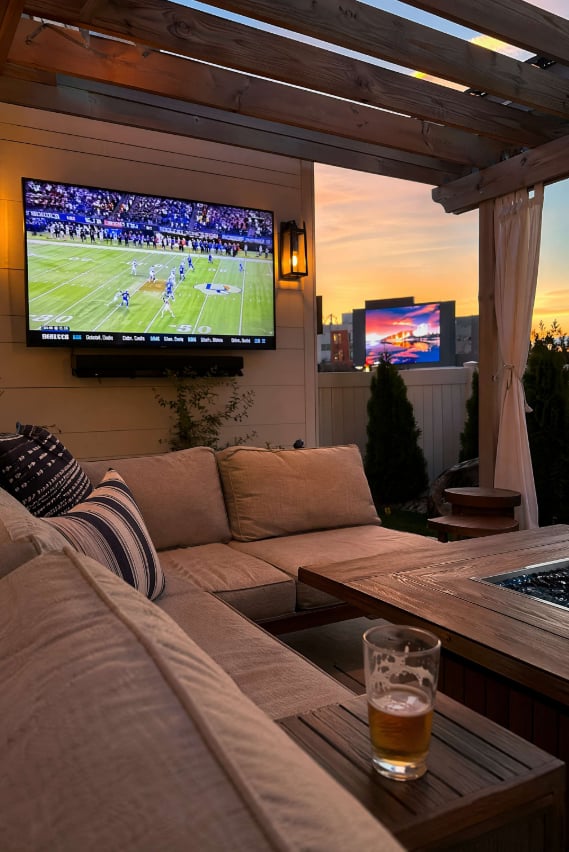
Outdoor TVs are residential-tier products designed for home use:
Digital signage displays are commercial-tier products designed for retail, hospitality, and outdoor advertising:
The categories overlap on basic functionality (both display video outdoors) but diverge sharply on duty cycle, brightness ceiling, and operating expectations.
For comparable size installations:
The 2-3x price premium reflects real engineering differences but represents significant investment when applied to wrong use cases.
Use a residential outdoor TV when:
Residential installations of any kind. Backyard pergolas, covered patios, outdoor kitchens, pool decks. Outdoor TVs are engineered for residential duty cycle (8-12 hours daily use), residential viewing distances, and consumer entertainment content.
Light commercial use under 14 hours daily. Restaurants and bars with outdoor TVs running during business hours but not overnight. Hospitality use where TVs power down at end of business day. Light-use commercial environments where the duty cycle stays within residential rated capacity.
Budget-conscious commercial deployments. Multi-TV restaurant or bar deployments where cost-per-unit at $1,500-$3,500 makes the project financially viable. Premium digital signage at $6,000-$12,000 per unit for the same install kills the budget for most independent operators.
Smart streaming apps required. Outdoor TVs support consumer streaming apps natively (Netflix, sports streaming, ESPN+, etc.). Digital signage displays typically don't include these apps and require external streaming devices or commercial signage software.
For typical US restaurant/bar/residential outdoor TV installs in 2026, the residential outdoor TV category — including the ByteFree BF-55ODTV at $1,499 — is the practical answer. Commercial digital signage is overkill for most use cases.
Use commercial digital signage when:
24/7 continuous operation. Quick service restaurants with outdoor menu boards, gas station displays, transit information signage, retail storefront displays — these run continuously and need products engineered for that duty cycle.
Direct full-sun exposure all day. Outdoor displays that must remain visible during peak afternoon sun without any shade. Highway-adjacent signage, fully exposed retail storefront displays, outdoor restaurant menu boards in fully open environments.
Brand-critical commercial deployments. Premium retail brands, luxury hospitality, corporate headquarters — where the cost of display failure during business hours is significant and the cost of replacement during failure is even more significant.
Centralized signage management. Enterprises managing 50+ outdoor displays across multiple locations need commercial signage software (Scala, BrightSign, Samsung MagicInfo) that residential outdoor TVs don't support. The software platform is often the deciding factor, not the display itself.
Compliance with commercial/insurance requirements. Some commercial deployments require equipment with specific commercial certifications, warranty terms, or service infrastructure that residential outdoor TVs don't provide.
Most buyers face one of three scenarios:
A homeowner buying for their own backyard, or a restaurant owner buying outdoor TVs for a partial-shade patio. Use case is 6-14 hours of daily operation. Smart TV apps for streaming sports and entertainment.
Right choice: Residential outdoor TV. The full price-to-spec advantage of outdoor TVs makes the math work.
A bar running outdoor TVs 16-18 hours daily including peak afternoon sun. A restaurant in a fully exposed beach club setting. A vacation rental property requiring near-continuous operation in challenging environment.
Decision factor: If duty cycle exceeds 14 hours daily AND environment is challenging (full sun, coastal), digital signage may be worth the premium. Otherwise, premium-tier residential outdoor TVs (Samsung The Terrace, SunBrite Cinema) at $3,000-$4,000 deliver most of the digital signage capability at significantly lower cost.
A QSR drive-through outdoor menu board. Highway-adjacent retail storefront display. Multi-location outdoor advertising deployment. Use case is 24/7 operation across all conditions.
Right choice: Commercial digital signage. The duty cycle and environment requirements genuinely exceed what residential outdoor TVs are engineered for.
Common mistakes in this category:
Buying digital signage for residential use. Spending $6,000+ for a residential backyard install where a $1,500 outdoor TV would deliver identical real-world performance. The premium is real engineering investment, but residential use doesn't tap into the capabilities you're paying for.
Buying outdoor TVs for genuine 24/7 commercial use. Saving money on the unit cost but watching residential outdoor TVs fail prematurely under continuous operation. The "savings" become more expensive than digital signage over the install lifecycle.
Underestimating commercial-tier residential outdoor TVs. Samsung The Terrace ($3,500+) and SunBrite Cinema ($3,000+) are residential-tier products with commercial capability margin. For light-to-medium commercial deployments, these deliver 80-90% of digital signage capability at 30-50% of digital signage price.
Overestimating "outdoor TV" branding from non-specialized brands. Some products listed as "outdoor TV" lack the engineering of category leaders. Verify spec sheet rather than brand language.
For a 55-inch outdoor display in 2026:
No. Digital signage displays are commercial-tier products designed for 24/7 operation in challenging environments — typically 2,500-5,000+ nits brightness, IP65+ weatherproofing, no consumer smart TV apps, and commercial signage software for content management. Outdoor TVs are residential-tier products designed for residential use patterns (6-14 hours daily) — typically 1,000-2,500 nits, IP55, smart streaming apps, and consumer-grade duty cycle rating.
Technically yes, but it's significant overkill for residential use. Digital signage at $4,500-$25,000 delivers capabilities (24/7 duty cycle, 2,500-5,000 nit brightness, IP66 weatherproofing) that residential users don't tap into. The same $4,500 spent on a premium-tier residential outdoor TV (Samsung The Terrace, SunBrite Cinema) delivers a much better residential experience including smart apps, audio, and consumer-friendly interface.
When duty cycle exceeds 14 hours daily continuously, when environment requires sustained 2,500+ nits brightness in full sun, or when commercial signage management software is required. For most US restaurant, bar, and hospitality outdoor TV deployments, residential outdoor TVs (especially mid-to-premium tier) handle the requirements without needing digital signage.
Entry-level commercial digital signage displays for outdoor use start around $4,500 for 55-inch sizes. Below that price point, products marketed as "digital signage" typically don't have the duty cycle ratings or warranty terms that justify the category positioning.
For most US restaurants with outdoor TV installs running during business hours (typically 8-14 hours daily), residential outdoor TVs deliver the right spec at the right price. Mid-tier outdoor TVs at $1,499-$1,699 (ByteFree BF-55ODTV, Sylvox DeckPro 2.0+) handle restaurant duty cycle without requiring commercial digital signage premium. For premium hospitality or 24/7 establishments (resort pool bars open continuously, beachfront restaurants with all-day operation), step up to premium-tier outdoor TVs ($3,000-$4,000) before considering true digital signage.
Outdoor TVs and digital signage are different product categories serving different use cases. The price gap (2-3x) reflects real engineering differences but represents significant overspending when applied to wrong use cases.
Use residential outdoor TV when:
Use commercial digital signage when:
For typical US residential and light-commercial outdoor TV needs in 2026, the ByteFree BF-55ODTV at $1,499 represents the right spec match — 1,500 nits, IP55, all-metal, Dolby Vision support, 30W hardware Atmos audio. Mid-tier residential outdoor TVs cover 80-90% of all real-world outdoor display use cases at 25-40% of digital signage prices.
Don't pay digital signage premium for residential use you'll never push the spec on. Don't put residential outdoor TVs into 24/7 commercial duty cycles they aren't engineered for. Match the product category to the actual use case.
Related reading:
Here's the honest comparison — what each category actually means, when the price premium for digital signage is justified, and which one fits your install.
What Each Product Category Actually Means
Outdoor TVs are residential-tier products designed for home use:
- Brightness 1,000-2,500 nits
- IP55 weatherproofing standard
- Smart TV platform with consumer streaming apps
- Standard HDMI inputs
- Operating temperature 32°F-122°F (or wider for cold-climate models)
- Typical lifespan 7-10 years in residential duty cycle
Digital signage displays are commercial-tier products designed for retail, hospitality, and outdoor advertising:
- Brightness 2,500-5,000+ nits
- IP65 or IP66 weatherproofing
- Commercial signage software (no consumer streaming apps)
- Often DisplayPort or commercial-grade HDMI
- Operating temperature -22°F to 122°F
- 24/7 operation rated for 5-7 years continuous use
The categories overlap on basic functionality (both display video outdoors) but diverge sharply on duty cycle, brightness ceiling, and operating expectations.
The Price Gap
For comparable size installations:
| Use Case | Outdoor TV Option | Digital Signage Option |
|---|---|---|
| 55-inch residential | $899-$1,699 | N/A (digital signage rarely sized this small) |
| 55-inch commercial | $1,499-$3,500 | $4,500-$8,000 |
| 65-inch commercial | $1,899-$4,500 | $6,000-$12,000 |
| 75-inch commercial | $2,800-$5,500 | $9,000-$18,000 |
| 85-inch commercial | $4,500-$8,000 | $14,000-$25,000 |
The 2-3x price premium reflects real engineering differences but represents significant investment when applied to wrong use cases.
When Outdoor TV Fits
Use a residential outdoor TV when:
Residential installations of any kind. Backyard pergolas, covered patios, outdoor kitchens, pool decks. Outdoor TVs are engineered for residential duty cycle (8-12 hours daily use), residential viewing distances, and consumer entertainment content.
Light commercial use under 14 hours daily. Restaurants and bars with outdoor TVs running during business hours but not overnight. Hospitality use where TVs power down at end of business day. Light-use commercial environments where the duty cycle stays within residential rated capacity.
Budget-conscious commercial deployments. Multi-TV restaurant or bar deployments where cost-per-unit at $1,500-$3,500 makes the project financially viable. Premium digital signage at $6,000-$12,000 per unit for the same install kills the budget for most independent operators.
Smart streaming apps required. Outdoor TVs support consumer streaming apps natively (Netflix, sports streaming, ESPN+, etc.). Digital signage displays typically don't include these apps and require external streaming devices or commercial signage software.
For typical US restaurant/bar/residential outdoor TV installs in 2026, the residential outdoor TV category — including the ByteFree BF-55ODTV at $1,499 — is the practical answer. Commercial digital signage is overkill for most use cases.
When Digital Signage Fits
Use commercial digital signage when:
24/7 continuous operation. Quick service restaurants with outdoor menu boards, gas station displays, transit information signage, retail storefront displays — these run continuously and need products engineered for that duty cycle.
Direct full-sun exposure all day. Outdoor displays that must remain visible during peak afternoon sun without any shade. Highway-adjacent signage, fully exposed retail storefront displays, outdoor restaurant menu boards in fully open environments.
Brand-critical commercial deployments. Premium retail brands, luxury hospitality, corporate headquarters — where the cost of display failure during business hours is significant and the cost of replacement during failure is even more significant.
Centralized signage management. Enterprises managing 50+ outdoor displays across multiple locations need commercial signage software (Scala, BrightSign, Samsung MagicInfo) that residential outdoor TVs don't support. The software platform is often the deciding factor, not the display itself.
Compliance with commercial/insurance requirements. Some commercial deployments require equipment with specific commercial certifications, warranty terms, or service infrastructure that residential outdoor TVs don't provide.
The Real-World Decision Matrix
Most buyers face one of three scenarios:
Scenario A: Residential or Light Commercial
A homeowner buying for their own backyard, or a restaurant owner buying outdoor TVs for a partial-shade patio. Use case is 6-14 hours of daily operation. Smart TV apps for streaming sports and entertainment.
Right choice: Residential outdoor TV. The full price-to-spec advantage of outdoor TVs makes the math work.
Scenario B: Demanding Commercial Use
A bar running outdoor TVs 16-18 hours daily including peak afternoon sun. A restaurant in a fully exposed beach club setting. A vacation rental property requiring near-continuous operation in challenging environment.
Decision factor: If duty cycle exceeds 14 hours daily AND environment is challenging (full sun, coastal), digital signage may be worth the premium. Otherwise, premium-tier residential outdoor TVs (Samsung The Terrace, SunBrite Cinema) at $3,000-$4,000 deliver most of the digital signage capability at significantly lower cost.
Scenario C: True 24/7 Industrial Use
A QSR drive-through outdoor menu board. Highway-adjacent retail storefront display. Multi-location outdoor advertising deployment. Use case is 24/7 operation across all conditions.
Right choice: Commercial digital signage. The duty cycle and environment requirements genuinely exceed what residential outdoor TVs are engineered for.
What Most Buyers Get Wrong
Common mistakes in this category:
Buying digital signage for residential use. Spending $6,000+ for a residential backyard install where a $1,500 outdoor TV would deliver identical real-world performance. The premium is real engineering investment, but residential use doesn't tap into the capabilities you're paying for.
Buying outdoor TVs for genuine 24/7 commercial use. Saving money on the unit cost but watching residential outdoor TVs fail prematurely under continuous operation. The "savings" become more expensive than digital signage over the install lifecycle.
Underestimating commercial-tier residential outdoor TVs. Samsung The Terrace ($3,500+) and SunBrite Cinema ($3,000+) are residential-tier products with commercial capability margin. For light-to-medium commercial deployments, these deliver 80-90% of digital signage capability at 30-50% of digital signage price.
Overestimating "outdoor TV" branding from non-specialized brands. Some products listed as "outdoor TV" lack the engineering of category leaders. Verify spec sheet rather than brand language.
The Spec Sheet Comparison
For a 55-inch outdoor display in 2026:
| Spec | Residential Outdoor TV | Commercial Digital Signage |
|---|---|---|
| Brightness | 1,000-2,500 nits | 2,500-5,000+ nits |
| IP rating | IP55 standard | IP65-IP66 |
| Duty cycle rating | 8-14 hours daily | 24 hours daily |
| Operating temperature | 32°F-122°F (residential) or -22°F-122°F (cold-climate models) | -22°F-122°F universal |
| Smart platform | Google TV, Tizen, Android TV, webOS | Commercial signage software (separate purchase) |
| Audio | 15-30W built-in speakers | Often no speakers (audio is separate system) |
| HDMI inputs | 3-4 standard consumer | 1-2 commercial-grade |
| Streaming apps | Native (Netflix, etc.) | Not included |
| Warranty | 2-3 years residential | 3-5 years commercial |
| Service infrastructure | Consumer support | Commercial AV integrators |
Frequently Asked Questions
Is digital signage the same as an outdoor TV?
No. Digital signage displays are commercial-tier products designed for 24/7 operation in challenging environments — typically 2,500-5,000+ nits brightness, IP65+ weatherproofing, no consumer smart TV apps, and commercial signage software for content management. Outdoor TVs are residential-tier products designed for residential use patterns (6-14 hours daily) — typically 1,000-2,500 nits, IP55, smart streaming apps, and consumer-grade duty cycle rating.
Can I use digital signage as an outdoor TV?
Technically yes, but it's significant overkill for residential use. Digital signage at $4,500-$25,000 delivers capabilities (24/7 duty cycle, 2,500-5,000 nit brightness, IP66 weatherproofing) that residential users don't tap into. The same $4,500 spent on a premium-tier residential outdoor TV (Samsung The Terrace, SunBrite Cinema) delivers a much better residential experience including smart apps, audio, and consumer-friendly interface.
When does outdoor TV become inadequate compared to digital signage?
When duty cycle exceeds 14 hours daily continuously, when environment requires sustained 2,500+ nits brightness in full sun, or when commercial signage management software is required. For most US restaurant, bar, and hospitality outdoor TV deployments, residential outdoor TVs (especially mid-to-premium tier) handle the requirements without needing digital signage.
What's the cheapest digital signage display?
Entry-level commercial digital signage displays for outdoor use start around $4,500 for 55-inch sizes. Below that price point, products marketed as "digital signage" typically don't have the duty cycle ratings or warranty terms that justify the category positioning.
Should I buy outdoor TV or digital signage for my restaurant?
For most US restaurants with outdoor TV installs running during business hours (typically 8-14 hours daily), residential outdoor TVs deliver the right spec at the right price. Mid-tier outdoor TVs at $1,499-$1,699 (ByteFree BF-55ODTV, Sylvox DeckPro 2.0+) handle restaurant duty cycle without requiring commercial digital signage premium. For premium hospitality or 24/7 establishments (resort pool bars open continuously, beachfront restaurants with all-day operation), step up to premium-tier outdoor TVs ($3,000-$4,000) before considering true digital signage.
Summary
Outdoor TVs and digital signage are different product categories serving different use cases. The price gap (2-3x) reflects real engineering differences but represents significant overspending when applied to wrong use cases.
Use residential outdoor TV when:
- Residential installations
- Light to medium commercial use (under 14 hours daily)
- Smart streaming apps required
- Budget-conscious deployments
Use commercial digital signage when:
- True 24/7 continuous operation
- Direct full-sun exposure all day
- Centralized signage management required
- Premium commercial deployments where failure cost is significant
For typical US residential and light-commercial outdoor TV needs in 2026, the ByteFree BF-55ODTV at $1,499 represents the right spec match — 1,500 nits, IP55, all-metal, Dolby Vision support, 30W hardware Atmos audio. Mid-tier residential outdoor TVs cover 80-90% of all real-world outdoor display use cases at 25-40% of digital signage prices.
Don't pay digital signage premium for residential use you'll never push the spec on. Don't put residential outdoor TVs into 24/7 commercial duty cycles they aren't engineered for. Match the product category to the actual use case.
Related reading:
Attachments
Last edited by a moderator:


