


Catalogs Hide
- 1 Why Commercial Outdoor TV Requirements Are Different
- 2 Key Specs for Commercial Outdoor TV
-
3
Top 5 Commercial Outdoor TVs for Restaurants & Bars in 2026
- 3.1 1. ByteFree BF-55ODTV — Best Value for Mid-Range Commercial Use
- 3.2 2. SunBrite Pro 2 Series — Established Commercial Brand
- 3.3 3. Furrion Aurora Full-Sun — Pool/Resort Restaurant Use
- 3.4 4. Samsung The Terrace LST7D — Premium Commercial Hospitality
- 3.5 5. Sylvox Pool Pro 2.0+ — Best Full-Sun Commercial at Mid-Range
- 4 Multi-TV Configuration Tips for Bars
- 5 Total Cost of Commercial Outdoor TV Installation
-
6
Frequently Asked Questions
- 6.1 Q: What's the best commercial outdoor TV for a restaurant?
- 6.2 Q: How many outdoor TVs does a sports bar need?
- 6.3 Q: Do outdoor TVs need different specs for commercial vs residential use?
- 6.4 Q: What's the ROI on adding outdoor TVs to a restaurant patio?
- 6.5 Q: Can I use residential outdoor TVs in a restaurant?
- 7 Verdict
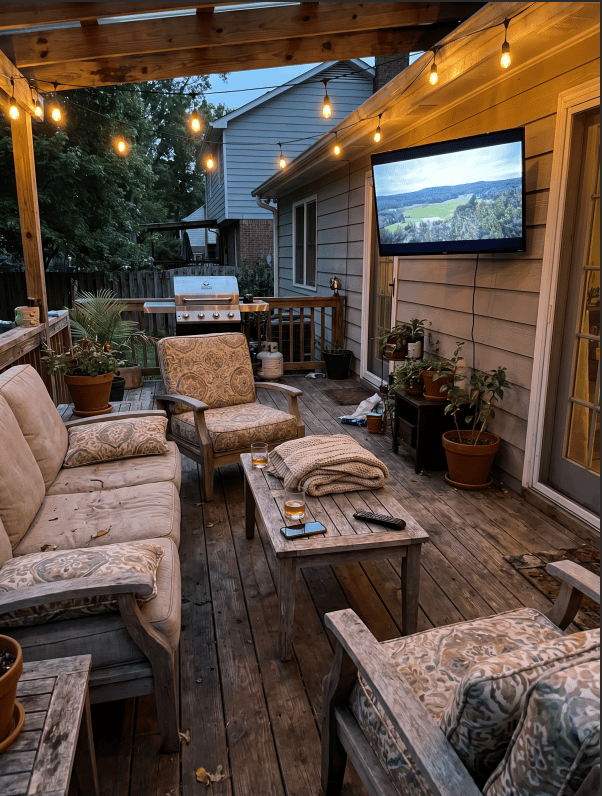
Commercial outdoor TV installs are different from residential ones in ways most buying guides miss. A restaurant patio TV runs 14-16 hours a day, every day, in heat. A sports bar's outdoor TVs survive 200+ guests touching, blocking views, and occasionally spilling drinks. Commercial duty cycle breaks consumer-grade outdoor TVs faster than weather does.
Here's what restaurants, bars, and outdoor dining venues need from outdoor TVs in 2026 — and which models actually hold up to commercial use.
Three things make commercial installs harder than residential:
1. Continuous duty cycle. A residential outdoor TV runs maybe 4-6 hours per day. A restaurant outdoor TV runs 12-16 hours daily, every day, year-round. Panel hours add up fast — at 16 hours/day, a 50,000-hour-rated panel hits its rated lifetime in 8.5 years, vs 22+ years of residential use. Heat dissipation, internal fan reliability, and capacitor longevity all matter more.
2. Sports content drives placement decisions. Bars and restaurants buy outdoor TVs primarily to attract sports-watching customers. NFL Sunday, NBA playoffs, college football season — these drive 30-40% of outdoor seating revenue at sports-focused venues. The TV needs to be visible from every seat at every angle, which usually means multiple TVs instead of one premium unit.
3. Customer behavior includes liability factors. Customers will lean on TVs, brace themselves on mounts, spill drinks near them, and occasionally try to adjust them. Mounting hardware needs to handle this. Glass surfaces need to handle accidental contact. Cable management needs to be tamper-resistant.
These factors usually push commercial buyers toward different products than residential buyers — even for the same patio environment.
Commercial outdoor dining areas typically have less shade coverage than residential patios — full or partial sun exposure during prime daytime hours when the TVs are actually being used. 1,500 nits is the practical minimum; 2,000 nits is preferred for fully exposed installs.
The brightness gap matters more commercially than residentially. Residential viewers will accept some afternoon washout because they can wait until evening. Commercial customers can't — if they can't see the game during lunch service, they go to the competitor down the block.
For most outdoor restaurant patios, IP55 is sufficient. For installs near pool/water features (resort restaurants, pool bars, beach clubs) or where the TV may be hosed down during cleaning, IP65 provides margin. Commercial cleaning crews often use higher-pressure water than residential homeowners — IP65 handles this without issue.
This isn't always a published spec, but it should drive the conversation with vendors. Commercial-grade outdoor TVs are designed for 18-24 hour daily operation. Consumer-grade outdoor TVs are typically engineered for 4-8 hours residential use. Running a consumer outdoor TV at commercial duty cycle voids most warranties and accelerates panel degradation.
How to verify: Ask the manufacturer or dealer specifically about commercial use warranty coverage. Some outdoor TV brands have separate commercial warranty terms; others won't honor warranty claims on consumer units used in commercial settings.
Counterintuitively, smart platform matters less in commercial use than residential. Commercial TVs typically run from a centralized streaming hub (cable box, DirecTV commercial receiver, sports streaming subscription) rather than the TV's built-in apps. The TV is essentially a display, not a smart device.
This frees commercial buyers to prioritize panel quality, brightness, and durability over smart OS sophistication.
Commercial installs in publicly accessible areas (sidewalk seating, beach club patios, bar outdoor decks) need theft-resistant mounting. Use security-screw VESA mounts that can't be removed without specific tools. Budget $50-100 extra per TV for security hardware — a stolen $1,500 TV plus replacement labor far exceeds this margin.
Price: $1,499 | Brightness: 1,500 nits | IP Rating: IP55
For restaurants and bars at the $1,500-tier per-TV budget — typical for mid-range establishments — the ByteFree BF-55ODTV delivers commercial-relevant specs at the right price. 1,500 nits handles outdoor dining environments with normal partial-sun exposure. All-metal construction and IP55 weatherproofing handle daily commercial cleaning.
The 50,000-hour panel rating, combined with 4 internal cooling fans, makes it appropriate for 14-hour daily duty cycles in moderate-climate markets. Operating temperature 32°F-122°F covers warm-climate US commercial use year-round.
Watch outs:
Best for: Mid-tier restaurants and bars in southern US, partial-sun outdoor dining patios, multi-TV installs where per-TV cost matters.
Price: $2,499–$3,299 | Brightness: 1,500–2,000 nits | IP Rating: IP55
SunBrite's commercial line — explicitly marketed and warrantied for commercial use. Established service infrastructure with custom integration partners nationwide. Multi-year commercial warranty options available.
Watch outs: Higher per-unit cost. For multi-TV installations (bars commonly run 6-12 outdoor TVs), the cost difference vs ByteFree compounds significantly.
Best for: Established restaurant chains, premium hospitality, integrator-driven commercial projects, locations where SunBrite's commercial service network adds value.
Price: $5,999–$6,999 | Brightness: 2,500 nits | IP Rating: IP66
Furrion's full-sun commercial line. Designed for fully exposed environments — beach clubs, pool bars, rooftop restaurants, resort outdoor dining. The IP66 rating is meaningfully better than IP55 for high-water-exposure environments where commercial cleaning crews use pressure washing.
Watch outs: Premium pricing makes sense only for fully exposed installs that genuinely need 2,500 nits and IP66. Overkill for typical covered restaurant patios.
Best for: Resort and beach club restaurant installations, fully exposed outdoor bars, locations where the install warrants premium spec investment.
Price: $3,497+ | Brightness: 2,000 nits | IP Rating: IP55
For hospitality venues where the outdoor TV is part of the premium customer experience — luxury hotel pool decks, high-end resort restaurants, premium private clubs — Samsung Terrace delivers brand prestige alongside spec performance. QLED panel quality, Tizen ecosystem (useful when integrated with Samsung commercial signage systems), 2,000-nit brightness.
Watch outs: Pricing makes multi-TV deployments expensive ($14,000+ for 4 outdoor TVs). For most commercial installs, the brand premium doesn't justify cost over Sylvox Pool Pro 2.0+ or SunBrite Pro 2.
Best for: Luxury hotels, high-end resorts, properties where Samsung brand recognition is part of the customer experience.
Price: $2,399 | Brightness: 2,000 nits | IP Rating: IP55
For commercial pool restaurants and uncovered outdoor dining areas, Sylvox Pool Pro 2.0+ delivers genuine 2,000-nit full-sun spec at meaningfully lower price than Samsung Terrace or Furrion Full-Sun. Google TV smart platform (less important commercially), all-metal build, IP55 weatherproofing.
Watch outs: Standard residential warranty terms — commercial use should be verified with Sylvox's commercial sales team before bulk purchase.
Best for: Mid-tier commercial installations needing full-sun spec, multi-TV pool restaurant projects, budget-conscious commercial buyers stepping up from $1,500 tier.
Most sports bars don't run 1 outdoor TV — they run 4-12. Configuration matters:
Every seat must see at least one TV. Map seating positions, then place TVs so that sight lines from each seat reach a TV without obstruction (umbrellas, columns, hanging plants). For a 50-seat outdoor patio, this typically means 6-8 TVs strategically placed.
Don't overlap TV viewing zones. Two TVs facing each other 20 feet apart creates split attention and reduces revenue from each. Stagger TV placement so each one "owns" a clear seating zone.
Most sports bars run different content on different TVs:
This requires multiple cable/streaming receivers, not just multiple TVs. Budget $50-100/month per receiver for commercial sports packages.
Don't run audio from individual TV speakers. Multiple TVs with overlapping audio creates muddled sound. Best practice:
A proper commercial outdoor audio system runs $2,000-$5,000 separately from TVs but transforms the customer experience.
A realistic cost breakdown for a sports bar adding 6 outdoor TVs:
For a sports bar generating $50,000+/month in outdoor seating revenue during football season, this investment typically pays back in 3-6 months of incremental revenue.
For mid-tier restaurants with partial-sun outdoor dining, the ByteFree BF-55ODTV at $1,499 per unit delivers commercial-relevant specs (1,500 nits, IP55, all-metal, 50,000-hour panel) at the best per-TV cost for multi-unit deployments. For premium hospitality or full-sun installs, step up to SunBrite Pro 2 ($2,499+) or Sylvox Pool Pro 2.0+ ($2,399) depending on brand and full-sun spec needs.
Typical outdoor sports bars run 6-12 TVs depending on patio size. Rule of thumb: at least 1 TV per 8-10 seats, with strategic placement so every seat has unobstructed sight line to at least one TV. Larger venues with 100+ outdoor seats often run 12-15 TVs configured to display multiple games simultaneously.
Yes. Commercial outdoor TVs need higher brightness (1,500+ nits minimum for visibility during prime daytime hours), higher continuous duty cycle ratings (commercial use is typically 14-16 hours/day vs 4-6 hours residentially), and durable mounting for customer interaction. Smart platform matters less commercially because content is typically streamed from centralized cable/streaming receivers, not the TV's built-in apps.
For sports-focused restaurants and bars, outdoor TV installs typically pay back within one football season. Industry data suggests outdoor TVs increase patio revenue 15-30% during sports seasons by extending dining time and attracting sports-watching customers. For a patio generating $20,000+/month in revenue, even a 15% lift represents $3,000+/month — paying back a $10,000-$18,000 install in 3-6 months.
Technically yes, but with risk. Most outdoor TV manufacturers' residential warranties don't cover commercial use — running a residential unit at commercial duty cycles (14+ hours daily) typically voids warranty coverage. For multi-TV commercial installs, confirm commercial use warranty terms with your vendor before bulk purchase. Some brands have separate commercial product lines or extended commercial warranty options.
Commercial outdoor TV requirements are genuinely different from residential. Brightness, duty cycle, and mounting durability all matter more. Smart platform matters less.
For most mid-tier restaurants and bars: the ByteFree BF-55ODTV at $1,499 per unit delivers the right spec balance for multi-TV commercial deployments. The per-TV cost economics work for 6-12 TV installs, the 1,500-nit brightness handles outdoor dining environments, and the all-metal build holds up to commercial cleaning routines.
For premium hospitality: SunBrite Pro 2 or Samsung Terrace earn their premium for venues where brand and aesthetics are part of the customer experience.
For pool restaurants and full-sun installs: Sylvox Pool Pro 2.0+ or Furrion Full-Sun deliver the brightness needed without Samsung Terrace pricing.
The most important commercial-specific decision: verify warranty terms for commercial use before bulk purchase. Many outdoor TVs are warrantied for residential use only — finding this out after a 6-TV deployment fails in year 2 is an expensive lesson.
Related reading:
Here's what restaurants, bars, and outdoor dining venues need from outdoor TVs in 2026 — and which models actually hold up to commercial use.
Why Commercial Outdoor TV Requirements Are Different
Three things make commercial installs harder than residential:
1. Continuous duty cycle. A residential outdoor TV runs maybe 4-6 hours per day. A restaurant outdoor TV runs 12-16 hours daily, every day, year-round. Panel hours add up fast — at 16 hours/day, a 50,000-hour-rated panel hits its rated lifetime in 8.5 years, vs 22+ years of residential use. Heat dissipation, internal fan reliability, and capacitor longevity all matter more.
2. Sports content drives placement decisions. Bars and restaurants buy outdoor TVs primarily to attract sports-watching customers. NFL Sunday, NBA playoffs, college football season — these drive 30-40% of outdoor seating revenue at sports-focused venues. The TV needs to be visible from every seat at every angle, which usually means multiple TVs instead of one premium unit.
3. Customer behavior includes liability factors. Customers will lean on TVs, brace themselves on mounts, spill drinks near them, and occasionally try to adjust them. Mounting hardware needs to handle this. Glass surfaces need to handle accidental contact. Cable management needs to be tamper-resistant.
These factors usually push commercial buyers toward different products than residential buyers — even for the same patio environment.
Key Specs for Commercial Outdoor TV
Brightness: 1,500+ Nits Mandatory
Commercial outdoor dining areas typically have less shade coverage than residential patios — full or partial sun exposure during prime daytime hours when the TVs are actually being used. 1,500 nits is the practical minimum; 2,000 nits is preferred for fully exposed installs.
The brightness gap matters more commercially than residentially. Residential viewers will accept some afternoon washout because they can wait until evening. Commercial customers can't — if they can't see the game during lunch service, they go to the competitor down the block.
IP55 Minimum, IP65 Preferred for Pool/Spray Installs
For most outdoor restaurant patios, IP55 is sufficient. For installs near pool/water features (resort restaurants, pool bars, beach clubs) or where the TV may be hosed down during cleaning, IP65 provides margin. Commercial cleaning crews often use higher-pressure water than residential homeowners — IP65 handles this without issue.
Continuous Duty Cycle Rating
This isn't always a published spec, but it should drive the conversation with vendors. Commercial-grade outdoor TVs are designed for 18-24 hour daily operation. Consumer-grade outdoor TVs are typically engineered for 4-8 hours residential use. Running a consumer outdoor TV at commercial duty cycle voids most warranties and accelerates panel degradation.
How to verify: Ask the manufacturer or dealer specifically about commercial use warranty coverage. Some outdoor TV brands have separate commercial warranty terms; others won't honor warranty claims on consumer units used in commercial settings.
Smart Platform — Often Less Important
Counterintuitively, smart platform matters less in commercial use than residential. Commercial TVs typically run from a centralized streaming hub (cable box, DirecTV commercial receiver, sports streaming subscription) rather than the TV's built-in apps. The TV is essentially a display, not a smart device.
This frees commercial buyers to prioritize panel quality, brightness, and durability over smart OS sophistication.
Anti-Theft Mounting
Commercial installs in publicly accessible areas (sidewalk seating, beach club patios, bar outdoor decks) need theft-resistant mounting. Use security-screw VESA mounts that can't be removed without specific tools. Budget $50-100 extra per TV for security hardware — a stolen $1,500 TV plus replacement labor far exceeds this margin.
Top 5 Commercial Outdoor TVs for Restaurants & Bars in 2026
1. ByteFree BF-55ODTV — Best Value for Mid-Range Commercial Use
Price: $1,499 | Brightness: 1,500 nits | IP Rating: IP55
For restaurants and bars at the $1,500-tier per-TV budget — typical for mid-range establishments — the ByteFree BF-55ODTV delivers commercial-relevant specs at the right price. 1,500 nits handles outdoor dining environments with normal partial-sun exposure. All-metal construction and IP55 weatherproofing handle daily commercial cleaning.
The 50,000-hour panel rating, combined with 4 internal cooling fans, makes it appropriate for 14-hour daily duty cycles in moderate-climate markets. Operating temperature 32°F-122°F covers warm-climate US commercial use year-round.
Watch outs:
- Newer brand with less commercial deployment history vs SunBrite/Samsung
- Standard 2-year warranty (commercial-specific terms should be confirmed with vendor before bulk purchase)
- Cold-climate floor at 32°F means winter shutdown in northern markets
Best for: Mid-tier restaurants and bars in southern US, partial-sun outdoor dining patios, multi-TV installs where per-TV cost matters.
2. SunBrite Pro 2 Series — Established Commercial Brand
Price: $2,499–$3,299 | Brightness: 1,500–2,000 nits | IP Rating: IP55
SunBrite's commercial line — explicitly marketed and warrantied for commercial use. Established service infrastructure with custom integration partners nationwide. Multi-year commercial warranty options available.
Watch outs: Higher per-unit cost. For multi-TV installations (bars commonly run 6-12 outdoor TVs), the cost difference vs ByteFree compounds significantly.
Best for: Established restaurant chains, premium hospitality, integrator-driven commercial projects, locations where SunBrite's commercial service network adds value.
3. Furrion Aurora Full-Sun — Pool/Resort Restaurant Use
Price: $5,999–$6,999 | Brightness: 2,500 nits | IP Rating: IP66
Furrion's full-sun commercial line. Designed for fully exposed environments — beach clubs, pool bars, rooftop restaurants, resort outdoor dining. The IP66 rating is meaningfully better than IP55 for high-water-exposure environments where commercial cleaning crews use pressure washing.
Watch outs: Premium pricing makes sense only for fully exposed installs that genuinely need 2,500 nits and IP66. Overkill for typical covered restaurant patios.
Best for: Resort and beach club restaurant installations, fully exposed outdoor bars, locations where the install warrants premium spec investment.
4. Samsung The Terrace LST7D — Premium Commercial Hospitality
Price: $3,497+ | Brightness: 2,000 nits | IP Rating: IP55
For hospitality venues where the outdoor TV is part of the premium customer experience — luxury hotel pool decks, high-end resort restaurants, premium private clubs — Samsung Terrace delivers brand prestige alongside spec performance. QLED panel quality, Tizen ecosystem (useful when integrated with Samsung commercial signage systems), 2,000-nit brightness.
Watch outs: Pricing makes multi-TV deployments expensive ($14,000+ for 4 outdoor TVs). For most commercial installs, the brand premium doesn't justify cost over Sylvox Pool Pro 2.0+ or SunBrite Pro 2.
Best for: Luxury hotels, high-end resorts, properties where Samsung brand recognition is part of the customer experience.
5. Sylvox Pool Pro 2.0+ — Best Full-Sun Commercial at Mid-Range
Price: $2,399 | Brightness: 2,000 nits | IP Rating: IP55
For commercial pool restaurants and uncovered outdoor dining areas, Sylvox Pool Pro 2.0+ delivers genuine 2,000-nit full-sun spec at meaningfully lower price than Samsung Terrace or Furrion Full-Sun. Google TV smart platform (less important commercially), all-metal build, IP55 weatherproofing.
Watch outs: Standard residential warranty terms — commercial use should be verified with Sylvox's commercial sales team before bulk purchase.
Best for: Mid-tier commercial installations needing full-sun spec, multi-TV pool restaurant projects, budget-conscious commercial buyers stepping up from $1,500 tier.
Multi-TV Configuration Tips for Bars
Most sports bars don't run 1 outdoor TV — they run 4-12. Configuration matters:
Sight Line Planning
Every seat must see at least one TV. Map seating positions, then place TVs so that sight lines from each seat reach a TV without obstruction (umbrellas, columns, hanging plants). For a 50-seat outdoor patio, this typically means 6-8 TVs strategically placed.
Don't overlap TV viewing zones. Two TVs facing each other 20 feet apart creates split attention and reduces revenue from each. Stagger TV placement so each one "owns" a clear seating zone.
Channel Strategy
Most sports bars run different content on different TVs:
- 2-3 TVs on the marquee game (NFL Sunday Night, NBA Finals, etc.)
- 2-3 TVs on secondary games (other NFL games, Premier League, golf)
- 1-2 TVs on horse racing, mixed sports highlights, or background content
This requires multiple cable/streaming receivers, not just multiple TVs. Budget $50-100/month per receiver for commercial sports packages.
Audio Strategy
Don't run audio from individual TV speakers. Multiple TVs with overlapping audio creates muddled sound. Best practice:
- Outdoor commercial speaker zones (Yamaha, JBL, or QSC outdoor commercial speakers)
- Audio routed from one TV/source to the entire patio
- Different zones can have different audio sources for different sport games
A proper commercial outdoor audio system runs $2,000-$5,000 separately from TVs but transforms the customer experience.
Mounting and Cable Management
- All cables in conduit — no exposed cables in commercial spaces
- Outdoor-rated outlets behind every TV — no extension cords (code violation)
- Security-screw VESA mounting — anti-theft hardware on all customer-accessible installs
- Service-clearance behind TVs — schedule maintenance access for filter cleaning, fan replacement
Total Cost of Commercial Outdoor TV Installation
A realistic cost breakdown for a sports bar adding 6 outdoor TVs:
| Line Item | Cost Range |
|---|---|
| 6× outdoor TVs ($1,499 each) | $8,994 |
| 6× commercial wall mounts with security hardware | $900 |
| Outdoor-rated cables and conduit | $400 |
| Commercial outdoor speaker system | $3,000 |
| 4× cable/streaming receivers | $1,200 |
| Electrical work (6 outdoor outlets, GFCI) | $2,000 |
| Professional installation labor | $2,000 |
| Total | ~$18,500 |
For a sports bar generating $50,000+/month in outdoor seating revenue during football season, this investment typically pays back in 3-6 months of incremental revenue.
Frequently Asked Questions
Q: What's the best commercial outdoor TV for a restaurant?
For mid-tier restaurants with partial-sun outdoor dining, the ByteFree BF-55ODTV at $1,499 per unit delivers commercial-relevant specs (1,500 nits, IP55, all-metal, 50,000-hour panel) at the best per-TV cost for multi-unit deployments. For premium hospitality or full-sun installs, step up to SunBrite Pro 2 ($2,499+) or Sylvox Pool Pro 2.0+ ($2,399) depending on brand and full-sun spec needs.
Q: How many outdoor TVs does a sports bar need?
Typical outdoor sports bars run 6-12 TVs depending on patio size. Rule of thumb: at least 1 TV per 8-10 seats, with strategic placement so every seat has unobstructed sight line to at least one TV. Larger venues with 100+ outdoor seats often run 12-15 TVs configured to display multiple games simultaneously.
Q: Do outdoor TVs need different specs for commercial vs residential use?
Yes. Commercial outdoor TVs need higher brightness (1,500+ nits minimum for visibility during prime daytime hours), higher continuous duty cycle ratings (commercial use is typically 14-16 hours/day vs 4-6 hours residentially), and durable mounting for customer interaction. Smart platform matters less commercially because content is typically streamed from centralized cable/streaming receivers, not the TV's built-in apps.
Q: What's the ROI on adding outdoor TVs to a restaurant patio?
For sports-focused restaurants and bars, outdoor TV installs typically pay back within one football season. Industry data suggests outdoor TVs increase patio revenue 15-30% during sports seasons by extending dining time and attracting sports-watching customers. For a patio generating $20,000+/month in revenue, even a 15% lift represents $3,000+/month — paying back a $10,000-$18,000 install in 3-6 months.
Q: Can I use residential outdoor TVs in a restaurant?
Technically yes, but with risk. Most outdoor TV manufacturers' residential warranties don't cover commercial use — running a residential unit at commercial duty cycles (14+ hours daily) typically voids warranty coverage. For multi-TV commercial installs, confirm commercial use warranty terms with your vendor before bulk purchase. Some brands have separate commercial product lines or extended commercial warranty options.
Verdict
Commercial outdoor TV requirements are genuinely different from residential. Brightness, duty cycle, and mounting durability all matter more. Smart platform matters less.
For most mid-tier restaurants and bars: the ByteFree BF-55ODTV at $1,499 per unit delivers the right spec balance for multi-TV commercial deployments. The per-TV cost economics work for 6-12 TV installs, the 1,500-nit brightness handles outdoor dining environments, and the all-metal build holds up to commercial cleaning routines.
For premium hospitality: SunBrite Pro 2 or Samsung Terrace earn their premium for venues where brand and aesthetics are part of the customer experience.
For pool restaurants and full-sun installs: Sylvox Pool Pro 2.0+ or Furrion Full-Sun deliver the brightness needed without Samsung Terrace pricing.
The most important commercial-specific decision: verify warranty terms for commercial use before bulk purchase. Many outdoor TVs are warrantied for residential use only — finding this out after a 6-TV deployment fails in year 2 is an expensive lesson.
Related reading:

