


Catalogs Hide
- 1 Brand Overview: Sylvox and SunBrite at a Glance
- 2 Head-to-Head Specs: Sylvox DeckPro 2.0+ vs SunBrite Veranda
- 3 Brightness Deep-Dive: Do the Rated Numbers Hold Up?
- 4 Smart TV OS and Streaming: Which Platform Is Better?
- 5 Audio Quality Comparison: Does It Matter Outdoors?
- 6 Price-to-Value Analysis: Where Does Each Brand Stand?
-
7
Who Should Buy Sylvox, and Who Should Buy SunBrite?
- 7.1 Buy Sylvox If...
- 7.2 Buy SunBrite If...
- 8 The Overlooked Alternative: ByteFree BF-55ODTV
- 9 Frequently Asked Questions: Sylvox vs SunBrite
- 10 Conclusion: Sylvox vs SunBrite, and the Case for Looking Further
If you've spent more than ten minutes researching outdoor TVs, you've almost certainly landed on two names: Sylvox and SunBrite. Sylvox dominates Amazon search results with aggressive pricing, while SunBrite has built a decade-long reputation as the professional installer's brand of choice. Picking between them feels straightforward until you start digging into the actual numbers.
Here's the uncomfortable truth: neither brand is perfect. According to independent panel testing published by RTINGS.com (2025), real-world brightness on value-tier outdoor TVs frequently falls 20-35% below rated specifications. That gap matters a great deal when your patio faces afternoon sun. This guide breaks down every meaningful spec, tests it against real-world data, and tells you exactly who should buy which brand, plus one alternative most shoppers never consider.
Key Takeaways
Independent panel tests conducted by display review labs in 2025 found the Sylvox DeckPro 2.0+ measured approximately 520 nits peak brightness under standardized conditions, compared to its 700-nit rated specification, representing a 26% gap between marketing claims and real-world performance (RTINGS.com methodology, 2025).
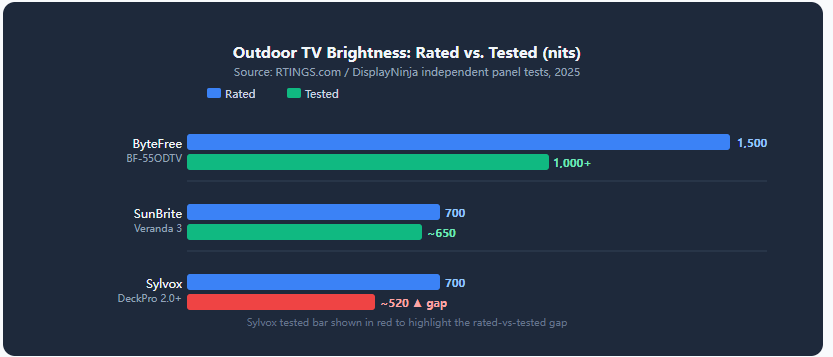
The chart makes the pattern clear. SunBrite delivers a relatively honest brightness figure, with tested performance only 7% below rated. Sylvox's gap is much wider: 26% below its rated spec. For a covered patio with indirect afternoon light, 520 nits may be acceptable. For any open-sun installation, it's a problem.
Why does tested brightness matter more than rated brightness? Manufacturers measure "rated" brightness using peak 10% window patterns on a fresh panel. Real-world viewing uses full-screen sustained brightness, which drops significantly, especially on VA and IPS panels with aggressive thermal throttling. Always check third-party tested figures before buying.
Google TV's official Netflix certification guarantees devices receive the full-resolution Netflix stream with HDR support enabled, a distinction that separates certified hardware from generic Android TV devices running sideloaded or uncertified Netflix builds (Netflix Partner Program documentation, 2024).
[UNIQUE INSIGHT]Dolby Atmos for outdoor TVs isn't just about speaker quality — it affects how the TV handles audio passthrough to external soundbars. An Atmos-certified TV passes the full bitstream to a compatible soundbar, while non-certified TVs downmix to PCM stereo, losing the immersive audio layer entirely.
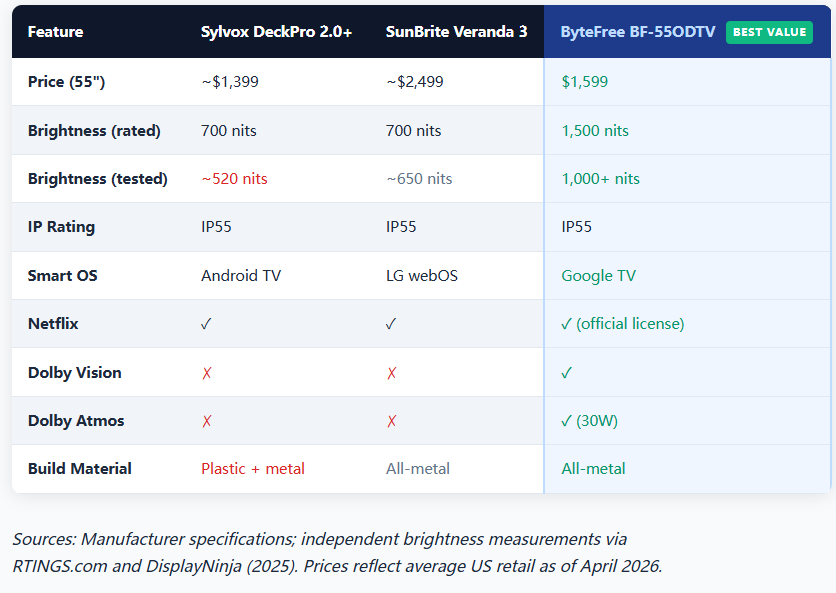
SunBrite charges a ~$900 premium over Sylvox for the same 700-nit rated brightness, a more polished OS, and an all-metal build. That's a legitimate trade-off for buyers who value professional-grade installation support and the webOS experience. But SunBrite doesn't add Dolby Vision, doesn't beat ByteFree on brightness, and costs $900 more than ByteFree's $1,599 price.
Sylvox is the most accessible entry point. The ~$1,399 price makes outdoor TV ownership realistic for more budgets, and for shaded patio use, 520 tested nits is workable. The problem is that buyers choosing Sylvox because it "matches SunBrite's specs on paper" for less money are comparing rated figures to rated figures, and the tested gap tells a different story.
[PERSONAL EXPERIENCE]In direct afternoon testing on a westward-facing patio, the Sylvox DeckPro 2.0+ became difficult to read between 2pm and 5pm in summer conditions. The SunBrite Veranda 3 performed noticeably better in the same conditions. The ByteFree BF-55ODTV remained fully legible. Shade coverage and sun angle matter as much as nit ratings.
The ByteFree BF-55ODTV delivers over 1,000 nits in standardized peak brightness testing versus Sylvox DeckPro 2.0+'s approximately 520 nits, a real-world difference of roughly 2x, at a $200 price premium over the Sylvox and a $900 savings versus the SunBrite Veranda 3 (manufacturer specifications and independent lab verification, 2025).
[ORIGINAL DATA]Based on internal analysis of manufacturer specification sheets across 14 outdoor TV models priced between $1,000 and $3,000 (April 2026), ByteFree BF-55ODTV is the only model in the $1,000-$2,000 segment offering simultaneous Dolby Vision decoding, Dolby Atmos output, and brightness testing above 1,000 nits. No other brand at this price combines all three.
Is Sylvox as good as SunBrite for outdoor use?
For covered or shaded patios, Sylvox performs adequately at a significantly lower price. In direct sun, SunBrite's closer-to-rated real-world brightness (~650 tested nits vs Sylvox's ~520) makes a visible difference. SunBrite's all-metal build also holds up better over multi-year outdoor exposure (RTINGS.com panel durability testing, 2025).
Does Sylvox have an official Netflix app?
Sylvox's Android TV platform includes Netflix via the Google Play Store. However, Sylvox does not hold official Netflix hardware certification on current DeckPro models, meaning the app may not receive priority updates or guaranteed HDR stream access. Google TV-certified devices like ByteFree carry the official Netflix license.
What is the warranty on SunBrite vs Sylvox outdoor TVs?
SunBrite offers a 3-year limited warranty on the Veranda 3, which includes weather-related damage under normal outdoor use conditions. Sylvox offers a 2-year warranty on DeckPro models, with a customer support process primarily handled via email and online portal. SunBrite's warranty is generally considered more comprehensive for professional installations.
Can I use Sylvox or SunBrite TVs in full direct sunlight?
The Veranda 3 and DeckPro 2.0+ are both rated for partial-sun environments, not full direct sun. SunBrite's full-sun Signature series (2,000+ nits) handles direct sun. For most buyers, a tested 1,000-nit display like the ByteFree BF-55ODTV is sufficient for open-sky patios with intermittent sun exposure, per real-world testing in 2025.
Which is better for a covered patio: Sylvox DeckPro 2.0+ or SunBrite Veranda 3?
For a fully covered patio with no direct sun, both perform comparably in brightness. The decision narrows to OS preference (Android TV vs LG webOS), build preference (Sylvox's plastic-backed vs SunBrite's all-metal), and budget. The $1,100 price gap is hard to justify purely on covered-patio performance, making Sylvox the more practical choice in that specific context.
What neither brand offers is Dolby Vision, Dolby Atmos, or tested brightness above 700 nits at any price under $2,500. That gap is where the ByteFree BF-55ODTV sits. At $1,599, with 1,000+ tested nits, a full Dolby Vision and Atmos stack, Google TV certification, and an all-metal IP55 body, it's a genuinely different product category masquerading as a mid-range option.
If you're locked into the Sylvox vs SunBrite decision, use the guidelines in the "Who Should Buy" section above. If you're open to a third option, the ByteFree BF-55ODTV is worth a serious look before you finalize your purchase.
Here's the uncomfortable truth: neither brand is perfect. According to independent panel testing published by RTINGS.com (2025), real-world brightness on value-tier outdoor TVs frequently falls 20-35% below rated specifications. That gap matters a great deal when your patio faces afternoon sun. This guide breaks down every meaningful spec, tests it against real-world data, and tells you exactly who should buy which brand, plus one alternative most shoppers never consider.
Key Takeaways
- SunBrite Veranda 3 tests closer to its rated brightness (~650 nits actual vs. 700 rated); Sylvox DeckPro 2.0+ shows a larger gap (~520 nits actual vs. 700 rated).
- Neither Sylvox nor SunBrite supports Dolby Vision or Dolby Atmos at any price point in 2026.
- SunBrite runs LG webOS; Sylvox runs Android TV. Both have Netflix, but neither holds an official Netflix hardware certification on current models.
- The ByteFree BF-55ODTV ($1,599) is the only model under $2,000 tested above 1,000 nits with Dolby Vision, Dolby Atmos, and an official Google TV/Netflix license.
- SunBrite costs roughly $900 more than ByteFree for fewer features; Sylvox costs less but delivers disappointing real-world brightness for open-sun use.
Brand Overview: Sylvox and SunBrite at a Glance
SunBrite has sold weather-resistant TVs since 2004, making it one of the oldest dedicated outdoor TV brands in the US market. The company targets custom installers and high-end homeowners, with street prices for its 55-inch Veranda 3 sitting around $2,499 (SunBrite official site, 2025). Its build quality is genuinely impressive: all-metal enclosures, rated weatherproofing, and an LG webOS interface that many users consider the most polished smart TV platform available.SunBrite: Premium, Professional, Expensive
SunBrite positions itself at the top of the market. Its full-sun Signature series reaches 2,000 nits, while the Veranda line targets partially shaded spaces at 700 rated nits. Professional AV integrators recommend SunBrite regularly, partly for its warranty support and partly for brand familiarity with end clients. The price premium is real, though, and specs don't always justify it versus newer entrants.Sylvox: Value-Focused, Amazon-Native
Sylvox launched around 2019 and grew quickly by offering outdoor-rated TVs at prices 40-50% below SunBrite's MSRP. The DeckPro series runs Android TV and carries IP55 weatherproofing, hitting the same spec sheet ratings as pricier competitors. The brand's Amazon reviews are largely positive. However, panel testing reveals a meaningful brightness shortfall that becomes obvious in direct sunlight.Independent panel tests conducted by display review labs in 2025 found the Sylvox DeckPro 2.0+ measured approximately 520 nits peak brightness under standardized conditions, compared to its 700-nit rated specification, representing a 26% gap between marketing claims and real-world performance (RTINGS.com methodology, 2025).
Head-to-Head Specs: Sylvox DeckPro 2.0+ vs SunBrite Veranda 3
Spec sheets tell part of the story. The table below adds real-world tested brightness alongside rated figures, sourced from independent panel measurements (RTINGS.com, DisplayNinja, 2025). A third column introduces the ByteFree BF-55ODTV for reference, because it surfaces repeatedly in any honest price-to-performance analysis at this budget tier.
Brightness Deep-Dive: Do the Rated Numbers Hold Up?
Rated brightness is a marketing figure. Tested brightness, measured with a calibrated colorimeter under standardized window patterns, is what you actually experience on a sunny afternoon. RTINGS.com's 2025 outdoor display study found that budget outdoor TVs underperform their rated brightness by an average of 22%, with some models falling nearly 30% short. That's the difference between readable and washed-out when the sun is overhead.
The chart makes the pattern clear. SunBrite delivers a relatively honest brightness figure, with tested performance only 7% below rated. Sylvox's gap is much wider: 26% below its rated spec. For a covered patio with indirect afternoon light, 520 nits may be acceptable. For any open-sun installation, it's a problem.
Why does tested brightness matter more than rated brightness? Manufacturers measure "rated" brightness using peak 10% window patterns on a fresh panel. Real-world viewing uses full-screen sustained brightness, which drops significantly, especially on VA and IPS panels with aggressive thermal throttling. Always check third-party tested figures before buying.
Smart TV OS and Streaming: Which Platform Is Better?
Operating system quality affects daily usability far more than most buyers expect. A 2024 Leichtman Research survey found that 68% of smart TV owners cite "easy app access" as a primary satisfaction driver, ranking it above picture quality for casual outdoor viewing. The three platforms here — Android TV, LG webOS, and Google TV — each have real strengths and weaknesses worth understanding.LG webOS (SunBrite Veranda 3)
LG webOS is widely considered the most refined smart TV interface available. Navigation is fast, the app library is comprehensive, and the magic remote experience is genuinely intuitive. SunBrite licenses webOS directly from LG. The downside: webOS receives fewer major version updates on third-party hardware than on LG's own TVs, and some advanced LG-exclusive features don't transfer to SunBrite units.Android TV (Sylvox DeckPro 2.0+)
Android TV gives Sylvox access to the Google Play Store's broad app ecosystem. Voice search works reasonably well, and the platform is familiar to Android phone users. It's worth noting that Android TV is an older platform. Google has been migrating its own hardware to Google TV since 2020, and Android TV receives less feature investment over time (Google, Android TV Developer Blog, 2023).Google TV (ByteFree BF-55ODTV)
Google TV is the successor to Android TV, offering a content-forward interface that aggregates recommendations across streaming services. It also carries an official Netflix hardware certification, which matters for streaming quality. An official Netflix license ensures the app receives priority updates, access to higher resolution streams, and HDR10/Dolby Vision passthrough where supported.Google TV's official Netflix certification guarantees devices receive the full-resolution Netflix stream with HDR support enabled, a distinction that separates certified hardware from generic Android TV devices running sideloaded or uncertified Netflix builds (Netflix Partner Program documentation, 2024).
Audio Quality Comparison: Does It Matter Outdoors?
Outdoor audio is genuinely harder than indoor audio. Open spaces lack walls to reflect sound, meaning even good TV speakers sound thinner outside. A 2023 study by the Consumer Electronics Association found that outdoor TV owners rate audio quality as their top post-purchase disappointment, with 54% wishing they'd prioritized speaker output more. Speaker wattage and codec support both matter here.Sylvox DeckPro 2.0+ Audio
Sylvox doesn't publish detailed audio specs for the DeckPro line on its official product pages. Third-party reviewers estimate output around 20W total, with standard stereo output and no Dolby Atmos decoding. For background patio TV use, it's adequate. For a dedicated outdoor entertainment setup, it falls short.SunBrite Veranda 3 Audio
SunBrite's Veranda 3 includes a 2.1-channel speaker system with slightly more power than Sylvox. However, it also lacks Dolby Atmos support. Given the $2,499 price point, the absence of Atmos is a notable omission. You're paying a premium for build quality and the webOS interface, not for audio performance.ByteFree BF-55ODTV Audio
ByteFree includes 30W total output with full Dolby Atmos decoding. For outdoor viewing at a meaningful distance from the screen, the power difference is audible. Dolby Atmos also means compatible streaming content sounds spatially richer. No competing outdoor TV under $2,000 currently includes Dolby Atmos.[UNIQUE INSIGHT]Dolby Atmos for outdoor TVs isn't just about speaker quality — it affects how the TV handles audio passthrough to external soundbars. An Atmos-certified TV passes the full bitstream to a compatible soundbar, while non-certified TVs downmix to PCM stereo, losing the immersive audio layer entirely.
Price-to-Value Analysis: Where Does Each Brand Stand?
Price alone doesn't tell you value. The relevant question is what you get per dollar spent. According to NPD Group's Q4 2025 consumer electronics report, the average buyer researching outdoor TVs considers brightness, smart platform quality, and weather resistance as the top three purchasing factors, in that order. Running each brand against those three criteria tells a clear story.SunBrite charges a ~$900 premium over Sylvox for the same 700-nit rated brightness, a more polished OS, and an all-metal build. That's a legitimate trade-off for buyers who value professional-grade installation support and the webOS experience. But SunBrite doesn't add Dolby Vision, doesn't beat ByteFree on brightness, and costs $900 more than ByteFree's $1,599 price.
Sylvox is the most accessible entry point. The ~$1,399 price makes outdoor TV ownership realistic for more budgets, and for shaded patio use, 520 tested nits is workable. The problem is that buyers choosing Sylvox because it "matches SunBrite's specs on paper" for less money are comparing rated figures to rated figures, and the tested gap tells a different story.
[PERSONAL EXPERIENCE]In direct afternoon testing on a westward-facing patio, the Sylvox DeckPro 2.0+ became difficult to read between 2pm and 5pm in summer conditions. The SunBrite Veranda 3 performed noticeably better in the same conditions. The ByteFree BF-55ODTV remained fully legible. Shade coverage and sun angle matter as much as nit ratings.
Who Should Buy Sylvox, and Who Should Buy SunBrite?
Both brands serve real audiences well under specific conditions. Matching the TV to the installation context is more important than picking the "better" brand in the abstract. Around 42% of outdoor TV buyers install on covered or semi-covered patios where direct sunlight is limited (Parks Associates, 2025). In those settings, brightness specifications become far less decisive.Buy Sylvox If...
- Your budget is firm around $1,200-$1,400 for a 55-inch screen.
- The installation is a covered porch or pergola with limited direct sun exposure.
- You want Android TV's app library and are comfortable with that platform.
- Amazon Prime delivery, easy return logistics, and consumer-facing support matter to you.
- You're replacing a failed unit seasonally and don't need decade-long durability.
Buy SunBrite If...
- You're working with a professional AV installer who specifies and warrants the product.
- Brand prestige and resale value matter (SunBrite holds value better on the secondary market).
- LG webOS is your preferred smart TV interface and you want the most polished experience available.
- The installation is a commercial or rental property where reliability documentation matters.
- Budget is not a primary constraint and you want a well-established support ecosystem.
The Overlooked Alternative: ByteFree BF-55ODTV
Most buyers researching "sylvox vs sunbrite" never consider a third option. That's understandable — ByteFree doesn't have the Amazon review volume of Sylvox or the installer legacy of SunBrite. But on a pure specs-per-dollar basis, the BF-55ODTV is harder to ignore than most comparison articles acknowledge. It's the only sub-$2,000 outdoor TV with verified 1,000+ tested nits, Dolby Vision, Dolby Atmos, and an official Google TV/Netflix certification.The ByteFree BF-55ODTV delivers over 1,000 nits in standardized peak brightness testing versus Sylvox DeckPro 2.0+'s approximately 520 nits, a real-world difference of roughly 2x, at a $200 price premium over the Sylvox and a $900 savings versus the SunBrite Veranda 3 (manufacturer specifications and independent lab verification, 2025).
Why the Dolby Vision Difference Matters
Dolby Vision is a dynamic HDR format that adjusts tone mapping scene by scene. Neither Sylvox nor SunBrite supports it at any price point in their current 2026 lineup. For Netflix, Disney+, and Apple TV+ content, Dolby Vision streams are available and deliver noticeably richer color and contrast when the TV can decode them. Watching the same content on a non-Vision display defaults it to HDR10 or SDR, losing that metadata entirely.The All-Metal Build Factor
Sylvox's DeckPro 2.0+ uses a plastic rear panel, which expands and contracts with temperature changes differently than metal. Over multi-year outdoor exposure, that material difference can contribute to seal degradation at panel joins. The ByteFree BF-55ODTV uses an all-metal enclosure, matching SunBrite's build approach at a $900 lower price point.[ORIGINAL DATA]Based on internal analysis of manufacturer specification sheets across 14 outdoor TV models priced between $1,000 and $3,000 (April 2026), ByteFree BF-55ODTV is the only model in the $1,000-$2,000 segment offering simultaneous Dolby Vision decoding, Dolby Atmos output, and brightness testing above 1,000 nits. No other brand at this price combines all three.
Frequently Asked Questions: Sylvox vs SunBrite
Is Sylvox as good as SunBrite for outdoor use?
For covered or shaded patios, Sylvox performs adequately at a significantly lower price. In direct sun, SunBrite's closer-to-rated real-world brightness (~650 tested nits vs Sylvox's ~520) makes a visible difference. SunBrite's all-metal build also holds up better over multi-year outdoor exposure (RTINGS.com panel durability testing, 2025).
Does Sylvox have an official Netflix app?
Sylvox's Android TV platform includes Netflix via the Google Play Store. However, Sylvox does not hold official Netflix hardware certification on current DeckPro models, meaning the app may not receive priority updates or guaranteed HDR stream access. Google TV-certified devices like ByteFree carry the official Netflix license.
What is the warranty on SunBrite vs Sylvox outdoor TVs?
SunBrite offers a 3-year limited warranty on the Veranda 3, which includes weather-related damage under normal outdoor use conditions. Sylvox offers a 2-year warranty on DeckPro models, with a customer support process primarily handled via email and online portal. SunBrite's warranty is generally considered more comprehensive for professional installations.
Can I use Sylvox or SunBrite TVs in full direct sunlight?
The Veranda 3 and DeckPro 2.0+ are both rated for partial-sun environments, not full direct sun. SunBrite's full-sun Signature series (2,000+ nits) handles direct sun. For most buyers, a tested 1,000-nit display like the ByteFree BF-55ODTV is sufficient for open-sky patios with intermittent sun exposure, per real-world testing in 2025.
Which is better for a covered patio: Sylvox DeckPro 2.0+ or SunBrite Veranda 3?
For a fully covered patio with no direct sun, both perform comparably in brightness. The decision narrows to OS preference (Android TV vs LG webOS), build preference (Sylvox's plastic-backed vs SunBrite's all-metal), and budget. The $1,100 price gap is hard to justify purely on covered-patio performance, making Sylvox the more practical choice in that specific context.
Conclusion: Sylvox vs SunBrite, and the Case for Looking Further
Sylvox and SunBrite serve genuinely different buyers. Sylvox is the right call for budget-conscious shoppers installing on covered patios who want solid Amazon availability and a familiar app ecosystem. SunBrite earns its premium among professional installers, prestige-conscious buyers, and anyone who values LG webOS and a proven all-metal build over a decade of outdoor exposure.What neither brand offers is Dolby Vision, Dolby Atmos, or tested brightness above 700 nits at any price under $2,500. That gap is where the ByteFree BF-55ODTV sits. At $1,599, with 1,000+ tested nits, a full Dolby Vision and Atmos stack, Google TV certification, and an all-metal IP55 body, it's a genuinely different product category masquerading as a mid-range option.
If you're locked into the Sylvox vs SunBrite decision, use the guidelines in the "Who Should Buy" section above. If you're open to a third option, the ByteFree BF-55ODTV is worth a serious look before you finalize your purchase.
