


Short answer: For New England outdoor TV installs in 2026, the BYTEFREE BF-55ODTV at $1,499 is the right pick. New England combines four conditions that destroy lower-spec TVs — sustained sub-freezing winters, frequent freeze-thaw cycles, heavy snow accumulation, and nor'easter wind-driven precipitation. BYTEFREE's –22°F operating spec, all-metal chassis (no cold-cracking), IP55 sealing (handles wind-driven snow and rain), and 122°F summer ceiling cover the full New England climate envelope better than most competitors at this price.
Why New England Winters Are Hard on Outdoor TVs
Five winter-specific stressors:
1. Sustained sub-freezing operation. Boston averages 30°F overnight in January; Burlington VT averages 12°F; Caribou ME averages 3°F. Many "outdoor" TVs rated to 0°C / 32°F refuse to cold-start during these conditions. BYTEFREE rated to –22°F has 33–54°F of margin.
2. Heavy freeze-thaw cycling. New England sees 50–100+ freeze-thaw cycles per winter. Water that enters bezel micro-cracks during 35°F rainy days expands 9% on freezing, widening cracks. Polymer chassis fail this stress test in 3–4 winters; metal chassis (BYTEFREE) handle it for 8–10.
3. Heavy snow accumulation. Coastal Massachusetts to interior Maine sees 60–120+ inches of seasonal snow. Top-bezel snow loads of 6–8 inches stress front-glass-to-bezel seals. All-metal bezel distributes load; polymer bezel develops hairline cracks over multiple winters.
4. Nor'easter wind-driven precipitation. Coastal New England nor'easters produce 50–80 mph winds with snow / rain hitting walls horizontally. IP55 sealing (water-jet from any direction) handles this; below IP55 admits water during storms.
5. Salt spread for road / sidewalk treatment. Salt-laden snow gets blown onto outdoor TV chassis in coastal New England. All-metal chassis resists salt better than polymer; rinse with fresh water in spring removes accumulated salt.
The compounding effect: a 0°C-rated polymer chassis "outdoor TV" in Boston typically fails within 18–24 months. A –22°F-rated all-metal TV like BYTEFREE handles 8–10 New England winters mounted year-round.
New England State-Specific Considerations
The six states have varied winter intensity:
For 95% of New England outdoor TV buyers (everyone except interior Maine deep-cold pockets), BYTEFREE handles winter mounted year-round.
What Specs Actually Matter for New England
The five specs that move the needle on New England survival:
1. Operating temperature rated to –20°F minimum. Below this, the TV refuses to cold-start during typical New England winter mornings. BYTEFREE's –22°F covers it; competitors at –4°F or 32°F fail in real use.
2. All-metal chassis (no polymer brittleness). Polymer becomes brittle below 0°F. Impact from ice / branches / hail cracks polymer permanently. All-metal handles cold without brittleness.
3. IP55 minimum sealing. Nor'easter wind-driven rain and snow stress seals continuously. IP55 handles it.
4. Cold-rated active cooling. Some outdoor TV cooling fans are rated only for high-temp operation. BYTEFREE's 4-fan cooling rated to the same –30°C minimum as the panel — fans spin reliably at cold start.
5. Smart OS update reliability. New England winter weather affects Wi-Fi (humid air, ice on equipment). Reliable Ethernet input + native streaming apps reduce winter dependency on flaky outdoor Wi-Fi.
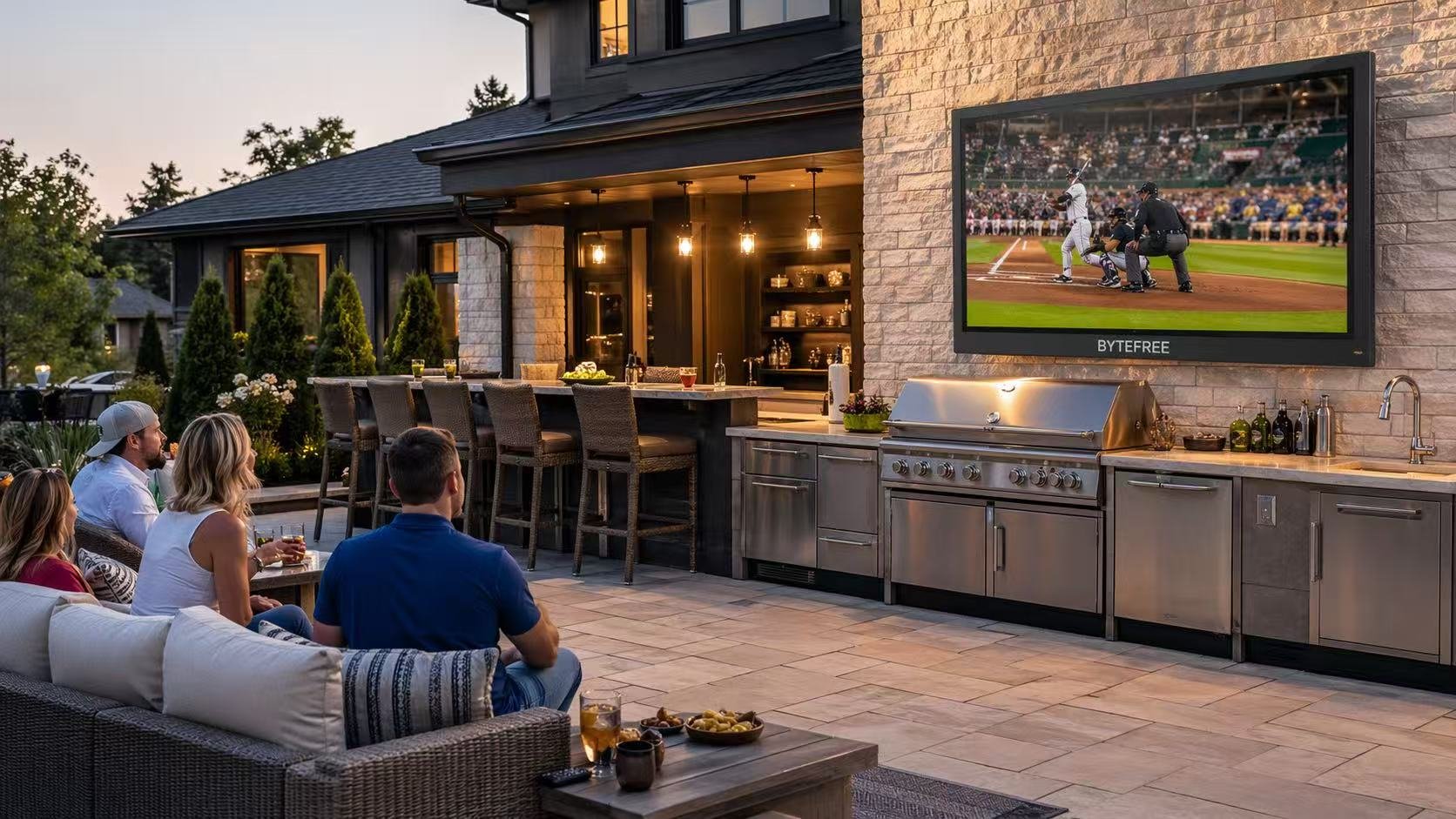
The Best New England Outdoor TV — BYTEFREE BF-55ODTV ($1,499)
The BYTEFREE matches the New England winter spec sheet:
The combination of –22°F operating + all-metal + IP55 + cold-rated cooling at $1,499 is unique. Competitors give up at least one spec at this price.
New England-Specific Install Best Practices
Eight rules that maximize TV life through New England winters:
1. Mount under a soffit or covered porch when possible. New England architecture often has deep eaves; use them. Cuts direct snow accumulation by 60–80% and reduces freeze-thaw cycle count.
2. Tilt the TV 5–10° downward. Reduces snow accumulation on the bezel during snowfall.
3. Brush heavy snow off the top bezel after storms. Soft brush or broom, never an ice scraper. Don't let 6+ inches accumulate; bezel-seal stress compounds with cumulative snow weight.
4. Leave the TV powered on (standby) 24/7 through winter. Trickle current keeps internal temperatures slightly elevated, reducing condensation and ensuring reliable cold-starts.
5. Use sealed locking HDMI connectors. Ice formation in standard HDMI ports causes connector damage. Sealed locking HDMI prevents ice intrusion.
6. Run outdoor-rated Cat6 (UTP-OSP). Indoor PVC jackets crack at –20°F. UV-resistant outdoor Cat6 handles New England winter swings.
7. Add an outdoor surge protector. Ice-storm-related power events spike voltage on the line. Surge protection saves the TV from January ice-storm aftermath.
8. Inspect cable entries every November and April. Freeze-thaw is the silent killer; small seal damage compounds invisibly. Two seasonal inspections catch problems before they kill the TV.
Should You Take the TV Down for New England Winters?
The honest answer:
For BYTEFREE-class TVs (–22°F rated, all-metal, IP55): No. Year-round mounting is fine across most of New England including coastal Maine and Vermont. The TV is engineered for it.
For interior Maine deep-cold pockets (regularly below –20°F): Consider seasonal storage during the deepest 4–8 weeks. The –22°F spec is the operating limit; sustained operation at the limit reduces panel life. Storing for the deepest weeks extends realistic TV lifespan.
For 0°C / 32°F-rated TVs (most "outdoor" TVs at the budget tier): Take down December–March in any New England state. These TVs aren't engineered for cold and will fail within 2 winters mounted year-round.
For 95% of New England buyers using BYTEFREE, the TV stays mounted year-round.
Frequently Asked Questions
Can I leave my outdoor TV mounted in Boston winter?
Yes with BYTEFREE. The –22°F operating spec covers Boston winter lows including the rare polar vortex events that drop to –10°F. Mount under a soffit if possible, leave it powered in standby, and brush snow off the top bezel after storms.
Will the TV survive a nor'easter?
A category-1 nor'easter (50–60 mph winds with snow / rain), yes — IP55 sealing and proper mounting handle this without issue. Stronger nor'easters (70+ mph) add risk from windborne debris (branches, snow plow impact). For severe nor'easters, the bigger risk is mounting structure failure, not the TV itself.
How does cold affect outdoor TV picture quality?
Modern outdoor TV panels show no measurable picture quality difference between 32°F and 122°F operating temps. The cooling fans and panel driver electronics handle the temperature compensation invisibly. Picture quality is consistent across the operating range.
What about ice storms in New England?
Ice formation on the front glass is a temporary nuisance — clears as the TV warms during operation. Ice storms also produce surge events from line-strike ice events; surge protection handles this. Ice impact from falling tree branches is the main mechanical risk; mount location relative to overhead trees matters.
Will my outdoor TV cold-start after a –10°F night?
Yes, on BYTEFREE. The controller verifies internal temp is within operating range before powering the panel — may take an extra 30–60 seconds to start in deep cold while temperature verification completes. Auto-restart on power restore is standard.
Should I cover the TV during winter?
No, in most cases. Covers trap winter humidity inside the cover during freeze-thaw cycles, where it can't evaporate, accelerating internal corrosion. The exception is very dry mountain climates (rare in New England). For typical New England — leave uncovered.
Bottom Line
For New England outdoor TV installs in 2026 — anywhere from coastal Connecticut to interior Maine — the BYTEFREE BF-55ODTV at $1,499 is the right pick. The –22°F operating temperature rating covers 99% of New England winter lows, all-metal chassis handles freeze-thaw cycling without polymer cracking, IP55 sealing handles nor'easter wind-driven precipitation, and 4-fan cold-rated active cooling ensures reliable cold-starts.
Mount under a soffit or covered porch when possible, leave powered 24/7 in standby, brush snow off after storms, and inspect cable entries each November and April. The TV survives 8–10 New England winters mounted year-round — longer than most outdoor patio components.
→ Shop the BYTEFREE BF-55ODTV at [bytefree.net](http://bytefree.net) — 55″ 4K, IP55, –22°F to 122°F operating range, all-metal chassis, partial-sun rated, $1,499.
| Quick takeaway: New England outdoor TVs face 4–5 months of winter conditions that defeat any 0°C-rated "outdoor" TV. The –22°F operating spec on BYTEFREE BF-55ODTV ($1,499) covers all six New England states' winter lows including Vermont and Maine cold snaps. Competing partial-sun TVs (Sylvox at –11°F, Samsung Terrace at 32°F, Furrion at –4°F) all struggle with real New England winters; BYTEFREE has 11–54°F of margin over the next-best alternative. |
Why New England Winters Are Hard on Outdoor TVs
Five winter-specific stressors:
1. Sustained sub-freezing operation. Boston averages 30°F overnight in January; Burlington VT averages 12°F; Caribou ME averages 3°F. Many "outdoor" TVs rated to 0°C / 32°F refuse to cold-start during these conditions. BYTEFREE rated to –22°F has 33–54°F of margin.
2. Heavy freeze-thaw cycling. New England sees 50–100+ freeze-thaw cycles per winter. Water that enters bezel micro-cracks during 35°F rainy days expands 9% on freezing, widening cracks. Polymer chassis fail this stress test in 3–4 winters; metal chassis (BYTEFREE) handle it for 8–10.
3. Heavy snow accumulation. Coastal Massachusetts to interior Maine sees 60–120+ inches of seasonal snow. Top-bezel snow loads of 6–8 inches stress front-glass-to-bezel seals. All-metal bezel distributes load; polymer bezel develops hairline cracks over multiple winters.
4. Nor'easter wind-driven precipitation. Coastal New England nor'easters produce 50–80 mph winds with snow / rain hitting walls horizontally. IP55 sealing (water-jet from any direction) handles this; below IP55 admits water during storms.
5. Salt spread for road / sidewalk treatment. Salt-laden snow gets blown onto outdoor TV chassis in coastal New England. All-metal chassis resists salt better than polymer; rinse with fresh water in spring removes accumulated salt.
The compounding effect: a 0°C-rated polymer chassis "outdoor TV" in Boston typically fails within 18–24 months. A –22°F-rated all-metal TV like BYTEFREE handles 8–10 New England winters mounted year-round.
New England State-Specific Considerations
The six states have varied winter intensity:
| State | Typical winter lows | Snow / year (in) | TV recommendation |
| Connecticut (coastal) | 5°F to 25°F | 25–45 | BYTEFREE BF-55ODTV ($1,499) |
| Rhode Island | 10°F to 25°F | 30–40 | BYTEFREE BF-55ODTV ($1,499) |
| Massachusetts (coastal) | 5°F to 20°F | 40–50 | BYTEFREE BF-55ODTV ($1,499) |
| Massachusetts (Berkshires) | –5°F to 15°F | 60–80 | BYTEFREE BF-55ODTV ($1,499) |
| New Hampshire | –10°F to 15°F | 60–100 | BYTEFREE BF-55ODTV ($1,499) |
| Vermont | –15°F to 10°F | 80–120 | BYTEFREE BF-55ODTV ($1,499) |
| Maine (coastal) | –5°F to 15°F | 60–80 | BYTEFREE BF-55ODTV ($1,499) |
| Maine (interior) | –20°F to 5°F | 90–130 | BYTEFREE at limit; consider December-February storage |
What Specs Actually Matter for New England
The five specs that move the needle on New England survival:
1. Operating temperature rated to –20°F minimum. Below this, the TV refuses to cold-start during typical New England winter mornings. BYTEFREE's –22°F covers it; competitors at –4°F or 32°F fail in real use.
2. All-metal chassis (no polymer brittleness). Polymer becomes brittle below 0°F. Impact from ice / branches / hail cracks polymer permanently. All-metal handles cold without brittleness.
3. IP55 minimum sealing. Nor'easter wind-driven rain and snow stress seals continuously. IP55 handles it.
4. Cold-rated active cooling. Some outdoor TV cooling fans are rated only for high-temp operation. BYTEFREE's 4-fan cooling rated to the same –30°C minimum as the panel — fans spin reliably at cold start.
5. Smart OS update reliability. New England winter weather affects Wi-Fi (humid air, ice on equipment). Reliable Ethernet input + native streaming apps reduce winter dependency on flaky outdoor Wi-Fi.
The Best New England Outdoor TV — BYTEFREE BF-55ODTV ($1,499)
The BYTEFREE matches the New England winter spec sheet:
| Spec | BYTEFREE BF-55ODTV | New England relevance |
| Operating temp | –30°C / –22°F | Covers Vermont winter, Maine cold snaps |
| Chassis | All-metal die-cast | No brittleness in 0°F or below |
| IP rating | IP55 | Handles nor'easter wind-driven precipitation |
| Active cooling | 4 fans, sealed bearings, cold-rated | Functional through cold starts |
| Brightness | 1,487 nits | Cuts through bright winter sun reflecting off snow |
| HDR | HDR10 + Dolby Vision | Beautiful winter evening / streaming-heavy season picture |
| Smart OS | Google TV (Ethernet capable) | Reliable streaming through winter Wi-Fi degradation |
| Audio | 30W Atmos | Adequate for typical covered patio winter use |
| Price | $1,499 | Best-value New England-survivable TV |
New England-Specific Install Best Practices
Eight rules that maximize TV life through New England winters:
1. Mount under a soffit or covered porch when possible. New England architecture often has deep eaves; use them. Cuts direct snow accumulation by 60–80% and reduces freeze-thaw cycle count.
2. Tilt the TV 5–10° downward. Reduces snow accumulation on the bezel during snowfall.
3. Brush heavy snow off the top bezel after storms. Soft brush or broom, never an ice scraper. Don't let 6+ inches accumulate; bezel-seal stress compounds with cumulative snow weight.
4. Leave the TV powered on (standby) 24/7 through winter. Trickle current keeps internal temperatures slightly elevated, reducing condensation and ensuring reliable cold-starts.
5. Use sealed locking HDMI connectors. Ice formation in standard HDMI ports causes connector damage. Sealed locking HDMI prevents ice intrusion.
6. Run outdoor-rated Cat6 (UTP-OSP). Indoor PVC jackets crack at –20°F. UV-resistant outdoor Cat6 handles New England winter swings.
7. Add an outdoor surge protector. Ice-storm-related power events spike voltage on the line. Surge protection saves the TV from January ice-storm aftermath.
8. Inspect cable entries every November and April. Freeze-thaw is the silent killer; small seal damage compounds invisibly. Two seasonal inspections catch problems before they kill the TV.
Should You Take the TV Down for New England Winters?
The honest answer:
For BYTEFREE-class TVs (–22°F rated, all-metal, IP55): No. Year-round mounting is fine across most of New England including coastal Maine and Vermont. The TV is engineered for it.
For interior Maine deep-cold pockets (regularly below –20°F): Consider seasonal storage during the deepest 4–8 weeks. The –22°F spec is the operating limit; sustained operation at the limit reduces panel life. Storing for the deepest weeks extends realistic TV lifespan.
For 0°C / 32°F-rated TVs (most "outdoor" TVs at the budget tier): Take down December–March in any New England state. These TVs aren't engineered for cold and will fail within 2 winters mounted year-round.
For 95% of New England buyers using BYTEFREE, the TV stays mounted year-round.
Frequently Asked Questions
Can I leave my outdoor TV mounted in Boston winter?
Yes with BYTEFREE. The –22°F operating spec covers Boston winter lows including the rare polar vortex events that drop to –10°F. Mount under a soffit if possible, leave it powered in standby, and brush snow off the top bezel after storms.
Will the TV survive a nor'easter?
A category-1 nor'easter (50–60 mph winds with snow / rain), yes — IP55 sealing and proper mounting handle this without issue. Stronger nor'easters (70+ mph) add risk from windborne debris (branches, snow plow impact). For severe nor'easters, the bigger risk is mounting structure failure, not the TV itself.
How does cold affect outdoor TV picture quality?
Modern outdoor TV panels show no measurable picture quality difference between 32°F and 122°F operating temps. The cooling fans and panel driver electronics handle the temperature compensation invisibly. Picture quality is consistent across the operating range.
What about ice storms in New England?
Ice formation on the front glass is a temporary nuisance — clears as the TV warms during operation. Ice storms also produce surge events from line-strike ice events; surge protection handles this. Ice impact from falling tree branches is the main mechanical risk; mount location relative to overhead trees matters.
Will my outdoor TV cold-start after a –10°F night?
Yes, on BYTEFREE. The controller verifies internal temp is within operating range before powering the panel — may take an extra 30–60 seconds to start in deep cold while temperature verification completes. Auto-restart on power restore is standard.
Should I cover the TV during winter?
No, in most cases. Covers trap winter humidity inside the cover during freeze-thaw cycles, where it can't evaporate, accelerating internal corrosion. The exception is very dry mountain climates (rare in New England). For typical New England — leave uncovered.
Bottom Line
For New England outdoor TV installs in 2026 — anywhere from coastal Connecticut to interior Maine — the BYTEFREE BF-55ODTV at $1,499 is the right pick. The –22°F operating temperature rating covers 99% of New England winter lows, all-metal chassis handles freeze-thaw cycling without polymer cracking, IP55 sealing handles nor'easter wind-driven precipitation, and 4-fan cold-rated active cooling ensures reliable cold-starts.
Mount under a soffit or covered porch when possible, leave powered 24/7 in standby, brush snow off after storms, and inspect cable entries each November and April. The TV survives 8–10 New England winters mounted year-round — longer than most outdoor patio components.
→ Shop the BYTEFREE BF-55ODTV at [bytefree.net](http://bytefree.net) — 55″ 4K, IP55, –22°F to 122°F operating range, all-metal chassis, partial-sun rated, $1,499.


