


no-one
Member
Catalogs Hide
Sylvox and SunBrite are the two names that come up most often when people start shopping for outdoor TVs. Both have been in the market for years, both have legitimate products, and both have strong enough brand presence to dominate most comparison searches.
But the outdoor TV market looks different in 2026 than it did two or three years ago. New competition has entered, pricing has shifted, and the two-brand narrative leaves out at least one option that competes directly with both.
Here's the honest breakdown.
What SunBrite does well:
Veranda 3 (~$2,199): 1,500 nits, IP55, Android TV. The entry point for SunBrite's residential lineup. Solid performer for covered patios and partial-sun installs.
DeckPro 3.0+ (~$3,499): 2,000 nits, IP55, Android TV. Full-sun capable. SunBrite's strongest residential 55" panel.
SunBrite's limitation in 2026: The pricing reflects a brand premium that's harder to justify when competitors have caught up on the core specs. You're paying for the name and the service network — both real things, but quantifiably expensive things.
What Sylvox does well:
DeckPro 2.0 (~$1,199): 1,000 nits, IP55, Google TV. Best for shaded installs. The value leader in the sub-$1,500 bracket.
Cinema (~$2,499): 2,000 nits, IP55, Google TV. Full-sun capable. Matches SunBrite DeckPro 3.0+ brightness at $1,000 less.
Sylvox's limitation: Less brand history than SunBrite means less data on long-term durability. The DeckPro 2.0's 1,000-nit ceiling is a real constraint for partial-sun installs.
The Sylvox vs. SunBrite choice usually comes down to one question: Is the SunBrite service network and brand track record worth $700–$1,000 more than the equivalent Sylvox spec?
For commercial or semi-commercial installs where reliability guarantee matters — sometimes yes. For residential installs where you're comparing products and choosing the better value — usually no.
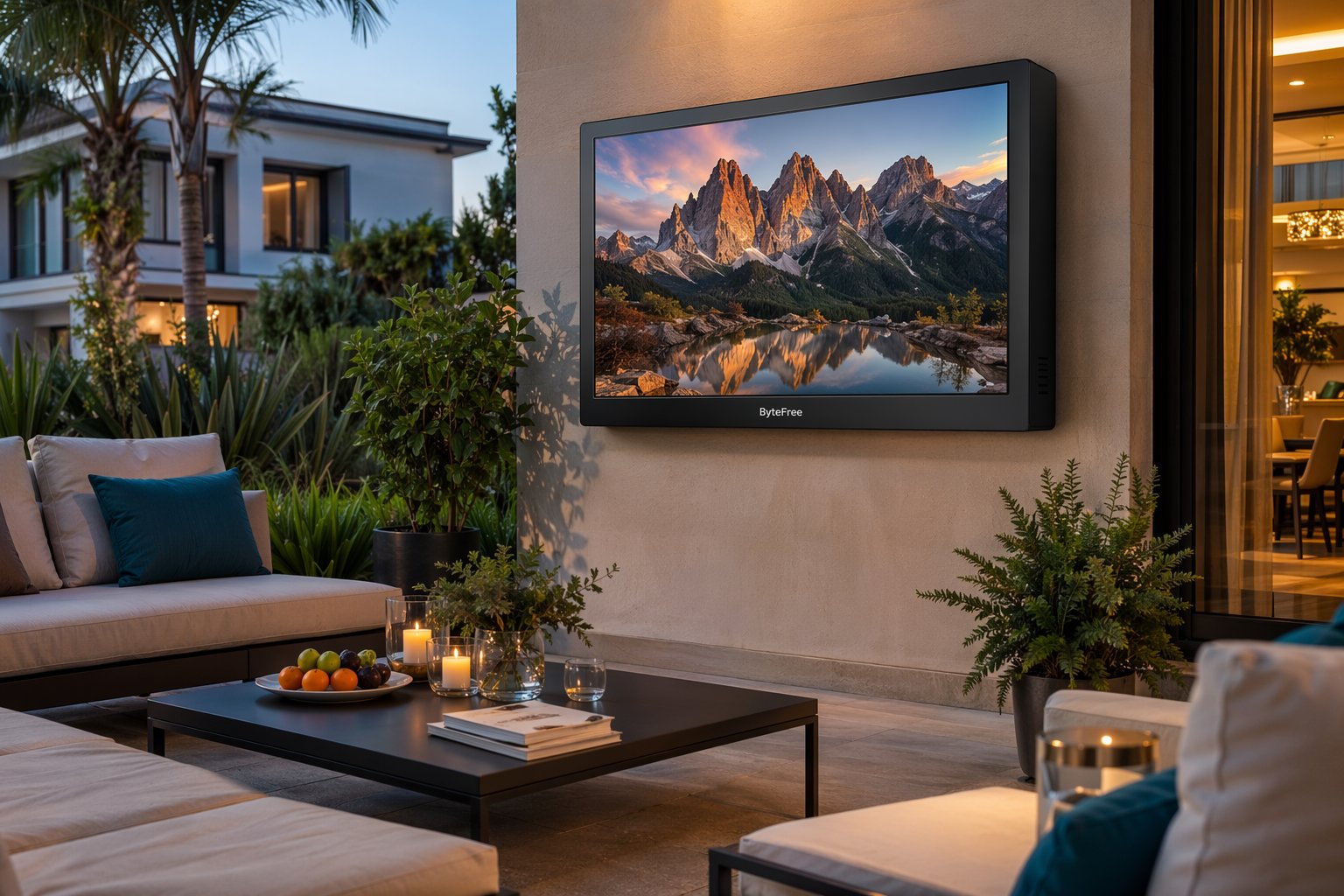
ByteFree isn't in most Sylvox vs. SunBrite comparison articles yet. That's a timing gap, not a quality gap.
The BF-55ODTV matches the SunBrite Veranda 3 on brightness (1,500 nits) and IP rating (IP55), runs Google TV instead of Android TV, and costs $700 less. It undercuts the Sylvox DeckPro 2.0 on brightness (1,500 vs. 1,000 nits) while costing $300 more.
That positioning — better brightness than the budget Sylvox, same brightness as the entry SunBrite at $700 less — is the ByteFree value case in one sentence.
Where ByteFree genuinely competes:
Choose Sylvox DeckPro 2.0 if: Your install is genuinely shaded and 1,000 nits is enough. The $1,199 price point is the best value in the shade-only category.
Choose Sylvox Cinema if: You need 2,000 nits for full-sun exposure and want Google TV. Better value than the SunBrite DeckPro 3.0+ at the same brightness.
Choose ByteFree BF-55ODTV if: You want 1,500-nit performance, all-metal build, and Google TV at $700 less than the SunBrite Veranda 3. The specs beat the Veranda 3 on price and beat the DeckPro 2.0 on brightness. The trade-off is less brand history.
If you're shopping this category without a strong brand loyalty reason to stay with Sylvox or SunBrite, ByteFree deserves a place in your comparison.
But the outdoor TV market looks different in 2026 than it did two or three years ago. New competition has entered, pricing has shifted, and the two-brand narrative leaves out at least one option that competes directly with both.
Here's the honest breakdown.
SunBrite: The Original Outdoor TV Brand
SunBrite has been making outdoor TVs longer than almost anyone. They built the category in the US market and their reputation for durability and weatherproofing is earned — not just marketed.What SunBrite does well:
- Proven long-term durability track record
- Broad product lineup from entry-level shaded installs to full-sun commercial applications
- Established dealer network with professional installation support
- Strong warranty and service infrastructure
Veranda 3 (~$2,199): 1,500 nits, IP55, Android TV. The entry point for SunBrite's residential lineup. Solid performer for covered patios and partial-sun installs.
DeckPro 3.0+ (~$3,499): 2,000 nits, IP55, Android TV. Full-sun capable. SunBrite's strongest residential 55" panel.
SunBrite's limitation in 2026: The pricing reflects a brand premium that's harder to justify when competitors have caught up on the core specs. You're paying for the name and the service network — both real things, but quantifiably expensive things.
Sylvox: The Challenger Brand That Caught Up
Sylvox entered the outdoor TV market later than SunBrite and built market share primarily through Google TV adoption and more competitive pricing. Their current lineup is genuinely strong.What Sylvox does well:
- Google TV platform — the better smart TV experience for most users
- More aggressive pricing than SunBrite at equivalent brightness tiers
- Competitive build quality that's improved significantly over recent generations
- Active product development with new models releasing regularly
DeckPro 2.0 (~$1,199): 1,000 nits, IP55, Google TV. Best for shaded installs. The value leader in the sub-$1,500 bracket.
Cinema (~$2,499): 2,000 nits, IP55, Google TV. Full-sun capable. Matches SunBrite DeckPro 3.0+ brightness at $1,000 less.
Sylvox's limitation: Less brand history than SunBrite means less data on long-term durability. The DeckPro 2.0's 1,000-nit ceiling is a real constraint for partial-sun installs.
Head-to-Head by Category
| Category | SunBrite | Sylvox | Winner |
|---|---|---|---|
| Brand history | 15+ years outdoor-focused | ~7 years | SunBrite |
| Smart TV platform | Android TV | Google TV | Sylvox |
| Price per nit (55") | Higher | More competitive | Sylvox |
| Full-sun 55" option | DeckPro 3.0+ ($3,499) | Cinema ($2,499) | Sylvox |
| Partial-sun 55" option | Veranda 3 ($2,199) | DeckPro 2.0 ($1,199) | Sylvox (but 500 nits less) |
| Dealer/service network | Extensive | Growing | SunBrite |
| Warranty support | Strong | Adequate | SunBrite |
The Sylvox vs. SunBrite choice usually comes down to one question: Is the SunBrite service network and brand track record worth $700–$1,000 more than the equivalent Sylvox spec?
For commercial or semi-commercial installs where reliability guarantee matters — sometimes yes. For residential installs where you're comparing products and choosing the better value — usually no.
The Third Option: ByteFree BF-55ODTV
55" | 4K | 1,500 nits | IP55 | Google TV | All-Metal | $1,499
ByteFree isn't in most Sylvox vs. SunBrite comparison articles yet. That's a timing gap, not a quality gap.
The BF-55ODTV matches the SunBrite Veranda 3 on brightness (1,500 nits) and IP rating (IP55), runs Google TV instead of Android TV, and costs $700 less. It undercuts the Sylvox DeckPro 2.0 on brightness (1,500 vs. 1,000 nits) while costing $300 more.
That positioning — better brightness than the budget Sylvox, same brightness as the entry SunBrite at $700 less — is the ByteFree value case in one sentence.
Where ByteFree genuinely competes:
- All-metal housing (bezel and rear) matches or exceeds both brands at this price point
- Four internal cooling fans for thermal management
- Dolby Vision + Dolby Atmos — feature set that the Veranda 3 matches but the DeckPro 2.0 doesn't fully
- Google TV platform with Chromecast built in
- Three HDMI ports including HDMI 2.1 with eARC
- Less brand history — ByteFree doesn't have the track record of either Sylvox or SunBrite
- Smaller dealer network — direct-to-consumer purchase rather than through established AV dealers
- 60Hz panel — same as most competitors at this tier, but worth noting
How to Choose Between the Three
Choose SunBrite Veranda 3 if: You want the most established brand name and the broadest service network for a 1,500-nit residential install. You're paying for peace of mind on top of the specs.Choose Sylvox DeckPro 2.0 if: Your install is genuinely shaded and 1,000 nits is enough. The $1,199 price point is the best value in the shade-only category.
Choose Sylvox Cinema if: You need 2,000 nits for full-sun exposure and want Google TV. Better value than the SunBrite DeckPro 3.0+ at the same brightness.
Choose ByteFree BF-55ODTV if: You want 1,500-nit performance, all-metal build, and Google TV at $700 less than the SunBrite Veranda 3. The specs beat the Veranda 3 on price and beat the DeckPro 2.0 on brightness. The trade-off is less brand history.
Bottom Line
Sylvox vs. SunBrite is the right comparison for 2023. In 2026, the field is wider. ByteFree has entered the 1,500-nit bracket with specs that compete directly with the Veranda 3 at a price that's hard to ignore.If you're shopping this category without a strong brand loyalty reason to stay with Sylvox or SunBrite, ByteFree deserves a place in your comparison.

