


Catalogs Hide
- 1 What Anti-Glare Glass Actually Does
- 2 Anti-Glare vs. Anti-Reflective: What's the Difference?
- 3 How to Verify the Glass Spec Before Buying
- 4 ByteFree BF-55ODTV — Anti-Glare Glass Confirmed on Spec Sheet
- 5 Anti-Glare Outdoor TVs: The 2026 Landscape
- 6 The Real-World Impact of Anti-Glare Glass
- 7 Bottom Line
Outdoor TV buyers obsess over nits. That's understandable — brightness is the most talked-about outdoor TV spec and one of the most important. But there's a second variable in the outdoor visibility equation that gets far less attention: what the glass in front of the panel actually does to the light that hits it.
Two TVs running identical brightness can look dramatically different outdoors. The reason is almost always the glass.
Standard glass is highly reflective. It acts like a partial mirror, bouncing ambient light back toward the viewer. On a bright day, you see a reflection of the sky, trees, your own image, and everything else in the outdoor environment overlaid on the TV image. The TV's pixels compete against their own glass for visibility.
Anti-glare glass uses surface treatments — typically micro-etching or multi-layer coatings — that scatter incoming light rather than reflecting it directly back. The result is a diffused surface that reduces specular reflection significantly. The TV image competes against diffused ambient light rather than a mirror image of the outdoor environment.
The practical effect: a 1,500-nit TV with anti-glare glass is more legible in partial sun than a 1,500-nit TV with standard glass. Sometimes meaningfully so.
Anti-glare (AG): Surface micro-etching that scatters light. Reduces specular reflection (the sharp mirror image) at the cost of some minor diffusion of the image itself. Very effective for outdoor use where the primary challenge is direct ambient light from large sources (sky, sun).
Anti-reflective (AR): Multi-layer optical coatings that cancel reflected light waves. More precise than AG — preserves image sharpness better — but more expensive and less durable in outdoor cleaning conditions. More common on high-end indoor displays and monitors.
For outdoor TVs, anti-glare is the correct technology. Anti-reflective coatings can scratch during the regular outdoor screen cleaning that salt air, bird droppings, and general outdoor grime require. Anti-glare surface treatments hold up better in real outdoor maintenance conditions.
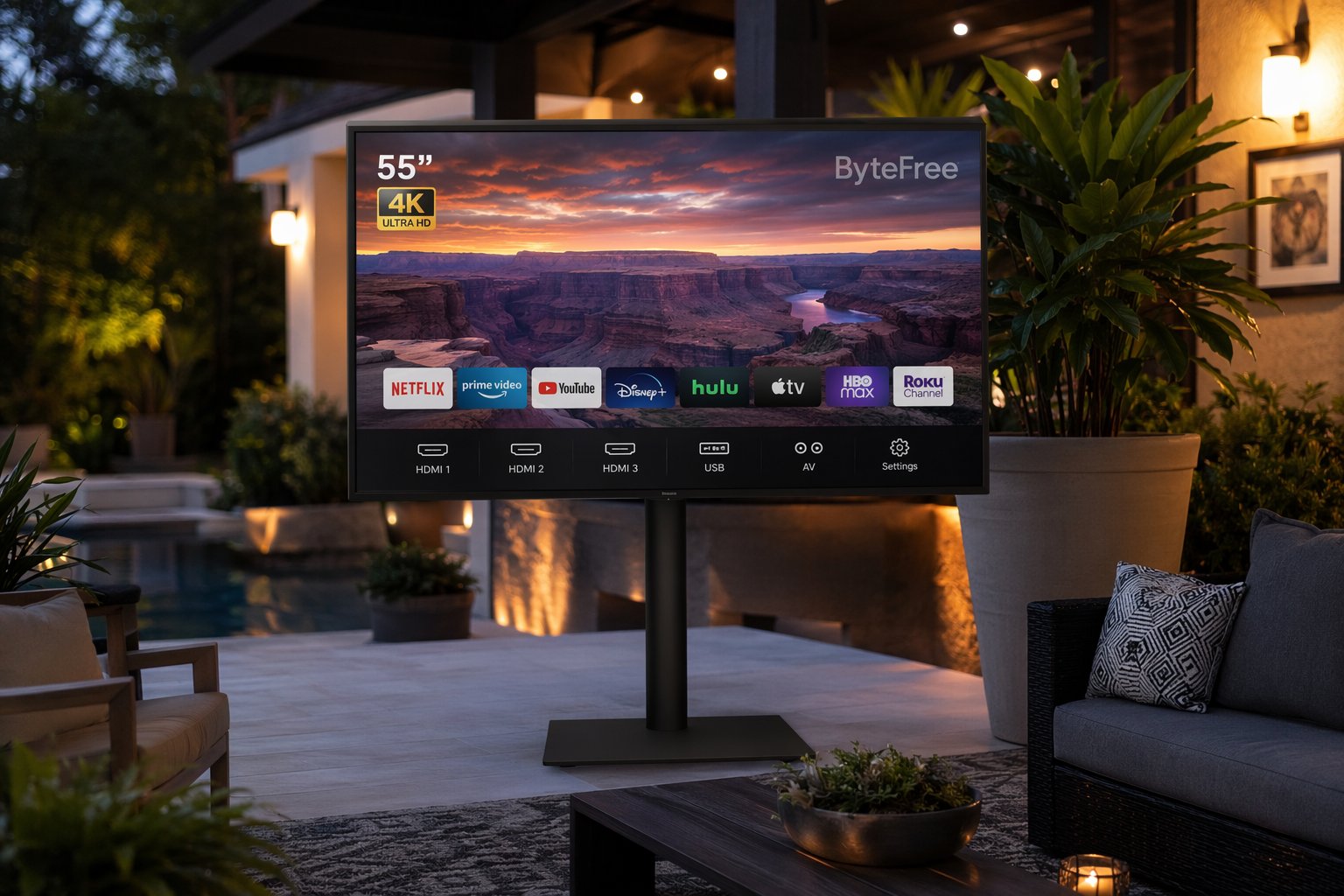
The ByteFree BF-55ODTV lists anti-glare glass explicitly in its specification documentation — not as marketing language but as a confirmed display component. In the outdoor TV market where glass specs are frequently omitted, this transparency is meaningful.
The combination of 1,500 nits and anti-glare glass produces outdoor visibility that outperforms higher-nit TVs using standard glass in many real-world partial-sun conditions. The anti-glare treatment reduces the reflected sky and surrounding environment that compete with the image, effectively increasing the perceived contrast ratio in outdoor ambient light conditions.
D-LED (direct-lit LED) backlighting further supports outdoor visibility by producing uniform brightness across the full panel area — no brightness gradient from edge to center that edge-lit panels can exhibit, which becomes more visible when ambient light is uneven across the screen.
For buyers specifically evaluating anti-glare outdoor TVs, ByteFree's confirmed spec at $1,499 competes directly with options charging $700–$1,000 more.
The Furrion Aurora Partial-Sun's glass spec is notably absent from its documentation — a gap at a $2,499 price point that buyers evaluating anti-glare specifically should note. ByteFree confirms anti-glare at $1,499, which is $1,000 less than Furrion for a TV in the same brightness tier with verified glass treatment.
The gap opens in conditions with meaningful ambient light:
The ByteFree BF-55ODTV confirms anti-glare glass explicitly, delivers 1,500 nits of brightness to work with it, and does both at $1,499. In the anti-glare outdoor TV category, it's the most accessible option at the 1,500-nit tier in 2026.
Two TVs running identical brightness can look dramatically different outdoors. The reason is almost always the glass.
What Anti-Glare Glass Actually Does
Every TV has a glass panel covering the screen. In a dark indoor room, the type of glass barely matters. Outside, where ambient light comes from multiple angles — the sky, reflective surfaces, neighboring walls — the glass becomes a primary factor in picture legibility.Standard glass is highly reflective. It acts like a partial mirror, bouncing ambient light back toward the viewer. On a bright day, you see a reflection of the sky, trees, your own image, and everything else in the outdoor environment overlaid on the TV image. The TV's pixels compete against their own glass for visibility.
Anti-glare glass uses surface treatments — typically micro-etching or multi-layer coatings — that scatter incoming light rather than reflecting it directly back. The result is a diffused surface that reduces specular reflection significantly. The TV image competes against diffused ambient light rather than a mirror image of the outdoor environment.
The practical effect: a 1,500-nit TV with anti-glare glass is more legible in partial sun than a 1,500-nit TV with standard glass. Sometimes meaningfully so.
Anti-Glare vs. Anti-Reflective: What's the Difference?
The terms appear interchangeably in marketing, but they describe different technologies:Anti-glare (AG): Surface micro-etching that scatters light. Reduces specular reflection (the sharp mirror image) at the cost of some minor diffusion of the image itself. Very effective for outdoor use where the primary challenge is direct ambient light from large sources (sky, sun).
Anti-reflective (AR): Multi-layer optical coatings that cancel reflected light waves. More precise than AG — preserves image sharpness better — but more expensive and less durable in outdoor cleaning conditions. More common on high-end indoor displays and monitors.
For outdoor TVs, anti-glare is the correct technology. Anti-reflective coatings can scratch during the regular outdoor screen cleaning that salt air, bird droppings, and general outdoor grime require. Anti-glare surface treatments hold up better in real outdoor maintenance conditions.
How to Verify the Glass Spec Before Buying
Not all manufacturers explicitly label their glass as anti-glare on product pages. Ways to confirm:- Look for "anti-glare glass" or "AG glass" in the spec sheet, not just the marketing description
- Check if the product page specifies glass type under display specifications
- Look for review photos taken outdoors in daylight — anti-glare glass shows diffused reflection; standard glass shows sharp mirror reflections
ByteFree BF-55ODTV — Anti-Glare Glass Confirmed on Spec Sheet
55" | 1,500 nits | D-LED | Anti-Glare Glass (confirmed) | IP55 | $1,499
The ByteFree BF-55ODTV lists anti-glare glass explicitly in its specification documentation — not as marketing language but as a confirmed display component. In the outdoor TV market where glass specs are frequently omitted, this transparency is meaningful.
The combination of 1,500 nits and anti-glare glass produces outdoor visibility that outperforms higher-nit TVs using standard glass in many real-world partial-sun conditions. The anti-glare treatment reduces the reflected sky and surrounding environment that compete with the image, effectively increasing the perceived contrast ratio in outdoor ambient light conditions.
D-LED (direct-lit LED) backlighting further supports outdoor visibility by producing uniform brightness across the full panel area — no brightness gradient from edge to center that edge-lit panels can exhibit, which becomes more visible when ambient light is uneven across the screen.
For buyers specifically evaluating anti-glare outdoor TVs, ByteFree's confirmed spec at $1,499 competes directly with options charging $700–$1,000 more.
Anti-Glare Outdoor TVs: The 2026 Landscape
| Model | Brightness | Glass Type | Price (55") |
|---|---|---|---|
| ByteFree BF-55ODTV | 1,500 nits | Anti-glare (confirmed) | ~$1,499 |
| SunBrite Veranda 3 | 1,500 nits | Anti-glare | ~$2,199 |
| Sylvox DeckPro 2.0 | 1,000 nits | Anti-glare | ~$1,199 |
| Sylvox Cinema | 2,000 nits | Anti-glare | ~$2,499 |
| SunBrite DeckPro 3.0+ | 2,000 nits | Anti-glare | ~$3,499 |
| Furrion Aurora Partial-Sun | 1,500 nits | Standard glass | ~$2,499 |
The Furrion Aurora Partial-Sun's glass spec is notably absent from its documentation — a gap at a $2,499 price point that buyers evaluating anti-glare specifically should note. ByteFree confirms anti-glare at $1,499, which is $1,000 less than Furrion for a TV in the same brightness tier with verified glass treatment.
The Real-World Impact of Anti-Glare Glass
In full shade or evening viewing, anti-glare glass has minimal visible impact — there's little ambient light to scatter or reflect, so both glass types perform similarly.The gap opens in conditions with meaningful ambient light:
- Overcast daylight: Anti-glare reduces the diffuse sky reflection that makes standard glass panels look washed-out on overcast days even without direct sun.
- Indirect late-afternoon light: When the sun is behind your seating position but still illuminating the sky, anti-glare scatters that reflected-sky light rather than bouncing it back as a mirror image.
- Near-water installs: Water surfaces are highly reflective. Poolside and lakeside installs see significant ambient light from water reflection — anti-glare glass handles this better than standard panels.
Bottom Line
Anti-glare glass is the outdoor TV spec that most buyers don't research and then wish they had. Brightness gets you into the right viewing condition range; anti-glare glass makes that brightness count in the varied ambient light conditions that outdoor environments produce.The ByteFree BF-55ODTV confirms anti-glare glass explicitly, delivers 1,500 nits of brightness to work with it, and does both at $1,499. In the anti-glare outdoor TV category, it's the most accessible option at the 1,500-nit tier in 2026.


