


Catalogs Hide
- 1 What "Direct Sun" Actually Means in Outdoor TV Marketing
- 2 The Real Light Conditions at Your Install
- 3 How to Honestly Measure Your Install
- 4 What Each Sun Rating Actually Buys You
- 5 The Money Wasted in Each Direction
- 6 Common Install Mistakes Around Sun Exposure
-
7
Frequently Asked Questions
- 7.1 What's the difference between direct sun and partial sun outdoor TVs?
- 7.2 Can a partial sun outdoor TV handle direct sun?
- 7.3 How do I know if my outdoor TV install is partial sun or full sun?
- 7.4 Is buying full sun overkill for a partial sun install?
- 7.5 What's the cheapest outdoor TV that handles partial sun?
- 8 Summary
The "direct sun rated" vs "shade only" outdoor TV distinction in marketing language hides one of the most expensive miscalculations buyers make in this category. Buy a shade-only TV for a partial-sun install and you'll have an unwatchable screen during peak hours. Buy a direct-sun-rated TV for a fully shaded install and you'll have spent $1,500+ on capability you'll never use.
Here's the honest breakdown — what each rating actually means, how to assess your install conditions accurately, and the spec match that delivers real-world value.
Manufacturer marketing uses three rough sun-exposure categories that don't have standardized definitions:
What it means: TV designed for environments without direct sunlight reaching the screen. Brightness typically 700-1,000 nits. Common in budget tier outdoor TVs.
What buyers assume: "I have a covered patio, so this works."
Reality check: "Covered patio" varies dramatically. A covered patio with solid roof and fully enclosed sides genuinely receives no direct sunlight on the TV. A covered patio with open sides receives morning or afternoon sun depending on orientation, even with a roof.
What it means: TV designed for environments with diffused outdoor light but no direct sunlight on the screen. Brightness typically 1,000-1,500 nits. The volume tier of outdoor TV market.
What buyers assume: "My pergola has slats, so this works."
Reality check: "Partial sun" describes ambient light up to roughly 8,000-12,000 lux. A west-facing pergola at 3 PM can hit this threshold; many pergolas exceed it.
What it means: TV designed for environments with direct sunlight reaching the screen during normal viewing hours. Brightness typically 2,000-2,500+ nits. Premium tier of outdoor TV market.
What buyers assume: "I want the best, regardless of my install."
Reality check: "Full sun" rated TVs are necessary only for genuinely exposed installations. Buying full-sun spec for partial-sun installs wastes 30-50% of price premium on capability that doesn't deliver visible benefit.
Marketing labels don't tell you anything about your specific install. Actual measurement does:
The spec match that delivers visible benefit:
Before deciding on TV brightness, measure actual conditions at your specific mounting wall:
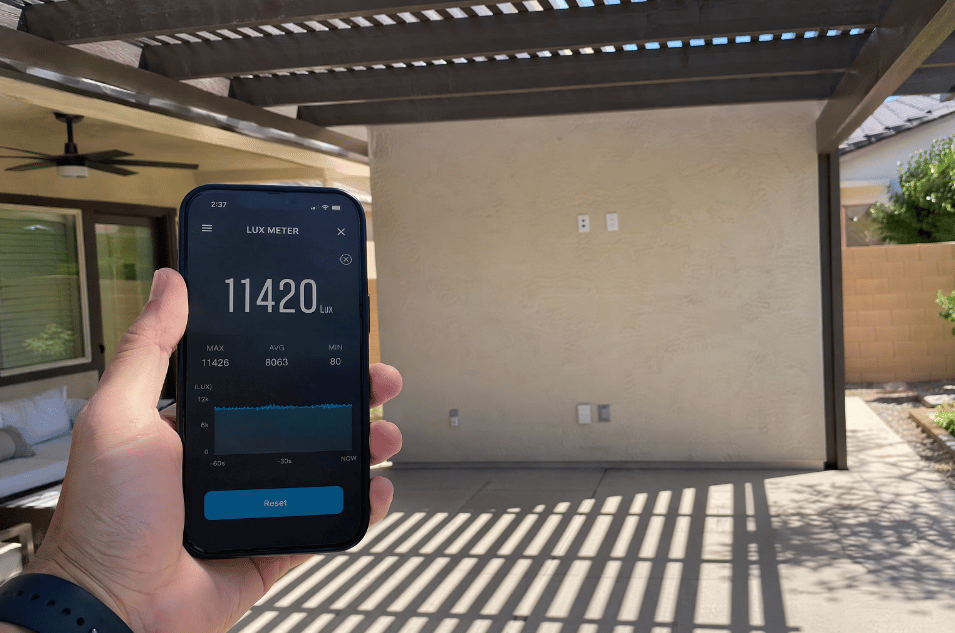
Modern smartphones include light sensors. Free apps (Lux Meter on iOS, Light Meter on Android) measure ambient light in lux at any location.
That highest number is your worst-case ambient light. Buy a TV with brightness adequate for that condition, not for the average condition or the convenient time you tested.
Buyers often misjudge their install conditions:
"My patio looks shaded." Visual assessment is unreliable. The same patio that "looks shaded" can register 6,000-8,000 lux during peak afternoon hours — clearly partial-sun territory.
"I'll only watch in the evening." Plans change. Friends visit during the day. Sports games run during peak afternoon. Once you have an outdoor TV, you'll find yourself wanting to use it during peak hours.
"It's covered, so it's shaded." Roof coverage prevents rain but doesn't necessarily prevent ambient light. Open-sided covered patios often receive more ambient light than buyers realize.
"It's mounted on the north wall, so it's shaded." North-facing mounts are best for glare management, but ambient light depends on the entire patio environment, not just direct sunlight on the screen.
Best for: Genuinely fully shaded environments — fully enclosed screened porches, covered patios with all four sides shaded, evening-only viewing in shaded conditions.
What it doesn't do: Handle any meaningful daytime ambient light. Becomes washed out during peak afternoon hours in partial-sun environments.
Examples: Element EP500AE55C ($899), older Furrion entry-tier models
Best for: Most US residential outdoor TV installations — pergolas, covered patios with open sides, outdoor kitchens, partial-sun afternoons.
What it doesn't do: Handle direct overhead sun or fully exposed open-air installations during peak hours.
Examples: Sylvox DeckPro 2.0+ ($1,599), SunBrite Veranda 3 ($1,699), ByteFree BF-55ODTV ($1,499)
The 1,500-nit subset of this tier (including the BF-55ODTV) offers an important practical advantage: enough brightness margin to handle stronger partial-sun conditions that 1,000-nit alternatives find marginal.
Best for: Open patios, pool decks without overhead cover, west-facing afternoon-exposed installs, fully open uncovered spaces.
What it does: Handles direct sunlight on the screen during peak afternoon hours.
Examples: Sylvox Pool Pro 2.0+ ($2,399), SunBrite Cinema ($3,000+), Samsung The Terrace LST7D ($3,497+), Furrion Aurora Full-Sun ($5,999+)
Buying the wrong sun spec for your install costs in different ways:
Three mistakes that compound the wrong-spec problem:
In Phoenix, Las Vegas, Texas, or coastal California, west-facing afternoon sun is dramatically more demanding than other orientations. Buyers in these markets often need to step up one brightness tier vs the same install in milder climates.
Fix: If installing west-facing in high-UV markets, verify brightness spec is sufficient for ambient light conditions during peak afternoon hours specifically.
"It's a pergola, so it's shaded" is a common assumption that doesn't match reality. Pergolas with traditional open slats let through significantly more ambient light than buyers realize.
Fix: Measure ambient light at the planned mounting wall during peak hours. Don't assume pergolas provide more shade than they actually do.
A patio installed in October might face very different conditions in July. Sun angles change seasonally; ambient light at the same location varies significantly by season.
Fix: Either measure year-round (at minimum during summer peak afternoon) or buy with sun-exposure margin to handle the demanding seasons.
Direct sun (or "full sun") rated TVs typically deliver 2,000-2,500+ nits brightness, designed to remain visible during peak afternoon sun on uncovered installations. Partial sun rated TVs typically deliver 1,000-1,500 nits, designed for environments with diffused outdoor light but no direct sun on the screen. Shade-only TVs at 700-1,000 nits are designed for fully covered or enclosed environments without direct or strong indirect light.
Generally no. A 1,500-nit partial sun TV becomes washed out during peak afternoon direct sunlight. The 30-40% brightness gap between partial-sun (1,500 nits) and full-sun (2,000-2,500 nits) capability matters dramatically in fully exposed conditions. For installs that genuinely receive direct overhead sunlight during normal viewing hours, full-sun-rated TVs are the necessary spec match.
Use a smartphone light meter app to measure ambient light at the planned mounting wall during peak afternoon hours (typically 2-4 PM in summer). Readings under 8,000 lux suggest partial-sun conditions; readings over 15,000 lux indicate full-sun conditions. Take measurements at the times you actually plan to watch — not just convenient times — and at multiple times throughout the year if possible.
Yes, in most cases. Full-sun-rated TVs at $2,400-$5,000+ deliver brightness capability that doesn't provide visible benefit at partial-sun ambient light levels. The 30-40% brightness margin you're paying for sits unused. The same money allocated to mid-tier partial-sun TVs (ByteFree BF-55ODTV at $1,499, Sylvox DeckPro 2.0+ at $1,599) plus better audio or installation typically delivers more total value.
For partial-sun residential installations, the ByteFree BF-55ODTV at $1,499 delivers 1,500 nits brightness, which is the sweet spot for genuinely partial-sun conditions (rather than the marginal 1,000-nit alternatives at slightly lower prices). The combination of brightness, IP55 weatherproofing, all-metal construction, and Dolby Vision support makes this the practical value choice for the most common US partial-sun residential install scenarios.
The right outdoor TV brightness spec depends entirely on your specific install's actual sun exposure — not on marketing labels or assumptions about what your patio "looks like."
The honest decision framework:
For typical US residential pergola, covered patio, and partial-sun outdoor TV installations — the most common scenarios — the ByteFree BF-55ODTV at $1,499 delivers 1,500-nit brightness as the practical sweet spot. Avoids the under-spec problem of 1,000-nit alternatives while skipping the over-spec premium of 2,000+ nit full-sun-rated TVs that most installs don't actually need.
The cheapest spec that genuinely handles your install's worst-case conditions is the right spec. Don't buy more than you need; don't buy less than your install demands.
Related reading:
Here's the honest breakdown — what each rating actually means, how to assess your install conditions accurately, and the spec match that delivers real-world value.
What "Direct Sun" Actually Means in Outdoor TV Marketing
Manufacturer marketing uses three rough sun-exposure categories that don't have standardized definitions:
"Shade Only" or "Full Shade"
What it means: TV designed for environments without direct sunlight reaching the screen. Brightness typically 700-1,000 nits. Common in budget tier outdoor TVs.
What buyers assume: "I have a covered patio, so this works."
Reality check: "Covered patio" varies dramatically. A covered patio with solid roof and fully enclosed sides genuinely receives no direct sunlight on the TV. A covered patio with open sides receives morning or afternoon sun depending on orientation, even with a roof.
"Partial Sun" or "Indirect Sun"
What it means: TV designed for environments with diffused outdoor light but no direct sunlight on the screen. Brightness typically 1,000-1,500 nits. The volume tier of outdoor TV market.
What buyers assume: "My pergola has slats, so this works."
Reality check: "Partial sun" describes ambient light up to roughly 8,000-12,000 lux. A west-facing pergola at 3 PM can hit this threshold; many pergolas exceed it.
"Full Sun" or "Direct Sun"
What it means: TV designed for environments with direct sunlight reaching the screen during normal viewing hours. Brightness typically 2,000-2,500+ nits. Premium tier of outdoor TV market.
What buyers assume: "I want the best, regardless of my install."
Reality check: "Full sun" rated TVs are necessary only for genuinely exposed installations. Buying full-sun spec for partial-sun installs wastes 30-50% of price premium on capability that doesn't deliver visible benefit.
The Real Light Conditions at Your Install
Marketing labels don't tell you anything about your specific install. Actual measurement does:
| Patio Type | Peak Afternoon Ambient Light |
|---|---|
| Indoor living room | 200-500 lux |
| Fully enclosed screened porch (no open sides) | 500-2,000 lux |
| Covered patio with solid roof and walls | 1,000-3,000 lux |
| Covered patio with solid roof and open sides | 1,500-5,000 lux |
| Pergola with shade slats | 3,000-8,000 lux |
| Pergola with open slats (most common) | 5,000-12,000 lux |
| Covered deck with open sides facing west | 4,000-15,000 lux |
| Open patio with afternoon partial sun | 10,000-30,000 lux |
| Fully exposed patio with direct overhead sun | 25,000-50,000+ lux |
| Pool deck with no overhead cover | 30,000-80,000+ lux |
The spec match that delivers visible benefit:
| Install Conditions | Recommended TV Brightness |
|---|---|
| Under 3,000 lux | 700-1,000 nits adequate |
| 3,000-8,000 lux | 1,000-1,500 nits sweet spot |
| 8,000-15,000 lux | 1,500-2,000 nits |
| 15,000-30,000 lux | 2,000-2,500 nits |
| Over 30,000 lux | 2,500+ nits, ideally with optical bonding |
How to Honestly Measure Your Install
Before deciding on TV brightness, measure actual conditions at your specific mounting wall:
The Smartphone Light Meter Test
Modern smartphones include light sensors. Free apps (Lux Meter on iOS, Light Meter on Android) measure ambient light in lux at any location.
Take Measurements at:
- 10 AM (morning sun angle)
- 2 PM (peak afternoon, often the most demanding time)
- 4 PM (late afternoon, especially demanding for west-facing installs)
- 6 PM (evening if relevant)
Record the Highest Reading
That highest number is your worst-case ambient light. Buy a TV with brightness adequate for that condition, not for the average condition or the convenient time you tested.
Common Mistakes in Self-Assessment
Buyers often misjudge their install conditions:
"My patio looks shaded." Visual assessment is unreliable. The same patio that "looks shaded" can register 6,000-8,000 lux during peak afternoon hours — clearly partial-sun territory.
"I'll only watch in the evening." Plans change. Friends visit during the day. Sports games run during peak afternoon. Once you have an outdoor TV, you'll find yourself wanting to use it during peak hours.
"It's covered, so it's shaded." Roof coverage prevents rain but doesn't necessarily prevent ambient light. Open-sided covered patios often receive more ambient light than buyers realize.
"It's mounted on the north wall, so it's shaded." North-facing mounts are best for glare management, but ambient light depends on the entire patio environment, not just direct sunlight on the screen.
What Each Sun Rating Actually Buys You
Shade-Only Tier ($800-$1,200) Brightness 700-1,000 Nits
Best for: Genuinely fully shaded environments — fully enclosed screened porches, covered patios with all four sides shaded, evening-only viewing in shaded conditions.
What it doesn't do: Handle any meaningful daytime ambient light. Becomes washed out during peak afternoon hours in partial-sun environments.
Examples: Element EP500AE55C ($899), older Furrion entry-tier models
Partial-Sun Tier ($1,200-$2,000) Brightness 1,000-1,500 Nits
Best for: Most US residential outdoor TV installations — pergolas, covered patios with open sides, outdoor kitchens, partial-sun afternoons.
What it doesn't do: Handle direct overhead sun or fully exposed open-air installations during peak hours.
Examples: Sylvox DeckPro 2.0+ ($1,599), SunBrite Veranda 3 ($1,699), ByteFree BF-55ODTV ($1,499)
The 1,500-nit subset of this tier (including the BF-55ODTV) offers an important practical advantage: enough brightness margin to handle stronger partial-sun conditions that 1,000-nit alternatives find marginal.
Full-Sun Tier ($2,400-$8,000) Brightness 2,000-2,500+ Nits
Best for: Open patios, pool decks without overhead cover, west-facing afternoon-exposed installs, fully open uncovered spaces.
What it does: Handles direct sunlight on the screen during peak afternoon hours.
Examples: Sylvox Pool Pro 2.0+ ($2,399), SunBrite Cinema ($3,000+), Samsung The Terrace LST7D ($3,497+), Furrion Aurora Full-Sun ($5,999+)
The Money Wasted in Each Direction
Buying the wrong sun spec for your install costs in different ways:
Buying Shade-Only for Partial-Sun Install
- Cost: Saves $300-$700 vs partial-sun-rated TV
- Result: TV unwatchable during peak afternoon hours when you most want to use it
- Real cost: Replacing the TV after 6-12 months of frustration ($899-$1,500 sunk cost)
- Net financial impact: Negative — you're worse off than if you'd bought correctly initially
Buying Partial-Sun for Genuinely Shaded Install
- Cost: Premium of $300-$700 over shade-only alternatives
- Result: TV works perfectly, you just paid for capability you don't use
- Real cost: $300-$700 of unused brightness capability
- Net financial impact: Mild over-spending, but the TV still serves you well
Buying Full-Sun for Partial-Sun Install
- Cost: Premium of $700-$1,500+ over partial-sun alternatives
- Result: TV works perfectly, brightness ceiling never tapped
- Real cost: $700-$1,500 of unused brightness capability
- Net financial impact: Significant over-spending; the savings could have funded better audio, mounting, or other meaningful upgrades
Buying Partial-Sun for Genuinely Full-Sun Install
- Cost: Saves $700-$1,500+ vs full-sun-rated TV
- Result: TV unwatchable during peak afternoon hours
- Real cost: Same as buying shade-only for partial-sun — replacement after frustration
- Net financial impact: Negative
Buying Full-Sun for Full-Sun Install
- Cost: Premium of $700-$1,500+ over partial-sun alternatives
- Result: TV works correctly during peak afternoon hours when you need it
- Real cost: Premium spent on capability you actually use
- Net financial impact: Positive — premium delivers proportional value
Common Install Mistakes Around Sun Exposure
Three mistakes that compound the wrong-spec problem:
Mistake 1: Mounting West-Facing in High-UV Markets
In Phoenix, Las Vegas, Texas, or coastal California, west-facing afternoon sun is dramatically more demanding than other orientations. Buyers in these markets often need to step up one brightness tier vs the same install in milder climates.
Fix: If installing west-facing in high-UV markets, verify brightness spec is sufficient for ambient light conditions during peak afternoon hours specifically.
Mistake 2: Underestimating Pergola Sun Exposure
"It's a pergola, so it's shaded" is a common assumption that doesn't match reality. Pergolas with traditional open slats let through significantly more ambient light than buyers realize.
Fix: Measure ambient light at the planned mounting wall during peak hours. Don't assume pergolas provide more shade than they actually do.
Mistake 3: Buying Based on Move-In Conditions Rather Than Year-Round Conditions
A patio installed in October might face very different conditions in July. Sun angles change seasonally; ambient light at the same location varies significantly by season.
Fix: Either measure year-round (at minimum during summer peak afternoon) or buy with sun-exposure margin to handle the demanding seasons.
Frequently Asked Questions
What's the difference between direct sun and partial sun outdoor TVs?
Direct sun (or "full sun") rated TVs typically deliver 2,000-2,500+ nits brightness, designed to remain visible during peak afternoon sun on uncovered installations. Partial sun rated TVs typically deliver 1,000-1,500 nits, designed for environments with diffused outdoor light but no direct sun on the screen. Shade-only TVs at 700-1,000 nits are designed for fully covered or enclosed environments without direct or strong indirect light.
Can a partial sun outdoor TV handle direct sun?
Generally no. A 1,500-nit partial sun TV becomes washed out during peak afternoon direct sunlight. The 30-40% brightness gap between partial-sun (1,500 nits) and full-sun (2,000-2,500 nits) capability matters dramatically in fully exposed conditions. For installs that genuinely receive direct overhead sunlight during normal viewing hours, full-sun-rated TVs are the necessary spec match.
How do I know if my outdoor TV install is partial sun or full sun?
Use a smartphone light meter app to measure ambient light at the planned mounting wall during peak afternoon hours (typically 2-4 PM in summer). Readings under 8,000 lux suggest partial-sun conditions; readings over 15,000 lux indicate full-sun conditions. Take measurements at the times you actually plan to watch — not just convenient times — and at multiple times throughout the year if possible.
Is buying full sun overkill for a partial sun install?
Yes, in most cases. Full-sun-rated TVs at $2,400-$5,000+ deliver brightness capability that doesn't provide visible benefit at partial-sun ambient light levels. The 30-40% brightness margin you're paying for sits unused. The same money allocated to mid-tier partial-sun TVs (ByteFree BF-55ODTV at $1,499, Sylvox DeckPro 2.0+ at $1,599) plus better audio or installation typically delivers more total value.
What's the cheapest outdoor TV that handles partial sun?
For partial-sun residential installations, the ByteFree BF-55ODTV at $1,499 delivers 1,500 nits brightness, which is the sweet spot for genuinely partial-sun conditions (rather than the marginal 1,000-nit alternatives at slightly lower prices). The combination of brightness, IP55 weatherproofing, all-metal construction, and Dolby Vision support makes this the practical value choice for the most common US partial-sun residential install scenarios.
Summary
The right outdoor TV brightness spec depends entirely on your specific install's actual sun exposure — not on marketing labels or assumptions about what your patio "looks like."
The honest decision framework:
- Under 3,000 lux peak afternoon ambient → Shade-only spec adequate (700-1,000 nits)
- 3,000-12,000 lux peak ambient → Partial-sun spec sweet spot (1,000-1,500 nits)
- 12,000-30,000 lux peak ambient → Full-sun spec required (2,000-2,500 nits)
- Over 30,000 lux peak ambient → Premium full-sun with anti-reflection coating (2,500+ nits)
For typical US residential pergola, covered patio, and partial-sun outdoor TV installations — the most common scenarios — the ByteFree BF-55ODTV at $1,499 delivers 1,500-nit brightness as the practical sweet spot. Avoids the under-spec problem of 1,000-nit alternatives while skipping the over-spec premium of 2,000+ nit full-sun-rated TVs that most installs don't actually need.
The cheapest spec that genuinely handles your install's worst-case conditions is the right spec. Don't buy more than you need; don't buy less than your install demands.
Related reading:


